

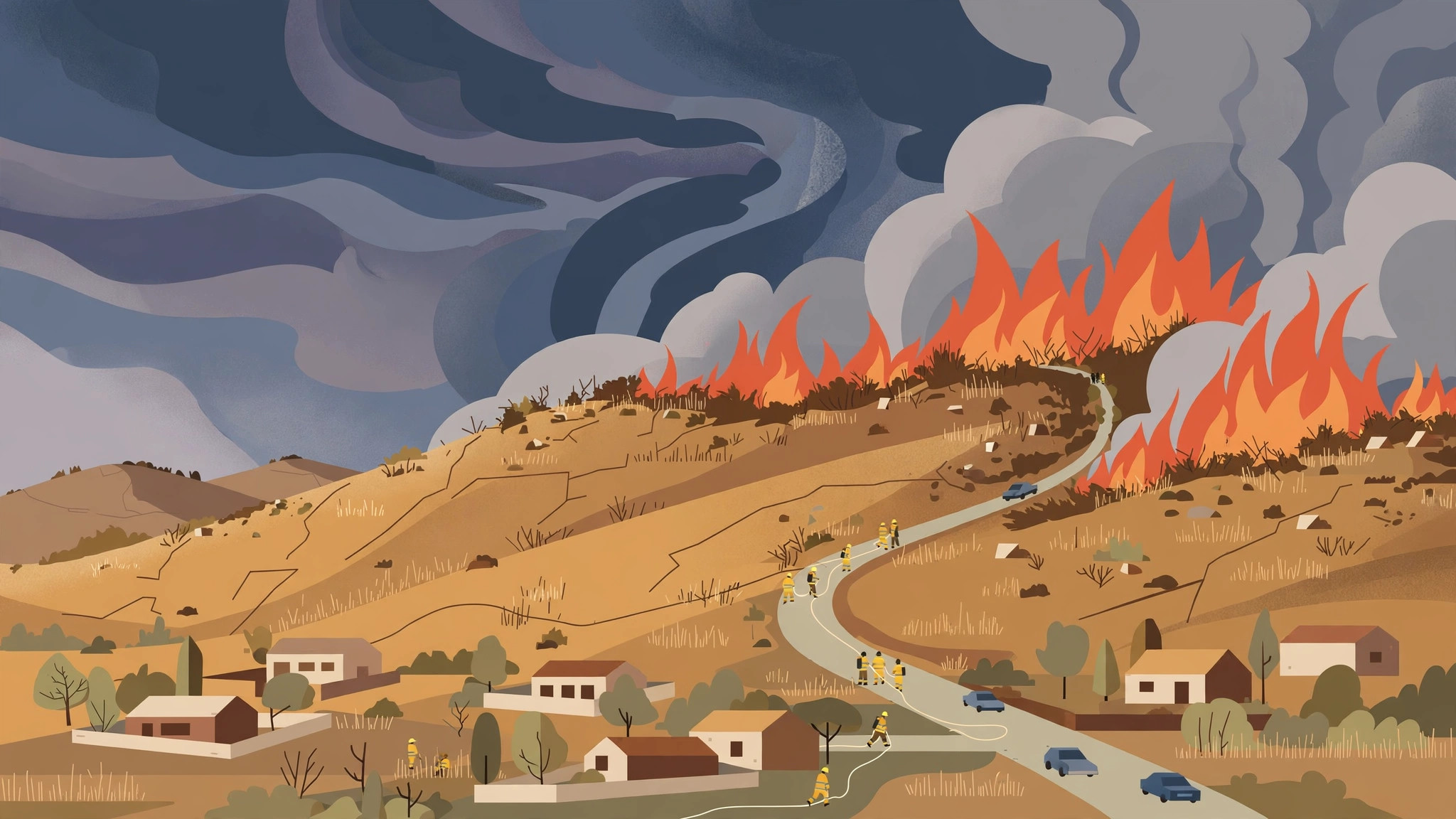
LOS ANGELES — California wildfire evacuations were ordered on Friday, 30 October 2026, as strong Santa Ana winds pushed a fast-moving fire through dry brush and toward homes, fire officials said, forcing residents to leave quickly and closing roads in the fire area. The fire grew rapidly in the morning as gusts carried embers ahead of the main front, a pattern firefighters say can turn a small ignition into a major incident in a matter of hours. Crews from multiple agencies were sent to the scene, aircraft were used where smoke and wind allowed, and sheriff’s deputies went door to door in the most threatened neighbourhoods to urge people to leave before conditions worsened.
Officials stressed that the situation remained fluid through the day. Evacuation orders can expand or shrink as wind shifts, and a road that is open in the morning can close by the afternoon if fire or smoke moves across it. Residents were told to take essential documents, medicines, pets and a bag packed for at least a few days, and not to wait for flames to become visible from their own street. That warning is a familiar one in California fire country, but officials said it mattered more than usual on Friday because the wind was expected to stay strong, humidity was expected to stay low, and the dry vegetation in the fire’s path could carry fire quickly even where it had not burned in recent years.
Santa Ana Winds Push the Fire Through Dry Brush
Santa Ana winds are dry, gusty winds that blow from inland deserts toward the California coast, usually in autumn and winter. They dry out vegetation, lower humidity and can push a fire forward at a speed that surprises people who have never seen one move in these conditions. On Friday, forecasters warned that gusts would be strong enough to throw embers well ahead of the fire, starting spot fires that crews then had to chase while also trying to hold the main line. That kind of fire does not move in a neat, predictable front. It jumps roads, ridges and patches of cleared land when the wind carries burning material far enough, which is why firefighters often describe Santa Ana fires as several fires at once rather than a single line to defend.
The vegetation in the area added to the danger. After a long dry period, grasses, shrubs and the lower branches of trees were dry enough to burn readily, and dead material on the ground provided fuel that could carry fire quickly between larger plants. Fire officials said crews were working to cut lines around the fire and to protect structures, but they also cautioned that in strong wind, containment lines can be breached by embers landing beyond them. Aircraft can slow a fire and protect homes, but they cannot fly safely in the strongest gusts or when smoke reduces visibility, so ground crews remained the main line of defence for much of the day. Officials asked the public to stay clear of the fire area so that engines, water tenders and evacuation traffic could move without delay.
California Wildfire Evacuation Orders and Road Closures
Evacuation orders were issued for neighbourhoods closest to the fire’s expected path, while nearby areas were placed under evacuation warnings, meaning residents should be ready to leave at short notice. The distinction matters, officials said. An order means leave now. A warning means prepare to leave, keep a vehicle facing outward, keep pets close, and monitor official updates rather than relying on social media posts that may be out of date. Deputies and fire personnel used loudspeakers, door knocks and official alert systems to reach people, and temporary evacuation points were opened where displaced residents could get information, water and help finding shelter.
Road closures followed the evacuation orders. Some routes were closed to all but emergency traffic so that fire engines could reach the fire and residents could leave without meeting incoming traffic head-on. Other roads were kept open in one direction only, or were closed for short periods when smoke made driving unsafe. Officials urged drivers not to use closed roads to get a closer look at the fire, and not to abandon vehicles on narrow roads where they could block engines and ambulances. People who were not in an evacuation zone were asked to avoid the area entirely, to keep roads clear, and to check official county and fire agency updates before travelling anywhere near the fire.
Power Shutoffs and the Risk to Homes
Power shutoffs were also part of Friday’s response. Utilities in California can switch off power in areas where strong winds and dry conditions raise the risk that a damaged line could start a fire, a measure known as a public safety power shutoff. Officials said shutoffs were in place or under consideration in parts of the affected region, and they urged residents to treat every downed or damaged line as live and dangerous, to keep clear of it, and to report it rather than trying to move it. People who rely on electrically powered medical equipment were urged to contact their utility or local emergency services for help, and to use a backup plan they had prepared in advance.
What Residents Described on the Roads Out
Residents who left described a tense, smoky drive out of the fire area, with traffic moving slowly on roads that are normally quiet. Some said they could smell smoke long before they saw flames, and that the wind made the air feel hot and dry even inside a car. Others said neighbours helped one another, knocking on doors, offering lifts to people without cars, and checking on older residents who might not have received an alert. That kind of neighbour-to-neighbour help is often the first response in a fast evacuation, officials said, and it can make the difference between an orderly departure and a panicked one.
What Is Confirmed — and What Is Not Yet Known
What is confirmed so far is the core of the story: a fire is burning in dry vegetation, Santa Ana winds are driving it, evacuation orders and warnings are in place, roads are closed in the fire area, and firefighters are working to protect homes. What is not yet confirmed, and should not be treated as fact, is the fire’s exact size, its containment percentage at any given hour, and its cause. Acreage figures in the first hours of a wildfire are often estimates based on aerial observation and mapping that can change as better information arrives. Containment figures also change as crews build and hold lines, and a single percentage can give a misleading impression of safety if wind is still pushing the fire in another direction.
The cause of the fire is also unconfirmed. Fire investigators typically examine the point of origin, interview witnesses, and review any reports of downed lines, equipment use or other activity in the area, but that work takes time and cannot be completed while the fire is still actively burning. Officials have not announced a cause, and any claim circulating online about how the fire started should be treated as unconfirmed unless it comes from the investigating agency itself. The same caution applies to reports of specific homes destroyed or damaged. Officials will release verified damage assessments only after crews can safely enter affected areas and count structures, a process that often lags behind the fire itself and can be revised as more streets are checked.
California has faced a run of disruptive weather emergencies in recent weeks, and fire officials said the same readiness — alerts, evacuation routes and shelter information — matters across hazards. USN previously reported on the Pineapple Express flood threat facing California and the Southwest over Halloween weekend.
Why Late-Season Fire Risk Remains High
Friday’s fire is a reminder that California’s fire risk does not end with summer. Late-season fires are often driven by Santa Ana winds, which arrive after months of dry weather have cured grasses and shrubs, and they can be especially dangerous because people may assume the worst of the fire season has passed. Climate researchers have noted that warmer, drier conditions can extend the period during which vegetation is ready to burn, while the timing of the first significant autumn rains varies from year to year. That combination — dry fuel, strong wind and low humidity — is what firefighters watch for, regardless of the date on the calendar.
The wider lesson, officials said, is preparation before the wind arrives. That means clearing dry vegetation from around homes, keeping gutters and roofs free of leaves, knowing more than one route out of a neighbourhood, and having a bag ready with documents, medicines and supplies. It also means signing up for county emergency alerts and taking evacuation warnings seriously, even when the fire seems far away. A fire driven by Santa Ana winds can cover ground quickly, and the time between a warning and an order can be short. Residents who had already prepared said the evacuation was still frightening, but they were able to leave faster and with less confusion than those who had to pack from scratch under smoke and sirens.
For now, the immediate priority remains the fire itself: protecting lives, keeping evacuation routes open, and holding lines where crews can do so safely. Officials said they would update evacuation orders, road closures and power restoration as conditions change, and they asked residents to keep checking official sources through the night. The fire’s ultimate size, its containment and its cause will become clearer in the days ahead, but on Friday the message from the fireground was simple and urgent: leave when told to leave, stay out until told it is safe to return, and give firefighters the road space they need to do their work.
Sources
USN reviewed reporting from multiple outlets for this story. Read more from Los Angeles Times, AP and Reuters.