

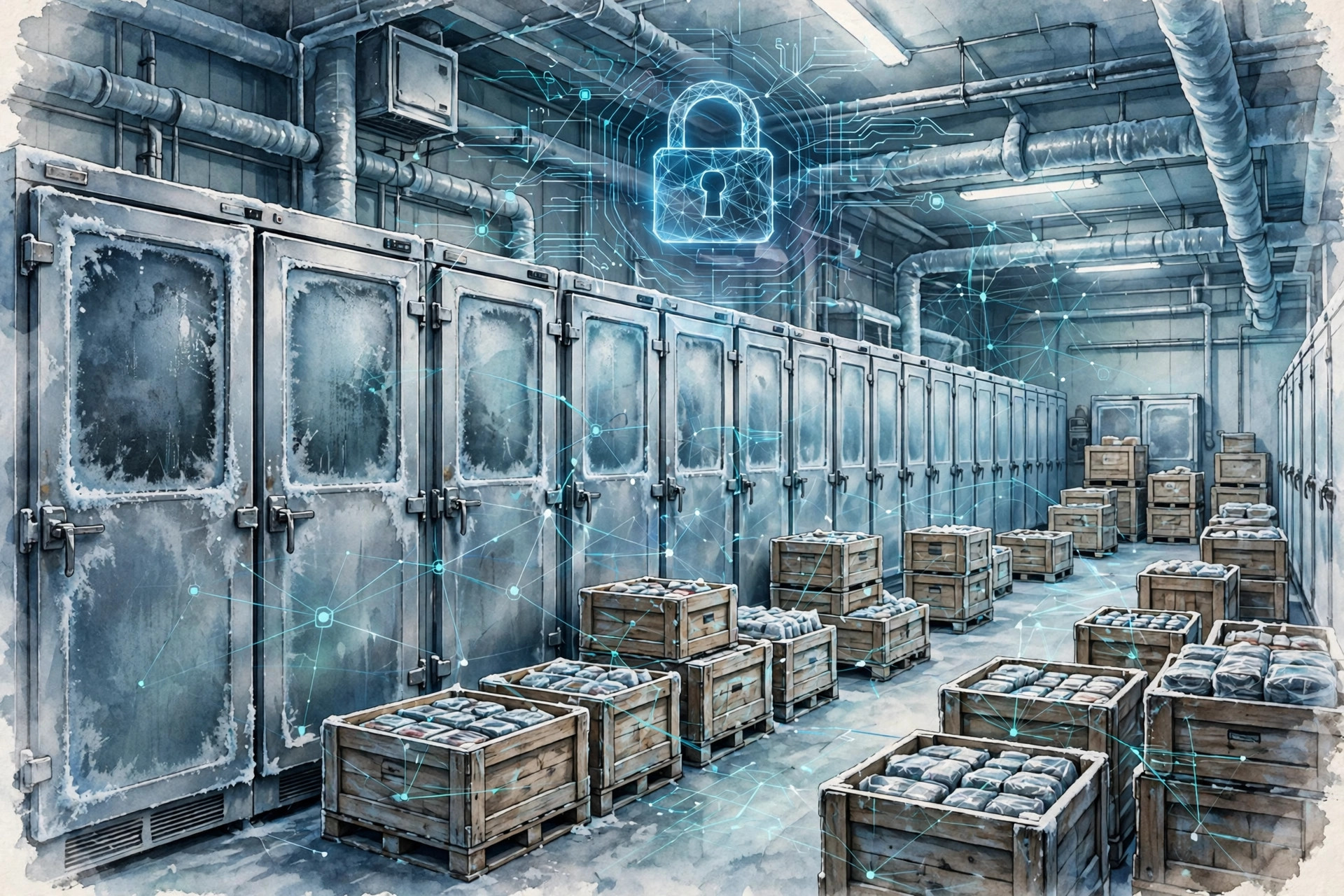
Something went wrong with the freezers at American military bases in August 2026, and the Pentagon is now treating the episode as a suspected cyberattack. According to officials familiar with the investigation, refrigeration units at a number of commissaries — the grocery stores where service members and their families shop on base — stopped behaving normally, and in at least some cases the temperature inside the units rose sharply overnight. By morning, large quantities of stored food had spoiled. What first looked like a run of equipment failures has since become a federal investigation involving military cyber specialists and criminal investigators, and it has drawn in counterparts in France, where a far larger wave of refrigeration failures struck supermarkets in October.
The investigation was first reported by Reuters on 29 October 2026, citing officials who spoke about an inquiry that had not previously been made public. At least six commissaries were affected, identified through contemporaneous social media posts and website updates from the bases themselves. The Defense Commissary Agency, which runs the stores, operates 235 commissaries around the world, so the affected sites represent a small share of the network. But the pattern of the failures — units warming up rather than simply shutting down, and doing so overnight — is what turned a maintenance problem into a security question. A freezer that merely breaks tends to warm slowly as it loses power. A freezer that switches itself into a defrost cycle and heats its contents is doing something else, and investigators want to know whether somebody told it to.
What happened at Fort Huachuca and other bases
The clearest public account comes from Fort Huachuca in Arizona. On 26 August 2026, the base said a freezer had gone into defrost mode and heated its contents, spoiling the food stored inside. The wording matters, because defrost mode is a normal function of a commercial freezer — it periodically warms its coils to clear ice — but it is supposed to be brief and controlled. A unit stuck in defrost, or commanded into defrost at the wrong time, will cook everything it was meant to preserve. Fort Irwin in California also reported refrigeration problems, in September 2026, and Naval Air Facility El Centro in California was among the installations whose records were examined as investigators pieced together the timeline.
Reports describe a consistent shape to the incidents: temperatures raised overnight, so that the damage was discovered in the morning when staff arrived to find spoiled stock. That timing is significant for two reasons. First, overnight is when a commissary is closed and unstaffed, so a malfunction — or an intrusion — would go unnoticed for hours. Second, it is also when a remote attacker would prefer to act, since nobody is standing in front of the unit to notice that something is wrong. Neither point proves a hack took place. Both explain why investigators are treating the pattern seriously rather than writing the episode off as a run of bad luck with ageing equipment.
The public record also contains an early warning that, at the time, attracted little attention. On 28 August 2026, a recently created blog called Signal and Silence first flagged the possibility of hacking behind the freezer problems. The blog was new and unknown, and its claim did not immediately lead to official confirmation. Two months later, the Pentagon’s own investigation suggests that the question it raised was worth asking. That sequence — an obscure early flag, followed by a formal inquiry — is common in cyber incidents, where the first people to notice something strange are often not the officials in charge of the systems involved.
Pentagon military base freezer hack investigation widens
A unit of US Cyber Command is now working on the case alongside interagency and law enforcement partners, and the US Army Criminal Investigation Division says its Cyber Field Office is involved. The involvement of both organisations tells its own story. Cyber Command brings the technical capability to examine whether refrigeration controllers were reached remotely and, if so, how. Army criminal investigators bring the authority to treat the episode as a potential crime against military property and personnel, rather than merely a technical fault. The Pentagon has confirmed that coordination is taking place, but it has not confirmed that a cyberattack occurred. That distinction is important and runs through all the reporting on this story: an investigation into a suspected attack is not the same thing as a confirmed attack.
Reuters itself was careful on this point, noting that it could not establish how far the investigation had progressed or whether investigators had reached conclusions about what caused the failures. No perpetrator has been publicly named, and no evidence has been published tying the American incidents to any particular actor or country. Readers should therefore treat the hacking explanation as alleged and unconfirmed, even though it is now the working hypothesis of the investigation. The confirmed facts are narrower: the outages happened, at least six commissaries were affected, the Fort Huachuca account of a defrost-mode failure is on the record, and Cyber Command and Army investigators are involved.
That caution also applies to the French connection. US investigators are in contact with French counterparts about a similar incident in France in October 2026, in which refrigeration controls at more than 350 establishments were affected. About 150 Intermarché stores and nearly 100 Super U stores were among those hit, and some units were reported at around 50 degrees Celsius, or 122 degrees Fahrenheit — far above any safe storage temperature. The scale in France dwarfs the American episode, and the parallel timing is what makes the comparison interesting to investigators. But a similar pattern in two countries is not proof of a single campaign, and no official has publicly claimed that the same attacker was behind both waves.
Why a freezer controller can be hacked at all
To most shoppers, a supermarket freezer is a sealed metal box that keeps things cold. To an engineer, it is a computer-controlled machine, and increasingly a connected one. Modern commercial refrigeration units use electronic controllers to regulate temperature, schedule defrost cycles, raise alarms and report faults. Many of those controllers can be monitored or managed remotely, so that a chain can watch hundreds of stores from a central office and dispatch a technician before food spoils. That connectivity is useful, and it is also an attack surface: anything that can be reached over a network can, in principle, be reached by the wrong person.
Many of the affected French units used controllers made by the Danish firm Danfoss. In August 2026, the cybersecurity firm Claroty reported that some Danfoss and Copeland controllers had vulnerabilities, including a hidden login that could allow an attacker to take over a unit. A hidden or undocumented login — sometimes called a backdoor, though that word carries implications about intent that are not always justified — is a serious flaw in any connected device, because it gives anyone who knows about it a way in that bypasses normal authentication. Danfoss has since released a fix for the issue. Whether the American commissary units used the same controllers, or the same vulnerable software, has not been publicly confirmed, and that gap is one of the key questions the investigation must answer.
The episode also illustrates a broader shift in how cyberattacks on physical systems work. Earlier generations of industrial hacking targeted power grids, pipelines and factories — the large, obvious pieces of critical infrastructure. Refrigeration sits one level down: it is not a power station, but it is part of the cold chain that keeps food safe for millions of people, including military families who depend on commissaries for affordable groceries. An attacker who can raise the temperature in a freezer does not need to steal data or shut down a network to cause real harm. Spoiled food, wasted money, disrupted supply and eroded trust in the safety of what is on the shelves are damage enough, and the disruption is easy to understand in a way that a data breach is not.
What remains unanswered
Several questions remain open, and honest reporting should list them rather than paper over them. First, was there in fact a hack, or did a software fault, a bad update or a cascade of equipment failures produce the same pattern? Second, if there was an intrusion, how did the attacker get in — through a vulnerable controller, through a commissary network, or through some other route? Third, were the American and French incidents connected, or is the resemblance a coincidence amplified by heightened attention to refrigeration after the French wave? Fourth, who, if anyone, was responsible, and what was their motive? None of these questions has a public answer yet.
The French embassy in Washington did not return a request for comment in the Reuters account, and the Pentagon has said only that coordination is under way. That restraint is normal during an active investigation, when premature statements can compromise evidence or mislead the public if early theories turn out to be wrong. It is also frustrating for the military families who lost groceries and want to know whether their food was safe. The commissaries involved have not, in public reporting, been accused of serving spoiled food; the accounts describe food being discarded after it spoiled, which is the correct response when the cold chain breaks.
For now, the story sits in an uncomfortable middle ground that is common to cyber incidents in their early stages: enough smoke to justify a serious investigation, not yet enough evidence to declare a fire, let alone name an arsonist. The involvement of Cyber Command and Army criminal investigators shows that the Pentagon is not treating this as routine maintenance. The absence of a confirmed attack or a named perpetrator shows that it has not yet found what it is looking for. Both facts deserve equal weight. As the investigation continues, the key developments to watch are whether officials confirm remote access to the controllers, whether a common vulnerability links the American and French cases, and whether any attribution — public or leaked — emerges. Until then, the freezers at Fort Huachuca and the other affected bases remain a mystery with a working hypothesis, and a reminder that the most ordinary machines in daily life are now computers too.
Sources
USN reviewed reporting from multiple outlets for this story. Read more from Nextgov, The Economic Times and Times Now News.