

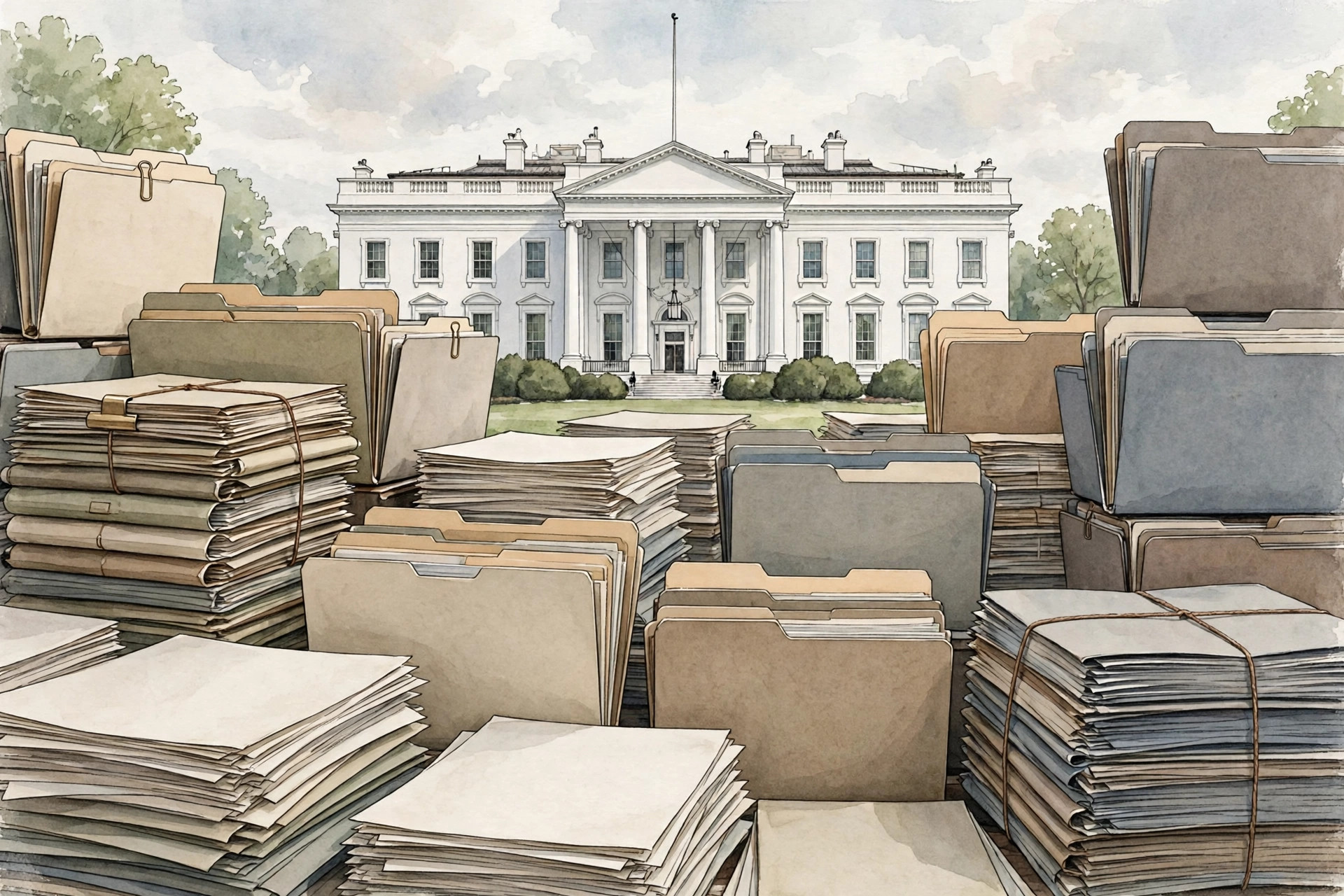
The next big confrontation between the White House and Congress may not be over a bill at all. It may be over paper: memos, messages, meeting notes, visitor records and testimony from the people closest to President Donald Trump. With Democrats projected to take control of both chambers in the 2026 midterm elections, the incoming majorities are preparing to use the investigative tools that come with the gavels, while the White House is preparing to resist at least some of those demands. The result, expected to play out through 2027, is a legal and political fight over executive privilege that could shape what the public ever learns about decisions made inside the administration.
None of this begins immediately. The new Congress is not seated until January 3, 2027, and committee chairs are formally chosen only when that Congress organizes itself. Until then, the current Republican majorities still hold the gavels, and the incoming Democratic leaders remain presumptive rather than confirmed chairs. That calendar matters, because it gives both sides weeks to prepare their opening moves, line up lawyers, draft preservation letters and decide which requests will be treated as routine and which will be treated as a constitutional test.
The stakes are high for both sides for a simple reason. Oversight is one of the few powers a new majority can exercise without the president’s signature. A president can veto legislation, and an override requires two-thirds majorities in both chambers, a threshold the projected Democratic majorities do not approach. Investigations, by contrast, do not need presidential approval. They need only a committee, a subpoena and, when a witness refuses, a willingness to fight in court or to seek a contempt vote. That is why the argument over privilege, rather than any single bill, may define the first months of divided government.
For readers trying to follow the story, it helps to separate three different questions that are often blurred together. The first is what Democrats say they want to investigate. The second is what legal tools the White House says it can use to withhold information. The third is how long any dispute is likely to take, and whether a court will resolve it before the political moment has passed. Each question has its own history, and each points to a different kind of outcome.
How the Trump executive privilege fight is expected to unfold
Reporting before the election described months of preparation inside the White House for exactly this scenario. Senior officials, including deputy chief of staff Stephen Miller and budget director Russell Vought, were reported to have worked with the White House Counsel’s Office since April to map executive actions the president could take without new legislation, on subjects including immigration, tariffs, housing costs and federal spending. White House counsel Will Scharf and his team were also reported to be examining what the president can do on his own, where the limits of that authority lie and how those decisions could be defended in court.
That planning included oversight itself. According to reporting on the preparations, White House lawyers briefed political appointees and agency leaders on how to handle congressional inquiries, document requests and subpoenas, and advised officials to be careful about what they put in writing. The White House was also reported to have sought a Justice Department opinion that could support invoking executive privilege to shield communications with private advisers from congressional scrutiny. The precise scope of any such opinion has not been made public in full, and its legal weight will be contested if it is ever relied on to refuse a subpoena.
On the Democratic side, the presumptive chair of the House Oversight and Government Reform Committee, Representative Robert Garcia of California, has signaled an aggressive opening. In public statements reported after the election, Garcia identified family business dealings, corporate corruption, immigration enforcement and the handling of records connected to the late financier Jeffrey Epstein among his priorities. Other incoming committee leaders have pointed to additional areas, including public health, executive power, the war with Iran and the work of the Department of Government Efficiency. Those lists are statements of intent, not findings, and the committees have not yet issued the subpoenas that would turn them into formal disputes.
What makes the coming fight different from an ordinary policy disagreement is that both sides can plausibly claim a constitutional principle. Congress argues that it cannot legislate, appropriate or inform the public without information from the executive branch. The White House argues that a president cannot receive candid advice if every conversation with advisers can later be hauled before a committee. Courts have tried to balance those claims for decades, but they have rarely produced a clean, fast answer when the president and Congress are in direct conflict.
What Democrats say they will seek first
Investigative priorities are not the same as subpoenas, and it is worth keeping that distinction in mind as headlines arrive in January. A committee can begin with voluntary requests, staff briefings and public hearings. Subpoenas usually follow when a request is ignored, answered only in part or answered so slowly that the committee concludes it has no other option. The early weeks of 2027 are therefore likely to feature letters and deadlines that look procedural but are, in practice, the opening moves in a negotiation over what will be produced and what will be withheld.
Based on statements reported so far, the Epstein records are expected to be among the earliest tests. Congress passed legislation in 2025 requiring the Justice Department to publish its Epstein files, and the president signed that law, but Democrats have argued that material was redacted or withheld. Garcia has been reported as wanting public hearings rather than closed-door interviews, and as wanting testimony from Attorney General Todd Blanche about how the department handled the files. The White House and the Justice Department have not, in the reporting reviewed for this article, publicly committed to a position on the specific subpoenas Democrats say they intend to issue.
Immigration enforcement is expected to be another early focus. Democrats have documented, while in the minority, incidents they describe as abuse or misconduct by immigration agents, including the killings of two United States citizens in Minnesota during enforcement operations. In the new Congress, they are expected to seek testimony and records about use of force, detention practices and compliance with the law. The administration, for its part, has defended its enforcement approach as a matter of border security and public safety, and any dispute over internal deliberations about those operations could quickly become a privilege fight.
Questions about presidential pardons, family business interests and outside business dealings are likely to be the most legally complicated. Here, Democrats are expected to seek information not only from agencies but also from businesses and individuals outside the government. That matters because executive privilege, as traditionally understood, protects communications within the executive branch and with the president’s advisers. It does not automatically shield private business records, and courts apply a different and more demanding test when Congress seeks a president’s personal records, as the Supreme Court made clear in the Mazars case discussed below.
What the White House has already prepared
The White House enters 2027 with a broader set of legal arguments than it had in the president’s first term, at least according to recent reporting and legal commentary. In August, the Justice Department’s Office of Legal Counsel was reported to have issued an opinion arguing that executive privilege could apply to presidential conversations with advisers outside government, provided those conversations relate to official presidential matters, involve or reflect communications with the president or his direct advisers, and were kept confidential. Supporters of that view argue that modern presidents routinely consult outside advisers and that candid advice should not lose protection merely because the adviser does not hold a government title.
Critics, including some former White House lawyers, have warned that such a reading stretches the doctrine further than courts have accepted. They point out that the privilege has always been described as qualified rather than absolute, and that courts weigh the need for confidentiality against the need for the information. A broad claim covering outside advisers could therefore delay compliance while the issue is litigated, even if a court ultimately narrows or rejects it. In oversight fights, delay itself can be a powerful outcome, because a Congress has only two years before the next election changes its membership and priorities.
The administration is also expected to rely on arguments beyond privilege itself. It may argue that a particular request lacks a valid legislative purpose, that the information can be obtained from another source, that producing it would burden the presidency, or that a request intrudes on core presidential powers such as foreign affairs, military command or pardons. Each of those arguments has appeared in past disputes, and each can be litigated separately, which is one reason a single subpoena can generate several rounds of briefing before a judge reaches the underlying documents.
There is also a practical layer of preparation that rarely appears in headlines. Lawyers for the administration and for allied outside groups have been reported to be organizing defense teams for officials who may be called to testify or produce records. One such effort, under the banner of the Oversight Project, was reported to be recruiting lawyers for that purpose. That kind of preparation does not decide any legal question, but it signals that the White House expects witnesses to be advised, in advance, about when to answer, when to decline and when to invoke a privilege claim on the record.
The legal map: Nixon, Mazars, McGahn and the newer immunity ruling
Executive privilege is not written in so many words in the Constitution. The Supreme Court has treated it as flowing from the separation of powers: the president needs confidential advice to carry out executive functions, just as Congress needs information to legislate. The leading case remains United States v. Nixon in 1974, in which the Court recognized a qualified privilege but held, unanimously, that it did not entitle President Richard Nixon to withhold tapes and documents needed for a criminal trial. The lesson most often drawn from Nixon is that privilege is real but not unlimited, and that a demonstrated need for specific material can overcome it.
Congressional requests have followed a different and slower path. In Trump v. Mazars in 2020, the Supreme Court addressed House subpoenas for the president’s personal financial records held by third parties. The Court did not grant absolute immunity from such subpoenas, but it set out a demanding four-part test for courts to apply, asking whether Congress has a valid legislative purpose, whether it can obtain the information elsewhere, whether the subpoena burdens the president, and whether enforcement would disrupt the separation of powers. The practical effect was delay: by the time records were produced, years had passed and the political context had changed.
The McGahn dispute from the president’s first term tells a similar story about time. The House sought testimony from former White House counsel Don McGahn, the White House directed him not to comply, and the resulting lawsuit ran for roughly two years. That history is often cited by both sides now. Democrats cite it as a warning that they must move quickly and choose their strongest cases first. The White House and its allies cite it as evidence that courts will not rush a separation-of-powers dispute, even when Congress argues that delay defeats the purpose of oversight.
A more recent ruling adds another layer. In Trump v. United States in 2024, the Supreme Court held that a former president enjoys absolute immunity from criminal prosecution for official acts within core constitutional authority, and presumptive immunity for other official acts. That case concerned criminal prosecution, not congressional subpoenas, and it should not be read as a ruling that Congress cannot investigate. But it has changed the way lawyers talk about presidential power, and it is expected to feature in arguments about which presidential actions Congress can examine and which it cannot second-guess through the courts.
For background on what Trump still controls without Congress, including executive orders, foreign policy and the veto, readers can see USN’s earlier explainer on the powers that remain with the presidency even under divided government. Those powers are the backdrop to the privilege fight, because they explain why oversight, rather than legislation, may become the main arena of conflict.
Where privilege is strongest, and where it is weakest
Not every document is equally protected, and the coming disputes are likely to turn on those distinctions. Communications that record the president’s direct deliberations with close advisers, on a matter within his constitutional responsibility, and that were kept confidential, present the strongest privilege claim. National security material, where disclosure could reveal sources, methods or ongoing operations, also presents a strong claim, although Congress has historically received such material through classified briefings and secure channels rather than public release.
Claims are weaker where the material is factual rather than deliberative, where it has already been shared widely, where it concerns private business rather than official advice, or where Congress can show a specific and pressing need for that exact material. A committee that asks for everything, without explaining why it needs each category, gives a court more reason to narrow or pause the request. A committee that ties a narrow request to a pending bill, an appropriations decision or a specific allegation gives a court a clearer legislative purpose to weigh.
That is why the drafting of subpoenas matters as much as the politics around them. Experienced oversight staff tend to start with preservation letters, then targeted requests, then subpoenas that describe categories precisely. They also tend to offer accommodations, such as reviewing documents in camera, accepting redactions for genuinely sensitive passages, or taking testimony in a closed session before deciding what can be made public. Those steps do not guarantee cooperation, but they strengthen a committee’s position if it later asks a court to enforce a subpoena.
The White House, in turn, is expected to test whether committees have followed those steps. If an administration lawyer can argue that a request is overbroad, duplicative or aimed at embarrassment rather than legislation, that argument may not win the case outright, but it can slow it down. In a two-year Congress, slowing down is often enough to change the political value of the information, even if the documents eventually emerge.
The enforcement trap: contempt, courts and time
When a witness refuses a subpoena, Congress has several options, and none of them is quick. The House can vote to hold a witness in criminal contempt and refer the matter to the Justice Department, but prosecution rests with the department, which exercises its own discretion. That creates an obvious tension when the witness is an administration official and the department is part of the administration under investigation. The House can also pursue civil enforcement in federal court, asking a judge to order compliance, or it can use its inherent contempt power, a tool it has rarely used in modern times and one that would itself invite a court challenge.
The pending Supreme Court petition from Peter Navarro illustrates how contempt law itself is now in dispute. Navarro, a White House trade adviser, was convicted of contempt of Congress after refusing to provide documents or appear for a deposition before the committee investigating the January 6, 2021, Capitol riot. He served four months in federal prison in 2024. His lawyers have now asked the Supreme Court to require prosecutors to prove that a witness knew defying a subpoena was unlawful, and to allow a defendant to present evidence that he believed executive privilege prevented compliance, even if that belief was mistaken. The Court has not yet decided whether to hear the case, and a ruling adopting Navarro’s position would raise the government’s burden in future criminal contempt cases without removing Congress’s subpoena authority.
That petition also shows why individual witnesses matter. A privilege claim is usually asserted by the president, not invented by a witness alone. In Navarro’s case, an appeals court found that he had not established that the president had invoked privilege for the subpoena at issue, and that some of the requested information concerned public statements and private activities rather than protected advice. Future witnesses who wish to rely on privilege will therefore need a clear, documented presidential assertion, not merely a personal belief that their conversations should remain private.
For the public, the practical consequence is patience. Even a successful oversight effort in early 2027 may not produce documents until late in the year, or into 2028, if courts are involved. Committees can still hold hearings, publish interim findings and use the threat of further action to encourage voluntary cooperation. But anyone expecting a single subpoena to settle a major question in a matter of weeks is likely to be disappointed by the pace of separation-of-powers litigation.
What to watch before the first subpoena lands
Several early signals will tell observers more than the rhetoric of the first week. The first is the language of the committees’ opening letters: are they narrow and tied to specific legislation, or broad and framed as general inquiries into conduct? The second is the White House response time: does it offer a briefing, a partial production or a log of withheld documents, or does it assert a blanket privilege claim? A log, even a disputed one, at least identifies what is being withheld and why, and gives a court something concrete to review.
The third signal is whether disputes are taken to court promptly or left to negotiation. Committees sometimes prefer negotiation because it can produce documents faster than litigation, even if the production is incomplete. The White House sometimes prefers negotiation for the same reason, because it can limit the scope of what is released. A rush to court, by either side, usually means that negotiation has broken down on a point of principle rather than on a single document.
The fourth signal is the role of the Senate. With Democrats also projected to hold the Senate, subject to the same uncalled races and certification process, oversight will not be confined to the House. Senate committees control confirmations, and a nominee’s hearing can become a forum for questions about documents and decisions that the House is pursuing separately. That dual pressure may encourage cooperation in some cases, and it may harden resistance in others, depending on how the White House weighs the cost of a confirmation fight against the cost of disclosure.
Finally, voters themselves will be watching a different question: whether oversight produces accountability, or whether it becomes a substitute for governing. The projected Democratic majorities campaigned heavily on affordability and accountability, and the two promises pull in different directions. Investigations can dominate headlines while legislation stalls, and a veto can block even a bipartisan bill if the president objects. How the new majorities balance those demands, and how the White House responds to the first serious test of privilege, will set the tone for the remainder of the president’s term. The fight has not yet formally begun, but both sides have already shown, in their preparations and their public statements, that they expect it to be long, legal and central to American politics in 2027.
Sources
USN reviewed reporting from multiple outlets for this story. Read more from Republic World, Washington Examiner and WHRO.