

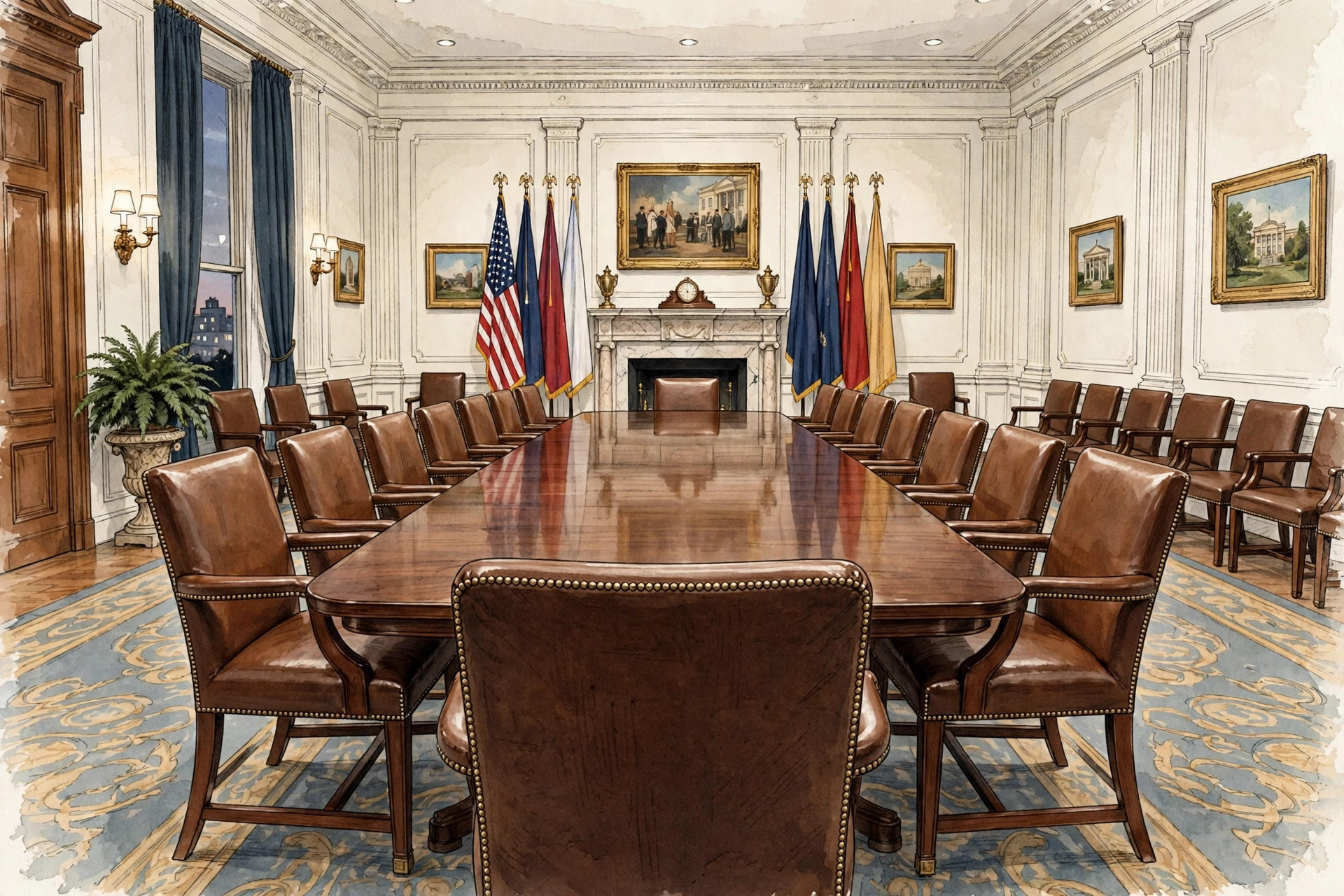
Washington is waiting for a meeting that, as of this writing, has not been publicly confirmed in its post-election form. After the 2026 midterm elections, in which Democrats are projected to have won majorities in both the House and the Senate, the first sit-down between President Donald Trump and the congressional leaders who will shape the next two years has become one of the most closely watched events on the political calendar, even though no White House announcement reviewed for this article sets out a confirmed date, time, attendee list or agenda for that specific meeting. That absence of detail is itself part of the story, because it reflects how little direct contact there has been between the president and Democratic leaders during much of his second term, and how much each side is now trying to set the terms before they are in the same room.
What is known, from public statements and reporting since election night, is the shape of the negotiation that any such meeting would have to address. Trump has said, in reported post-election remarks, that he expects to get along with Democrats unless they want to be destructive, while also pointing to his veto power as a central tool. Democratic leaders, led in the House by Hakeem Jeffries, who is on course to become speaker if the projected majority holds through certification, have said their incoming majority will focus on affordability and accountability. Those two words, repeated by Democrats since the campaign, cover a wide range of policy: housing, health care, grocery and fuel costs, and scrutiny of the administration. They do not, by themselves, describe a deal.
The meeting, when it happens, will therefore be less about a single agreement and more about a test. Each side will want to learn whether the other is prepared to trade, to delay, or to use the next two years mainly to define the other for the 2028 election. A first meeting rarely settles a funding bill, a tariff policy or an oversight dispute. It usually reveals who is willing to negotiate in private, who prefers to negotiate through public statements, and which subjects are treated as opening offers rather than firm conditions.
It is also important to be clear about who would be at the table in principle, and who would not yet hold the title their party expects. In the current Congress, the top four leaders are House Speaker Mike Johnson, Senate Majority Leader John Thune, House Democratic Leader Jeffries and Senate Democratic Leader Chuck Schumer. After January 3, 2027, when the new Congress is seated, those roles are expected to change if the projected results are certified as reported, with Jeffries expected to move into the speakership and with Democratic leaders expected to take the Senate majority roles, while Johnson has said he will not continue to lead his caucus next year. A meeting held before January would therefore involve leaders in transition, while a meeting held after January would involve leaders with formal authority to schedule votes and issue subpoenas. The timing of the meeting matters as much as its content.
What the first Trump congressional leaders meeting is expected to test
The most immediate test is tone. Trump and Jeffries have met formally only rarely during the president’s second term, according to reporting on their previous contact. One earlier planned meeting, in the run-up to a funding deadline in the autumn, was cancelled by the president after he described Democratic demands as unproductive, while Democratic leaders said they remained willing to meet at any time to negotiate a spending agreement. A private conversation in August between Jeffries and Jared Kushner, the president’s son-in-law and outside adviser, was later reported to have covered housing, immigration and the cost of living, but its full contents were not publicly disclosed and it did not produce a reported policy agreement.
That history suggests a first post-election meeting will be watched for signals that go beyond any joint statement. Will cameras be present for part of the discussion, or will it be entirely closed? Will leaders emerge together, separately, or not at all? Will the White House describe the session as productive, or will each side release its own account within hours? In past funding fights, the public staging of such meetings has sometimes mattered as much as the private discussion, because each leader must also speak to their own party, which may be skeptical of compromise.
For Trump, the meeting offers a chance to present himself as willing to work with the new majorities while preserving his leverage. He has repeatedly pointed to the veto in post-election remarks, including in a social media image of a cap bearing that word, and he has said he does not want to spend two years simply vetoing everything. That combination, cooperation in principle and veto in reserve, is a familiar negotiating posture. It allows the president to invite Democrats to bring him bills he can sign, while warning that bills he regards as unacceptable will be returned.
For Jeffries and Schumer, the meeting offers a chance to establish that the new majorities intend to govern, not merely to investigate. Their campaign emphasis on affordability gives them a reason to seek tangible results on costs, even if those results are modest. It also gives them a reason to avoid a first meeting that is remembered only for confrontation, because voters who supported them on pocketbook issues may judge them on whether prices, housing and health costs improve, not only on whether hearings are held.
What Trump wants from the table
From the White House side, the priorities reported before and after the election point in several directions at once. The first is room to govern by executive action. Reporting on White House planning described months of work, led in part by deputy chief of staff Stephen Miller, budget director Russell Vought and White House counsel Will Scharf, to identify executive actions on immigration, tariffs, housing and spending that the president could pursue without new legislation. A meeting with congressional leaders does not need to approve those actions, but Trump is likely to want to signal that he will continue to use executive authority where Congress will not act, and to test whether Democrats will challenge that approach in court, in legislation or through oversight.
The second White House priority is control over the legislative agenda through the veto. Overriding a veto requires two-thirds majorities in both chambers, 290 votes in the House and 67 in the Senate, thresholds that the projected Democratic majorities, at least 54 seats in the Senate in reported counts with Alaska and Mississippi still uncalled, do not reach. Trump can therefore block most partisan Democratic bills even if they pass both chambers. That power does not, however, allow him to pass his own legislation without Democratic votes, and it does not protect executive actions from court challenge or from congressional investigation.
A third priority is likely to be funding and border enforcement. The federal government faces a further funding deadline in December, during the lame-duck period before the new Congress takes office, and immigration enforcement funding has been a recurring point of contention. The president is expected to press for funding arrangements that preserve his enforcement policies, while Democrats are expected to seek conditions on how enforcement agencies operate. Those conditions, including proposals discussed in public debate about warrants, body cameras, uniforms, use-of-force training and local investigations, have not been agreed in any reported post-election meeting, and should not be presented as settled terms.
Trump is also likely to want a discussion about tariffs that preserves his central economic tool while addressing the political cost of higher prices. Democrats have blamed tariffs, some of which courts have ruled unlawful in certain applications as reported, for raising costs for households. The president has defended tariffs as a source of leverage and revenue, and as a way to reshape trade relationships. A meeting is unlikely to resolve that disagreement, but it could reveal whether either side sees room for targeted changes, such as relief for particular goods or trading partners, without a wholesale reversal.
What Jeffries, Schumer and the incoming majorities want
From the Democratic side, the stated agenda begins with affordability, and the details reported so far give that word more shape than a slogan. Early plans described in reporting after the election include extending expired health care tax credits, ending tariffs on Canada, restoring protected status for Haitian migrants and reversing an order that ended collective bargaining for federal workers. Those items are reported as early plans and task-force priorities, not as a finalized legislative package, and they have not been presented as demands formally delivered to the White House in a post-election meeting.
Health care is likely to be the most concrete early test. Democrats have long argued that enhanced premium tax credits under the Affordable Care Act help lower-income and middle-income households buy insurance, and they have warned that allowing those credits to lapse would leave millions uninsured or facing higher premiums. Republicans have argued that such subsidies should be debated separately from a short-term funding bill. Whether health care is treated as part of a funding negotiation, or as a separate bill in the new Congress, will be one of the first procedural decisions leaders must make, and it may be discussed, in general terms, at any early meeting.
Housing is another area where both sides claim common ground, even if they differ on method. Jeffries has listed housing alongside health care and the cost of gas, groceries and goods as priorities, and a bipartisan housing-affordability bill passed earlier in the year with support from both parties. That history suggests housing could be an area where a first meeting produces a constructive signal, even if the details of any new bill remain to be negotiated in committee.
Accountability, the second half of the Democratic message, is likely to be present in the room even if it is not the headline subject. Incoming Democratic committee leaders have said they intend to investigate family business dealings, corporate corruption, immigration enforcement and the handling of Epstein-related records, among other subjects. Trump has dismissed concerns about impeachment in reported remarks, arguing that such an effort would damage Democrats politically, while also saying he is prepared to work with them on legislation. A first meeting will not settle those investigations, which will in any case not begin in earnest until committees are organized in January, but it may set the tone for whether oversight is treated as a separate track or as a bargaining chip.
Funding: the first deadline before the new Congress arrives
Funding is the subject most likely to force contact before January, because it cannot wait for the new Congress to organize itself. The current Congress must still pass a measure to fund the government past December, and the lame-duck period gives outgoing Republican leaders and the White House an opportunity to shape that measure, while incoming Democratic leaders can argue that a short-term extension would be more appropriate than a long-term bill that binds the new majority.
That dynamic creates a different kind of meeting from the one expected in January. A December funding discussion would involve leaders whose authority is about to change, negotiating a bill that may last only weeks. A January meeting, by contrast, would involve leaders with a full two-year horizon, negotiating bills that could define the rest of the president’s term. Readers should therefore be cautious about treating any single reported meeting as the definitive post-election negotiation. There may be more than one, with different participants and different stakes.
The recent history of funding talks also counsels caution. A record shutdown in the previous autumn, lasting 43 days according to commentary published after the midterms, damaged the standing of both parties in different ways and left voters frustrated with Washington’s inability to keep basic services running. Neither side is likely to want to be blamed for another shutdown, but neither side is likely to accept the other’s funding terms without conditions. That tension, rather than any single demand, is what makes funding the most likely subject of an early, practical conversation.
For background on the president’s own post-election message, see USN’s earlier article on Trump congratulates Democrats and accepts the midterm results while denying a personal rebuke. That message, combining congratulation with a veto warning, is the public starting point for any meeting that follows.
Tariffs and the cost of living: where the two agendas collide
Tariffs sit at the intersection of the two sides’ arguments about affordability, which is why they are likely to feature in any substantive meeting even if no tariff deal is expected. Democrats argue that import taxes raise prices for American households and businesses, and they point to court rulings that have questioned the legal basis for some tariffs. Trump argues that tariffs give the United States leverage in trade negotiations, protect domestic industries and generate revenue that can be used for other priorities.
The legal context complicates any negotiation. The Supreme Court has reaffirmed a role for Congress in tariff policy, according to commentary published after the election, and Congress could in principle legislate on tariffs if it can assemble a veto-proof majority or persuade the president to sign a narrower bill. Neither condition appears likely on the basis of projected majorities alone. That leaves executive action, court cases and targeted legislative changes as the more realistic paths, and a meeting could help leaders identify whether any targeted change, such as relief for a specific sector or country, is politically viable.
There is also a broader economic argument that may surface. Democrats have linked tariffs to the war with Iran and to supply pressures that have raised fuel and consumer prices, while the administration has defended its foreign policy decisions and argued that its economic record is strong. A meeting is not a forum for settling a debate about the causes of inflation, but it can reveal whether leaders are prepared to separate economic relief measures, such as health credits or housing support, from the larger argument about trade and foreign policy, or whether they intend to link them together.
Oversight in the room, even if it is not on the agenda
Even if oversight is not formally listed as a meeting topic, it will shape the negotiation. A president who expects subpoenas in January has less incentive to make concessions in November or December that could be used as evidence in a later investigation, and a congressional leader who expects to chair an investigative committee has less incentive to agree to a private understanding that cannot be defended in public. That mutual caution is normal in divided government, but it is heightened when the oversight agenda is as broad as the one Democrats have described.
The White House has also been preparing for oversight on a legal track that runs parallel to any meeting. As USN has reported in a separate article on the privilege dispute, White House lawyers have briefed officials on handling document requests and subpoenas, and the administration has sought legal opinions that could support broad privilege claims. Those preparations do not mean a meeting will fail, but they do mean that leaders entering the room will already be thinking about what they say, what they commit to in writing, and what could later be requested by a committee.
For Democrats, the challenge is to keep oversight credible without allowing it to consume the legislative agenda. Public statements from incoming leaders have emphasized both investigation and affordability, but time in a two-year Congress is limited, and a committee that spends months on a single inquiry has less time for bills on health care, housing or funding. How leaders divide that time, and whether they present oversight as a complement to legislation rather than a replacement for it, will be one of the judgments voters make about the new majorities.
Why past meetings are a warning, not a template
The recent record of meetings between Trump and Democratic leaders offers a warning against expecting a smooth first session. The planned autumn meeting on funding was cancelled before it took place, after the president said Democratic demands could not lead to a productive discussion and Democratic leaders said they remained willing to meet. That episode shows how quickly a meeting can become a public dispute about whether to meet at all, rather than a negotiation about policy.
The August conversation between Kushner and Jeffries offers a different lesson. It was private, it covered substantive subjects, and it did not produce a public agreement. Private channels can be useful for testing ideas without the pressure of cameras, but they can also create suspicion among other leaders and within each party if they are seen as side deals. A post-election meeting that is intended to build trust will therefore need to be inclusive enough that other leaders do not feel bypassed, and transparent enough that the public can judge whether anything was actually agreed.
There is also the question of Republican leaders in transition. Johnson’s announcement that he will not continue to lead his caucus next year, and Thune’s position as Senate leader in a chamber that is projected to change hands, mean that Republican voices in any early meeting may be speaking for a caucus that is itself regrouping. That does not make their views irrelevant, because Republicans will still hold a large minority and, in the Senate, the ability to filibuster most legislation. It does mean that a first meeting may involve more listening and positioning than decision-making.
What a deal would need, and what failure would look like
A workable outcome from a first meeting does not require a signed agreement. In divided government, a successful first session often produces only three things: a shared understanding of the next deadline, a process for staff-level talks, and an agreement not to surprise each other in public before those talks have a chance. If leaders leave a meeting with those three elements, even without a policy deal, the session can be described as a start rather than a failure.
Failure, by contrast, would look familiar. It would involve competing public statements issued within hours, each side accusing the other of refusing to negotiate, and a funding or policy deadline allowed to drift toward crisis. That pattern has occurred before, and it tends to harden positions rather than soften them, because each leader must then defend their public account to their own party. The risk is higher when a meeting is held under media pressure, with cameras waiting outside, than when it is held as a working session with time for staff follow-up.
Looking ahead, the calendar will impose its own discipline. The December funding deadline arrives before the new Congress, the new Congress organizes on January 3, and committees will then begin their oversight work in earnest. A president and congressional leaders who have not established a working relationship by then will still have to govern together, but they will do so through vetoes, subpoenas, court filings and public statements rather than through negotiation. That is a possible future, and it is one that both sides have warned about in different ways, but it is not yet a decided one.
For now, the most accurate way to describe the first post-election White House meeting is as expected, consequential and still unconfirmed in detail. Readers should treat any report of a date, an attendee list or an agreement with caution until the White House or congressional leaders announce it themselves, and should treat claims of a deal, a breakdown or a specific quote from a private session as unverified unless a named source confirms it. The subjects for that meeting are clear enough: funding, tariffs, health care, housing and the shadow of oversight. Whether the meeting produces a path through those subjects, or merely confirms the depth of the divide, will become clear only when leaders actually sit down, and when what they say afterwards can be checked against what they do next.
Sources
USN reviewed reporting from multiple outlets for this story. Read more from USA Today, Arab News and Times Now.