

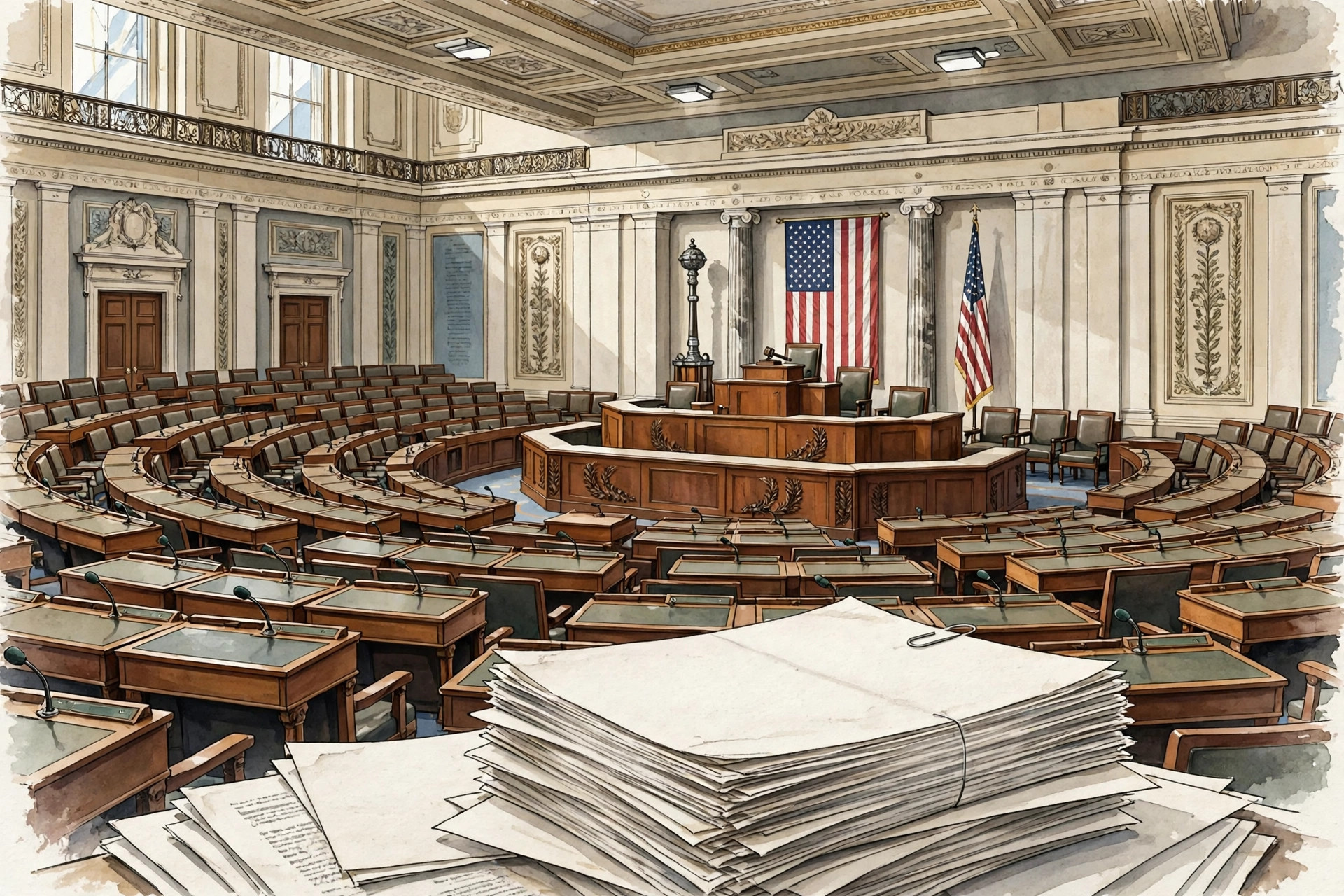
When the new Congress convenes on January 3, 2027, the House is projected to change hands. News organisations projected after the November 3, 2026 midterm elections that Democrats would win majorities in both the House and the Senate, although many individual races remained uncalled and no result is certified until states complete their official counts. That distinction matters for everything that follows: the incoming Democratic leadership can plan an agenda, and it can pass bills in the House, but it cannot yet claim a settled mandate on the size of its majority, and it cannot turn a House vote alone into law.
Reporting in the days after the election sketched a familiar opening sequence. Incoming House Democrats were reported to be preparing a fast first round of votes aimed squarely at household costs: restoring expanded health insurance subsidies that had been allowed to expire, reversing Medicaid changes enacted under Republican control, and challenging the tariff policy imposed by President Donald Trump. House Democratic Leader Hakeem Jeffries, who is widely expected to be nominated for speaker when the new House meets, was reported to have framed the programme in affordability terms, arguing that Democrats had campaigned on the cost of living and now had to govern on it. The details, however, were still being worked out, including which measures would move first and how much of the programme would be legislative and how much would be oversight.
This article looks at the three subjects at the centre of the expected January agenda — voting rights, ethics reform and health care — and at the obstacles that stand between a House vote and a signed law. The agenda is best understood as two things at once: a statement of priorities that the new majority wants voters to see, and a negotiation with a Senate that still requires 60 votes for most bills and a president who retains the veto. Both halves of that story will shape what actually happens in January.
What the First 100 Hours Are Reported to Cover
According to post-election reporting, the first votes would come quickly, within the opening days of the new Congress, in a deliberate echo of the first-100-hours plans that incoming majorities have used before to signal intent. The reported health measures head the list. Expanded subsidies for health plans sold under the Affordable Care Act were allowed to expire under Republican control, and restoring them would lower premiums for people who buy coverage on the exchanges. Reversing Medicaid cuts and work requirements imposed in last year’s domestic policy law would be a second, related step, aimed at the same affordability argument from a different direction: one measure helps people buying insurance, the other protects coverage for lower-income households.
Trade policy is reported to be a third early item. Democrats were said to be preparing legislation to repeal the sweeping tariffs imposed by the president and to restore a larger congressional role in setting import duties. That is a difficult bill to turn into law, since tariff authority and foreign policy sit heavily with the executive branch and any repeal would face a likely veto, but as a House vote it serves a clear political purpose: it forces members of both parties to take a recorded position on a policy that Democrats blame for higher prices on groceries, goods and fuel.
Behind those headline votes sits a broader affordability structure built before the election. Jeffries set up five working groups covering health care, housing, groceries and goods, gas and utilities, and caregiving, each pairing a progressive and a centrist member. That pairing was itself a message about how the new majority intends to govern: it wants an agenda broad enough to hold together members from safe seats and members from competitive districts, where the next election will be fought. Whether that structure produces detailed legislation or mainly produces themes for later bills will be one of the first tests of the new Congress.
House Democrats First Bills 2027 and the Voting Rights Fight
Voting rights has been a stated Democratic priority for years, and the projected 2027 agenda puts it back near the front. The general shape of the proposals is well established from earlier Congresses: expanded early voting and vote-by-mail options, national standards for election administration, protections against changes that restrict access to the ballot, and new disclosure rules for campaign money. Supporters argue that federal standards are needed because election rules vary so widely from state to state, while opponents argue that elections are properly run by the states and that federal mandates would override local decisions.
The history here counsels caution about early success. A voting rights bill failed in the Senate in January 2022, when a bid to change filibuster rules for that measure fell short, and Democrats have not held the 60 votes needed to advance such legislation since. The projected 2027 Senate majority, reported to be in the low to mid-50s with some races still uncalled, does not change that arithmetic on its own. Unless a substantial number of Republicans support the bill, or unless Democrats agree among themselves to change Senate rules, a voting rights measure can pass the House and still stall in the Senate.
Republicans, meanwhile, have their own election proposal already in circulation. A House-passed package combined a stock trading measure with a voter identification requirement for federal elections, and Senate Democrats blocked that combined bill, arguing that the trading restrictions were too weak and that the identification requirement would make voting harder. That episode previews the 2027 argument: both parties claim to speak for election integrity, but they define it in opposite ways, one emphasising access and the other emphasising identification checks. A January voting bill will therefore be read as much as a statement of values as a piece of legislation, and its fate will depend on whether either side is willing to separate the issues it has previously bundled together.
Ethics Reform: Stock Trading, Lobbying and Disclosure
Ethics reform is the second pillar of the expected agenda, and it may be the one with the broadest public support. Polling has consistently shown large majorities in favour of restricting stock trading by members of Congress, and proposals have circulated in both parties for years. The debate is not really about whether trading looks bad; it is about how strict a ban should be, whom it should cover, and what should happen to lawmakers who break it.
Several versions are already on the table. One bipartisan approach would bar members of Congress, their spouses and dependent children from owning or trading individual stocks, commodities and futures, with penalties for non-compliance. Another approach, advanced by some Democrats, would go further, covering senior officials in the executive and judicial branches as well, requiring blind trusts, and imposing a lifetime ban on former members becoming lobbyists. Former White House chief of staff Rahm Emanuel added his voice after the election, urging Democrats to make a comprehensive ethics bill a top 2027 priority covering all three branches, including a ban on betting on prediction markets and restrictions on foreign income during and after government service.
The politics of ethics reform are complicated by the fact that both parties have used it as a campaign weapon and then struggled to pass it in government. House Democrats blocked the Republican-combined stock trading and voter identification bill in the Senate, saying its trading rules were too weak, while Republicans accused Democrats of rejecting a reasonable compromise. In January, Democrats will have to decide whether to start with a narrower stock trading ban that might attract Republican votes, or a broader package that makes a stronger statement but risks losing the bipartisan support needed to reach 60 votes in the Senate. The choice will reveal how much of the ethics agenda is about passing law and how much is about drawing a contrast for the next election.
Health Care Beyond the Subsidies
Health care runs through the entire January agenda, not just the opening votes. Restoring the expired Affordable Care Act subsidies is the most immediate step, because its effects would be felt quickly in premiums, but Democrats are also reported to be looking at the longer-term structure of the system. That includes reversing Medicaid changes, strengthening protections for people with pre-existing conditions, and examining the influence of large health care companies on prices. Senator Ron Wyden, the leading Democrat on the Senate Finance Committee, was reported after the election to have named affordability and accountability as his committee’s twin priorities, including closer scrutiny of tax payments by wealthy individuals, corporate influence on health care, and trade policy.
There are real limits to what a single Congress can do on health care without presidential cooperation. The subsidies and Medicaid changes involve federal spending, which means they can in principle move through budget reconciliation, the special process that allows certain spending and revenue bills to pass the Senate with a simple majority. But reconciliation is limited in scope, can be used only a certain number of times, and cannot carry every policy Democrats might want. Broader health care restructuring would need 60 Senate votes and a presidential signature, neither of which the projected majorities provide. The realistic January outcome, therefore, is likely to be a set of House-passed bills that define the party’s health care position, followed by a longer negotiation over what can actually be attached to must-pass spending legislation.
For voters, the test will be practical rather than procedural. Premium notices, Medicaid renewal letters and pharmacy bills arrive on fixed schedules, and households will judge the new majority by whether those costs move. That creates pressure on Democrats to show results quickly, but also creates a risk: if early bills pass the House and die in the Senate or at the president’s desk, the party will have to explain why a majority it campaigned on did not translate into lower costs, and that explanation will have to survive contact with a Republican opposition eager to make exactly that argument.
The Senate, the Filibuster and the Veto
The central arithmetic of 2027 is simple and unforgiving. Most legislation needs 60 votes in the Senate to end debate, a threshold known as cloture. The projected Democratic Senate majority is reported to be well short of that number, with some races still unresolved and a final total that could move by a seat or two as counting finishes. That means that even if House Democrats pass their full agenda, they will need Republican votes in the Senate for most of it, or they will need to change Senate rules.
Changing the rules is possible but far from easy. The Senate can alter how its rules apply by a simple majority vote setting a new precedent, the procedure often called the nuclear option, and it has been used before for nominations. Extending that approach to legislation would be a much larger step, and it would require every Democrat in the projected majority to agree, including members from states where such a change might be unpopular. Democrats debated this question in 2022 and could not agree, and there is no public evidence yet that the incoming majority is united on it. Until that question is settled, the filibuster remains the single biggest constraint on the January agenda.
Beyond the Senate sits the veto. President Trump remains in office until January 2029, and he has made clear that he intends to use his veto power freely against Democratic legislation. Overriding a veto requires two-thirds of both chambers — 290 votes in the House and 67 in the Senate — thresholds far above the projected Democratic majorities. That means the realistic path for most January bills is not enactment over presidential opposition, but negotiation: finding measures that can attract enough Republican support to survive, attaching priorities to spending bills the president must sign, or using House passage to set up the 2028 election argument. None of those paths is as satisfying as signing a bill into law, but all of them are more plausible than expecting a veto override.
For more on the procedural obstacles, readers may want to revisit why a Democratic majority cannot simply pass its agenda, which sets out the filibuster, veto and 60-vote rules in detail.
The Republican Response
Republicans are not expected to greet the new majority quietly. Outgoing Speaker Mike Johnson, who remains speaker until the new Congress convenes, has promised what he called a Republican firewall against Democratic investigations and legislation, and House Republicans preparing to move into the minority have already framed the incoming agenda as overreach. Their argument will likely run on two tracks: that Democratic bills on voting, ethics and health care are partisan measures dressed up as reform, and that Democratic oversight of the administration is political retaliation rather than accountability.
That response matters because Republicans will still hold real power in 2027. They will hold enough Senate seats to sustain a filibuster, they will hold the presidency, and they will hold a large House minority capable of shaping public debate. They will also control the timing of the lame-duck session that precedes the new Congress, giving them a final opportunity to lock in spending and policy choices before January 3. Democrats will therefore face a Republican opposition that is wounded but not powerless, and the January agenda will be negotiated in that shadow from its first day.
What to Watch in January
Several early markers will show how serious the January agenda is. The first is the order of the bills: whether health subsidies move before voting rights, and whether ethics reform arrives as a single package or as separate measures. The second is the Senate response: whether any January House bill attracts Republican co-sponsors, and whether Senate Democratic leaders signal a rules change or rule it out. The third is the White House response: whether the president engages on any item, such as a narrower stock trading ban, or vetoes early bills outright to set a tone for the next two years.
None of those markers will be visible until the new Congress actually meets, and all of them depend on final, certified results that are still weeks away in some states. For now, the January agenda is best read as a plan, not a promise: a list of bills that incoming House Democrats say they will prioritise, framed by affordability, tested by the Senate’s 60-vote rule and the president’s veto, and answered by a Republican Party preparing its own case for 2028. The votes in January will show how much of that plan survives contact with governing.
Sources
USN reviewed reporting from multiple outlets for this story. Read more from The Fiscal Times, The Washington Sun and USA Today.