

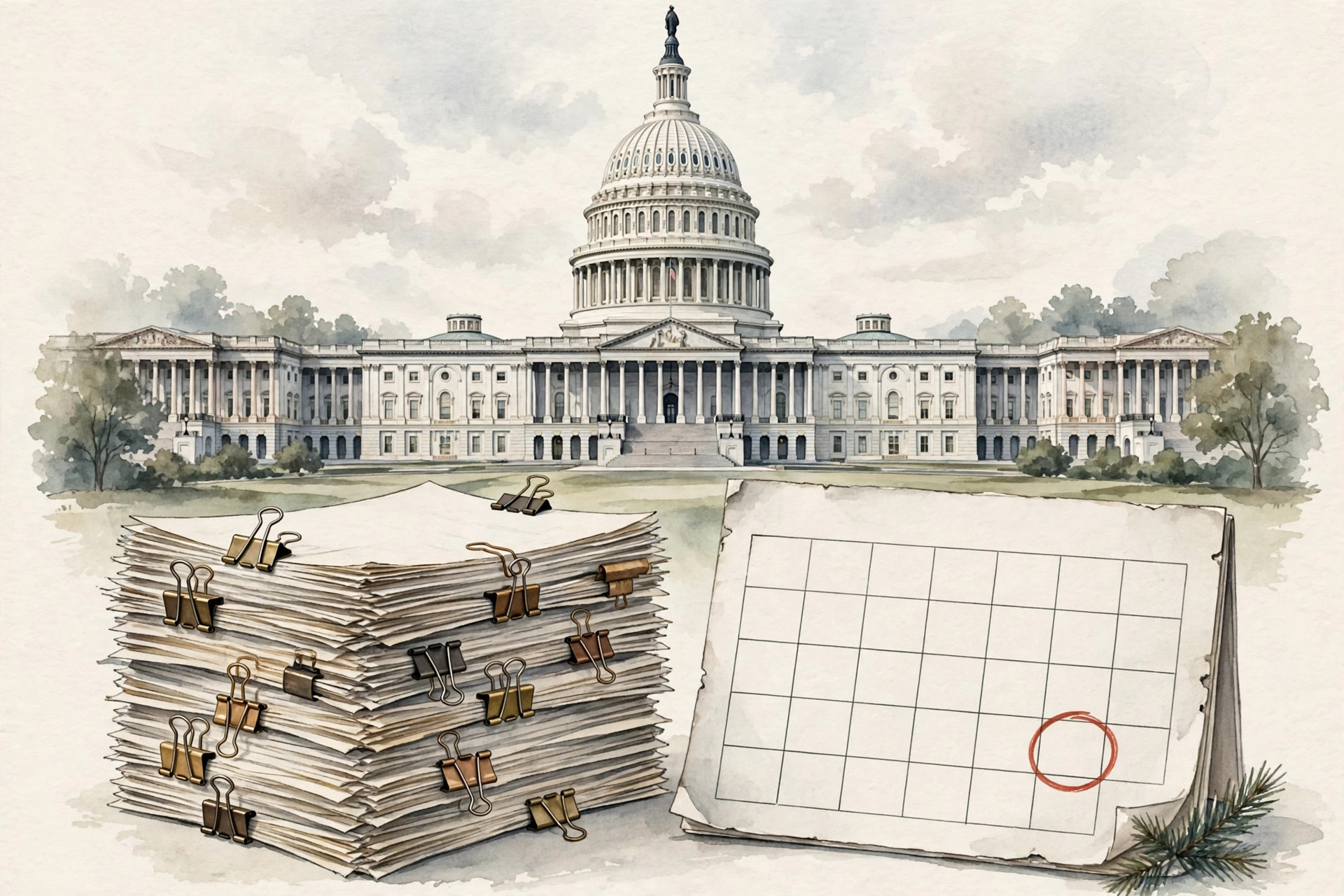
Congress returns to Washington on November 9, 2026 for a lame-duck session unlike most in recent memory. The label describes the period between an election and the start of a new Congress, when outgoing members still hold their seats and the incoming majority has not yet taken over. This year that period carries unusual weight, because news organisations projected after the November 3 midterm elections that Democrats would win majorities in both chambers, although many races remained uncalled and no result is certified until states finish their official counts. Until January 3, 2027, however, the current Congress remains in charge, with Republican majorities in both chambers and Speaker Mike Johnson still presiding over the House.
That split creates a race against two clocks. The first is the calendar: the session is expected to run for roughly six or seven weeks, with a break for Thanksgiving, before the holiday adjournment. The second is a set of deadlines that will arrive whether or not Congress is ready. Current government funding runs out on December 11, 2026. The farm bill has already expired, with a harder deadline at the end of December. The annual defence authorisation bill, known as the NDAA, remains unfinished in the Senate. And communities hit by disasters in 2025 are still waiting for long-term recovery money that only Congress can appropriate. Each item is important on its own; together, they compete for the same scarce floor time in the same few weeks.
What follows is a guide to that must-pass list: what each bill does, where it stands, what happens if it slips past January 3, and why the change of control makes the lame-duck session harder, not easier, to manage. The central point is that a bill that fails in December does not simply disappear. It returns in a different Congress, under different leadership, with different priorities, and often with a higher price for delay.
Government Funding: The December 11 Deadline
The most immediate deadline is government funding. In September, Congress passed a temporary spending bill, known as a continuing resolution, that keeps the federal government open through December 11, 2026. If lawmakers do not pass another funding bill by then, parts of the government shut down. That is the one deadline that cannot be postponed by agreement alone, because it is written into the funding law itself.
Lawmakers face a choice about what kind of funding bill to pass. One option is to finish the twelve annual appropriations bills that fund the government for the full fiscal year. Before the pre-election recess, the House had passed three of those bills, covering agriculture, military construction and veterans affairs, and national security and state, while the Senate had not completed comparable floor action. Finishing all twelve in a few weeks would be an enormous undertaking, and analysts reported that leaders were instead considering a shorter continuing resolution that would keep agencies funded into early 2027, possibly into March.
The choice is political as well as practical. Republicans, who still control both chambers until January, may prefer to lock in spending levels now, while they still set the terms. Democrats, who are projected to take control in January, may prefer to defer the negotiation, so that they can shape the final spending package with their new majorities. House Democratic Leader Hakeem Jeffries was reported to favour doing the appropriations bills during the lame-duck period, which suggests at least some Democratic appetite for a deal now. But the two parties also disagree on spending levels, policy riders, defence funding and health care, and any of those disputes could push the negotiation past December 11 and into a shutdown fight.
A short extension would solve the immediate problem without solving the underlying one. It would keep the government open, but it would hand the full-year spending negotiation to the new Congress, where it would compete with the incoming majority’s own January agenda. A longer deal would settle the question, but it would require compromises that neither side may want to make in the shadow of an election it has just lost or won. That tension is likely to define the first weeks of the lame-duck session.
The NDAA: Defence Authorisation Still Unfinished
The National Defense Authorization Act is the annual bill that sets policy for the armed forces, military construction, defence research and Department of Energy national security programmes. Congress has passed some version of it every year for more than six decades, which makes its unfinished state this year notable. The House passed its version of the fiscal year 2027 NDAA in July 2026, but the bill stalled in the Senate, and the two chambers have not yet reconciled their differences.
Several issues complicate the negotiation. The administration has sought a very large defence budget, reported at around 1.5 trillion dollars in one request, a figure Senate Democrats rejected as a starting point. The separate question of the size of the overall defence bill, reported elsewhere at around 1.15 trillion dollars, shows how far apart the two sides’ frameworks remain. Oversight of military operations, including the conflict with Iran, and policy riders attached to the bill, add further complications. So does the lapsed surveillance authority under Section 702 of the Foreign Intelligence Surveillance Act, which some senators want to attach to the NDAA as a vehicle for renewal.
Despite those complications, leaders in both parties are reported to expect a deal. The NDAA’s long record of annual passage gives negotiators a strong incentive to find one, and the bill’s size makes it a natural vehicle for other provisions that need a ride to the president’s desk. The risk is not that the NDAA fails outright, but that it becomes overloaded: every unrelated proposal that gets attached increases the chance that some faction objects, and in a compressed lame-duck calendar there is little time to untangle a bill once it becomes controversial.
If the NDAA does slip past January 3, it will not be the first defence bill to be delayed, but it will enter a new political environment. The incoming Democratic majorities would take over the committees that write it, the administration’s defence requests would be debated under new leadership, and the bill’s priorities could shift. Delay would not be catastrophic in itself, since existing authorisations and funding continue for a time, but it would signal that even the most routine must-pass bill could not survive the transition intact.
Disaster Aid: Money Still Waiting for Survivors
Disaster relief is the must-pass item with the most direct human cost, and it is also the one where delay is already visible. More than 10 billion dollars in long-term federal recovery funding is reported to be needed by communities still waiting to rebuild, including neighbourhoods in Los Angeles County hit by wildfires, St. Louis after a tornado, and the Texas Hill Country after flooding. That money flows mainly through the Community Development Block Grant Disaster Recovery programme, run by the Department of Housing and Urban Development, which pays for the long work of rebuilding homes, infrastructure and small businesses after emergency assistance ends.
The programme has a structural problem: it has no standing pot of money. Congress must appropriate funds disaster by disaster, which means every affected community waits in line for a separate act of Congress. Reporting in October 2026 found that the last disaster to receive long-term recovery funds through this programme was Hurricane Milton, which struck Florida in October 2024, and that no disaster since then had received such funding. Survivors of the 2025 disasters therefore remain in limbo more than a year after some of those events, a delay that echoes earlier cases, such as survivors of the 2020 Puerto Rico earthquakes who waited hundreds of days for funds to be allocated.
In July 2026, the programme was written into permanent law for the first time, authorising it for three years, but that authorisation did not itself provide money. Senators wrote to appropriations leaders in July urging them to include long-term disaster recovery funding in any supplemental appropriations package, pointing to unmet needs in North Carolina after Hurricane Helene as well as in California, Texas and other states. That request underlines a distinction that matters for the lame-duck debate: authorising a programme and funding it are different acts, and only the second puts money in survivors’ hands.
Republican leaders have discussed a large emergency package combining defence money, aid for farmers hit by drought and low crop prices, and disaster relief that has been stalled for months. Whether such a package comes together in the lame duck, or whether disaster aid is attached to the funding bill or the NDAA, will determine whether survivors see money before the new Congress takes over. If it slips to 2027, the new Democratic majorities will face the same structural problem, but with a different political incentive: they will be able to blame the delay on their predecessors, while survivors will still be waiting for the same money.
The Farm Bill: Expired, With a Harder Deadline Ahead
The farm bill is the broadest of the must-pass items, covering crop programmes, food assistance through the Supplemental Nutrition Assistance Program, conservation, rural development, research and forestry. The 2018 farm bill, already extended three times, expired on September 30, 2026, and the continuing resolution that funds the government through December 11 did not include another extension. Some programmes stopped immediately: the Farm Service Agency said it had no authority to approve new Conservation Reserve Program contracts after September 30, at a moment when a large area of enrolled land was set to expire.
Other programmes continue for now, which is why the expiration has not produced an immediate crisis. Crop insurance operates under separate authority, and major safety-net programmes, including Agriculture Risk Coverage and Price Loss Coverage, along with Dairy Margin Coverage and major conservation programmes, were funded through 2031 in the 2025 budget reconciliation law. Food assistance also continues. But a second, harder deadline arrives at the end of December. If Congress does not pass a new farm bill or an extension by December 31, farm programmes revert to permanent law written in the 1930s and 1940s, a prospect commonly called the dairy cliff because dairy would be affected first when its new marketing year begins on January 1.
Those old laws would require the government to support certain farm prices at levels far above current market prices, with dairy support reported at potentially around 50 dollars per hundredweight, compared with market prices in the mid-teens. That would cause major disruption to dairy markets and large costs to the federal government, which is why analysts across the political spectrum expect Congress to act before it happens. The House passed its version of a new farm bill earlier in 2026, and the Senate Agriculture Committee advanced its own version in September, but the two chambers have not reconciled their bills, and disagreement over food assistance provisions remains a sticking point.
An extension is the most likely lame-duck outcome if a full bill cannot be finished, and it would buy time for the new Congress to negotiate a longer-term law. But an extension is not cost-free: it leaves conservation, research and rural development programmes that were not funded through 2031 in uncertainty, and it postpones the policy choices that a full farm bill is supposed to make. Farmers planning for the 2027 season need to know which programmes will exist, not just that a crisis has been averted, and that planning uncertainty is itself a cost of delay.
Lame-Duck Must-Pass Bills: What Else Is Competing for Time
The headline items are not the only ones on the lame-duck list. Surface transportation programmes expire on December 11 alongside government funding, and analysts expect another extension into 2027 rather than a full reauthorisation. Export-Import Bank authorisation expires on December 31. Selected health care extensions, the Water Resources Development Act, which the House passed by a large margin in September, and permitting reform all compete for the same floor time. A year-end tax package is also possible, though not guaranteed.
Two larger Republican ambitions hang over the session and may shape it more than any single bill. One is a possible debt-limit increase large enough to cover the remainder of the president’s term, which would deny the incoming Democratic majority the chance to condition a future increase on policy concessions. The other is a third reconciliation package pairing a debt-limit increase with defence funding and farm aid, which could pass the Senate with a simple majority. Both ideas were reported as under discussion, but neither was settled, and fiscal conservatives’ demands for spending offsets, along with narrow margins and departing members who may not attend, make large party-line measures difficult in a short session.
Judicial confirmations are a further priority for the outgoing majority. Because confirmations need only a simple majority in the Senate, Republicans can use their remaining weeks to confirm judges who would otherwise face a Democratic-controlled Senate in 2027. That work competes with legislation for Senate floor time, and it gives the lame-duck session a legacy dimension: the judges confirmed in December will serve long after the Congress that confirmed them has ended.
What Happens If Bills Slip to 2027
If the lame-duck session ends with work unfinished, the consequences vary by bill, but the pattern is consistent: delay transfers power to the new Congress and raises the price of action. Government funding would arrive as a short extension, forcing the new majority to negotiate full-year spending while also launching its January agenda. The NDAA would be rewritten under Democratic committee leadership, with different priorities and a different negotiating dynamic with the White House. Disaster aid would remain unpaid, with survivors’ frustration directed at whichever party holds power when the money finally moves. The farm bill would either be extended again or face the dairy cliff, with market disruption as the penalty for inaction.
There is also a less visible cost: trust. Every time a must-pass bill slips, it reinforces the impression that Congress can only govern by crisis, and that impression makes the next negotiation harder. Leaders on both sides know this, which is why lame-duck sessions often produce a flurry of deals in their final days, when the alternative is a shutdown or a market disruption that neither side wants to own. Whether that pattern holds this year depends on whether the outgoing Republican majorities and the incoming Democratic leadership can agree, even tacitly, that some bills are too important to use as leverage.
The calendar gives them a narrow window to prove it. Congress returns on November 9, takes a Thanksgiving break, and is expected to adjourn for the holidays in mid to late December. Within that window, it must fund the government, authorise defence policy, decide on disaster aid, and either pass or extend the farm bill, all while managing leadership transitions in both parties. The session will be judged not by how many bills it passes, but by whether the bills that matter most to people’s daily lives — a pay cheque for a federal worker, a rebuilt home, a farm loan, a military pay policy — are in place when the new year begins.
Sources
USN reviewed reporting from multiple outlets for this story. Read more from Holland & Knight, WilmerHale and No Labels.