

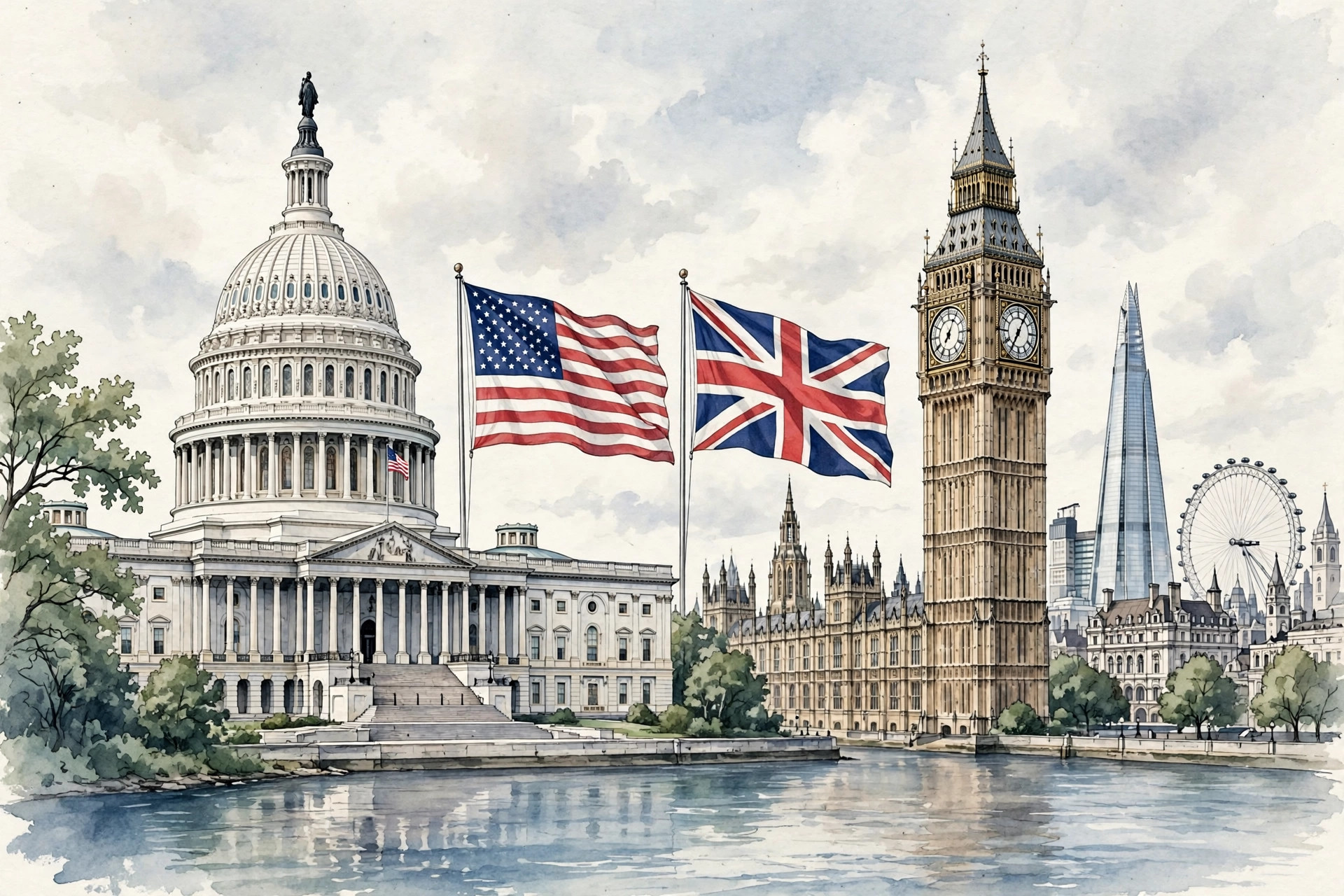
London’s first reaction to the projected Democratic victories in the United States midterm elections was deliberately calm. British officials stressed continuity, not celebration. The United Kingdom’s closest ally, they said, remained the United States, whatever party controlled Congress. Beneath that careful language, however, the result matters a great deal for Britain. It changes the balance of power in Washington at a moment when London is trying to protect a hard-won trade arrangement, sustain defence cooperation through NATO, manage the costs of war in Ukraine and the Middle East, and rebuild a transatlantic relationship that has been strained by tariffs, public disagreements and competing priorities.
The projected outcome, reported after voting on 3 November 2026, pointed to Democratic majorities in both the House of Representatives and the Senate. Those projections are not final certifications, and several races were still subject to counting and certification when world leaders began to respond. The new Congress is not due to take office until January 2027, and President Donald Trump remains in the White House with the veto and wide executive powers. For London, that means the midterm result is best understood as a shift in leverage, not a change of government in Washington. Congress can now block legislation, delay appointments, demand answers in hearings and shape spending bills. It cannot, on its own, sign a trade deal, order a military deployment or reverse a presidential decision.
Britain also enters this new phase with a new prime minister of its own. Andy Burnham became prime minister on 20 July 2026, succeeding Keir Starmer after a Labour leadership change. Burnham therefore inherits both the opportunities and the constraints of the Starmer era: a trade framework negotiated with the Trump administration, a defence relationship built around NATO and Ukraine, and a political style that sought to keep disagreements private while preserving access to the White House. The question for the months ahead is whether a Democratic Congress gives Burnham more room to deepen that relationship, or whether it simply adds another centre of power in Washington that London must learn to navigate.
London’s reaction: continuity first, opportunity second
Burnham’s public response to the projected results focused on the cost of living and on ending wars, rather than on party politics in Washington. He said the world now had an opportunity to unite around the issue affecting people most directly, the pressure on household budgets, and argued that progress on that front was linked to resolving conflicts in the Middle East and in Ukraine. That framing is revealing. It presents the midterm result not as a partisan victory to be celebrated abroad, but as a chance to refocus international attention on prices, energy costs and the economic spillover from war.
Other British officials struck a similar note. Health Minister James Frith said the United Kingdom would maintain steady and strong ties with Washington despite what he described as a seismic shift in American domestic politics. He argued that changes in the balance of power in Washington are frequent, while the mainstay of the British-American relationship remains unchanged. That message was aimed at two audiences at once: at Washington, to reassure the administration that London was not taking sides in an American election, and at a domestic audience, to signal that the government would not be knocked off course by events in another country.
British newspapers, by contrast, were less restrained. One leading daily described the result as a historic blue tsunami, reflecting a sense of drama that official statements avoided. That gap between press excitement and ministerial caution is normal after an American election, but it also reflects a real uncertainty. London does not yet know how the new Congress will use its powers, how the president will respond to losing control of Congress, or whether the next two years will bring negotiation, gridlock or a mixture of both. Until those patterns become clear, the safest British position is to welcome democratic participation, reaffirm the alliance and avoid language that could be read in Washington as interference.
UK trade deal hopes after the US midterms: the Starmer-era framework
Trade is where the midterm result could matter most directly for British businesses, and it is also where the limits of congressional power are most visible. The trade arrangement negotiated under Starmer was presented as a historic first step: tariffs on British-made cars exported to the United States were reduced, from a higher rate to 10 percent for up to 100,000 vehicles a year, and tariffs on steel and aluminium exports were cut. The deal also opened new market access in areas such as beef and ethanol. For carmakers, steel producers and exporters more broadly, those changes were material, even though a broader 10 percent tariff on most other British goods remained in place.
Yet the arrangement was never a full free trade agreement, and it was not fully ratified in the way a comprehensive treaty would be. Parts of it were implemented through executive action, while a complete deal would require detailed negotiation and congressional approval. That distinction matters now. A Democratic-led Congress will have a greater say over any future trade legislation, over tariff-related measures that require congressional authority and over the scrutiny of executive trade decisions. British officials and business groups will therefore need to build relationships not only with the White House and the United States Trade Representative, but also with incoming House and Senate committee leaders who will influence trade policy.
There are reasons for cautious optimism in London, and reasons for restraint. On the optimistic side, Democrats have historically been more sympathetic to multilateral cooperation, to predictable trade rules and to consultation with allies before tariff changes. A Congress that questions sudden tariff threats, including threats linked to disputes over Greenland and NATO burden-sharing, could give Britain more predictability. On the restrained side, trade politics in the United States is not simply partisan. Democrats have their own concerns about manufacturing jobs, labour standards, agricultural access and digital regulation, and they may press Britain on issues that the previous Congress did not prioritise. A new Congress could therefore be both more predictable and more demanding.
British ministers have also learned that a trade deal with Washington is never only about tariffs. It touches food standards, animal welfare rules, digital services taxation, pharmaceutical pricing and access for American agricultural products, all of which are sensitive in British domestic politics. Previous British governments have ruled out weakening animal welfare standards to secure a deal, and have faced criticism from opposition parties that the existing arrangement gave away too much for too little. Burnham’s government will face the same pressures, with the added complication that any attempt to deepen the deal will now be negotiated in a Washington where power is divided between a Republican president and a Democratic Congress. That division could slow progress, but it could also create an incentive for both sides in Washington to show that they can still deliver a workable agreement with a close ally.
Defence and NATO: a shared interest, a different conversation
Defence cooperation is the second pillar of the British-American relationship, and here the midterm result may change the tone of the conversation even if it does not change the fundamentals. Britain has been one of the strongest European supporters of Ukraine, has increased its defence spending under pressure from Washington and has worked closely with the United States on intelligence, air defence and support for Kyiv. That cooperation is institutional, built through NATO, through bilateral military channels and through joint operations, and it does not depend on which party controls Congress.
What Congress can change is the political context for that cooperation. A Democratic House and Senate are expected to scrutinise defence spending, to press for continued support for Ukraine and to question any move that weakens NATO commitments. For London, that scrutiny could be helpful, because it reinforces the case for sustained American engagement in Europe. It could also be uncomfortable, because Congress may ask harder questions about European defence spending, about burden-sharing and about whether Britain and other allies are doing enough to reduce their dependence on American capabilities.
European defence ministers have already signalled that they do not intend to treat a Democratic Congress as a reason to relax. Germany’s defence minister has argued that NATO must become more European in order to remain transatlantic, and that European states should take on a larger share of the burden regardless of American politics. That message aligns with Britain’s own direction. Burnham, on taking office, reiterated support for Ukraine, and British officials have continued to announce practical support, including air-defence assistance for the winter. The midterm result does not replace that work, but it may make it easier to coordinate, because a Congress that is more sympathetic to Ukraine and to NATO is more likely to support funding and oversight that align with London’s priorities.
There are also areas of potential friction. The United States and Britain have disagreed publicly over the war involving Iran, over the use of joint bases and over the future of territories such as Greenland and Diego Garcia. Burnham’s predecessor faced pressure over trade threats linked to those disagreements, and insisted that Britain would not be dragged into a war that was not in its national interest. Burnham has inherited those sensitivities. A Democratic Congress may be more sympathetic to Britain’s positions on some of these questions, particularly where congressional oversight can check executive action, but it will not resolve them. Defence policy, like trade policy, will still be shaped by the president, by the Pentagon and by the strategic choices of both governments.
The Starmer-Trump dynamic, and what Burnham changes
The relationship between Starmer and Trump was often described as a careful balancing act. Starmer invested heavily in personal diplomacy, secured the first trade arrangement with the Trump administration and sought to keep Britain insulated from the worst effects of American tariffs, while also disagreeing with Washington on issues such as Greenland, NATO spending and the Middle East. Critics in Britain argued that the approach was too cautious, that it prioritised access to the White House over clear public positions. Supporters argued that it delivered tangible results, including the tariff reductions for cars and steel, and preserved a working relationship at a difficult time.
Burnham brings a different political style, shaped by his background as a northern politician and former mayor, and by a domestic agenda focused on the cost of living, public services and what he has called a circuit-breaker for Britain. His early weeks in office were dominated by domestic promises, a new cabinet and a first budget timetable, rather than by foreign policy set pieces. That domestic focus may actually help him in Washington, because the midterm result was itself driven in large part by American voters’ concerns about prices and living costs. A British prime minister who speaks in similar terms about household pressures may find common ground with both the administration and the new Congress, even when they disagree on specific policies.
At the same time, Burnham cannot simply reset the relationship by changing tone. The trade framework, the defence commitments and the disagreements over Greenland, Iran and the Middle East are structural, not personal. They will be negotiated by officials, tested in Congress and shaped by events beyond London’s control. What Burnham can do is use the new congressional landscape to broaden Britain’s contacts in Washington, to make the case for the trade arrangement in both parties and to position Britain as a reliable partner that is also willing to speak plainly when it disagrees. That is a subtler form of reset than a headline summit or a joint statement, but it may be more durable.
There is also a European dimension to Burnham’s approach. Former prime minister Starmer and former chancellor Rachel Reeves have both argued in recent interventions that Britain should strengthen its European relationships because American partnership can no longer be counted on in the same way, and that Brexit has weakened Britain’s security and economic standing. Burnham has not adopted a single formal position on closer European integration, and his government has left the precise institutional question open. The midterm result may give him more flexibility here: a Congress that values alliances could make a stronger transatlantic relationship easier, while also making closer cooperation with European partners less of a choice between Washington and Brussels and more of a complement to both.
What to watch next for Britain
The first test will be the lame-duck session and the early weeks of the new Congress. British diplomats will watch which committees take up trade and defence, which hearings are scheduled on tariffs and Ukraine, and whether any early legislation signals a new approach to allies. They will also watch the president’s response: whether he seeks a bargain with Congress, uses the veto to defend executive trade and foreign policy powers, or continues to govern largely through executive action. Each path has different implications for London, and Britain’s strategy will need to adapt accordingly.
The second test will be the trade timetable. If the administration and Congress move to clarify, extend or deepen the existing Economic Prosperity Deal framework, British exporters will gain certainty. If trade policy becomes entangled in a wider budget or tariff fight, certainty may be delayed. British business groups have already signalled that they expect the government to double down on the existing deal rather than abandon it, valuing its specific exemptions, including reduced car tariffs and protections for pharmaceuticals. That expectation puts pressure on Burnham to defend the deal in Washington while also explaining its limits at home.
The third test will be defence and Ukraine. If Congress moves faster on Ukraine aid, as some Democrats have predicted, Britain may find it easier to coordinate air-defence and winter support with American partners. If aid becomes a bargaining chip in a budget standoff, coordination may become harder. Either way, Britain’s own commitments will be judged on their own merits, not only by reference to Washington. European allies are watching whether London continues to lead on Ukraine support, whether it raises defence spending as promised and whether it can sustain that support through a difficult winter.
The fourth test will be domestic. Burnham’s government faces its own budget, its own cost-of-living pressures and its own political timetable, with the next general election due by 2029 unless one is called earlier. A transatlantic reset that does not translate into lower prices, more secure jobs or clearer security for British households will be hard to sustain politically. The midterm result has opened a new chapter in Washington, but the chapter that matters most in London will be written in the choices Burnham makes about trade, defence and diplomacy in the coming months. For now, the reset is best described as prospective: a more divided Washington gives Britain more interlocutors, more scrutiny of American policy and potentially more stability, but it does not guarantee a better deal. The work of turning a projected congressional majority into tangible benefits for British exporters, for NATO cooperation and for households facing high costs has only just begun.
Sources
USN reviewed reporting from multiple outlets for this story. Read more from Al Jazeera, The Week and Georgetown University.