

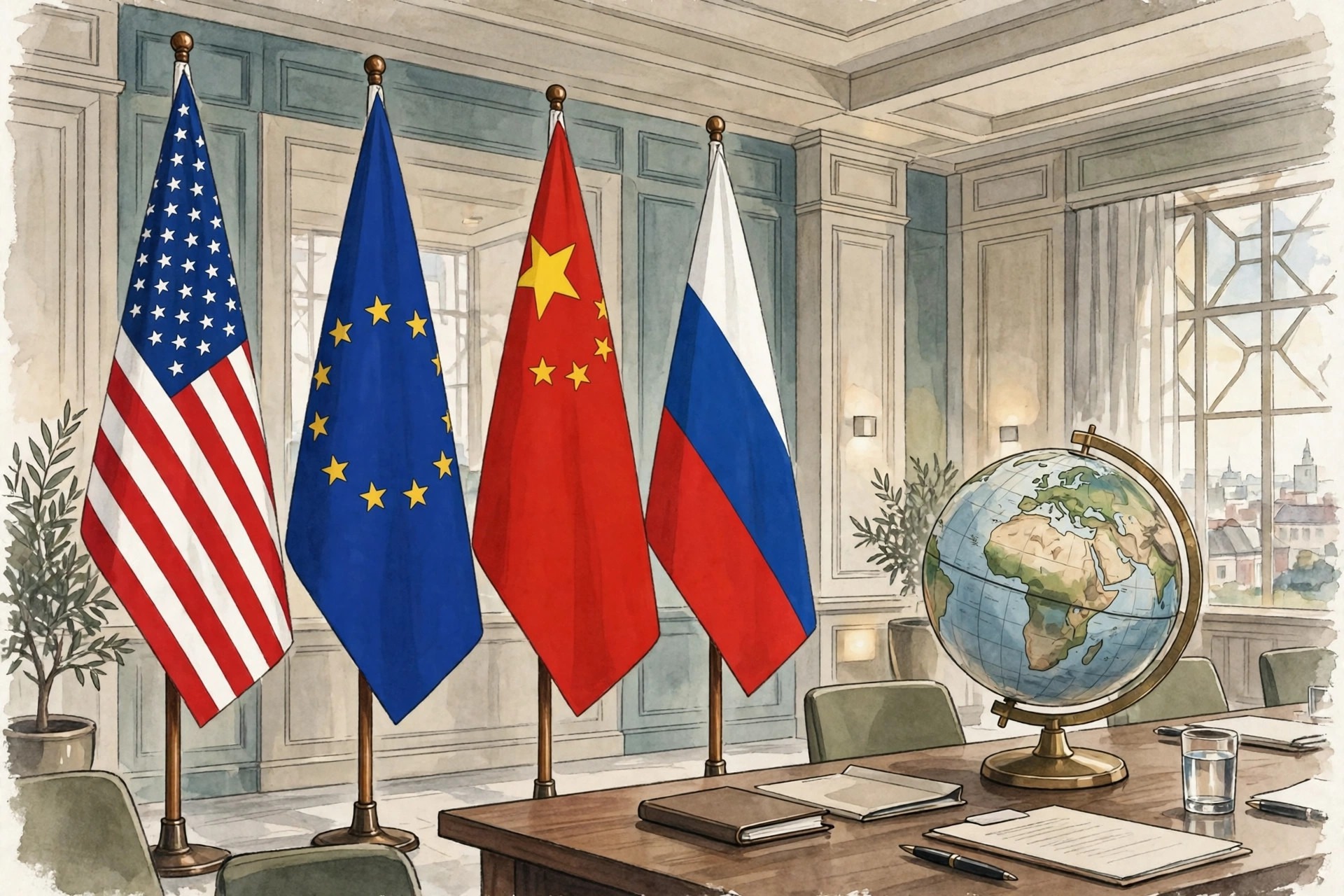
The results of the United States midterm elections were watched as closely abroad as they were at home, and the reactions that poured in on Wednesday showed how much the rest of the world had riding on the outcome. Democrats scored a major victory, taking control of both chambers of Congress in a stinging rebuke of President Donald Trump and his Republican Party, and foreign leaders immediately began to calculate what the new political reality in Washington could mean for their countries. The responses ranged from open celebration in some European capitals to careful silence in others, from a call for cooperation in Beijing to a warning in Moscow that the Democratic Party’s approach to Russia was sharply negative. Together, they form a map of the world’s hopes and fears about the final two years of the Trump presidency.
Foreign leaders often shy away from commenting directly on United States midterm elections, unlike with presidential elections, when the stakes for diplomacy are more obvious. This time, several made public statements anyway, and newspapers around the world gave the results the kind of coverage usually reserved for a change of government. The French newspaper Liberation called the Democratic win une vague bleue, or a blue wave. Britain’s Daily Mail dubbed it a historic blue tsunami. The Times of India ran the headline midterm blues for Trump. The Ukrainian newspaper The Kyiv Independent was hopeful, with the headline: Democrats seize control of Congress in blow to Trump, potential boost for Ukraine. Russia’s state-run daily Rossiyskaya Gazeta took a different view, suggesting that the results would be a blow to Ukraine and warning Brussels to brace itself, because after the Republicans’ defeat, Trump’s anger would fall on Europe.
The reactions matter because the midterm results change the balance of power in Washington, but they do not change who conducts American foreign policy. The president remains in charge of diplomacy, trade, and the armed forces, and Congress’s new majorities can constrain him, investigate him, and block his legislation, but they cannot replace him as the voice of the United States abroad. That is why so many of the reactions were hedged: leaders welcomed the result, but they also made clear that they were not counting on a transformation.
Europe: cautious optimism and a warning to stand on its own feet
In Europe, the dominant note was cautious optimism, mixed with a determination not to depend on Washington. European Parliament Vice President Christel Schaldemose said the results left her cautiously optimistic on Europe’s behalf, not because everything now changes for the better, but because the result could benefit support for Ukraine, the green transition, and relations with the rest of the world. She added, however, that the European Union must continue the course of standing stronger and standing on its own two feet, and that this was not up for debate. The message was that Europe welcomed the Democratic victory, but it was not going to relax its efforts to provide for its own security.
German Chancellor Friedrich Merz suggested that, having lost control of Congress, Trump is likely to bypass it by using executive orders, and said he thinks little will change, because Trump has mostly governed without involving Congress since returning to the White House in 2025 and is likely to continue to do so. Berlin’s Defence Minister Boris Pistorius congratulated the Democratic Party on what he called a historic victory, but reiterated that Europe must continue to raise its game regarding looking after its own security. The two messages, from the chancellor and the defence minister, captured the German position: welcome the result, but prepare for a president who will keep governing on his own.
Elsewhere in Europe, the reactions were more openly celebratory. Spanish Prime Minister Pedro Sanchez said the Democratic victory was emblematic of the unravelling of the global far right, and said American voters had rejected policies promoting hatred, sexism, and climate change denial, arguing that the far-right political wave was losing momentum. Sanchez, who has an acrimonious relationship with Trump, was among the most forthright in his response, and his comments reflected a view held by many on the European left: that the midterm results were not only an American event but a signal for politics everywhere. French Economy Minister Roland Lescure described the Democratic gains as undeniable and said Trump would be left in a weakened position on domestic policy, while French social-democratic politician Raphael Glucksmann called the results a victory of democracy and decency, but warned that Trump retained significant influence over international affairs. In Greece, government spokesman Pavlos Marinakis said United States-Greek relations would not be affected by the election results, and that Greek-American relations would remain strong.
China calls the election a domestic affair
China’s response was the most carefully worded of any major power. Foreign Ministry spokesperson Mao Ning said Beijing would continue its constructive strategic relationship with the United States, stressing that the elections are a domestic affair of the United States. China is willing to work with the United States to safeguard and implement the important consensus reached by the two heads of state, strengthen communication, properly manage differences, and expand cooperation, she told reporters in Beijing. The phrasing was deliberate: it acknowledged the result without endorsing either side, and it signaled that Beijing’s priority is continuity in the relationship with Trump, not a new relationship with Congress.
Japan struck a similar note. Government spokesperson Minoru Kihara said the alliance with Washington remained essential regardless of the election outcome, and that the partnership was vital for global peace and stability, while Tokyo would closely monitor financial markets as the results emerged. South African President Cyril Ramaphosa said the results could usher in a new era in world relations, as his government faces growing trade tensions with Washington. The message from all three was the same: the relationship with the United States matters more than the party that controls Congress, and the priority is to keep it working.
Russia waits and Iran claims a rejection of war
Moscow’s reaction was cautious and skeptical. Kremlin spokesman Dmitry Peskov said Moscow hoped the midterm results would not affect Trump’s peacemaking efforts, and Deputy Foreign Minister Sergey Ryabkov stressed the need to wait for the final results to come into focus, but noted that leaders in the Democratic Party had a sharply negative approach to relations with Moscow. Ryabkov added that Russia’s position on Ukraine and broader foreign policy is not based on short-term considerations and does not depend on the fluctuations of the political barometer in other countries. The message was that Moscow does not expect the Democratic victory to improve relations, and that it is waiting to see what the new Congress actually does.
Tehran read the results very differently. Iranian parliament speaker Mohammad Bagher Ghalibaf, who is also the chief negotiator in talks with the United States, said voters had rejected conflict, writing on X: Americans said NO TO WAR, and we endorse this message. Deputy Parliament Speaker Ali Nikzad described the Republican setback as a consequence of what he called Washington’s failure to pressure Iran through sanctions and economic measures. Iran’s Supreme Leader Mojtaba Khamenei, meanwhile, said partisan shifts in Washington would not alter the United States’ hostility towards Tehran. The three statements, taken together, showed a leadership that sees the election as a rebuke of the war, but does not expect the rebuke to change American policy.
Trump himself has acknowledged that the war with Iran likely affected his party’s performance, saying voters were probably not ready for the short-term consequence of higher gasoline prices. Vice President JD Vance went further, blaming the war directly for the Republican losses. That acknowledgment is one reason the Iranian reaction carries weight: it is not only Tehran’s interpretation of the election, but also, in part, the interpretation of the American vice president.
What the world is really waiting for
For all the statements and headlines, the world’s leaders are, in the end, waiting for the same thing the American public is waiting for: the final results, and the first actions of the new Congress. The size of the Democratic majorities is still not settled, because dozens of races remain uncalled, and the new Congress does not take its seats until January 3. Until then, the reactions are provisional, and the real test will come when the new majorities begin to legislate, to investigate, and to set the terms of the relationship with the White House.
What is already clear is that the world sees the midterm results as a turning point, even if it does not yet know what it is turning toward. Europe sees a chance to rebuild support for Ukraine and for the green transition, but also a reason to keep building its own defenses. China sees a weakened president who is still the only American leader it can deal with. Russia sees a Democratic Party it distrusts, and a president it hopes will keep pursuing his peacemaking efforts. And Iran sees a public that, in its reading, has rejected war. All of them will be watching January 3, and what comes after, with the same attention they gave to November 3.
Sources
USN reviewed reporting from multiple outlets for this story. Read more from Al Jazeera, TRT World and KNKX.