

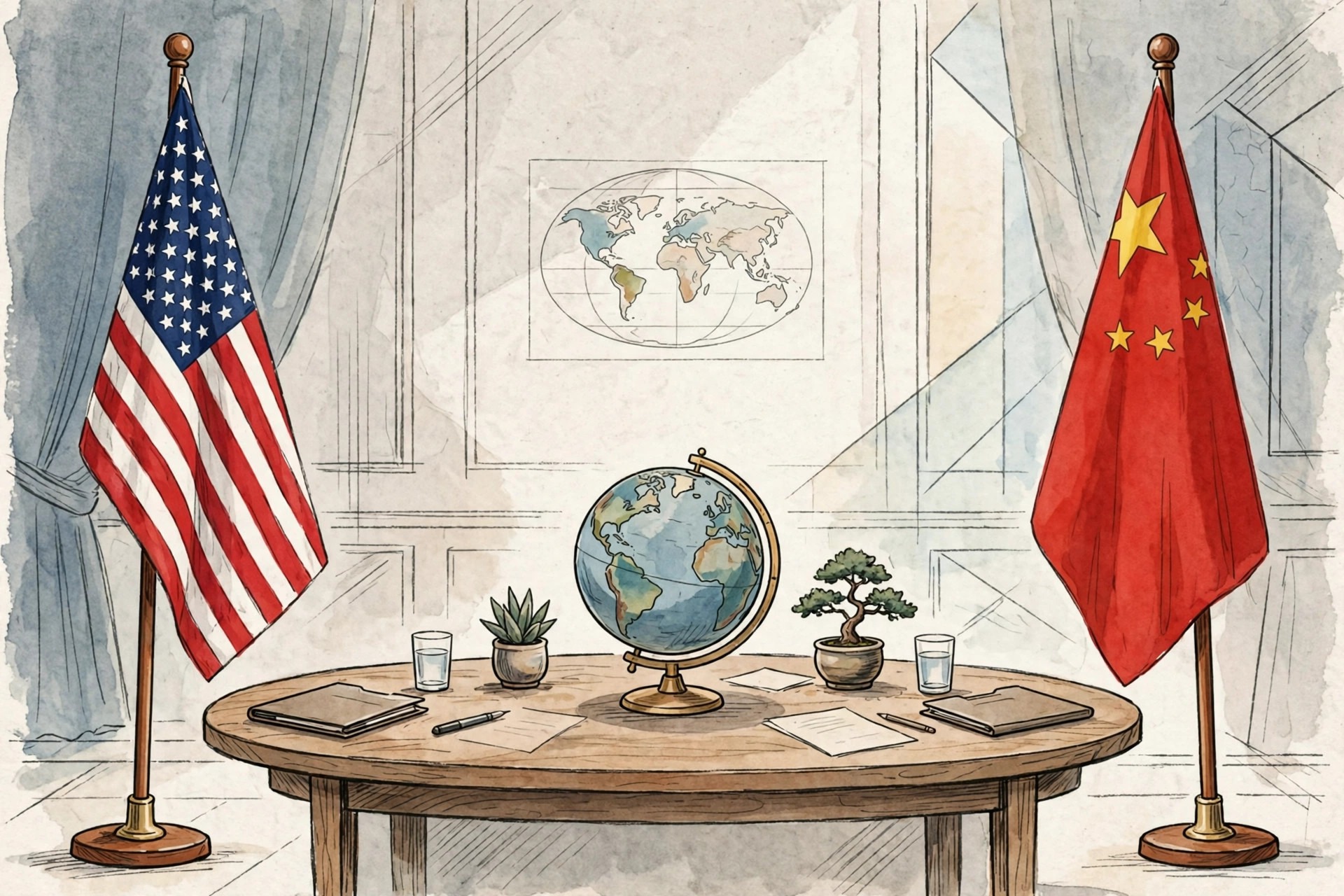
As Chinese internet users pored over the wreckage of the Republican losses in the midterm elections, the hashtag Trump Total Defeat went viral on the microblogging platform Weibo, gathering more than 70 million views by Wednesday evening. The reaction online was gleeful, and it reflected a widespread view in China that the American president had been humiliated by his own voters. Officials in Beijing, however, quickly signaled business as usual. Mao Ning, a spokesperson for China’s Foreign Ministry, described the elections as a United States domestic affair during a regular briefing, while showing faith in advancing the understandings reached by the two heads of state, Donald Trump and Xi Jinping, whose third summit of the year unfolds in about two weeks. The contrast between the online celebration and the official calm captures the central fact about China and the midterms: Beijing sees both an opportunity and a risk in the Democratic victory, and its priority is to manage the relationship with the president, not to celebrate his defeat.
The Democratic sweep presents China with a complicated set of possibilities. Winning control of both houses of Congress puts Democrats in a position to limit Trump’s liberal use of tariffs on Chinese goods during his final two years in office, which could be a potential benefit for Beijing. At the same time, a Democratic-led Congress may lead to more oversight of the administration’s tariff exemptions, enforcement of export controls, and deals involving sensitive semiconductor technology, and it could press for tougher measures on China, including the arms sale to Taiwan that the administration has been holding up. The relationship that emerges will depend on which of those tendencies prevails, and on whether the new Congress and the weakened president find common ground on China, or pull in opposite directions.
The stakes are high because the relationship has been through a bruising period. After Trump’s return to the White House, Beijing endured a sweeping trade war in 2025 that took tariff rates to triple digits. Since then, however, China has stabilized the relationship, ushering in a mutual period of strategic stability that has seen Washington show restraint on chip curbs and on its support for Taiwan. An extension to the trade truce at Xi’s summit with Trump in September, the second of potentially four meetings between the two leaders this year, bought both sides more time, even as a sharp divide remains over issues like Taiwan and the development of artificial intelligence. The midterm results arrive in the middle of that fragile stability, and they could either reinforce it or disrupt it.
Will Democrats limit Trump’s tariffs?
The most immediate question for Beijing is whether the new Congress will limit the president’s ability to use tariffs as a tool in negotiations. Winning control of both houses puts Democrats in a position to curb Trump’s use of tariffs on Chinese products, analysts say, and that could be a significant change. The trade truce between the two countries is scheduled to expire in January, and the question of whether it is extended, renegotiated, or allowed to lapse will be one of the first tests of the new balance of power in Washington.
Wu Xinbo, director of the Institute of International Studies at Fudan University in Shanghai, believes that if the Democratic Party limits the imposition of tariffs, President Trump will be less likely to use tariffs as a tool in negotiations with Beijing. That would reduce one of the main sources of pressure on China, and it would make the relationship more predictable, at least on trade. But the same Democratic majorities that might limit tariffs could also demand more oversight of the exemptions the administration has granted, and of the enforcement of export controls, which could create new friction. As Ben Kostrzewa, an international trade lawyer at Hogan Lovells and a former United States trade official, put it, a Democratic-led Congress may lead to more oversight of the administration’s tariff exemptions, enforcement of export controls, and deals involving sensitive semiconductor technology.
The pending legislation illustrates the point. A series of bills in Congress would tighten United States export curbs on China, and the Match Act, for example, would direct the administration to identify chip equipment and Chinese manufacturing facilities that should be restricted, while pressing allies to adopt controls just as stringent as those faced by United States companies. Two years after Trump swept to victory determined to ratchet up economic confrontation with Beijing, the president is now acting as a restraint on lawmakers with far more hawkish views on China. That reversal is one of the ironies of the midterm results: the president who started the trade war is now the leader Beijing prefers to deal with, because Congress may be tougher than he is.
Taiwan: the issue that could change everything
The issue of Taiwan, the self-governed democratic island claimed by Beijing, could be a game changer, analysts say. Washington is Taipei’s most important security backer and has sold billions of dollars’ worth of arms to Taiwan that the island would use to fend off a potential Chinese attack. But Trump threw the United States stance into question in May when he declared that American arms sales to Taiwan could be a bargaining chip in talks with China, and his administration has since delayed for months a 14 billion dollar batch of weapons. The Trump administration approved a record 14 billion dollar arms package for Taiwan in December last year but has held off on implementation, and Beijing is demanding that the United States halt arms sales to Taiwan.
The new Congress could change that calculation. Democrats have historically been more supportive of Taiwan than the current administration has been, and a Democratic-led Congress may press the administration to proceed with the arms sale, or to take a firmer line on Taiwan more generally. That would be welcomed in Taipei and opposed in Beijing, and it could become one of the first points of tension between the new Congress and the White House on foreign policy. As Neil Shearing, group chief economist at Capital Economics, noted, China could also use the remaining two years of Trump’s presidency to increase pressure on Taiwan, particularly if Beijing judges that Washington is distracted or that Trump would be willing to agree to terms not to intervene.
The Taiwan question is also connected to the broader strategic competition between the two countries, including the development of artificial intelligence and the control of semiconductor technology. The September summit between Xi and Trump did not resolve the major differences over Taiwan and artificial intelligence, but it did extend the trade truce, and it showed that both leaders prefer to manage the competition rather than let it escalate. Whether that preference survives the midterm results will depend on how the new Congress chooses to engage with the issue.
Will Beijing treat Trump as a lame duck?
From China’s perspective, even though Trump has been politically weakened by the midterms, Beijing is unlikely to change its strategy toward working with him, analysts say. Patricia Kim, a foreign policy expert at the Brookings Institution, said Beijing is likely to continue cultivating him through high-profile, leader-to-leader engagement with Xi Jinping, viewing this as the least costly way to manage bilateral relations. Neither Beijing nor Washington appears to expect or seek a fundamental improvement in relations, she added, and the priority for both sides is to maintain dialogue and manage disagreements.
Steve Tsang, director of the China Institute at the School of Oriental and African Studies in London, suggested that Trump’s declining political influence after the election could lead Beijing to increase pressure in negotiations. Trump being relegated to lame-duck status will be used by the Chinese to put more pressure on him, Tsang said, and observers believe the midterm results may create additional domestic political pressure on the Trump administration, even if they are unlikely to lead to fundamental changes in United States policy toward China. The overall stability is sustainable at least until the end of this term, one analyst said, but it is a stability built on managing differences rather than resolving them.
Henry Huiyao Wang, founder of the Center for China and Globalization think tank in Beijing, described the situation as a new equilibrium, and said this new equilibrium will force both sides to work together. After a bruising standoff over almost 10 years of trade wars, the two countries have reached a point where neither can afford a complete breakdown, and both have an interest in keeping the relationship functioning. The midterm results do not change that basic fact, but they do change the politics around it, and they introduce a new actor, the Democratic Congress, into a relationship that has been managed, for the past two years, almost entirely by the two presidents.
The summit and the months ahead
The next test comes in about two weeks, when Trump and Xi meet for their third summit of the year. The meeting will be the first high-level contact between the two leaders since the midterm elections, and it will show whether the personal relationship between the two presidents can survive the change in the political landscape. Beijing has made clear that it wants to safeguard and implement the important consensus reached by the two heads of state, and to build a constructive strategic relationship based on mutual respect, peaceful coexistence, and mutually beneficial cooperation. Whether that language translates into concrete agreements on trade, Taiwan, and technology will depend on the negotiations that take place in the weeks ahead.
For now, the message from Beijing is one of continuity. The elections are a domestic affair, the relationship with Trump remains the priority, and the goal is to expand cooperation and manage differences. The message from the Chinese internet is different: a celebration of the president’s defeat, and a sense that the tide is turning against him. Both messages are true, in their own way, and the tension between them will shape the relationship for the next two years. The midterm results have not settled the future of United States-China relations. They have made it more complicated, and more interesting, than it was before.
Sources
USN reviewed reporting from multiple outlets for this story. Read more from NDTV, Free Malaysia Today and The Economic Times.