

President Donald Trump confirmed on Friday, November 6, 2026, that United States forces had carried out new strikes against an Iranian air defense system on Qeshm Island, a large island in the Strait of Hormuz, in the latest direct military action in a conflict that began in late February 2026. Trump described the operation as limited in scale, calling the strikes minor, and said the targeted system had been knocked out in about fifteen minutes, perhaps five. The announcement, made in public remarks by the president, added a fresh and fast-moving chapter to a confrontation that has already produced repeated exchanges between Washington and Tehran, and it immediately raised questions about how Iran would respond, whether the fighting would spread beyond the island, and whether the parallel diplomatic track that both sides have kept open could survive another round of violence.
Qeshm Island sits in one of the most strategically sensitive stretches of water in the world. The island lies in the Strait of Hormuz, the narrow channel through which a large share of the world’s seaborne oil and liquefied natural gas passes every day, and any military action there carries consequences far beyond the immediate target. An air defense system on Qeshm would be part of the network Iran uses to watch and, in principle, to challenge aircraft operating near the strait, and its destruction, even if limited to a single site, would be read in Tehran as a deliberate American decision to degrade that network rather than as an accident or a warning shot. For shipping companies, energy markets and governments across the region, the location matters almost as much as the weapon used, because a clash in the strait can disrupt trade, push up insurance costs and force navies to raise their readiness even when neither side says it wants a wider war.
What Trump Said About the Qeshm Island Strike
Trump’s account of the operation was brief and characteristically confident. He said American forces had struck an Iranian air defense system on Qeshm Island and that the system had been put out of action quickly, in about fifteen minutes, or perhaps five. He did not, in the remarks reported so far, provide a detailed public account of which aircraft or weapons were used, how many munitions were fired, or whether American personnel had been at risk at any point during the mission. The emphasis in his description was on speed and on the limited nature of the target: a single defensive system, struck and disabled, rather than a broad attack on Iranian forces, cities or infrastructure. That framing matters, because it suggests the White House wanted the operation to be understood as a contained and purposeful act, not as the opening of a new and open-ended bombing campaign.
The description also leaves important questions unanswered, and those gaps are part of the story. A claim that a system was knocked out in minutes is difficult for outside observers to verify independently, because the site is on Iranian territory and neither side has published detailed damage imagery in the public domain at the time of writing. Military analysts will look for satellite images, for changes in Iranian air defense activity around the strait, and for any further American statements that add detail, but in the first hours after such an operation the public record usually consists of the president’s words, the statements of Iranian state media, and the careful language of the American military command responsible for the region. Readers should therefore treat the precise timeline and the full extent of the damage as claims that have not yet been independently confirmed, even while the central fact, that the United States says it struck the system, is clear.
What Iran Says Happened on Qeshm Island
Iranian state media reported explosions and missile impacts in the Suza area of Qeshm Island, and the reports described two impacts in that part of the island. Suza is a town on the southern side of Qeshm, and the mention of a specific place gave the Iranian account a concrete geography that matched, in broad terms, the American claim that a strike had taken place on the island. The Iranian reports did not, in the material reviewed for this article, offer a full independent assessment of what had been destroyed, and they framed the event through the lens of Iranian state media, which routinely presents American military action as aggression and Iranian responses as defensive. That framing does not by itself settle what happened on the ground, but it does show that Tehran was not denying that something had happened on Qeshm, even as it disputed the American version of events.
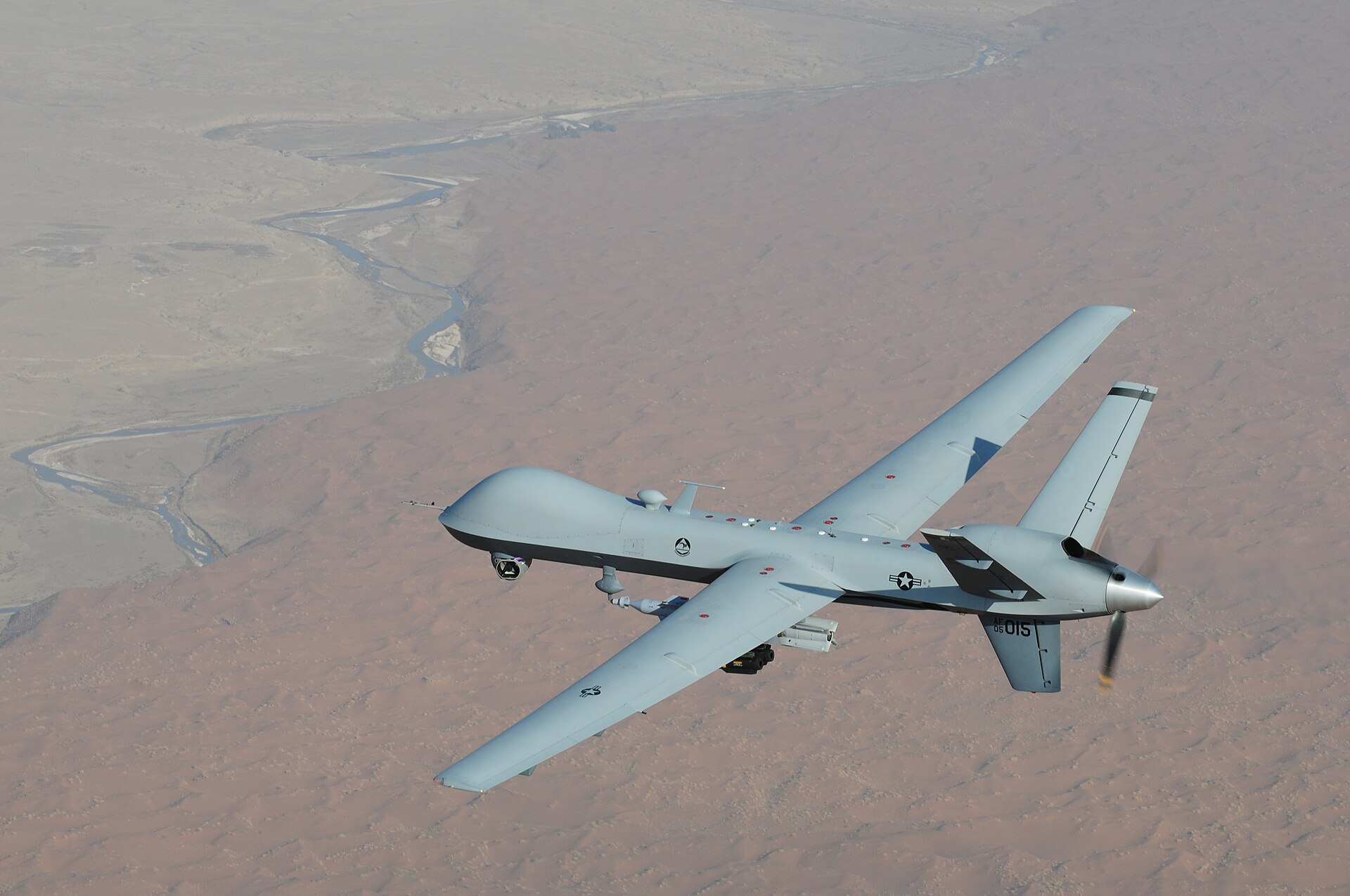
Separately, the Islamic Republic of Iran Broadcasting organisation, known as IRIB, carried a statement from the Iranian army claiming that an MQ-9 drone had been intercepted and destroyed over Qeshm. The MQ-9 is a large American remotely piloted aircraft used for surveillance and for strikes, and it has been a frequent presence in the skies over the Middle East. If an American drone had indeed been shot down, it would be a significant Iranian claim, because it would suggest that Iranian air defenses were able to respond to American aircraft even as the United States said it was destroying one of those defenses. The United States has not confirmed any loss of a drone in connection with this operation, and no American official statement reviewed for this article acknowledges that an MQ-9 was downed. The drone claim must therefore be reported as an Iranian claim, not as an established fact, and readers should wait for any American confirmation, wreckage evidence or independent verification before treating it as proven.
The Strait of Hormuz at the Centre of the Latest US Strikes on Iran
The choice of Qeshm Island as the location is inseparable from the geography of the Strait of Hormuz. The strait is only about thirty-three kilometres wide at its narrowest point, and the shipping lanes that pass through it carry oil from Saudi Arabia, Iraq, Kuwait, the United Arab Emirates and Qatar to markets in Asia, Europe and beyond. Iran has long argued that its position on the northern shore of the strait gives it leverage in any confrontation, and it has at various times threatened to close or disrupt the waterway, a step that would have immediate global economic consequences. The United States, for its part, has long maintained a naval presence in the region precisely to keep the strait open, and American officials have repeatedly said that freedom of navigation there is a core interest that Washington will defend.
An air defense system on Qeshm therefore sits at the intersection of two competing logics. From Tehran’s point of view, the system is part of the protection of Iranian territory and of the strait’s northern shore, and an attack on it is an attack on Iranian sovereignty. From Washington’s point of view, the system is part of a military capability that could threaten American aircraft and ships operating in international waters and airspace near the strait, and striking it can be presented as a defensive measure to protect American forces. Both sides can describe the same event in opposite terms, and that is why the language used by each side matters so much. Trump called the strikes minor, a word that downplays their scale. Iranian officials, by contrast, are likely to describe any strike on their territory as a serious escalation, whatever the size of the target. The gap between those two descriptions is where the risk of miscalculation lies.
From the 2 November Strikes to the 6 November Operation
The November 6 operation did not come out of nowhere. Just four days earlier, on Monday, November 2, the United States carried out what it described as defensive strikes on Qeshm Island, an earlier round of action that was reported at the time as a response to a threat to American forces. That earlier operation is important background, because it shows that Qeshm had already become a focal point of the conflict before Friday’s strike, and that both sides had already been operating in a pattern of action and response around the island. The November 6 strike can therefore be understood as a continuation of that pattern rather than as a wholly new departure, even though it was a new and separate operation with its own target and its own timing.
The wider context is a war that began on February 28, 2026, and that has now run for more than eight months. Over that period the conflict has moved through phases of intense fighting, pauses, diplomatic contacts and renewed strikes, and neither side has achieved a decisive outcome that would end the confrontation. The United States has used its air and naval power to strike Iranian military targets, while Iran has used its missile forces, its regional allies and its threats to shipping to try to impose costs on Washington and its partners. The result has been a grinding and dangerous conflict in which each new strike carries the risk of escalation, and in which both governments have repeatedly said they do not want a wider war while continuing to take military action. For background on the warnings that preceded this latest round, see Washington warns allies of possible new Iran strikes as Vance sends Tehran a quiet letter.
Iran’s Vow of Retaliation and the Question of Limits
Iran’s response to the latest strike was swift and uncompromising in tone. On November 7, an Iranian army spokesperson, Mohammad Akraminia, said Iran would retaliate and that there would be no geographical limits to that retaliation. The phrase was deliberately broad: it suggested that Iran would not confine any response to Qeshm Island or to the immediate area of the strike, and that American forces, bases or interests elsewhere in the region could be considered legitimate targets. Such language is a familiar part of Iranian public messaging after American strikes, and it serves more than one purpose. It signals resolve to a domestic audience, it warns the United States and its allies that further action will carry costs, and it leaves Tehran with flexibility about what, if anything, it actually does next.
At the same time, the gap between a vow of retaliation and an actual retaliatory strike is often wide, and history suggests that Iran’s leadership weighs its options carefully before acting. A direct and large-scale attack on American forces would risk a much larger American response, and Iranian leaders know that the United States retains overwhelming air and naval power in the region. A more limited response, such as a strike on a less sensitive target, an action through an allied group, or a cyber operation, would allow Tehran to claim it had answered the attack without inviting a full-scale escalation. The United States Central Command, known as CENTCOM, described the situation as relatively calm in the aftermath of the strike, a phrase that suggests American commanders did not, at that point, see signs of an imminent large Iranian attack. That assessment may change quickly, and it should be read as a snapshot of the moment rather than as a guarantee that the coming days will remain quiet.
Diplomacy in Parallel: Qatar Mediation and Talk of a Deal
Even as the two sides exchange strikes and threats, a diplomatic track continues to run in parallel, and Qatar has been playing a central role as a mediator. Qatari officials have been passing proposals between Washington and Tehran on the future of Iran’s nuclear programme, the issue that has driven much of the confrontation. The details of the latest proposals have not been made public, and it is not clear how far apart the two sides remain on the core questions: the level of uranium enrichment Iran would be allowed to keep, the scope of international inspections, and the lifting of sanctions that have crippled the Iranian economy. What is clear is that both sides have kept the channel open even while fighting, which suggests that neither government has fully abandoned the idea of a negotiated outcome.
Trump has said that Tehran wants a deal and that talks are progressing, a claim that should be read with care. American presidents in the middle of a military confrontation often describe negotiations as moving forward, both to reassure allies and markets and to put pressure on the other side to engage. Iranian officials, for their part, have at times spoken positively about diplomacy while also insisting that they will not negotiate under military pressure. The tension between those two positions is one of the central difficulties of the current moment: the United States is using military force to try to strengthen its negotiating position, while Iran is using the threat of retaliation and its nuclear programme to try to do the same. Whether the Qatari mediation can bridge that gap, and whether the latest strike helps or harms the chances of a deal, will only become clear in the days and weeks ahead.
What Happens Next
The immediate question is whether Iran will carry out the retaliation it has threatened, and if so, in what form and on what scale. American forces across the Middle East will be on heightened alert, and allies in the Gulf will be watching closely for any sign of missile launches, drone activity or disruption to shipping in the strait. A second question is whether the United States will carry out further strikes, either in response to any Iranian retaliation or as part of a continuing campaign against Iranian air defenses. A third question is whether the diplomatic track can produce a pause, even a temporary one, that would allow both sides to step back from the cycle of strike and counter-strike. None of those questions has a certain answer, and the history of this conflict suggests that the next move could come from either side with little warning.
For the people who live on Qeshm Island and in the wider region, the stakes are immediate and human. Qeshm is home to fishing communities, traders and families who have lived with the shadow of conflict for months, and each new strike brings fear, disruption and economic hardship, whatever its military purpose. For the wider world, the stakes are economic and strategic: the price of oil, the safety of shipping, and the stability of a region that has already endured years of war. The November 6 strike was described by the American president as minor, but in a conflict that has already lasted more than eight months, even a minor strike can have major consequences, and the coming days will show whether this latest operation was a contained act or another step toward a wider war.
Sources
USN reviewed reporting from multiple outlets for this story. Read more from Al Jazeera, Siasat and Daily Inference.