

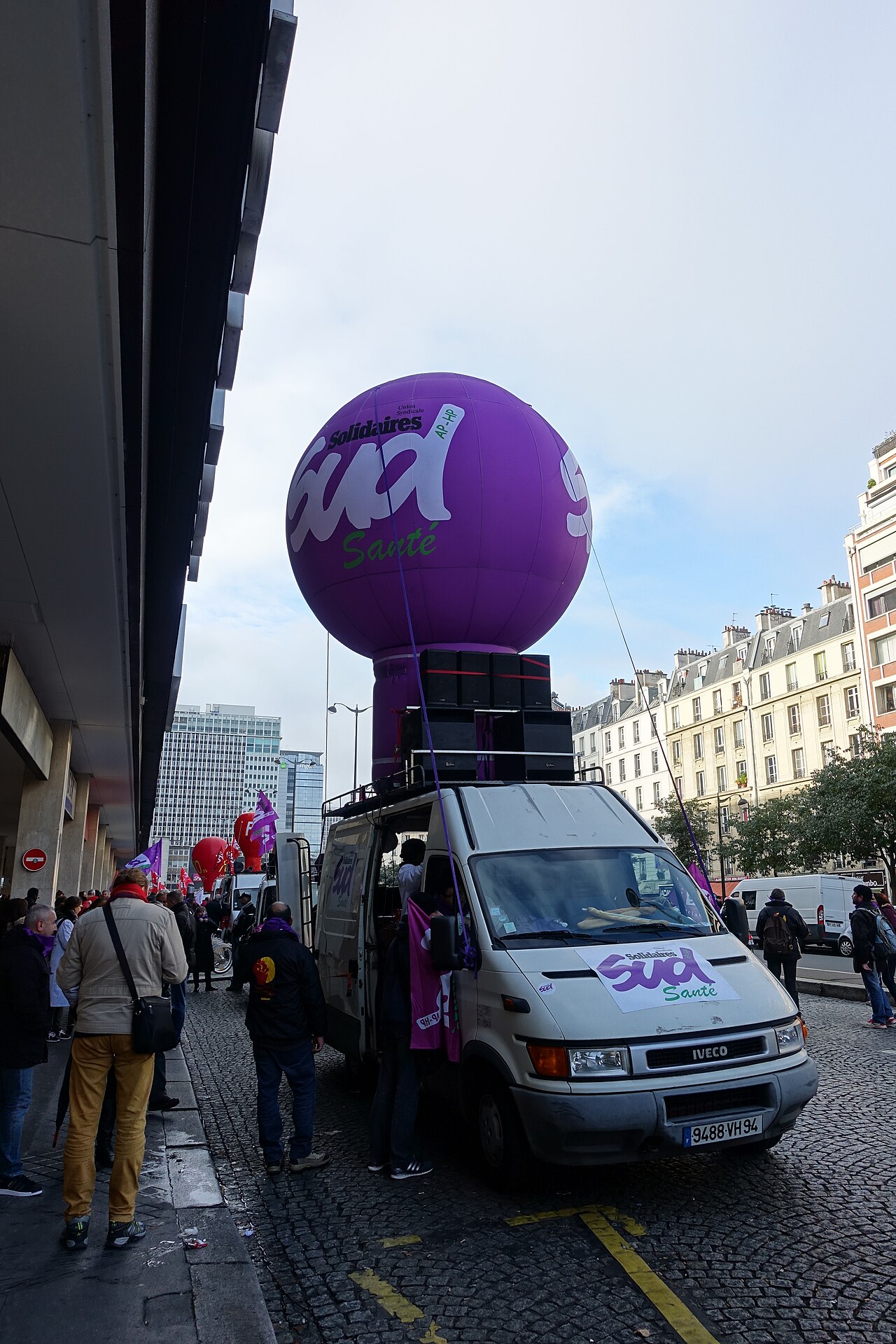
Nearly 600,000 people took part in demonstrations across France on Thursday 5 November, according to a provisional estimate from the Interior Ministry, in the biggest turnout yet of the cost-of-living protest movement that has been building through the autumn. Trade unions organised roughly 260 rallies around the country, and strikes by teachers, rail workers, hospital staff, postal workers, air traffic controllers and some energy workers disrupted schools, transport and public services. The marches were largely peaceful, but clashes broke out in Paris and Lyon, with police firing tear gas as violence and vandalism broke out in some cities. By the end of the day, 448 people had been arrested and 53 police officers were injured.
The turnout figure is itself contested, as such figures always are in France. The Interior Ministry’s final figure was 575,000, close to its provisional estimate of nearly 600,000. The CGT trade union confederation, the country’s largest, claimed nearly 1.6 million protesters took part nationwide. The gap between the official count and the union claim is wide — nearly threefold — and it reflects the familiar politics of counting crowds in France, where the authorities and the unions have long produced very different numbers for the same demonstrations. Both figures should be reported as what they are: the Interior Ministry’s 575,000 to 600,000 is the official figure, and the CGT’s 1.6 million is the union claim. Neither should be presented as the only count.
The protest movement is about the cost of living. The unions demand higher wages for all workers, a 10 percent rise in the minimum wage, tax reform, better funding for education and improved pensions, and help with rising fuel, food and energy costs. The demands are broad, but they share a single theme: that ordinary households are being squeezed, and that the government should act to raise incomes and ease the pressure on family budgets. The strikes on Thursday were the movement’s largest mobilisation so far, and the unions have described the day as a demonstration of its strength.
The day also drew a response from the government. Prime Minister Sébastien Lecornu announced a “social conference” with trade unions and employers’ organisations at Matignon on Monday 9 November — a meeting that the unions will attend with their demands on the table. The conference is the government’s answer to the protests: a negotiation, rather than a concession, and one whose outcome will determine whether the movement escalates or subsides. The protests come as France, the eurozone’s second-largest economy, battles to redress its finances, with the government trying to pass a belt-tightening budget through a divided parliament.
France strikes November 2026: the turnout in dispute
The question of how many people marched on Thursday is the first fact of the story, and it is also the most contested. The Interior Ministry’s provisional estimate was nearly 600,000 demonstrators across France, and its final figure was 575,000. The CGT claimed nearly 1.6 million. Both numbers describe the same day, the same marches, the same crowds — and they differ by a factor of almost three.
The discrepancy is not new, and it is not a matter of error. The Interior Ministry counts protesters using police estimates at each demonstration, a method that has consistently produced lower figures than the unions’ own counts, which are based on the organisers’ estimates at the head of each march. The two methods measure different things, and the gap between them has been a feature of French protest politics for decades. What matters for the record is that both figures are reported, with their sources, and that neither is presented as the definitive count.
What is not in dispute is that Thursday’s turnout was the largest since the protest movement began. The Interior Ministry’s own figure — 575,000 in the final count, nearly 600,000 in the provisional estimate — is higher than the turnout at any previous demonstration in this movement, and the unions’ claim of 1.6 million is likewise their highest figure so far. By either measure, the movement grew on Thursday, and the growth is the story: a protest that began in the autumn has, by November, become the largest street mobilisation in France this year.
The scale of the mobilisation was visible in the number of rallies: roughly 260 around the country, from the large marches in Paris and Lyon to smaller demonstrations in towns and cities across France. The breadth of the turnout — not just the size of the Paris march, but the number of places where people took to the streets — is what the unions point to as evidence that the movement is national rather than metropolitan, and that the cost-of-living grievance is felt across the country rather than only in the capital.
Who marched and who struck
The strikes on Thursday cut across the public sector and parts of the private sector. Teachers, rail workers, hospital staff, postal workers, air traffic controllers and some energy workers all took part, and the disruption was felt in schools, on the railways, in hospitals and in the skies. The Education Ministry said nearly 16 percent of teachers were on strike on Thursday, and schools and universities were disrupted across the country. The strike also contributed to a reduction in France’s nuclear output early on Thursday, as energy workers joined the action.
The breadth of the strike is significant, because it reflects the breadth of the unions’ demands. The call for higher wages and a 10 percent rise in the minimum wage speaks to workers across the economy; the demand for better funding for education speaks to teachers and to the students and parents who depend on schools; the demand for improved pensions speaks to older workers and to retirees. The movement is not a single-sector dispute but a general mobilisation around the cost of living, and the range of workers who struck on Thursday is the evidence of that.
CGT Secretary-General Sophie Binet called the strike “extremely effective” and called on the government to respond to workers’ demands. Binet’s assessment is, of course, the view of the movement’s largest union, and it should be read as such. But the figures support the claim in at least one respect: the turnout was the largest of the movement so far, the strikes disrupted services across the country, and the government responded within hours with the announcement of the social conference. Whether the strike was “extremely effective” in the sense of forcing concessions is a question that the conference on Monday will begin to answer.
The unrest also has a longer history than Thursday’s marches. It follows a high-school student movement that began in mid-September over education conditions, funding and staffing, which culminated on 17 October in the worst rioting France has seen in years. The student movement and the trade union movement are distinct — one led by school students, the other by the unions — but they share grievances about education funding and about the conditions in which young people live and learn. The October rioting is the backdrop against which Thursday’s largely peaceful marches should be understood: the government and the police were prepared for violence, and the deployment of 70,000 officers reflects that preparation.
What the unions want
The unions’ demands are specific, and they are worth setting out in full, because they are the substance of the dispute. They want higher wages for all workers, a 10 percent rise in the minimum wage, tax reform, better funding for education and improved pensions, and help with rising fuel, food and energy costs. Each of those demands addresses a different part of the household budget, and together they describe a programme for raising incomes and easing the pressure on living standards.
The 10 percent rise in the minimum wage is the most concrete of the demands, and the one that would have the most direct effect on the lowest-paid workers. A rise of that size would be a significant intervention in the labour market, and it is the demand that the government is least likely to grant in full. But it is also the demand that best captures the movement’s argument: that wages have not kept pace with prices, and that the state should act to close the gap.
Tax reform is the most open-ended of the demands, and it is the one that speaks most directly to the government’s budget. France is trying to pass a belt-tightening budget through a divided parliament, and the unions’ call for tax reform is, in part, a call for the burden of that budget to fall differently — on higher earners and on wealth, rather than on public services and on ordinary households. The demand for better funding for education and for improved pensions follows the same logic: that the budget should protect services and incomes rather than cut them.
The help with fuel, food and energy costs is the most immediate of the demands, and the one that speaks most directly to the daily experience of the cost of living. Prices for fuel, food and energy have risen sharply in recent years, and the unions argue that the government should act to cushion households against those rises — through price measures, through subsidies, or through the wage increases that would allow households to absorb them. The demand is a reminder that the protest movement is not, at its heart, about an abstract programme, but about the price of filling a tank, heating a home and feeding a family.
Clashes, arrests and injuries
The marches on Thursday were largely peaceful, but the day was not without violence. Clashes broke out in Paris and Lyon, with police firing tear gas as violence and vandalism broke out in some cities. By the end of the day, 448 people had been arrested and 53 police officers were injured. About 70,000 police were deployed nationwide, with armoured vehicles, drones and helicopters — a deployment that reflects both the scale of the demonstrations and the government’s expectation of trouble.
The violence was concentrated in the largest cities, and it was the familiar pattern of French demonstrations: a largely peaceful march, with a fringe of participants engaging in vandalism and clashes with the police. The use of tear gas in Paris and Lyon, and the number of arrests, are the measures of how far the violence went. The 53 injured officers are the measure of its cost to the police, and the 448 arrests are the measure of the police response.
The deployment of 70,000 officers is itself a story. It is a very large number — roughly one officer for every eight or nine protesters, on the official count — and it reflects the government’s determination to prevent a repeat of the rioting of 17 October, when the student movement culminated in the worst unrest France has seen in years. The armoured vehicles, drones and helicopters are the visible signs of that determination, and they are also a reminder that the French state treats large demonstrations as a security operation as well as a democratic right.
It is important to keep the violence in proportion. The marches were largely peaceful, and the clashes were confined to parts of Paris and Lyon and to some other cities. The great majority of the 575,000 to 600,000 people who marched — or the 1.6 million, on the union count — did so peacefully, and the day’s significance lies in the scale of the peaceful mobilisation rather than in the violence at its edges. But the violence matters too, because it shapes the public perception of the movement and the government’s response to it, and because the arrests and injuries are the facts that will be cited by both sides in the days ahead.
The government’s answer and the road ahead
Prime Minister Sébastien Lecornu’s announcement of a “social conference” with trade unions and employers’ organisations at Matignon on Monday 9 November is the government’s direct response to the protests. A social conference is a formal negotiation — a meeting at the prime minister’s residence, with the unions and the employers on either side of the table, and the government’s budget and labour policy on the agenda. It is not a concession, and it is not a rejection. It is an invitation to talk, and its outcome will depend on what the government is prepared to offer and what the unions are prepared to accept.
The conference comes at a difficult moment for the government. France, the eurozone’s second-largest economy, is battling to redress its finances, and the government is trying to pass a belt-tightening budget through a divided parliament. The unions’ demands — higher wages, a 10 percent rise in the minimum wage, tax reform, better funding for education, improved pensions — all cost money, and the government is under pressure to spend less, not more. The tension between the demands and the budget is the central difficulty of the conference, and it is the reason the outcome is uncertain.
The political calendar adds to the pressure. The demonstrations come about five to six months ahead of elections to replace President Emmanuel Macron, who cannot run again, with the far right leading in opinion polls. The election is next year, and the cost-of-living protests are taking place in the shadow of a campaign that has not yet formally begun. The far right’s lead in the polls is the context in which the government and the unions are both operating: the government is anxious not to be seen as indifferent to the cost of living, and the unions are anxious to show that they can deliver for their members before the election reshapes the political landscape.
The movement’s future will be decided, in part, by what happens on Monday. If the social conference produces concrete offers — on wages, on the minimum wage, on education funding or on pensions — the unions may be able to claim a victory and the movement may subside. If it produces only a promise of further talks, the unions may call for further action, and the turnout on Thursday — the largest so far — suggests that they have the capacity to mobilise again. The protest movement has grown through the autumn, from the student demonstrations of September to the rioting of October to the mass marches of November. Thursday was its largest day yet. Whether it grows further, or whether the conference brings it to a close, is the question that Monday will begin to answer.
Sources
USN reviewed reporting from multiple outlets for this story. Read more from Dawn, Tribune Pakistan and Astro Awani.