

By Farhan Khan, November 8, 2026
Six people were killed and at least 15 wounded when a gunman opened fire in Krakow’s Main Market Square on Saturday 7 November, in Poland’s deadliest shooting since the fall of communism in 1989.
The attack happened at about 3 p.m. local time, 2 p.m. GMT, in the historic centre of Poland’s second city. The gunman drove a car onto the square and fired at random people. Police shot and wounded him in a gunfight a short distance away.
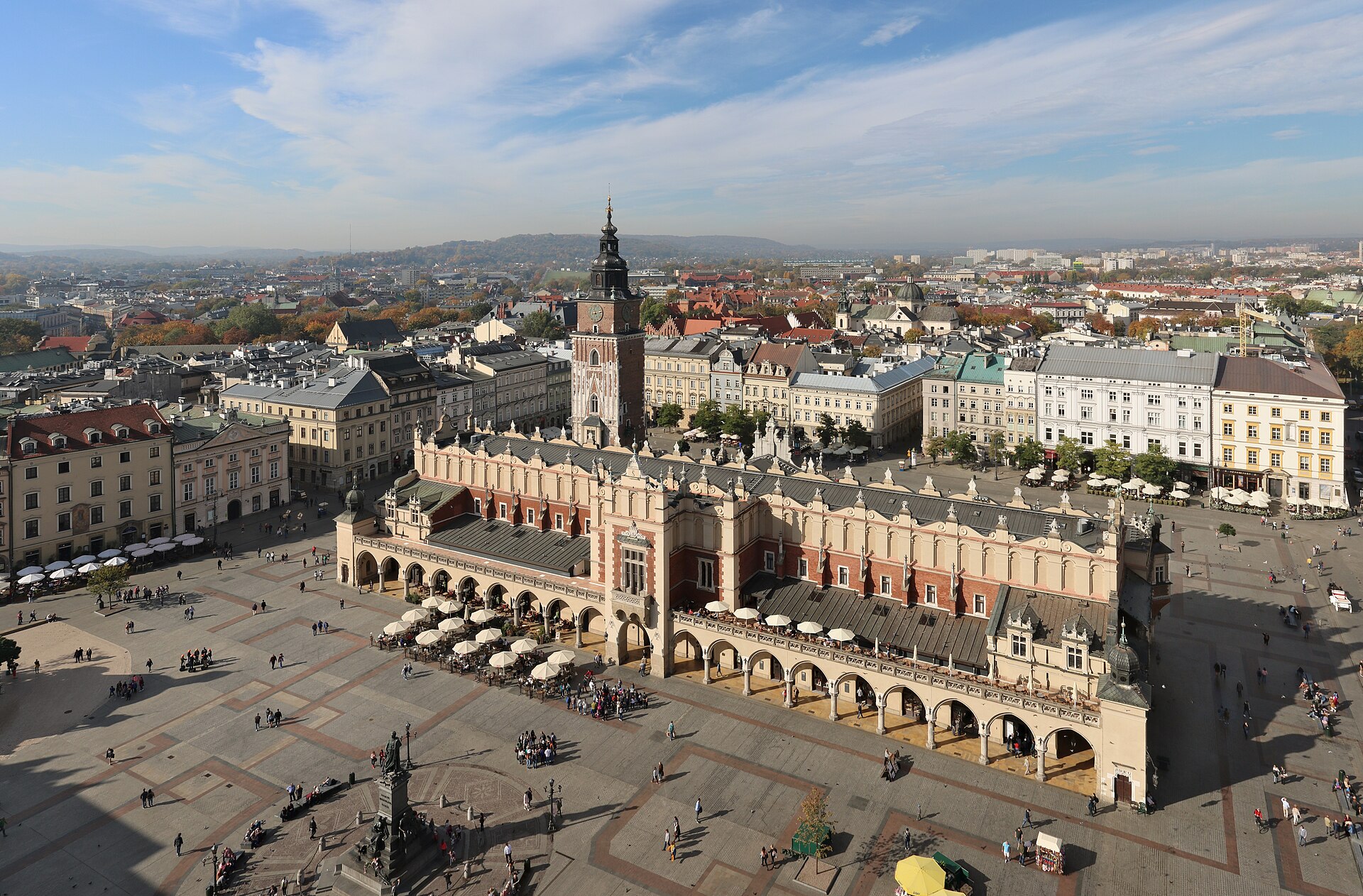
Krakow’s Main Market Square, known in Polish as Rynek Glowny, is one of the largest medieval squares in Europe. Surrounded by historic buildings, cafes and shops, it sits at the heart of the city’s historic centre. On a Saturday afternoon it would have been crowded with tourists and local residents.
Krakow receives about 15 to 16.2 million visitors a year, and the square is one of the first places many of them visit.
Krakow Market Square shooting: six killed, wounded count updated
The six people killed in the square were four women and two men. Among the dead was a British national, according to police chief Marek Boron.
The wounded figure changed during the evening as more information became available. At first, 15 people were reported wounded. That was later updated to 16 wounded, with 13 of the 16 taken to hospital with serious injuries. Two police officers were wounded, one seriously.
Different outlets reported slightly different figures: 15 in the first count from the AFP, 16 in the later Associated Press reporting, and 17 including two police officers and the assailant in one outlet.
Five foreigners were among the wounded, from Austria, Britain, Germany, Portugal, and Russia.
The suspect, the gunfight, and three bodies at his home
The suspect is a Polish citizen. His age was first given as 24 and then corrected to 25 during the day. He was born in 2002.
He was wearing military-style fatigues and a bulletproof vest when he carried out the attack. He used a military-type long gun, described as an AR-15-style semi-automatic rifle. More weapons and ammunition were found in his car.
Police have said he acted alone. There is no indication in the reporting that he had an accomplice.
After the shooting, he was taken to hospital for surgery and is in critical condition, in custody. He has not yet been questioned in detail, and the investigation into his motives and his background is at an early stage.
The gunman also shot two horses pulling tourist carriages in the square. Both horses are alive, one grazed and one hit in the leg.
Three more bodies were later found at the suspect’s home in Ostrowiec Swietokrzyski, about 150 to 160 kilometres northeast of Krakow. Police are investigating that discovery alongside the shooting.
The three were two women and a man, later identified by regional police as the suspect’s parents — a 53-year-old man and a 52-year-old woman — and his 21-year-old sister.
Those three deaths are not part of the six killed in the square. The two figures are not a single toll of nine. The three deaths at the home are separate deaths, under investigation, and the circumstances of those deaths have not yet been established in the reporting.
The suspect was named in some media as “Michal O.” That name is not confirmed in the verified AP and AFP reporting.
Far-right views: what ministers said, and what is preliminary
Interior Minister Marcin Kierwinski said the gunman was “fascinated by far-right ideologies” and held “very radical” and “ultra-nationalist” views. Defence Minister Wladyslaw Kosiniak-Kamysz called the attack an “act of terror”, and Prime Minister Donald Tusk also called it terrorism.
Those are the most direct indications so far of how the attack is being understood. They are not, on their own, a formal finding of motive by the police.
The motive is preliminary. The ministers’ descriptions are characterisations based on the information available to the government in the hours after the attack, and they may be refined or revised as the investigation continues.
Prime Minister Tusk praised the police who responded to the attack, and President Karol Nawrocki said he awaited “a full explanation” of what had happened. Both statements were made on X.
National mourning in Poland after a rare attack
Tusk announced two days of national mourning, on 8–9 November. The mayor of Krakow, Lukasz Gibala, put the city in mourning until Wednesday. National mourning in Poland involves the lowering of flags, the cancellation or postponement of public events, and a period of public reflection on the loss of life.
The attack has shocked Poland, where mass shootings are rare. The country has about 411,000 gun-permit holders in a population of 37 million, and more than 50,000 new licences were issued in 2025. Gun ownership is not uncommon. The use of a gun to kill multiple people in a public place is, by the standards of Polish crime, an exceptional event.
For Krakow itself, the attack is a blow to a city that depends on tourism and takes pride in its historic centre. The Main Market Square is not only a tourist attraction; it is the place where the city’s residents meet, shop, and celebrate.
Sources: The Week, Malay Mail, Dawn