

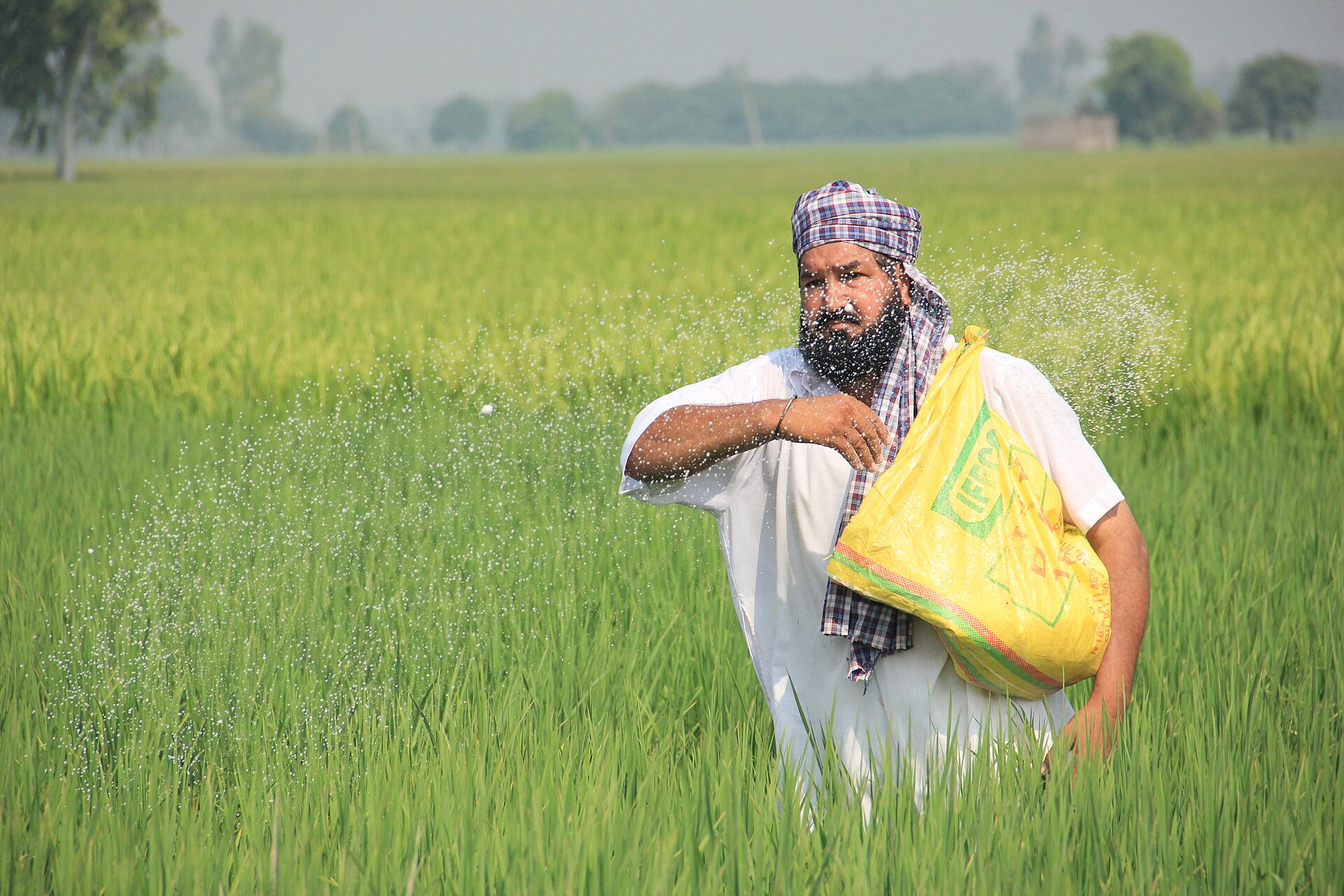
The Union Cabinet on 11 November 2026 approved a fertiliser subsidy package of Rs 62,370.02 crore for the Rabi season 2026-27, in one of the largest seasonal farm-input decisions the government has taken in recent years. The approval covers phosphatic and potassic fertilisers, the nutrients that wheat, mustard, chickpea and other winter crops depend on most, and it applies to the six months from 1 October 2026 to 31 March 2027. The Cabinet, chaired by Prime Minister Narendra Modi, cleared the proposal at a meeting on Wednesday, and Information and Broadcasting Minister Ashwini Vaishnaw announced the decision to reporters afterwards.
The headline figure is striking because of how sharply it has risen. The tentative budgetary requirement of Rs 62,370.02 crore is about Rs 24,417.73 crore higher than the Rs 37,952.29 crore required for the Rabi season of 2025-26, an increase of roughly 64 per cent in a single year. In dollar terms, the allocation amounts to 623.70 billion rupees, or about 6.65 billion dollars, and it is 244.2 billion rupees above the 379.5 billion rupees that had been budgeted for the period. The government says the extra money is needed because international prices of fertilisers and their raw materials have climbed steeply, and it has chosen to absorb that increase itself rather than pass it on to farmers in the middle of the sowing season.
For farmers, the most immediate consequence is the price they will pay at the shop. The government has said that a 50-kilogram bag of di-ammonium phosphate, universally known as DAP, will continue to cost Rs 1,350, the same price as before, even though the cost of producing and importing it has risen sharply. That single assurance matters more to a wheat grower in Punjab or a mustard farmer in Rajasthan than any budget figure, because DAP is the fertiliser most Rabi farmers buy first, and it is usually applied at sowing time, when there is no room to wait for prices to fall.
What the Cabinet approved
The decision taken on 11 November was to fix the Nutrient Based Subsidy rates for the Rabi season 2026-27 on phosphatic and potassic fertilisers, known as P&K fertilisers. The rates apply from 1 October 2026 to 31 March 2027, the full length of the Rabi season, and they cover 28 grades of P&K fertiliser, including DAP and the various NPKS grades that combine nitrogen, phosphorus, potash and sulphur in a single product. The proposal came from the Department of Fertilisers, which sits inside the Ministry of Chemicals and Fertilisers, and the Cabinet approved it as part of a wider package of decisions worth an estimated Rs 77,101 crore that also included a metro extension in the National Capital Region, a new national museum in Delhi and the extension of two credit guarantee schemes for small businesses.
It is important to understand what the Rs 62,370.02 crore figure actually is. The Press Information Bureau describes it as the tentative budgetary requirement for the season, which means it is the government’s estimate of what the subsidy will cost, not a final audited spending figure. The actual amount spent will depend on how much fertiliser is actually sold during the season, on the quantities of each nutrient that farmers buy, and on how international prices move over the coming months. If sales are higher than expected, the bill could rise; if they are lower, it could fall. The figure is therefore best read as the scale of the commitment the government has made, rather than as a fixed sum that has already been spent.
The subsidy itself does not go directly into a farmer’s bank account. Under the Nutrient Based Subsidy scheme, the money is paid to fertiliser manufacturers and importers at rates fixed by the government, and those companies then sell the fertiliser to farmers at the subsidised retail price. That is the mechanism that has operated since the scheme began on 1 April 2010, and it is the reason the retail price of DAP can stay at Rs 1,350 even while the cost of the imported phosphoric acid and ammonia used to make it has risen. The farmer sees the benefit as a lower price at the shop; the company sees it as a payment from the government that covers the gap between its costs and that price.
How the subsidy is worked out nutrient by nutrient
The Nutrient Based Subsidy scheme does not subsidise fertiliser products as such. Instead, it fixes a subsidy rate for each nutrient inside the fertiliser, per kilogram of that nutrient, and the total subsidy on any bag is calculated from the nutrients it contains. For the Rabi season 2026-27, the Cabinet has fixed the subsidy at Rs 94.21 per kilogram for nitrogen, Rs 66.11 per kilogram for phosphorus, Rs 2.38 per kilogram for potash and Rs 10.42 per kilogram for sulphur. Those four numbers are the heart of the decision, because they determine how much support each type of fertiliser actually receives.
The changes from last year are large, and they are not evenly spread. The subsidy on nitrogen has risen by nearly 119 per cent compared with the Rabi season of 2025-26, and it has almost doubled from the Rs 47.32 per kilogram that applied during the Kharif season of 2026. Phosphorus, the nutrient that matters most for DAP, has risen to Rs 66.11 per kilogram from Rs 52.76 per kilogram in Kharif 2026. The steepest increase of all is in sulphur, where the rate has climbed to Rs 10.42 per kilogram from Rs 2.87 per kilogram last Rabi, a rise of more than 260 per cent. Potash, by contrast, is unchanged at Rs 2.38 per kilogram, a rate that has now stayed constant for several seasons in a row.
The pattern of those increases tells a story about global markets. Sulphur and phosphorus have seen the sharpest price rises internationally, and the government has raised their subsidy rates the most to match. Nitrogen has also become much more expensive to produce, largely because natural gas, the main feedstock for nitrogen fertiliser, remains costly. Potash prices, on the other hand, have been comparatively stable, so the subsidy for that nutrient has not needed to move. The result is a subsidy structure that follows the market: the nutrients whose world prices have risen fastest receive the largest increases in support.
There is also a deliberate policy aim behind the numbers. The government has said the new rates are intended to encourage more balanced use of nutrients, and to promote alternatives such as single superphosphate in place of DAP and ammonium sulphate in place of urea. Indian soils have for years received far more nitrogen than phosphorus, potash and sulphur, partly because urea has been the cheapest and most heavily subsidised fertiliser. By raising the subsidy on sulphur and phosphorus sharply, the government is trying to make it more attractive for farmers to use fertilisers that feed the soil a fuller diet, rather than relying on nitrogen alone.
DAP price held at Rs 1,350 a bag
The detail that will matter most to farmers this winter is the price of DAP. The government has confirmed that a 50-kilogram bag will continue to sell at Rs 1,350, with no increase, and it has put special provisions in place to make that possible. Strictly speaking, fertiliser companies are free under the policy to fix the retail price of DAP themselves. In practice, the government has insisted that they should not sell a 50-kilogram bag above Rs 1,350, and it has adjusted the subsidy on phosphorus, the main component of DAP, season by season in line with global prices so that the companies can still make the numbers work at that price.
The Cabinet decision extends those special provisions beyond the ordinary subsidy framework. The extra support that keeps DAP at Rs 1,350 has now been extended to triple superphosphate and to monoammonium phosphate, both imported and domestic, so that farmers who cannot get DAP have affordable alternatives with a similar nutrient profile. The decision also provides a freight subsidy for single superphosphate, which helps move that cheaper fertiliser to areas where it is needed, and it continues the subsidy on ammonium sulphate, a product that supplies both nitrogen and sulphur in a single application.
The DAP assurance is significant because DAP has been the fertiliser most prone to shortages and price pressure in recent seasons. It is the single most widely used phosphatic fertiliser in India, and demand for it peaks sharply at sowing time, when millions of farmers buy it within a few weeks of each other. Holding its price steady through the whole Rabi season removes one source of uncertainty for those farmers, and it also removes the incentive for hoarding and black-market sales that can appear when a widely used input is expected to become more expensive. Whether the assurance holds in practice will depend on supplies reaching every district on time, which is why the government has also published its stock position alongside the subsidy decision.
Why the fertiliser subsidy bill jumped 64 per cent in a year
The immediate reason for the sharp increase is the state of world fertiliser markets. The government has pointed to recent trends in the international prices of fertilisers and inputs such as urea, DAP, muriate of potash and sulphur, and reporting on the decision has linked the price pressure to the continuing crisis in West Asia and the war between Russia and Ukraine, both of which have disrupted supplies of fertiliser raw materials and pushed up the cost of energy used to make them. When the world price of a nutrient rises, the gap between what it costs to produce or import a fertiliser and what a farmer pays for it widens, and the subsidy must grow to fill that gap.
The increase also reflects a longer pattern. The government had in fact cut the total fertiliser subsidy by more than 8 per cent in the budget for the financial year 2026-27, bringing it down from about Rs 1.86 lakh crore in 2025-26, on the assumption that global prices would ease. That assumption has not held. Spending on fertiliser subsidy in the first six months of the financial year, up to September, had already crossed 70 per cent of the full-year budget estimate, according to figures from the Controller General of Accounts, which means the original budget was being overtaken well before the Rabi season even began. The Cabinet decision is, in effect, the government acknowledging that reality and providing for it.
The scale of the overshoot is considerable. The Rabi subsidy of Rs 62,370.02 crore, together with the Rs 41,533.81 crore already announced for the Kharif season of 2026-27, takes the total Nutrient Based Subsidy allocation for the financial year to about Rs 1.04 lakh crore. That is 92.41 per cent higher than the budget estimate of Rs 54,000 crore set aside for the scheme. Adding the urea subsidy, for which the budget estimate is about Rs 1.16 lakh crore, the overall fertiliser subsidy bill for the year could cross Rs 3 lakh crore, according to one analysis of the figures, while another estimate puts the total for the year at between Rs 2.4 lakh crore and Rs 2.5 lakh crore, against Rs 2.17 lakh crore spent in 2025-26. The exact total will only be known when the year closes, but the direction is clear: the government is spending far more on fertiliser support than it planned.
Stocks, demand and the sowing season ahead
Money alone does not put fertiliser in a farmer’s hands, and the government has therefore also given an account of the physical position. Total fertiliser stocks in the country stood at 235.21 lakh tonnes as on 10 November 2026, against 173.46 lakh tonnes on the corresponding date last year, a much healthier position than a year ago. Urea stocks were at 103.12 lakh tonnes, against 72.14 lakh tonnes a year earlier, and DAP stocks had risen to 28.65 lakh tonnes from 24.86 lakh tonnes. Those figures suggest that, at the start of the Rabi season, the pipeline is better stocked than it was at the same point last year, when shortages were reported in several states.
Demand for the season is expected to be large. Based on feedback received from the states, the Centre has estimated total fertiliser demand for the current Rabi season at about 350 lakh tonnes. Within that total, urea demand is estimated at 199.27 lakh tonnes, DAP at 55.07 lakh tonnes, muriate of potash at 16.4 lakh tonnes and complex fertilisers at 79.12 lakh tonnes. Those are estimates, not confirmed sales, and they will be tested against actual buying over the next few months. But they give a sense of the scale of the operation: roughly a third of a billion tonnes of fertiliser, in various forms, must reach farms across the country between now and the end of March.
The timing of the decision matters as much as its size. The Rabi season is the winter cropping season, when wheat, mustard, gram, barley and peas are sown, and the sowing window is short. Farmers who miss it cannot simply sow later and expect the same yield. Announcing the subsidy rates on 11 November, with the season already under way since 1 October, gives dealers and state governments certainty about prices for the months that remain, but it also means the decision arrives after some early sowing has already taken place. The real test over the coming weeks will be whether fertiliser reaches the districts where sowing is still to happen, at the announced price, and without the queues and shortages that have marked some previous seasons.
What the decision means for the budget
A subsidy of this size has consequences beyond the farm. Every rupee spent on fertiliser support is a rupee that cannot be spent on something else, and the fertiliser bill is now one of the largest single items in the central budget after interest payments, defence and food subsidy. The government has chosen to absorb the higher global costs rather than pass them to farmers, which is a political choice as well as an economic one: food prices, farm incomes and rural sentiment are all closely tied to what fertiliser costs, and a sharp rise in input prices in the middle of a sowing season would have been felt immediately in villages across the country.
The decision also sits alongside the other choices the Cabinet made on the same day. The full package was worth an estimated Rs 77,101 crore, including an extension of the Noida to Greater Noida metro line, the development of a new national museum in Delhi at an estimated cost of Rs 3,230 crore, and the continuation of credit guarantee schemes for small businesses until March 2031. The fertiliser subsidy was by far the largest single item in that package, accounting for more than four-fifths of the total. That proportion shows where the government’s immediate priorities lay on the day: keeping farm inputs affordable came ahead of infrastructure and culture in the allocation of new money.
Economists will watch two things in the months ahead. The first is whether the government seeks extra funds through a supplementary budget, or whether it manages the higher bill within existing allocations by trimming spending elsewhere. The second is whether global fertiliser prices finally ease, which would reduce the subsidy needed for the next season, or whether they stay high, which would force another difficult decision when the Kharif rates are fixed next year. Neither question has an answer yet, and the government has not announced how it intends to fund the additional spending. What is clear is that the fertiliser subsidy has once again become one of the most expensive commitments in the budget, and that its cost is being driven by forces outside India’s control.
What farmers should watch next
For the farmers the decision is meant to help, the most useful thing to watch is not the budget figure but the price and availability of fertiliser in their own district. The subsidy works only if the fertiliser actually arrives, and arrives at Rs 1,350 a bag for DAP. Farmers who are asked to pay more, or who find DAP unavailable, have a concrete reason to raise the matter with their dealer, their cooperative society or the district agriculture office, because the government has now publicly committed itself to both the price and the supply. State governments, which collect the demand estimates and run the distribution networks, will be under pressure to make sure the stocks that the Centre reports actually reach the mandis and villages where they are needed.
There are also questions the decision leaves open. The announcement does not say how the government will handle the situation if global prices rise further during the season, nor does it set out any new measure to reduce India’s dependence on imported fertiliser raw materials, which is the underlying reason the subsidy bill swings so sharply with world markets. India imports a large share of its phosphatic and potassic fertilisers, and of the raw materials used to make them, so every disruption in West Asia or Eastern Europe feeds directly into the subsidy bill. Longer-term answers, such as more domestic production, greater use of alternative nutrients and better soil health management, are part of the government’s stated aims, but they will take years to change the arithmetic.
For now, the message from the Cabinet is simple: the Rabi crop will be supported, the price of DAP will not rise, and the government will carry the extra cost. Whether that promise is kept in full will be judged not in Delhi but in the fields, as the sowing season progresses and the harvest approaches. If fertiliser is available at the announced price through the winter, the decision will have done its job. If shortages or overcharging appear, the size of the subsidy will matter far less than the experience of the farmers it was meant to protect.
Sources
USN reviewed reporting from multiple outlets for this story. Read more from Press Information Bureau, The Hindu and The Hindu BusinessLine.