

The daily commute between Noida and Greater Noida West is set to change. On 11 November 2026, the Union Cabinet approved an extension of the Noida Metro’s Aqua Line from Noida Sector 51 to Greater Noida Sector 4, a project estimated to cost Rs 2,390 crore and to add five new elevated stations to one of Uttar Pradesh’s busiest urban corridors. The decision was announced after the Cabinet meeting by Information and Broadcasting Minister Ashwini Vaishnaw, and Prime Minister Narendra Modi announced the decision on X the same day, underlining the importance the government attaches to metro connectivity in the National Capital Region.
The approval matters because it answers a question that residents of Greater Noida West have asked for years: when will the metro reach them? The Aqua Line has run since January 2019 between Noida Sector 51 and the Depot station in Greater Noida, but the fast-growing residential sectors beyond it — the high-rise clusters of Greater Noida West, home to lakhs of families — have remained beyond the metro’s reach. The newly approved corridor is designed to close that gap, running 8.449 kilometres on elevated track from Noida Sector 51 to Greater Noida Sector 4 and connecting the Aqua Line directly with the Delhi Metro’s Blue Line at Noida Sector 61.
It is important to be precise about what has happened. The Cabinet has approved the project. That approval is a major decision, and it authorises the project to move forward, but it is not the start of construction and it is not the start of passenger services. No construction start date has been announced, and no opening date, fare or service frequency has been announced either. The Rs 2,390 crore figure is an estimate, and the completion target given at the Cabinet briefing is four years. Everything that follows in this article is based on what was approved and announced on 11 November, and where the picture is still incomplete, this article says so plainly rather than filling the gaps with guesswork.
What the Cabinet approved on 11 November
The Union Cabinet’s decision covers an 8.449-kilometre elevated corridor of the Noida Metro’s Aqua Line, running from Noida Sector 51 to Greater Noida Sector 4. The corridor will be built entirely on elevated track, in keeping with the rest of the Aqua Line, and it will have five elevated stations. The estimated cost of the project is Rs 2,390 crore, and the completion target stated by Minister Ashwini Vaishnaw at the Cabinet briefing is four years. The decision was taken at the Cabinet meeting on 11 November 2026, and the Prime Minister announced it on X the same day.
The approval is the central government’s formal go-ahead for the project. Metro projects in India typically require a series of clearances before work can begin on the ground, and Cabinet approval of this kind is the decision that unlocks the next stages. It is worth noting that the approved corridor is a defined, limited stretch: it runs from Noida Sector 51 to Greater Noida Sector 4, and no further. The approval does not cover any extension beyond Greater Noida Sector 4, and it should not be confused with the wider plans for the Aqua Line that have been discussed at other times, including a longer proposed stretch from Sector 51 to Knowledge Park V, which is a separate and larger plan with its own length and station count. What the Cabinet has approved now is the 8.449-kilometre section with five stations, and that is the scope this article describes.
The cost figure deserves the same care. Rs 2,390 crore is the estimated cost of building the corridor, and it is described as an estimate rather than a final audited figure. Large infrastructure projects are routinely costed in advance and then refined as detailed designs, tenders and ground conditions are worked through, so the figure should be read as the government’s current estimate of what the project will cost, not as a final bill. Similarly, the four-year completion target is a target announced at the Cabinet briefing. It describes the intended construction period, but since no construction start date has been announced, it does not translate into a calendar opening date, and no such date should be inferred from it.
The timing of the announcement also matters. The decision came on the same day that the Prime Minister shared it publicly on X, which is how many commuters in Noida and Greater Noida first heard the news. The government’s own release, published by the Press Information Bureau, sets out the corridor’s length, its five stations, the estimated cost and the interchange with the Blue Line, and it is the primary official record of what was approved. The reporting that followed from DD India and The Indian Express confirmed the same details, including the four-year completion target and the commercial hubs the line is expected to serve.
The five new stations on the Aqua Line extension
The approved corridor will add five elevated stations to the Aqua Line. They are, in order from Noida towards Greater Noida: Noida Sector 61, Noida Sector 70, Noida Sector 122, Noida Sector 123 and Greater Noida Sector 4. Each of these stations sits in a part of the twin cities that has grown rapidly in recent years, and each serves a different mix of homes, offices and shops. Together, they extend the Aqua Line’s reach from its present terminus at Noida Sector 51 deeper into the residential heart of Greater Noida West.
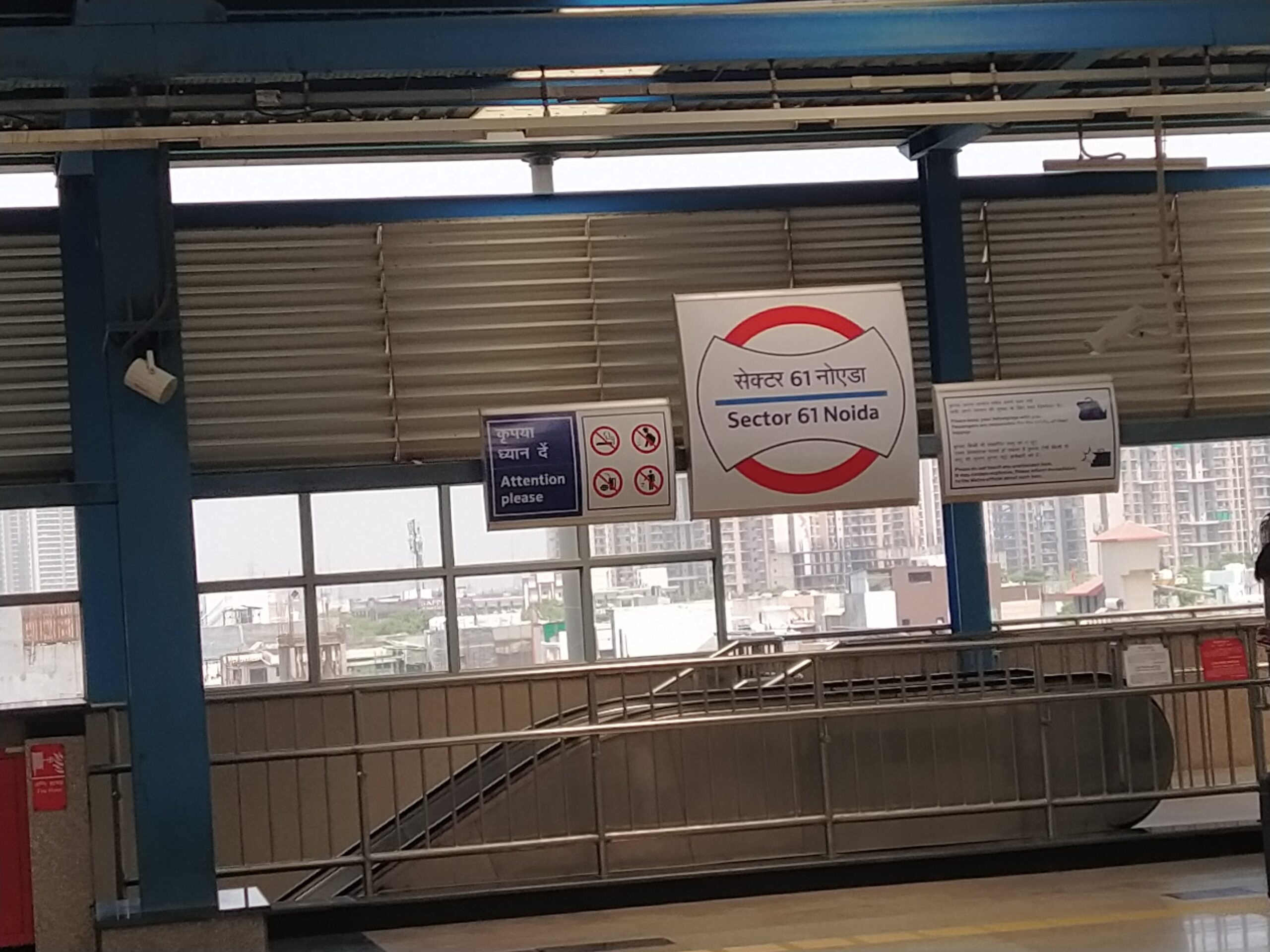
The first new station, Noida Sector 61, is the most important of the five for connectivity, because it is where the extended Aqua Line will meet the Delhi Metro’s Blue Line. A passenger boarding at Sector 61 will be able to change to the Blue Line and travel onwards into Delhi, which turns the extension into a link between two metro networks rather than a standalone spur. Sector 61 is also a busy commercial and office area in its own right, and a station there puts the metro within easy reach of workplaces that today depend heavily on road transport.
The next two stations, Noida Sector 70 and Noida Sector 122, serve the dense residential sectors that have filled up with apartment blocks over the past decade. Sector 70 lies close to established housing in central Noida, while Sector 122 sits further east, in the direction of Greater Noida West, where large group-housing societies have come up in large numbers. For residents of these sectors, the new stations would mean a metro stop close to home, replacing part of a road journey that currently depends on buses, shared autos, cabs or private vehicles.
Noida Sector 123 follows, and then the corridor reaches its terminus at Greater Noida Sector 4. Greater Noida Sector 4 is the endpoint of the approved corridor, and it is the station that brings the metro into Greater Noida West proper. It is worth repeating, because the geography matters: the approval covers the corridor up to Greater Noida Sector 4 and no further. Any discussion of the metro going beyond that point belongs to other proposals, not to this Cabinet decision. The five stations are all elevated, which means the line will run on a viaduct above the road, in the same style as the existing Aqua Line, where every station is elevated.
Once the extension is operational, the active metro network in Noida and Greater Noida will total 71.878 kilometres. That figure reflects the combined network after the new corridor joins the existing lines, and it gives a sense of the scale of the change: a network that began with a single 29.7-kilometre line in 2019 will have grown by more than eight kilometres in one decision, with five more stations for passengers to use.
A Blue Line interchange at Noida Sector 61
The interchange at Noida Sector 61 is the single feature that most changes what the Aqua Line can do for a commuter. Today, the Aqua Line connects with the Delhi Metro at Noida Sector 51, where passengers cross by footbridge to the Blue Line station at Noida Sector 52. The new extension adds a second meeting point between the two networks, at Sector 61, and that second interchange matters for two reasons: it shortens journeys for people who live or work near Sector 61, and it gives the network a measure of redundancy, so that passengers have more than one route into the Delhi Metro system.
For a commuter travelling from Greater Noida West to Delhi, the practical effect is straightforward. Instead of travelling to Noida Sector 51 and changing there, a passenger boarding at Greater Noida Sector 4 or at one of the intermediate stations will reach Sector 61 and change to the Blue Line there, continuing into Delhi on the same network that serves Noida City Centre, Mayur Vihar, Mandi House, Rajiv Chowk and the rest of the capital. The Blue Line is one of the Delhi Metro’s busiest corridors, and a direct interchange with it is what turns the Aqua Line extension from a local link into a genuine regional connection.
The interchange also matters for the reverse journey. Office workers in Noida’s Sector 62 and Sector 63 belt, students travelling to institutions in Greater Noida, and shoppers heading for the malls of Greater Noida West will all be able to reach the Aqua Line from the Blue Line at Sector 61 and travel onwards without returning to Sector 51. In a region where the road journey between Noida and Greater Noida West can slow to a crawl at peak hours, a second interchange gives the metro network a flexibility it does not have today, and it spreads the interchange load across two stations instead of concentrating it at one.
It is worth remembering that none of this is available yet. The interchange at Sector 61 will exist only once the extension is built and opened, and no date for that has been announced. What the Cabinet has approved is the corridor and its stations, including the interchange station; the construction, testing and commissioning that must follow are still ahead. The promise of the interchange is real, but it is a promise attached to a project that is still at the approval stage, and it should be described as such.
What the extension means for Greater Noida West
Greater Noida West, also known as Noida Extension, has grown faster than almost any other residential area in the National Capital Region. Row after row of high-rise apartments has come up over the past decade, and the population has grown accordingly, but public transport has lagged behind the housing. For most residents, the daily journey to work, to school or to the shops still means a road trip — by bus, by shared auto, by cab or by private car — and the roads that carry that traffic, including the Noida-Greater Noida Link Road and the roads around Gaur City and the Greater Noida West sectors, are busy at the best of times and congested at peak hours.
The five new stations are placed to serve that population where it lives. The corridor runs through sectors that are already densely settled, and its terminus at Greater Noida Sector 4 puts the metro at the doorstep of the area’s largest residential clusters. For a family living in Greater Noida West, a metro station within walking distance or a short feeder ride away would change the daily calculation: the journey to Noida or Delhi would no longer depend entirely on the road, and the time spent in traffic would no longer be the unavoidable price of living where homes are affordable.
The commercial geography of the corridor is part of the same story. The government’s announcement specifically names the commercial hubs the extension will connect: Gaur City Mall, H&S Mall, Blue Sapphire Mall, IKEA at Noida Sector 51, and Anthurium Mall at Noida Sector 73. These are not incidental landmarks. They are the shopping and leisure destinations that draw large crowds from across Noida and Greater Noida, and they are also significant employers. A metro line that serves them directly makes them easier to reach for shoppers and easier to staff for the businesses inside them, and it ties the retail economy of Greater Noida West into the wider metro network.
IKEA at Noida Sector 51 deserves a particular mention because it sits at the starting point of the new corridor. The store, which draws visitors from across the National Capital Region, is already served by the existing Aqua Line terminus at Sector 51, and the extension will carry that connectivity onwards through Sectors 61, 70, 122 and 123 to Greater Noida Sector 4. Anthurium Mall at Sector 73, meanwhile, sits close to the corridor’s path, and the malls of Greater Noida West — Gaur City Mall, H&S Mall and Blue Sapphire Mall — will be within reach of the new stations. For shopkeepers, mall workers and delivery staff as well as shoppers, the difference between a metro stop nearby and a bus ride away is the difference between a predictable journey and an unpredictable one.
There is also a quieter, longer-term effect to consider. Metro lines shape where people choose to live and where businesses choose to open. A confirmed metro corridor, once built, tends to raise the value of homes and shops near its stations and to encourage further development around them. None of that can be promised in advance, and the Cabinet approval alone does not change property prices or open a single shop. But the history of metro construction in Indian cities suggests that the corridor, when it is built, will become a spine around which the next phase of Greater Noida West’s growth organises itself. For now, the honest description is that the approval creates that possibility; the realisation depends on the construction that follows.
The Aqua Line today: 21 stations over 29.7 km since 2019
To understand what the extension adds, it helps to remember what the Aqua Line already is. The line has 21 stations over 29.7 kilometres, running from Noida Sector 51 in the north to the Depot station in Greater Noida in the south, and it has been operational since 25 January 2019. It was inaugurated that day by Uttar Pradesh Chief Minister Yogi Adityanath, and it has carried passengers between the twin cities ever since, entirely on elevated track. Its stations include Noida Sector 76, Sector 101, Sector 81, NSEZ, Sector 83, Sector 137, Sector 142, Sector 143, Sector 144, Sector 145, Sector 146, Sector 147 and Sector 148, before the line enters Greater Noida and passes through Knowledge Park II, Pari Chowk, Alpha 1, Delta 1 and the GNIDA Office to its terminus at Depot station.
The Aqua Line is the only metro line of the Noida Metro system, which is owned and built by the Noida Metro Rail Corporation, a state-owned corporation. It is a standard-gauge line, and its trains are lightweight rakes made of stainless steel and aluminium. The line runs from early morning to late evening, and it carries tens of thousands of passengers a day between homes in Greater Noida and workplaces, schools and shops in Noida and, through the interchange at Sector 51, onwards into Delhi. For many of those passengers, the Aqua Line is already the most reliable part of the daily journey, because it is unaffected by the road congestion that slows buses and cars on the same route.
The extension approved on 11 November 2026 is the first major addition to the Aqua Line since it opened. It does not change the existing line’s route: the 21 stations and 29.7 kilometres that exist today will remain exactly as they are, and the new corridor will branch from the existing terminus at Noida Sector 51. That is an important point for existing passengers. The extension grows the network outwards from Sector 51 in the direction of Greater Noida West, along a different alignment from the existing line’s southward run to Depot station. A passenger travelling from Greater Noida’s Depot station to the new stations would travel north on the existing line to Sector 51 and then onwards on the new corridor — or, once the Sector 61 interchange is built, change to the Blue Line there instead.
The seven years since the Aqua Line opened have also changed the cities it serves. Noida and Greater Noida have both grown, and Greater Noida West in particular has added housing at a pace that the transport network has struggled to match. The Cabinet’s decision can be read as a response to that growth: the metro is being extended to where the people now are, rather than asking the people to come to where the metro already is. That is the logic of the corridor, and it is why the announcement was welcomed by residents’ groups and commuters in the area, even though the trains themselves are still years away.
What the approval does not decide yet
A Cabinet approval is a beginning, not an ending, and it is worth setting out plainly what remains undecided. No construction start date has been announced. No opening date has been announced. No fare has been announced, and no service frequency has been announced. Anyone who states a date on which the new stations will open, or a price for a ticket between Sector 51 and Greater Noida Sector 4, is guessing, because the government has announced neither. This article does not state any opening date, and readers should treat any date they see elsewhere with caution unless it comes from an official announcement.
The same caution applies to the cost. Rs 2,390 crore is the estimated cost given at the Cabinet briefing, and estimates on projects of this kind are revised as detailed engineering, land requirements and tender prices become clear. The figure is the best available statement of what the project is expected to cost, but it is not a final account, and it should not be quoted as though the money has already been spent. The four-year completion target is similarly a target, not a timetable with dates attached. It describes the intended duration of the work once it begins, and since the start date has not been announced, it cannot be converted into a calendar year for opening.
There are also two confusions that readers should avoid. The first concerns the wider plans for the Aqua Line. A longer proposed extension, from Noida Sector 51 to Knowledge Park V, covering 17.435 kilometres and 11 stations, has been discussed separately. That is a different and larger proposal, and it is not what the Cabinet approved on 11 November. The approval covers only the 8.449-kilometre corridor to Greater Noida Sector 4 with five stations, and the two should not be mixed up. The second confusion concerns construction contracts announced separately. On 9 November 2026, Larsen and Toubro announced an order for construction work on two other Aqua Line stretches, from Botanical Garden to Sector 142 and from Depot station to Boraki, covering 10 stations. That is a separate construction order for separate stretches, and it is not part of the Cabinet approval described in this article. Keeping the three apart — this approval, the longer Knowledge Park V proposal, and the separate construction order — is essential to an accurate picture.
There is one more point of precision. The approved terminus is Greater Noida Sector 4, and that is the wording used by the Press Information Bureau. Some descriptions of the area use local landmarks to identify the same neighbourhood, but the official name of the station and the terminus is Greater Noida Sector 4, and this article uses that wording throughout. Accuracy about station names matters, because it is the station name that will appear on maps, on signboards and on tickets when the line eventually opens.
What happens next before construction begins
What follows a Cabinet approval of this kind is a sequence of steps that is familiar from other metro projects, and it is useful to describe them in general terms so that readers know what to watch for. None of the steps described here has been given a date, and this article does not claim that any of them has started. The point is to explain what normally has to happen between an approval and the first train, so that the absence of a construction date is understood as normal rather than as a delay.
The first stage, in general, is detailed design and tendering. The approved corridor must be engineered in detail — the exact alignment of the viaduct, the design of each of the five stations, the location of entry and exit points, and the integration with the existing station at Noida Sector 51 and with the Blue Line station at Sector 61. Contractors are then appointed through tenders to build the civil works, the stations and the systems that a metro needs, from tracks and power supply to signalling and ticketing. These are substantial contracts, and the tender process itself takes time.
Alongside the engineering, the project will need land and clearances. An elevated metro runs above public roads for much of its length, but stations, entry points and construction sites all need land, and the acquisition and handover of that land is often the slowest part of a metro project. Utility shifting — moving water, power and telecom lines out of the path of construction — is another task that has to be completed before viaduct pillars can rise. None of this is visible to the public in the way that construction is, but it determines when construction can actually start.
Only after those stages comes the visible work: the pillars, the viaduct, the stations and then the laying of track, the installation of systems and the testing of trains. Metro lines are tested extensively before they open, with trial runs and safety inspections that must be passed before passengers are allowed on board. That is why the gap between a Cabinet approval and an opening is measured in years rather than months, and why the four-year completion target given at the briefing should be read as the intended construction period rather than a promise of a particular opening day.
For residents of Noida and Greater Noida West, the practical advice is simple: follow the official announcements. The Press Information Bureau’s release is the authoritative record of what was approved, and future announcements — about tenders, about the start of construction, about trial runs and eventually about opening — will come through the same official channels and through the Noida Metro Rail Corporation. Until those announcements are made, the honest position is the one this article has taken throughout: the Cabinet has approved an 8.449-kilometre, five-station, Rs 2,390 crore extension of the Aqua Line to Greater Noida Sector 4, with a Blue Line interchange at Noida Sector 61 and a four-year completion target, and the construction and opening dates are yet to be announced. That is a significant decision for the twin cities, and it is enough, for now, to describe it accurately and wait for the work to follow.
Sources
USN reviewed reporting from multiple outlets for this story. Read more from PIB, DD India and The Indian Express.