

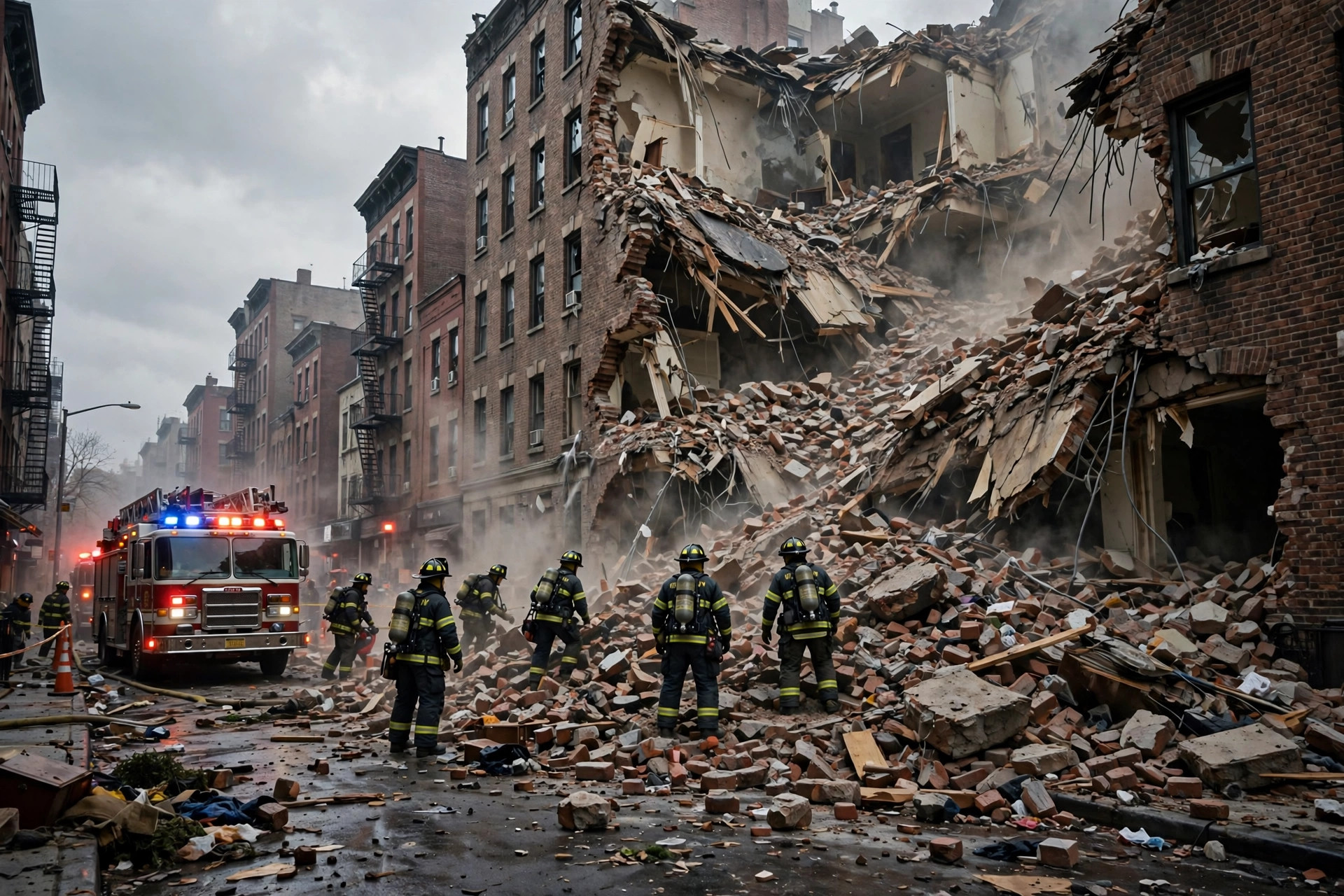
Eight people, including two children aged nine and ten, died when a three-story building in Flatbush, Brooklyn, collapsed into the open excavation of a construction site next door on Wednesday afternoon. Firefighters ended their search of the rubble on Thursday afternoon, confirming that no one else was trapped, and the city has ordered inspections at about 100 construction sites linked to the companies behind the neighbouring project. The cause of the collapse has not been determined, and the Brooklyn District Attorney’s office is working with city investigators to establish whether any criminal conduct contributed to it.
The collapse, at 1321 Flatbush Avenue, happened just after 4 p.m. on Wednesday, November 11, in a busy stretch of one of Brooklyn’s main commercial streets. The building, a 1930s mixed-use block with a shop at street level and apartments above, fell sideways into the excavation at 2625 Bedford Avenue, where workers had been digging for a new building. Part of the neighbouring building at 1323 Flatbush Avenue was torn away in the collapse. Within hours, what had begun as a rescue operation became a recovery operation, and by Thursday the questions had shifted from who might still be alive under the rubble to how a building that had stood for nearly a century could come down in an afternoon, and who, if anyone, was responsible.
What Happened on Flatbush Avenue
The first 911 call came at 4:01 p.m. on Wednesday, according to the Fire Department, and doorbell-camera footage from the street showed the collapse beginning minutes earlier, at about 3:58 p.m. The three-story building at 1321 Flatbush Avenue, near the corner with Bedford Avenue, fell into the open excavation next door, where workers were digging foundations for a new development. The force of the collapse tore the side off the adjacent building at 1323 Flatbush Avenue and sent a cloud of dust across the street, where shoppers, workers and residents were going about an ordinary Wednesday afternoon.
Firefighters, police officers and emergency medical crews arrived within minutes and began searching the rubble by hand and with dogs, while the street was closed and the surrounding buildings were evacuated. The Fire Department’s search continued through the night and into Thursday, as crews worked in shifts through the debris. At 7:24 a.m. on Thursday, Mayor Zohran Mamdani posted that eight New Yorkers had died. By a briefing at 12:30 p.m., the picture was complete: eight dead, six of them recovered from the rubble and two who died after being taken to hospital, and 18 injured, 14 of them civilians and four of them firefighters. One person remained in critical condition.
The early hours of the rescue were marked by uncertainty. On Wednesday evening, officials did not know how many people might still be in the collapse zone or how many were missing, and the Fire Department commissioner said so plainly. Early reports put the injured at 17, a figure that was revised to 18 as the casualty count was confirmed. The search ended at 3:37 p.m. on Thursday, when the Fire Department said it had searched the whole site and found no more victims, and handed the scene to the Department of Buildings and the Police Department.
The Eight Victims of the Brooklyn Building Collapse
Police released the names of all eight people who died on Thursday evening. The youngest were Nicole Daniela Salvada Rodriguez, aged nine, and her cousin Kevin Santiago Reyes Gonzalez, aged ten. The six adults were Juan Daniel Salvada Guzman, 31; Ndiaye Mamadou, 31; Barry Mamadou, 23; Gabriel Siguencia, 22; Edgar Sapon, 26; and Jose Luis Caguana Cosquillo, 26. The mayor said the victims came from several countries, including Ecuador, Colombia, Mexico and Trinidad. Two of the dead were construction workers, and two were children.
The names tell a story about who lived and worked in that part of Flatbush. The building held a medical-uniforms store at street level, with apartments above, and the people inside it on a Wednesday afternoon were shopkeepers, workers, tenants and children coming home from school. The two children who died were cousins, and their deaths, announced alongside those of six adults, gave the casualty list a weight that the bare number eight does not carry. The city has not released further details about the victims, and their families have not spoken publicly in the first days after the collapse.
The injured, too, were a cross-section of the street. Fourteen civilians were hurt, along with four firefighters who were injured during the rescue. Seven children were among the injured in the first reports, and one person remained in critical condition on Thursday. The hospitals that received the injured have not been named in the public briefings, and the city has not said how many of the injured remained in hospital by Friday. What is known is that the casualty count rose through Wednesday evening and Thursday morning as the search went on, and that the final toll of eight dead was more than three times the two deaths reported in the first hours.
The Search That Ended on Thursday Afternoon
The rescue operation was one of the largest the Fire Department has mounted in Brooklyn in years. Crews worked through the night in the rubble of a building that had fallen into a hole, a task made harder by the instability of the remaining structure and by the need to shore up the excavation walls before anyone could safely enter. Search dogs were used, and firefighters listened for sounds from beneath the debris. The work was slow, dangerous and, for the families waiting behind the cordon, agonising.
By Thursday morning, the operation had become a recovery. The mayor and the Fire Department commissioner briefed the public as crews continued their work, and the commissioner’s message was that the search would go on until every part of the site had been checked. That work finished at 3:37 p.m. on Thursday, when the Fire Department said the site had been fully searched and no more victims had been found. The handover to the Department of Buildings and the Police Department marked the end of the emergency phase and the beginning of the investigation phase, which will take far longer.
For the people who live on Flatbush Avenue, the end of the search did not mean a return to normal. The Department of Buildings has issued full vacate orders on the buildings at 1323, 1325 and 1327 Flatbush Avenue, and engineers must clear them before anyone can move back in. The residents of those buildings, along with the tenants of the building that fell, are displaced, and the street itself remains a construction site and a crime scene at once. The neighbourhood’s questions, about safety, about the buildings they live in, and about what happens next, are only beginning to be asked.
The Building and the Excavation Next Door
The building that fell, at 1321 Flatbush Avenue, was built in 1930 and held four apartments above a ground-floor store, according to city records. The store sold medical uniforms, and the building was one of many pre-war mixed-use blocks that line Flatbush Avenue. City housing records list 98 open violations at the address, ranging from leaks to bedbugs, according to reporting by CBS New York. The owner of record is Isolag Realty Corporation, whose registered agent is the Brooklyn landlord Olufemi Falade, according to city records cited by CBS New York.
Next door, at 2625 Bedford Avenue, workers were excavating for a new building. City records show that excavation permits for the adjoining site were issued in September 2026, and the work had drawn a violation for continuing during a stop-work order. The Department of Buildings has since issued a full stop-work order on the adjacent site while investigators work out the cause of the collapse. A permit is not a determination of what caused the collapse, and the department has been careful to say that the cause remains under examination.
The relationship between the two sites is the central fact of the investigation. A building that had stood for 96 years fell into a hole that had been dug beside it within the last two months, and the excavation is the obvious place to look for an explanation. But an obvious place to look is not the same as a proven cause, and the city’s own handling of the question in the first days shows how careful investigators are being. An early entry in the Department of Buildings’ records blamed unsafe construction at the neighbouring site for the collapse. The department later said that entry had been entered prematurely and was inaccurate, removed the wording from its vacate order, and revised it to cite the full stop-work order issued because of the collapse. The cause, officials say, has not been determined.
What Caused the Brooklyn Collapse? Not Yet Known
As of Thursday afternoon, officials had not said what caused the collapse, and the cause remains under investigation. What is known is that the three-story building fell into an open construction site next door, that workers were digging at that site when it happened, and that the city’s Department of Buildings is investigating alongside the Police Department. The Brooklyn District Attorney’s office is also working with the department and law enforcement to determine whether any criminal conduct contributed to the collapse, according to CBS New York. No one has been accused, and no charges have been announced.
The rise and fall of the department’s early finding is itself part of the story. The first written finding, that the collapse was caused by unsafe construction operations at the adjacent property, was reported widely on Thursday morning and appeared to settle the question. Within hours, the department withdrew it, saying the cause remained under investigation and that the entry had been made too early. The correction matters, because it is the difference between a finding and a guess, and because the families of the dead, the owners of the buildings, and the companies that dug the hole all have a right to an answer that has been properly established rather than hastily asserted.
There are several questions the investigation will have to answer. Was the excavation properly shored and supported, and was it monitored as it deepened beside a 96-year-old building. Was the stop-work order that the site had already drawn a warning that was ignored, and did work continue after it was issued. Did the condition of 1321 Flatbush Avenue itself, with its 98 open violations, make it more vulnerable than it should have been. And what role, if any, did the permits issued in September play. None of these questions has an answer yet, and the investigation is expected to take weeks at least.
The City’s Response: 100 Sites Ordered Checked
Mayor Mamdani moved quickly to widen the response beyond the single site. He ordered inspections at about 100 construction sites linked to five entities tied to the neighbouring project, a sweep designed to find out whether the conditions that may have contributed to the Flatbush collapse exist anywhere else in the city. The order covers sites connected to the companies and individuals behind the Bedford Avenue excavation, and it is the most direct signal yet that the city is treating the collapse as a possible symptom of a wider problem rather than an isolated accident.
The inspections are one part of a response that also includes the vacate orders on the three neighbouring buildings, the stop-work order on the excavation, and the criminal investigation now under way. The Department of Buildings, which issues the permits and enforces the codes that are supposed to prevent collapses like this one, will be under scrutiny itself, not least because of the premature finding it entered and then withdrew. The department’s commissioner has not yet given a full public account of what its inspectors knew about the Bedford Avenue site before Wednesday, or what they did about the violation for working through a stop-work order.
For New Yorkers, the sweep of 100 sites will be watched closely. The city has seen deadly construction accidents before, and each one has produced promises of tougher enforcement that have not always lasted. Whether this one produces lasting change will depend on what the inspections find, and on whether the findings are made public. The mayor has said the city will act on what the investigation establishes. The test will be whether that promise survives the weeks and months it takes to establish it.
The Families and the Neighbourhood
Flatbush is one of Brooklyn’s most diverse neighbourhoods, and the victims of the collapse reflect it. The dead came from Ecuador, Colombia, Mexico and Trinidad, and the building they died in was the kind of place where immigrants, shopkeepers and working families have lived for generations. The neighbourhood’s response in the first days has been one of grief and of practical help: neighbours offering shelter to the displaced, local businesses collecting donations, and elected officials visiting the site to promise answers.
Local reporting from the scene has captured a community that is angry as well as sad. Residents interviewed by neighbourhood outlets spoke of their shock at seeing a building they walked past every day reduced to rubble, and of their worry about the other old buildings on the street and the construction sites beside them. Their comments are their own experiences and opinions, not findings about what caused the collapse, but they describe a fear that is real and reasonable: if a building can fall into a hole dug beside it, what protects the building next door.
The two children who died, Nicole and Kevin, have become the focus of much of that grief. They were nine and ten years old, cousins, and their deaths have been reported in every account of the collapse because they make the scale of the loss impossible to ignore. The city has not said whether any memorial or fund has been set up for the families, and the families themselves have not spoken publicly. What is certain is that the neighbourhood will remember this week for a long time, and that the names of the dead will be attached to the questions about the collapse for as long as those questions remain unanswered.
What Comes Next for Flatbush
The immediate next steps belong to the investigators. The Department of Buildings and the Police Department now control the site, and the District Attorney’s office will decide, on the basis of their findings, whether any criminal charges are warranted. The inspections at the 100 linked sites will produce their own results, and the engineers who must clear the vacated buildings at 1323, 1325 and 1327 Flatbush Avenue will decide when, or whether, their residents can return. None of this will happen quickly, and the street will remain disrupted for weeks.
For the city as a whole, the collapse raises questions that go beyond a single excavation. New York has thousands of pre-war buildings standing beside construction sites, and the rules that are supposed to protect them depend on permits being properly issued, stop-work orders being obeyed, and inspections being carried out. The Flatbush collapse will test whether those rules worked, and if they did not, where they failed. The answers will matter far beyond Flatbush Avenue, because the same combination of an old building and a new excavation exists on streets across all five boroughs.
For the families of the eight people who died, none of that is consolation. They lost children, siblings, parents and partners on an ordinary Wednesday afternoon, in a building that had stood since 1930, on a street they knew well. The search is over, the site has been handed to the investigators, and the city has ordered its checks. What remains is the wait for an explanation, and the hope that whatever the investigation finds will prevent the next collapse before it happens, rather than explain it afterwards.
Sources
USN reviewed reporting from multiple outlets for this story. Read more from Firstpost, North Jersey and NYC In Focus.