

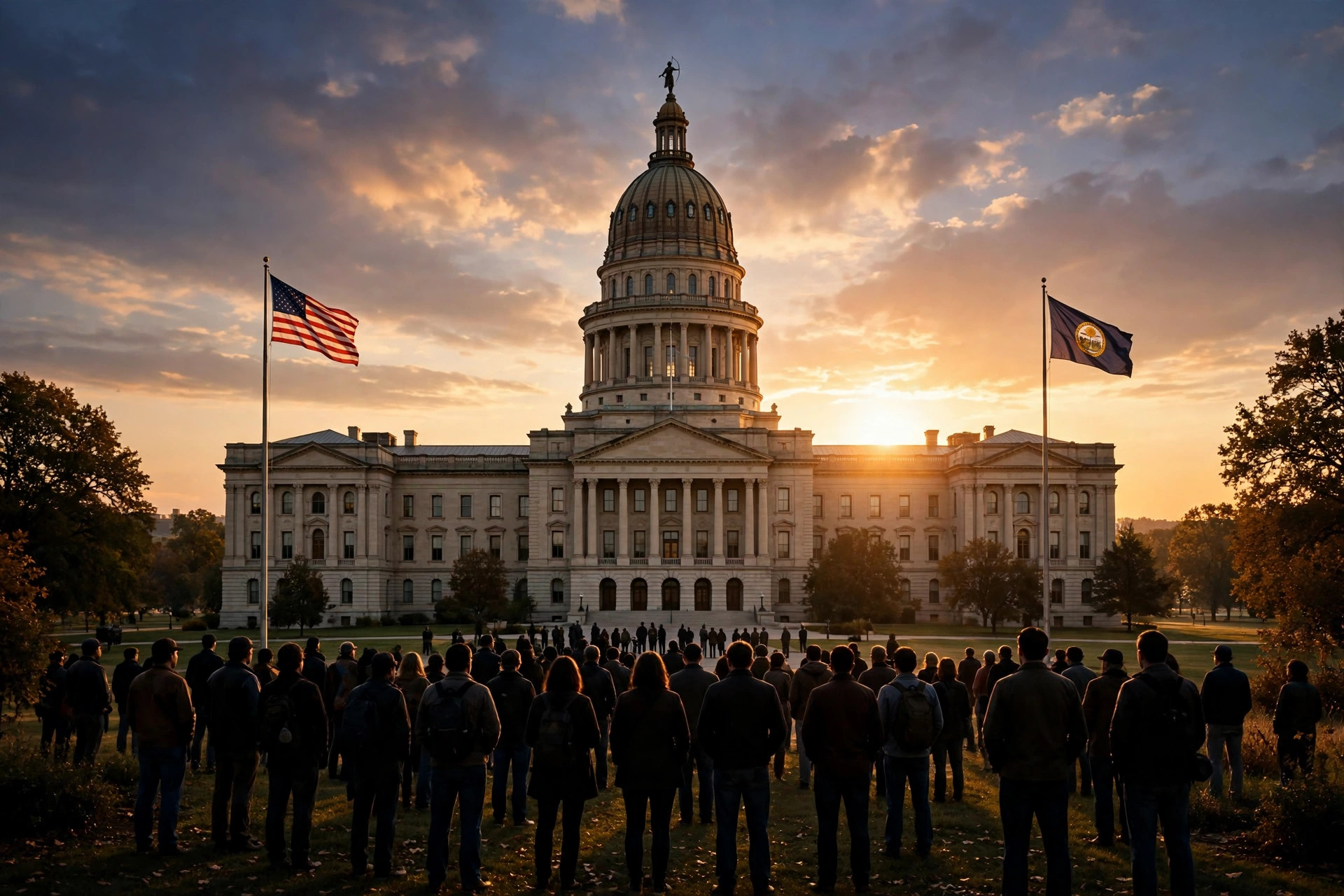
Democrat Cindy Holscher has won the race for governor of Kansas, defeating Republican Ty Masterson in one of the closest statewide contests in the state’s history. The Associated Press called the race on Thursday, November 12, 2026, nine days after voters went to the polls on Election Day, bringing an end to more than a week of uncertainty while election workers counted provisional ballots and carried out audits across all 105 Kansas counties.
Holscher, a Democratic state senator from Overland Park, held a lead of 7,358 votes when the race was called, according to unofficial results reported on November 12. She won about 50.3 percent of the vote to about 49.7 percent for Masterson, a margin of roughly seven-tenths of a percentage point out of more than 1.09 million ballots cast. The results remain unofficial until the state completes its certification process, and small changes in the totals were still possible as counties finished their work, but the gap proved large enough for the Associated Press to declare a winner.
Masterson, the president of the Kansas Senate, conceded on Thursday, saying in a statement that it looked as though his campaign would come up just short. He said he had called Holscher to congratulate her on her election. His concession closed a hard-fought campaign in a state that usually leans Republican, and it kept the governor’s office in Democratic hands for a third consecutive term.
The outcome carries weight well beyond Kansas. Holscher succeeds term-limited Democratic Governor Laura Kelly and is scheduled to take office on January 11, 2027. Her victory makes Kansas the first state in the country to elect four Democratic women as governor, and it marks the first time in Kansas history that voters have chosen a Democrat to succeed another Democratic governor. For a party that has often struggled in statewide races across the Great Plains, holding the Kansas governor’s office was a significant prize, and the narrow margin showed how competitive the state has become at the top of the ticket.
The Call Comes Nine Days After Election Day
The governor’s race was one of three statewide contests in Kansas that remained too close to call in the days after the November 3 general election. Election officials spent the following days counting provisional ballots, the ballots cast by voters whose eligibility needed to be checked before their votes could be counted, while local officials also carried out recounts and audits in the closely contested race. Because the margin was less than one percentage point, state law required each county to audit ballots from 10 percent of its precincts, a process that added to the delay.
By Thursday afternoon, the Associated Press had seen enough to call the race for Holscher. Decision Desk HQ also declared her the winner on the same day. Holscher had already claimed victory on November 4, the day after the election, and on November 10 she announced that she had met with Governor Kelly to begin planning the transition of power. Her campaign released a video that day in which she thanked her supporters and told Kansans who had voted the other way that she would be their governor too, promising to spend every day working to earn their trust.
The long wait was unusual but not without precedent in Kansas politics. In recent elections, most statewide races have been decided on election night, and the delay left both campaigns and voters in suspense for more than a week. The careful pace reflected the closeness of the contest: with the candidates separated by only a few thousand votes out of more than a million cast, election officials needed to be certain that every valid ballot had been counted before any news organization would declare a winner.
How Close Was the Kansas Governor’s Race?
The numbers explain why the race took so long to call. Holscher’s lead of 7,358 votes as of November 12 represented about 0.7 percentage points, with Holscher at 50.3 percent and Masterson at about 49.7 percent. Later unofficial updates from the Kansas Secretary of State’s office put the gap at 7,644 votes, a reminder that the totals were still moving as counties completed their canvasses. Either way, the contest was the closest race for Kansas governor since 1974, when Republican Robert Bennett defeated Democrat Vern Miller by 3,677 votes in the first election held under the state’s shift to four-year terms for governor.
The 2026 race was also the tenth Kansas gubernatorial election decided by fewer than 10,000 votes since 1884, the first election in which each of the top two candidates for governor received at least 100,000 votes. It was a rare two-person race for the office, the first since 1994 in which no third-party or independent candidate appeared on the ballot, which meant that every vote counted directly in the contest between Holscher and Masterson.
Turnout was heavy, with more than 1.09 million Kansans casting ballots in the governor’s race. The closeness of the result stood in contrast to the expectations of many analysts before the election, some of whom had rated the race as leaning toward Masterson. Polling late in the campaign had generally shown a tight race, and the final result confirmed that the electorate was almost evenly divided between the two candidates.
The Data Center Debate That Shaped the Campaign
One issue dominated the campaign more than any other: the rapid growth of large data centers in Kansas, and in particular the giant facilities built to power artificial intelligence. Holscher made a statewide pause on new data center construction a cornerstone of her campaign, arguing that the huge facilities were driving up electricity costs, putting pressure on water supplies, and leaving local communities with too little say over projects in their own backyards. She said voters across the political spectrum shared those concerns, telling reporters late in the race that the issue cut across party lines.
Holscher had initially supported data center development but changed her position as she heard from residents during campaign stops around the state. In an opinion column published during the campaign, she wrote that it was time to press the pause button, pointing to a planned hyperscale data center in De Soto that would cover about 1.14 million square feet, an area she compared to 20 football fields. She argued that Kansans wanted limits on the energy and water the centers use and wanted to be sure the projects created local jobs.
Masterson took a different position. He opposed a moratorium on new data centers but pledged to put stronger safeguards in place for the communities that host them. His campaign drew support from a pro-data center political group, and he argued that the projects brought investment and jobs to Kansas. The contrast between the two candidates gave voters a clear choice on an issue that affects utility bills, water use, and land development across the state, and the scale of the industry is enormous: about 46 billion dollars in data center projects have been announced in Kansas, most of them in the Kansas City area.
The question now is what Holscher can actually do once she takes office. A pause on new data centers would be difficult to impose by executive action alone, because many of the decisions about where the facilities are built rest with local governments. The Kansas Legislative Research Department has noted that a governor would probably need the legislature to pass a new law to halt construction statewide, which would require the cooperation of Republican majorities in both chambers. Holscher may instead press lawmakers for new rules on energy and water use, or work with local officials on guidelines, a path a previous Kansas governor followed when she sought to limit wind power development in parts of the Flint Hills.
Masterson Concedes and Congratulates Holscher
Masterson’s concession came quickly after the race was called. In a social media post on November 12, he said he had called Holscher to congratulate her, and he acknowledged that his campaign had come up short. In his statement, he said the things his campaign had fought for were no less important than they had been the day before, and he described carrying the Republican banner for the state he loves as the honor of his life. He added that he believed in Kansas and in the people who live there, and that his belief had not changed.
The gracious tone of the concession stood out after a hard-fought campaign in which Masterson had the endorsement of President Donald Trump. The president’s backing had been a central feature of the race, and Masterson’s campaign had sought to tie Holscher to the national Democratic Party. Holscher, for her part, sought to tie Masterson to the president, and she campaigned on populist themes that included legalizing marijuana, expanding Medicaid, funding public schools, and reducing property taxes.
Reports during the campaign said Holscher had been outspent by a wide margin on advertising, with one account putting the gap at nearly three to one, which made her victory all the more striking to political observers. Her win came as part of a broader set of Democratic victories in the 2026 midterm elections, in which Democrats also won the Kansas attorney general’s race and picked up a seat in the United States Senate from Kansas, their first in that office since 1932.
A Historic First for Kansas Democrats
Holscher, 57, has served in the Kansas Legislature since 2017, first in the state House and then in the Senate, where she represents Overland Park in Johnson County. Before entering politics, she worked as a manager for Sprint Corporation, and she lives in the Kansas City suburbs that grew rapidly after the Second World War. Her running mate, State Representative K.C. Ohaebosim of Wichita, will become lieutenant governor, and he is the first Black person to win statewide office in Kansas since the 1880s and only the second Black person elected to a statewide office in the state’s history, after State Auditor Edward P. McCabe, who won elections in 1882 and 1884.
Governor Kelly highlighted the historic nature of the result on November 4, noting both the back-to-back Democratic governors and the fact that Kansas is the first state to elect four Democratic women as governor. In a written statement, Kelly said leadership was about more than the office or the title next to a name, and about what a leader does with the opportunities the office brings. She said she looked forward to Holscher building on the progress of her administration and leaving her own mark on the state.
The result also reshaped the balance of power in the Kansas Legislature. Democrats gained 20 seats in the Kansas House, according to unofficial results, with 11 of those gains coming in Johnson County, and the gains were enough to break the Republican supermajority in the chamber. The new House is expected to have 68 Republicans and 57 Democrats. That change matters for Holscher, because breaking the supermajority means Republicans can no longer override a governor’s veto on their own, giving her more room to defend her priorities than Kelly often had. Even so, Republicans still hold majorities in both chambers, so Holscher will need to negotiate with them to pass her agenda.
What Happens Next: Certification and Transition
The results remain unofficial, and the formal process of confirming them is still under way. County commissions across Kansas have until Monday, November 16, to consider provisional ballots and certify their county results. The State Board of Canvassers, which includes Governor Kelly, is scheduled to meet on December 1 to certify the final statewide results. Only after that meeting will the outcome become official in the eyes of the law.
The post-election audit required by state law will also continue. Because the margin was under one percentage point, every county was required to hand-count ballots from a randomly selected 10 percent of precincts to check the accuracy of the count. Several counties had not finished that work when the race was called, but the audits were not expected to change the outcome, given the size of Holscher’s lead relative to the number of ballots checked.
Meanwhile, the transition is already in motion. Holscher met with Kelly on November 10, two days before the race was called, to begin planning the handover, and the two administrations are working together to ensure a smooth transfer of power. Holscher is scheduled to be sworn in on January 11, 2027, and she will then face the immediate task of putting together her administration, presenting a budget to the legislature, and deciding how to pursue the promises that defined her campaign, from the data center pause to property tax relief and school funding.
Governing With a Republican Legislature
The biggest test for Holscher will be governing alongside a legislature still controlled by Republicans. She ran on an ambitious platform that included legalizing marijuana, expanding Medicaid, placing a moratorium on data centers, increasing funding for public schools, and cutting property taxes, and she blamed years of underfunded special education for pushing costs onto local taxpayers. With Republicans holding the majority in both the House and the Senate, she is likely to have trouble enacting those priorities in full, and she will need to find common ground on at least some issues to get bills passed.
Property taxes are one area where both parties campaigned on relief, and they could become an early point of agreement. Data centers are likely to be more contentious, given the industry’s powerful supporters in the legislature and the investment at stake. School funding is another area where the two sides have clashed in the past, although the new balance in the House may give Holscher more leverage than her predecessor enjoyed.
For now, though, the focus in Topeka is on the transition and on the simple fact that the long wait is over. After nine days of counting, auditing, and waiting, Kansas has its next governor, and the margin by which she won is a reminder of how closely divided the state is. Holscher promised during the campaign that she would serve every Kansan, including those who voted against her, and she repeated that pledge in the video she recorded before the race was called. Whether she can turn that promise into a governing coalition will be the story of her first months in office.
Sources
USN reviewed reporting from multiple outlets for this story. Read more from NPR, Topeka Capital-Journal and Kansas Public Radio.