

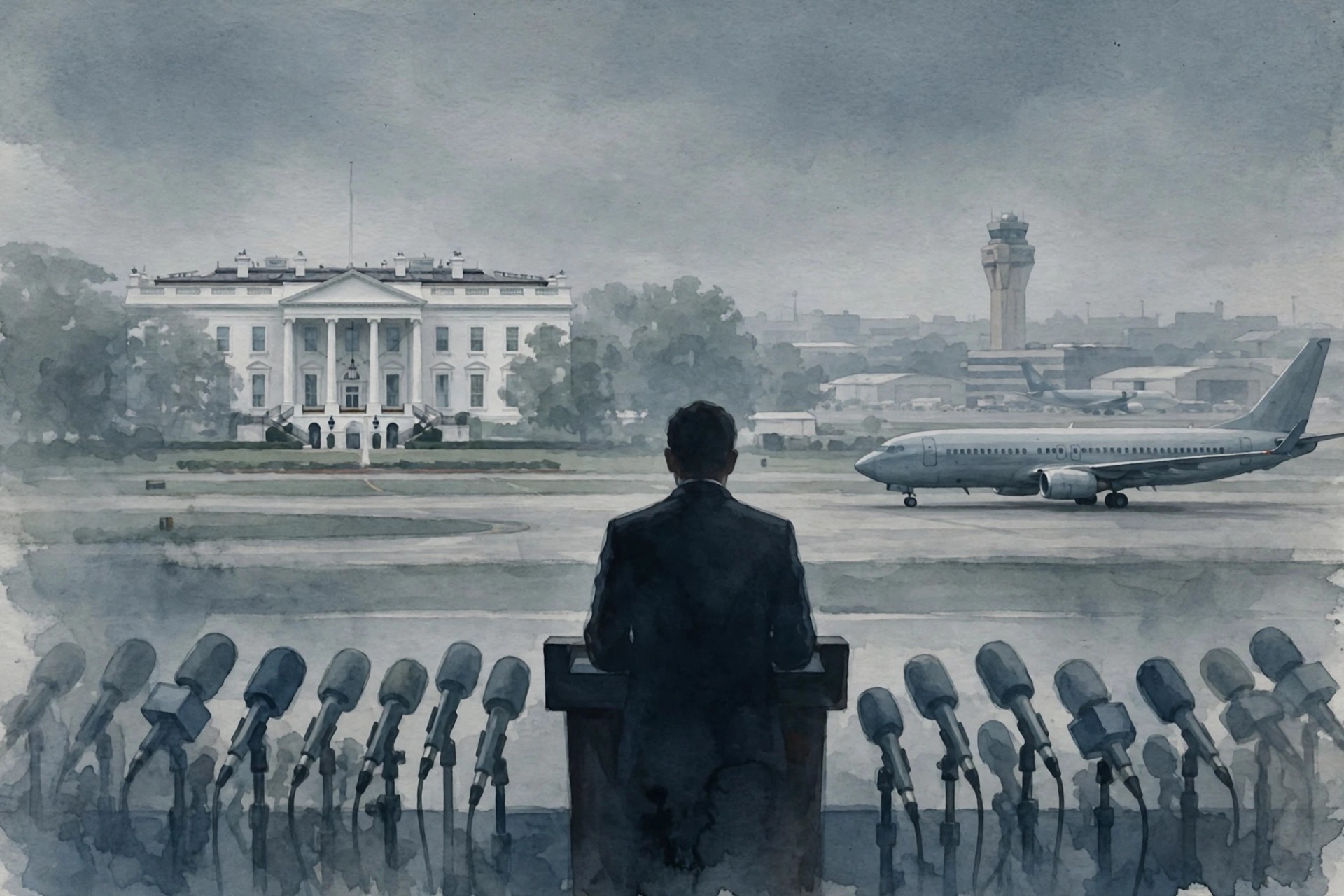
President Donald Trump said on Monday, 16 November 2026, that he takes no responsibility for the nationwide ground stop that brought American air travel to a halt three days earlier, blaming decades-old equipment and past administrations for the failure. “I don’t take any responsibility,” he told reporters outside the White House as he prepared to leave for a trip to Asia. “The only responsibility should be for 40 years they should have done this.”
The remark, delivered on the South Lawn before he boarded Marine One, was the president’s first direct answer to the question of who was to blame for the 13 November grounding, and it set the tone for a combative exchange with the press that quickly became the story of the morning. Within minutes, Trump was trading insults with NBC News White House correspondent Yamiche Alcindor, calling her “pathetic” and a “loser” after she asked whether his focus on construction projects in Washington had come at the expense of the nation’s air traffic system.
This article is about what Trump said on Monday, and about the argument that followed. The ground stop itself, which was covered in detail in USN’s earlier reporting, is background here. The new development is the president’s own response: his refusal to accept responsibility, his account of where he was and what he did while flights were grounded, his defence of the White House renovations, and his attack on the reporter who questioned his priorities.
Trump on FAA ground stop responsibility: “I don’t take any responsibility”
Trump was asked directly what responsibility he accepted for the grounding. His answer was short and absolute. “I don’t take any responsibility,” he said, adding that the people who ran the response had done well. “They did a great job, Secretary Duffy, they acted incredibly.” He praised Transportation Secretary Sean Duffy and the Federal Aviation Administration for their handling of the crisis, and he emphasised that nobody had been hurt. “Everybody was safe. Nobody was hurt. No crashes. No nothing,” he said.
The president described the failure in vivid terms. “Essentially, what you saw on Friday was very, very old equipment that had a heart attack,” he said. The system that failed, in his account, was one that should have been replaced decades ago, and the fault lay with the administrations that had left it in place. “The only responsibility should be for 40 years they should have done this,” he said, a formulation that spread the blame across four decades of government while exempting his own administration entirely.
Trump also insisted that he had been fully involved in managing the crisis, even though he had said nothing in public about it for nearly two days. He told reporters that he had worked out of the Oval Office throughout the ground stop, receiving updates from his staff, including Duffy. “I didn’t think there was any reason for me to do,” he said of his lack of public involvement. “I thought they did a very good job, but I was in the Oval Office.” The public communications job, he said, had been delegated to Duffy and to Homeland Security Secretary Markwayne Mullin, who briefed the press on Friday while the president stayed out of sight.
That account is open to question on the facts of the weekend. During the ground stop and in the two days that followed, Trump posted roughly two dozen times on Truth Social about an array of other subjects, including legislation to support the film industry and his White House construction projects. On Friday afternoon, while the airspace was still closed, he posted a 294-word message endorsing a federal film incentive. Over the following days he posted photographs of a Washington park and a golf course that a judge had temporarily blocked him from closing. His first public comment on the aviation crisis itself did not come until Sunday morning, 15 November, when he posted on Truth Social blaming the Biden administration and calling for more money from Congress.
The clash with Yamiche Alcindor over White House renovations
The sharpest exchange of the morning came when Alcindor, the NBC News White House correspondent, asked Trump what he would say to people who believe he has been too focused on construction projects in Washington instead of the nation’s airline systems. She asked whether he took any responsibility for the hours-long ground stop on Friday, which was the nation’s longest in 25 years, and whether he could have given more money to address the upgrades, noting that Republicans currently control both chambers of Congress.
Trump did not answer the funding question. Instead, he turned on the reporter. “You’re so pathetic,” he said. “Listen, I have the responsibility to make sure the symbolism of our country is in decent shape. And it takes me 10 minutes a day, very little time. I have people. You don’t see me on the scaffold.” He went on to say that the renovations took “talent”, and that the reporter did not have any. “This is called talent,” he said. “You don’t have talent. You don’t know what a broken column is.”
He also made a remark about Alcindor’s background that drew attention in the coverage that followed. “I know you don’t see dirt, but if you take a look at the White House, you never notice broken windows, obviously, from where you come,” he said. Alcindor is Black, and the remark was widely quoted in reporting on the exchange. Trump then described the condition in which he said he had found the White House: 18 broken windows, exterior plaster falling off the wall, an embarrassment. “Well, if you take a look at the White House, it’s flawless,” he said. “Take a look at the helipad. I hope you like it.” He added that the White House was now in better shape than it had been when it was built, saying it was built in 1792.
Trump insisted that the renovation work cost almost nothing and that he was paying for it himself. “This doesn’t cost money. This is peanuts. And I pay for it,” he said. That claim sits uneasily with the reporting on the projects. The Washington Post reported in August that Trump’s White House construction projects will cost at least $900 million, and that the bill would be covered primarily by taxpayers. The gap between the president’s description of the work as “peanuts” and the reported cost of at least $900 million is one of the reasons the exchange drew so much attention.
“And losers like you come out and they say, ‘Why are you focused on the White House?'” Trump said. “Because the White House is a symbol of our country.” Monday was not the first time Trump had clashed with Alcindor in public. In 2020, when she was a reporter for PBS NewsHour, he told her to “be nice” and “don’t be threatening” after she asked him to clarify public statements in which he had questioned how many ventilators states actually needed during the Covid-19 pandemic. She later said in a statement that she was not the first person to be spoken to in that way while doing her job, and that her approach was to stay steady and press forward.
What happened on 13 November: the ground stop in brief
The event at the centre of the argument took place on Friday, 13 November. The Federal Aviation Administration ordered a nationwide ground stop shortly before 4 p.m. Eastern time, after what administration officials described as a breakdown in the communications network affecting all Air Route Traffic Control Centers. Air traffic was cleared to resume at 8:15 p.m. that evening, so the stoppage itself lasted about four hours, although the disruption to schedules ran on for days. It was only the second nationwide ground stop since the terrorist attacks of 11 September 2001, and, according to People magazine, the longest in 25 years.
The cause, as described by the administration, was a routine upgrade that went wrong. A newly installed router at a facility in El Dorado, Arkansas, was replaced as part of an ongoing effort to switch old copper wiring for fibre-optic cable. Once the new router was turned on, it began flooding other routers in the air traffic control system with excessive data. A system at a facility in Amarillo, Texas, that had been replaced about three weeks earlier also began causing problems. The routers from both facilities are being examined by the contractor that did the work, L3Harris Technologies. Duffy said on Friday that the ground stop was necessary for safety, and Mullin said there was no indication of a cyberattack, a point the administration repeated in the days that followed.
The scale of the disruption was large. More than 20,000 flights were cancelled between 13 and 15 November, according to FlightAware figures reported by USA Today, and more than 12,000 delays had already been recorded by Monday morning. Thousands of flights were halted on Friday itself, and passengers were stranded at airports across the country. The backlog created by the stoppage was still being untangled days later, even after the airspace had reopened. These figures may be revised as airlines finalise their counts, but they give a sense of why the question of responsibility became so politically charged.
It is worth noting what is still not settled about the cause. Whether the failure came down to an error by the installer or a faulty router has not been determined, according to the reporting available on Monday. The administration has described the episode as the product of an ageing system pushed over the edge by a modernisation project, but the detailed findings of the investigation have not yet been published. That uncertainty matters, because it bears directly on the question Trump was asked on Monday: who is responsible, and for what, exactly. On Tuesday, 17 November, the FAA paused all new installations of the Juniper routers linked to the failure and disabled the same function on existing ones. Duffy said investigators had recreated the El Dorado incident, but the root cause was still unknown.
Old equipment and the blame on past administrations
Trump’s answer to that question was to point backwards. He blamed President Joe Biden by name, and he blamed the administrations that came before his own. In a Truth Social post on Sunday morning, he wrote: “The Biden Administration was an FAA disaster. Everything they touched turned bad. Big money spent unwisely, making an old and broken system worse than when they began.” On Monday he returned to the theme, saying Biden’s administration had “hooked up a lot of copper into glass” and that the equipment was in some cases more than 50 years old. He also lashed out at Biden’s Transportation Secretary, Pete Buttigieg, saying Buttigieg had “ruined the system.”
There is a genuine, long-standing problem at the heart of this argument. The air traffic control system is old, and its modernisation has been slow under administrations of both parties. Duffy himself, speaking on NBC’s “Meet the Press” on Sunday, refused to blame one party. “I can’t blame Republicans or Democrats because it’s all of them,” he said. “It goes back, 20, 25, 30 years of a lack of investment.” That is a very different framing from the president’s, and it is worth recording, because it comes from the cabinet secretary Trump praised on Monday morning.
At the same time, the specific failure on Friday was not simply a matter of old equipment wearing out. According to the administration’s own account, it was triggered by a new router, installed as part of a current modernisation programme, which flooded the network with data. That is why critics have questioned whether blaming the previous administration tells the whole story. Airline industry analyst Henry Harteveldt, president of the Atmosphere Research Group, told USA Today that he thought it was wrong for Trump to pin all the blame on the Biden administration. The question is not whether the system is old, which few people dispute, but whether the work done on the president’s watch contributed to the failure, and whether the administration moved quickly enough once it happened.
Duffy has said that about 70 per cent of the ageing copper-wire telecommunications infrastructure in the FAA’s air traffic control system has been replaced, but that the agency still needs new air traffic control towers and runways. The modernisation programme is therefore well advanced in one respect and far from complete in others. That mixed picture is part of the reason the debate over responsibility has become so tangled: the administration can point to real progress on replacing copper wire, while its critics can point to the fact that the failure happened during its own upgrade work.
The funding fight: a $50 billion ask and $12.5 billion already approved
The argument about responsibility is also an argument about money. On Friday evening, Duffy called on Congress to provide $50 billion to overhaul the air traffic control system, and Trump repeated the call on Monday, saying his administration wanted to “blow it up and put new in” and that he had already informed Congress. “I think the one good thing that comes out of it, I’m sure Congress now will give us the money to fix,” he said. On Tuesday, 17 November, Duffy, FAA Administrator Bryan Bedford and budget director Russ Vought sent Congress a formal request for $50.1 billion, split five ways — $10.1 billion for air-traffic-control technology, $10 billion for airport grants, $10 billion for a terminal pilot programme, $10 billion for up to five consolidated en-route centres and $10 billion for up to 140 towers.
Democrats in Congress have pushed back, and their objection is specific. Congress approved $12.5 billion in 2025 to modernise the FAA’s air traffic system, and Democrats on the House Transportation and Infrastructure Committee said in a statement on 14 November that the administration had not spent much of it. “Fifteen months later, the administration’s obligated $4.3 billion but only spent $1 billion, leaving $8 billion unobligated and $11 billion unspent,” Representatives Rick Larsen of Washington and Andre Carson of Indiana said in the statement. “Explain to Congress, again, why they need more money?” Senator Tammy Duckworth of Illinois put the point more bluntly in a social media post on 13 November: “There’s always been money for vanity projects. But none to fix our air traffic control system?”
Those figures are the administration’s own spending record as cited by its critics, and they have not been disputed in the reporting available on Monday. They do not prove that the money could have prevented the ground stop, and the administration would argue that large infrastructure projects take time to deliver. But they do explain why Democrats are sceptical of a fresh request for $50 billion, and why the question Alcindor asked about priorities, about construction projects in Washington versus investment in aviation, landed as it did.
It is also worth noting the political context in which the funding request is being made. Republicans have controlled Congress for the last two years, something Democrats have pointed to as Trump pushes for more FAA money. The president is therefore asking a Congress controlled by his own party for money his own administration has been slow to spend, while blaming the previous administration for the state of the system. That combination is at the centre of the political argument that followed Monday’s remarks, and it is likely to shape the hearings and briefings expected this week.
The two silent days: what Trump did instead
One of the most striking features of the episode is how long Trump stayed silent about it. For more than a day and a half after the ground stop, he did not publicly comment on the aviation crisis, even as travellers were stranded and thousands of flights were cancelled. Instead, according to CNN’s account, he posted roughly two dozen times on Truth Social about other subjects, including legislation to boost the film industry and the dispute over his construction projects. The contrast between the scale of the disruption and the president’s public silence became a central theme of the coverage.
On Friday afternoon, as the ground stop was still in force, he posted a 294-word message endorsing legislation to create a federal film incentive, writing: “Everyone feels strongly about the Motion Picture and Television Industry, and so do I, and we all want to save it.” He followed that with several more posts and reposts over the next couple of days, including photographs of a Washington park and a golf course that a judge had temporarily blocked him from closing. The film legislation post is particularly notable because it was published while the airspace was closed, and because it showed the president’s attention elsewhere at the very moment the aviation system was failing.
The silence ended on Sunday morning, when Trump posted on Truth Social blaming the Biden administration and calling for more money from Congress. Even then, his first public words on the crisis were an attack on his predecessor rather than an account of what had happened or what was being done. By Monday morning, when he finally faced reporters, the question was no longer just about the ground stop. It was about the two days in between, and about whether the president had treated the crisis with the seriousness it deserved.
Trump’s answer on Monday was that he had been working behind the scenes, in the Oval Office, with Duffy, and that the public-facing work had been left to his cabinet secretaries. That may be true as far as it goes, but it does not address the criticism that a president’s public silence during a national disruption is itself a failure of leadership. Duffy and Mullin briefed the press on Friday, and Duffy made a full round of appearances on the Sunday morning news shows, but the president’s voice was absent until Sunday’s social media post. For his critics, that absence is the point. For his supporters, the safe landing of every aircraft and the absence of injuries are the point. Both claims are now part of the public record.
Reaction: Buttigieg, Democrats and the view from Congress
The reaction to Trump’s remarks was swift, and it came from both his critics and, in more measured terms, from within his own administration. Buttigieg responded on social media on Monday, saying he had launched the effort to move away from copper wire, and that the Trump administration had not adequately explained “why their execution of it triggered the worst FAA communications breakdown this century.” He said he supported additional funding for the FAA, but that the administration “owes Americans an honest accounting of how they have spent the billions of dollars already authorized, clearer answers on why their repair work brought down the entire system on Friday, and an explanation of what they are doing to make sure this failure is not repeated.”
That response is significant because it comes from the person Trump blamed by name, and because it accepts the premise that more money is needed while disputing the president’s account of who is responsible. Buttigieg’s argument is that the transition away from copper wire began under his tenure, and that the failure happened during the current administration’s execution of that transition. Whether that argument holds up will depend on the findings of the investigation into the router failure, which have not yet been published.
Democrats in Congress, meanwhile, used Monday’s remarks to renew their questions about the administration’s spending and priorities. The House Transportation and Infrastructure Committee statement, the figures on the unspent $12.5 billion, and Duckworth’s post about “vanity projects” all point in the same direction: a challenge to the president to explain why more money is needed when the money already provided has not been fully spent. The administration’s answer, so far, is that the scale of the overhaul requires far more than $12.5 billion, and that the ground stop has shown Congress why the larger sum is necessary.
The exchange with Alcindor also drew a reaction of its own. The language Trump used, calling a reporter “pathetic” and a “loser” and questioning her talent, was widely reported, and it revived a familiar debate about the president’s treatment of journalists, and in particular of women journalists who ask him difficult questions. His supporters will see a president refusing to be lectured by the press. His critics will see a president who, when asked about responsibility for a national disruption, chose to attack the person asking the question. Either way, the exchange is now part of the record of the ground stop, and it is likely to be remembered longer than the funding figures or the technical account of the router failure.
What happens next is a matter of process rather than rhetoric. Administration officials sent Congress the detailed $50.1 billion request on Tuesday, 17 November. The investigation into the router failure continues, and its findings will determine whether the blame Trump assigned on Monday stands up. And the president himself has now left Washington for Asia, where he faces a very different set of questions, about a trilateral summit with Xi and Putin, about trade, and about North Korea. The aviation crisis will follow him there, in the form of the funding request he has just made and the accountability questions he has just refused to answer.
Sources
USN reviewed reporting from multiple outlets for this story. Read more from USA Today, People and CNN.