

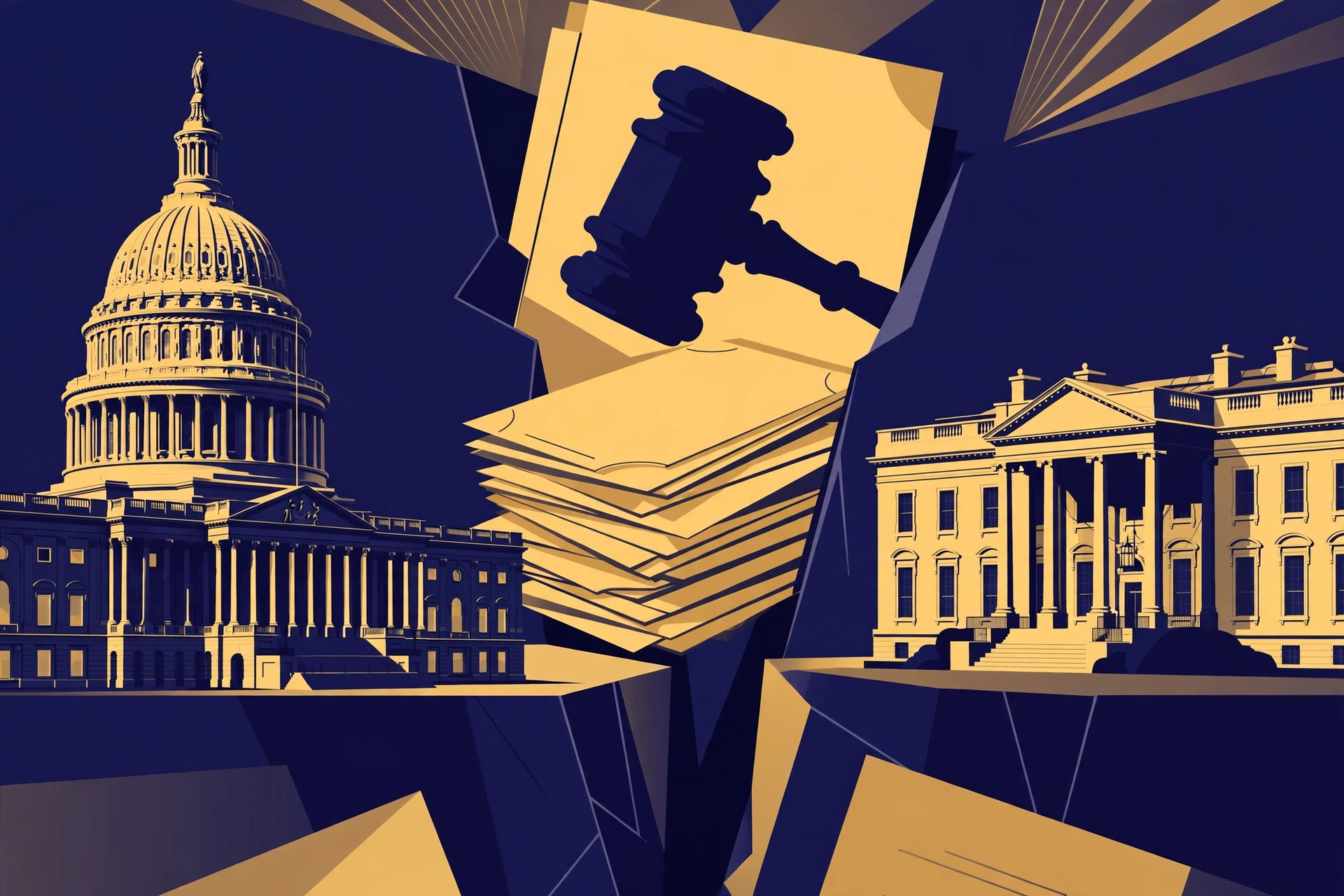
Washington — The White House has warned the Democrat set to lead the House Oversight Committee that the investigations his party has promised against the Trump administration could themselves amount to crimes, opening a constitutional confrontation weeks before the new Democratic-controlled Congress is seated in January.
In a three-page letter dated Monday, November 9, White House counsel William O. Scharf told Representative Robert Garcia of California, the incoming chairman of the House Committee on Oversight and Government Reform, that threats to executive branch officials and subpoenas issued only to abuse or intimidate them “may cross the line into blatant criminality” and “may warrant further investigation.”
The letter, first reported by Punchbowl News and then obtained by ABC News and other outlets, does not name a criminal statute, does not identify any specific act by any member of Congress as a crime, and does not announce a referral to the Justice Department. But its language is blunt, and it arrives at a moment when Democrats are openly preparing a wide programme of investigations into the administration, its officials and the president’s family and business interests.
Garcia rejected the warning on Wednesday, saying Congress draws its investigative power from Article I of the Constitution, not from the permission of the White House, and that the committee would not be deterred. The exchange sets up a fight that is likely to dominate the first months of the 120th Congress, testing how far a new majority can push oversight of a president who has already said he will treat such investigations as a crime.
The White House Warning: What Scharf’s Letter Actually Says
Scharf’s letter rests on a legal argument that is, in its narrow form, widely accepted: congressional investigations must serve a legitimate legislative purpose, and Congress may not use its investigative power to act as a prosecutor or a court. He cited two Supreme Court decisions for that principle, Watkins v. United States from 1957 and Trump v. Mazars from 2020, the case that set standards for congressional subpoenas seeking a president’s records.
From that starting point, the letter moves into much more contested territory. Scharf wrote that the administration is “monitoring the abusive and capricious threats” now coming from Democratic lawmakers, and argued that public vows of sweeping investigations show an intent to harass rather than to legislate. “Compulsory process is a power Congress has for oversight functions, and only for oversight functions,” he wrote, adding that “abusive threats and public statements about the indiscriminate issuance of subpoenas, along with threats directed at prospective targets within the Administration make it abundantly clear that any forthcoming investigative processes will be deployed to harass and aggrandize, rather than to advance any legitimate legislative end.”
The letter’s operative passage is the criminal warning itself. “Threats to executive branch officials designed to deter them from public service, or process designed merely to abuse or instill fear in the recipient may cross the line into blatant criminality,” Scharf wrote. “And issuing unlawful subpoenas with the intention of depriving citizens of their constitutional rights and privileges may warrant further investigation.”
He closed with a line that has since been quoted widely: the administration “will not be extorted and will not be cowed by unlawful process.” What the letter does not appear to do, based on published accounts, is identify any specific federal law that any Democrat has broken, say who would investigate, or claim that any referral has been made. ABC News noted that it is unclear how the Democratic statements cited in the letter could violate federal criminal law, and legal analysts quoted in early coverage were sceptical that the warning carried real legal force.
As evidence of intent, Scharf pointed to lawmakers’ own public statements and social media posts. Among them was Garcia’s own message on election night, November 3, when Democrats won control of both the House and the Senate: a two-word post reading “LAWYER UP,” aimed at administration officials. The letter also cited comments by other Democrats, including a remark that subpoenas would be handed out like candy and a statement by a congressman-elect that he could not wait to see Defence Secretary Pete Hegseth “squirm in a hearing room.”
How the Fight Escalated After Election Night
The Scharf letter did not arrive out of nowhere. It followed a weekend of sharp escalation from the president himself. On Saturday, November 7, President Donald Trump wrote on social media that Democrats’ threatened investigations amounted to “extortion at the highest level” and said he was ordering the Justice Department to look into what he called a “criminal act.”
On Sunday, November 8, Attorney General Todd Blanche criticised the planned investigations and said the Justice Department would represent administration officials before Congress. Blanche told CNN the same day that “there could be” a crime if Democratic rhetoric turned threatening, according to reporting by the Associated Press. He later struck a gentler tone, saying Congress has oversight authority and that the department works with lawmakers through subpoenas and letters.
The letter also landed days after Trump named Stephen Miller as White House chief of staff, replacing Susie Wiles, a change that put one of the administration’s most combative figures at the centre of its dealings with Congress. The sequence — the president’s “extortion” post, the attorney general’s warning, and then a formal letter from the White House counsel — has led Democrats to describe the episode as a coordinated attempt to frighten investigators before they take power. The White House, for its part, has framed it as a defence of constitutional limits that Democrats themselves have crossed in their public promises.
Democrats, meanwhile, were already moving to protect the evidence they will need. On the same day Scharf’s letter was dated, November 9, Representative Jared Huffman of California, the top Democrat on the House Natural Resources Committee, sent 36 preservation requests to federal agencies, companies and other organisations, asking private entities to “preserve all records and data responsive to oversight conducted” by the committee. The requests extend to messages on personal accounts and devices, ask recipients to disable disappearing-message settings, recover deleted information where possible and certify compliance by November 23. Huffman said in a statement that “our investigations will continue full steam ahead” and directed agency officials and corporate executives receiving the letters to “save everything.”
Garcia’s Answer: Article I, Not White House Permission
Garcia answered the White House on Wednesday. “Let’s be clear: Congress’ authority comes from Article I of the Constitution, not from the permission of the White House,” he said, adding that the committee would continue its work despite the threats. In a statement to CBS News, he said: “We are a co-equal branch of government and will not be deterred by baseless threats from a weaponized DOJ or from the President’s lawyers.”
In interviews this week, Garcia has been equally defiant. “We are not going to be threatened or intimidated because we are demanding accountability and oversight,” he said, adding that the idea that the White House counsel would send threatening letters “is not going to stop our important work.” He has also argued that the letter itself suggests the president has something to hide, a point his allies have repeated.
There was one awkward detail in the exchange. A spokesperson for Garcia said on Wednesday morning that the Oversight Committee had not formally received Scharf’s letter, even though it had already been reported in the press and published in full. That gap — between a letter written to the incoming chairman and a committee that says it has not formally received it — underlines how much of this fight is still being conducted in public, through statements and social media, rather than through the formal channels of Congress.
Garcia, who is expected to chair the House Oversight and Government Reform Committee when the new Congress is seated in January, has become the most visible face of the Democrats’ oversight plans. He has said his team will go after “the crooks, the con men, and the Trump crime family,” and has declared that “the days of us not fighting back are over.” That rhetoric is precisely what the White House letter cites as evidence of an improper purpose — and precisely what Garcia and his supporters describe as the ordinary language of a party that has just won an election on a promise of accountability.
The Legal Argument: Watkins, Mazars and Legislative Purpose
The legal question at the heart of the dispute is not new, but it has rarely been raised in such direct terms before a new Congress has even been seated. The Supreme Court has long held that Congress’s power to investigate is broad but not unlimited. In Watkins v. United States in 1957, the court held that investigations conducted solely for the personal aggrandisement of investigators, or to punish those investigated, are indefensible. In Trump v. Mazars in 2020, the court set out a balancing test for subpoenas seeking a president’s personal records, weighing Congress’s legislative interest against the burdens on the presidency.
Scharf’s letter leans heavily on both cases. The argument, as presented, is that Democrats’ own words betray a purpose that is not legislative at all: to harass officials, to deter them from public service, and to punish people associated with the president. If that is the purpose, the letter argues, the investigations would fall outside the constitutional limits on congressional power, and the conduct could cross into criminality.
Legal analysts quoted in early coverage were sceptical. ABC News legal analyst James Sample called the idea of criminalising the work of legislators more about posturing than a real threat. Democrats may also point to earlier warnings from Trump allies after the 2024 election, ABC News noted, suggesting that the letter is part of a pattern of political pressure rather than a serious legal claim. The letter’s critics make a further point: it does not explain how a statement by a member of Congress, or even a subpoena issued by a committee, could itself violate a specific federal criminal law, and it does not say which law would apply.
Supporters of the administration’s position would answer that the letter is a warning, not a prosecution, and that its purpose is to put Democrats on notice that the White House will test the limits of their investigations in court if necessary. That is a fight the administration has fought before. In Trump’s first term, he tried to block his accounting firm and two banks from complying with House subpoenas. In 2020, the Supreme Court declined to hand Congress those records immediately, but it reaffirmed that subpoenas need a legitimate legislative purpose — the same standard Scharf now invokes.
What is genuinely new is the suggestion, made in a formal letter from the White House counsel, that the investigative process itself could be investigated as a crime. No subpoena has been issued. The 120th Congress has not convened. The committees Democrats will run have not yet been organised. The warning is, for now, a statement of intent on both sides: Democrats intend to investigate, and the White House intends to challenge them.
The Widening Net: Preservation Demands to Senate Democrats
Within days of the Scharf letter, the confrontation widened beyond the House. Aaron Reitz, the United States attorney for the Southern District of Texas, sent preservation demands to three Democratic senators, each tied to their planned oversight work. Senator Richard Blumenthal of Connecticut received a letter on November 11, Senator Elissa Slotkin of Michigan on November 12, and Senator Elizabeth Warren of Massachusetts on Sunday, November 15.
A preservation demand is a letter asking the recipient to keep records. It is not a subpoena, not a court order and not a criminal charge, and no charges have been announced against any of the three senators. But the letters used striking language. Reitz accused Warren of potentially misusing her future position as chair of the Senate Banking Committee and cited two federal criminal civil-rights statutes, 18 U.S.C. sections 241 and 242, which concern conspiracies to interfere with constitutional rights and the deprivation of those rights by someone acting under government authority.
Reitz wrote that Warren was “on the warpath to wield her committee gavel like a tomahawk, seeking the scalps of those who associate ‘too closely’ with President Trump,” and said: “Congressional investigations can’t be used to punish Americans for exercising their 1A (First Amendment) rights.” He pointed to Warren’s appearance on CBS News’ “Face the Nation” earlier in November, during which she discussed plans to investigate major technology companies, Wall Street executives and corporations suspected of breaking the law. Asked whether her focus would be legislation or investigations, Warren said: “We have to do both. But I do want to be clear. If you’ve been making your profits by cheating American families and scamming your investors, you better get ready for some investigations, serious ones.”
Reitz also cited letters Warren had sent alongside other Democrats seeking information about fundraising connected to Trump’s projects, including the proposed White House ballroom, and spending by major technology companies. The letter to Blumenthal concerned his October letter to White House ballroom donors, which Reitz said showed an intent to deprive citizens of constitutional rights. Warren’s letter demanded that she preserve documents connected to potential investigations of the president’s associates and confirm compliance.
On Monday, 16 November, the confrontation reached Garcia himself. Reitz sent Garcia a fourth letter of his own, opening a preliminary inquiry into the incoming chairman and citing the same two statutes, 18 U.S.C. sections 241 and 242. The letter ordered Garcia to preserve documents and to confirm compliance in writing by 6 p.m. ET on Monday, 23 November. The same day, the watchdog group Campaign for Accountability filed a complaint against Reitz with the State Bar of Texas.
President Trump amplified Reitz’s letter to Warren by reposting it, and White House chief of staff Stephen Miller reposted it as well, writing simply: “18 USC 241 and 242.” White House communications director Steven Cheung accused Democrats of pursuing politically motivated investigations against people associated with the president, calling it “nothing more than an extension of their political witch-hunt that has gone on for far too long.” Democrats have indicated that their investigations could include major corporations, Miller himself and the technology billionaire Elon Musk.
Taken together, the five letters — Scharf’s to Garcia, Reitz’s to Blumenthal, Slotkin and Warren, and Reitz’s preliminary-inquiry letter to Garcia himself — amount to a pattern: the administration is warning the incoming Democratic majority, in writing and in public, that its oversight plans may carry legal consequences. Whether that pattern is a legitimate defence of constitutional limits or an attempt to intimidate a co-equal branch is now the central question of the pre-January standoff, and it is one that both sides are answering in the most public way possible.
What Democrats Plan to Investigate in January
Democrats have previewed a long list of targets for the new Congress. According to reporting by the Associated Press, they include Trump family wealth accumulated since the president returned to office, the administration’s handling of the Jeffrey Epstein investigation, immigration enforcement operations, the White House ballroom and other construction projects, Trump family roles in mineral deals and the president’s cryptocurrency dealings with special envoy Steve Witkoff.
The breadth of that list is part of what the White House objects to. Scharf’s letter treats the sheer range of promised investigations as evidence that they are not tied to any single legislative purpose, but are instead a programme of harassment. Democrats respond that the range reflects the range of their concerns, and that each inquiry would be tied to legislation, appropriations or the oversight of executive agencies — the ordinary work of Congress.
The two sides also disagree about what counts as evidence of improper intent. The White House cites campaign-style rhetoric: “lawyer up,” subpoenas “like candy,” officials made to “squirm” in hearings. Democrats cite the same remarks as political speech, and note that members of Congress have always previewed their oversight plans in blunt terms before taking power. The test, if it ever reaches a court, will be whether the investigations themselves serve a legislative purpose — a question that can only be answered once the investigations actually begin.
Reaction on the Republican side has been mixed. House Oversight Chairman James Comer of Kentucky said he had not read the letter, described the committee as “very independent” and called Garcia’s “lawyer up” remark bad taste, according to the Associated Press. Representative Thomas Massie of Kentucky said he hopes lawmakers pursue substantive oversight rather than squander the chance on “stupid things.” Neither man endorsed the White House’s criminal framing, and neither condemned it outright — a split that suggests the letter’s reception among Republicans is far from settled.
For now, the Democrats’ plans remain plans. No subpoenas have been issued, no hearings have been scheduled, and no committee has been organised under the new majority. The investigations Democrats have promised will only become real when the new Congress convenes, and it is only then that the White House’s warning will be tested against the actual conduct of those investigations.
What Happens Next Before the New Congress Is Seated
The weeks between now and January will be filled with positioning. Democrats have now begun sending preservation letters of their own — Garcia sent 12 on Wednesday, 18 November — locking down records before the transition of committee power. The administration is expected to continue warning, in public and in private, that it will resist what it regards as abusive process. Attorney General Blanche, who said on November 15 that “we welcome oversight” but that what Democrats have been talking about “has nothing to do with oversight,” will be central to any dispute over whether officials comply with subpoenas or resist them.
Several markers are worth watching. The first has already moved: on Wednesday, 18 November, Garcia sent 12 preservation letters of his own — to Donald Trump Jr., Eric Trump, Jared Kushner, Kimberly Guilfoyle, Vice President JD Vance, Chief of Staff Stephen Miller, Attorney General Todd Blanche, former chief of staff Susie Wiles, Kristi Noem and Corey Lewandowski — covering Trump-family business, corporate corruption, Department of Homeland Security misconduct and the Epstein files. The same day, Scharf wrote to House and Senate ranking members that ranking-member requests carry no obligation to comply and must start over in January, calling the demands “pettiness”. The second is the preservation deadline of November 23 set in Huffman’s requests and in Reitz’s letter to Garcia, and whether the recipients comply, resist or seek court protection. The third is whether the Justice Department takes any further formal step beyond the letters already sent.
The longer-term question is whether the courts will be drawn in at all. Past clashes between Congress and the White House over subpoenas have often ended in negotiation, delay or a narrow court ruling rather than a decisive confrontation. But the language used in the last ten days — “extortion,” “blatant criminality,” “weaponized” Justice Department, “witch-hunt” — suggests that both sides see this fight as political as much as legal, and that neither is looking for a quiet compromise.
What is clear is that the oversight fight has begun before the oversight itself. The White House has put the incoming chairman on notice. The incoming chairman has said he will not be deterred. The senators who received preservation demands have not backed down. And the new Congress, when it is seated in January, will inherit a confrontation that is already fully formed — over subpoenas not yet issued, investigations not yet begun, and a constitutional question that the courts may ultimately have to answer: where does legitimate oversight end, and where does the White House say criminality begins?
Sources
USN reviewed reporting from multiple outlets for this story. Read more from Sullivan & Cromwell, Court News and MEAWW.