

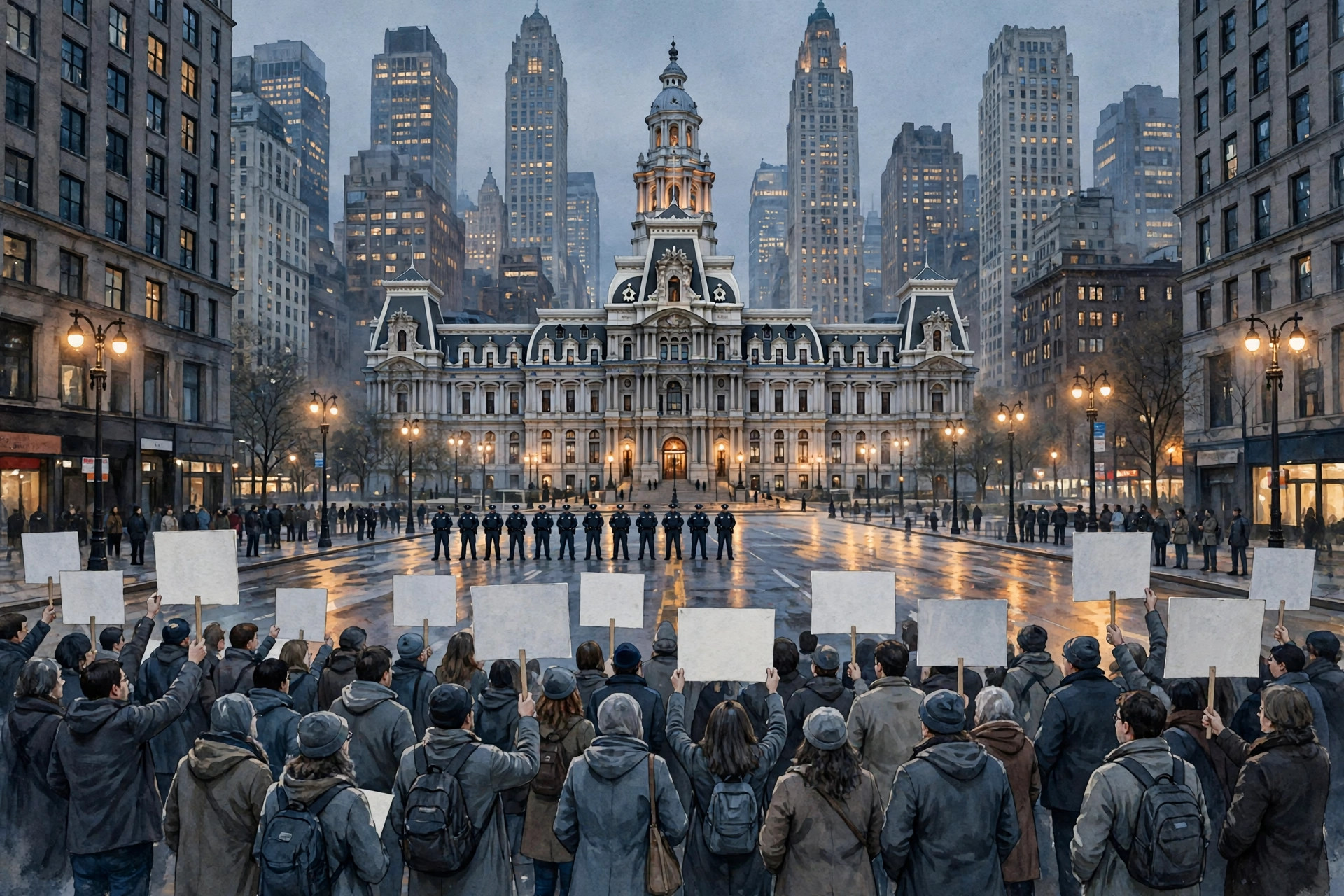
New York City Mayor Zohran Mamdani announced on Monday, November 16, 2026, that the city is disbanding the New York Police Department’s Strategic Response Group, the controversial unit that has policed large demonstrations in the city for more than a decade. The decision, announced jointly with Police Commissioner Jessica Tisch, fulfils one of the most prominent promises of Mamdani’s mayoral campaign and sets in motion the largest reorganisation of protest policing in New York in years. In place of the unit, the administration is creating a civilian-led Community Dialogue and De-escalation Division inside the mayor’s office and a new Patrol Support Division inside the police department, while moving the unit’s counterterrorism work to the NYPD’s Intelligence and Counterterrorism Bureau.
“During our campaign, I promised New Yorkers that we would disband the Strategic Response Group and separate counterterrorism from protest response, and today we are delivering on that promise,” Mamdani said in announcing the change. “New Yorkers exercising their constitutional right to protest should not be met with the same police response as a terrorism threat,” he said in a statement accompanying the announcement. The mayor’s argument, repeated throughout his campaign, is that the city has for years answered demonstrations with the same heavily armed posture it uses against a terrorist threat, and that the mismatch has produced confrontation, injury and litigation. Supporters of the change say the new structure will treat a march, a rally or a picket line as a civic event first, with force held in reserve for genuine threats. Critics, including the city’s largest police union, say the move removes a trained and tested capability at a moment when large, volatile demonstrations remain a regular feature of city life.
The Strategic Response Group, known as the SRG, was established in 2015 as a unit that combined counterterrorism duties with the policing of protests and civil disorder. Its officers were equipped with long guns, heavy protective gear and, in some deployments, machine guns, and they were sent to secure sensitive locations as well as to manage crowds. Over time, however, the unit became associated above all with protest policing, and in particular with the demonstrations that followed the killing of George Floyd in 2020 and the wider Black Lives Matter movement. During those protests, officers were accused of using excessive force against demonstrators, journalists and legal observers, and the unit’s tactics became a central grievance of civil liberties groups, activists and lawmakers. A review by the city’s Department of Investigation previously found that the NYPD had used excessive force during demonstrations and infringed on protesters’ First Amendment rights, with the SRG playing a central role in the department’s protest response during that period.
Why the NYPD Strategic Response Group became so controversial
The legal reckoning came in 2023, when the city reached a settlement after New York Attorney General Letitia James, the New York Civil Liberties Union and others sued over excessive force against protesters, journalists and legal observers during the protests against police violence in the summer of 2020. The settlement rebuked the SRG and required the department to revise its procedures, including restrictions on surrounding protesters. The NYCLU and other civil rights groups cautiously welcomed Mamdani’s announcement on Monday, while expressing concern that the new Patrol Support Division might end up as a rebranding of the SRG rather than a genuine disbanding. The Legal Aid Society, the city’s largest public defender’s office, commended the disbanding of what it called “one of the NYPD’s most notorious units” in a statement, but said the new unit “will require vigilant oversight to ensure that the SRG’s tactics are not repeated.” The NYCLU said it will be “monitoring this new unit closely, including for compliance with our 2023 settlement with the City.”
The unit’s history did not end with the settlement. It faced particularly harsh criticism following the 2020 protests, and a city oversight review found that police had violated protesters’ rights, with the unit playing a central role in crowd control during those demonstrations. Police officials maintain that the SRG’s involvement in demonstrations has since been significantly reduced. Between the beginning of 2026 and October, the unit was deployed to just 22 of the city’s 2,730 protests and made 18 arrests, according to reporting on the announcement. That figure has become part of the argument on both sides: supporters of disbanding say it shows the unit is no longer central to protest policing and can safely be dissolved, while critics say it shows the unit was already being used sparingly and that its removal solves a problem that had largely been addressed. The dispute over those numbers illustrates how differently the two sides read the same record, and why the coming months of implementation will matter as much as the announcement itself.
Pressure on Mamdani to act intensified again last month following clashes between police and demonstrators protesting the activities of federal immigration authorities. A Democratic congressional candidate was pushed to the ground by a police officer, prompting activists to demand the unit’s immediate dissolution. Police maintained that SRG officers had not participated in that incident. Nevertheless, the controversy increased political pressure on the mayor from left-wing activists who had supported his election, and it sharpened the question of whether the new mayor would move quickly on a promise that had been central to his campaign. The announcement on Monday answers that question in the affirmative, but it also leaves the administration with the harder task of showing that the replacement structure works in practice, on the street, at the next large demonstration.
What replaces the disbanded NYPD protest unit
Under the restructuring, the responsibilities of the SRG will not disappear but will be redistributed. Counterterrorism duties, including deploying heavily armed officers at sensitive locations, will move to the NYPD’s Intelligence and Counterterrorism Bureau. Officers will be reassigned to other roles, with no reduction in police staffing. Commissioner Tisch, who runs one of the world’s largest police forces and its nearly 7 billion dollar annual operating budget, said there were about 500 SRG officers who would be reassigned within the department before next spring. Some, she added, would go to the existing Counterterrorism Bureau. Other reporting has put the unit’s size lower, at roughly 300 to 350 officers, a discrepancy that reflects different ways of counting assigned, attached and deployable personnel; the commissioner’s figure of about 500 is the administration’s own account of how many officers will be reassigned, and it is the figure the department will be judged against as the transition proceeds.
The civilian side of the new structure is the Community Dialogue and De-escalation Division, which will sit inside the mayor’s office. Its members will not carry weapons and will not have arrest powers. A 30-officer NYPD team, the First Amendment Support Team (FAST), will receive specialised training in negotiating with protest organisers. Another police unit will handle situations requiring crowd dispersal or arrests, and its officers will also assist in searches for missing people, major parades and emergencies. The dissolution of the SRG is expected to be completed in spring 2027. The administration has said the new protest-response structure will be implemented without requiring additional funding or increasing the overall size of the NYPD workforce. That pledge will be tested as the new division hires, trains and deploys staff, and as the department works out which of its existing units absorb the work the SRG used to do.
The reform also aligns with proposals contained in the CURB Act, legislation proposed by New York City Councilmember Chi Ossé, who led the bill calling for these changes. Ossé has said that long guns, tear gas, kettling and pepper spray will not be used as crowd-management tools under the new approach. The CURB Act has not passed — it has not had a hearing and has stalled in committee — so the restructuring currently rests on the mayor’s executive action, and the civilian division is not expected to be operational until 2027–2028. The connection to the bill still matters because it signals that the City Council, or at least a significant part of it, supports the direction of travel. Former Mayor Eric Adams urged City Hall late on Monday, 16 November, to reverse the decision, citing unrest in Paris. Whether the council formalises the new arrangements in law, and how it exercises oversight over the new division, will be one of the questions to watch in the months ahead.
New limits on kettling, tear gas and pepper spray
One of the most significant parts of Mamdani’s announcement involves restrictions on police crowd-control tactics. The NYPD will formally prohibit kettling, a controversial tactic in which officers surround and contain groups of demonstrators, restricting their ability to leave an area. The new rules will also introduce restrictions on the use of tear gas and long guns during protests. Officers will be prohibited from using tear gas or long guns, while the use of pepper spray will be restricted, and pepper spray will no longer be permitted as a crowd-management tool. The use of powerful long-range acoustic devices will be limited, with their use capped at a maximum of 90 decibels, and officers will not be permitted to use bicycles as weapons against protesters except when necessary to prevent death or physical injury.
These restrictions are intended to reduce the use of force during demonstrations and establish clearer boundaries for police conduct. For civil liberties advocates, they are the most concrete part of the announcement, because they constrain specific tactics that produced injuries and complaints in 2020 and afterwards, rather than merely changing the name of the unit that used them. For police leaders, they raise practical questions about how officers should respond when a demonstration turns violent or blocks a bridge or a roadway, and whether the new limits leave officers with workable alternatives. Commissioner Tisch sought to answer that concern directly, telling ABC’s Eyewitness News in a joint interview with the mayor that “nothing would change about the way that the NYPD responds to crowd control conditions.” A spokesperson for the mayor did not respond to queries about how the new Patrol Support Division would differ from the SRG, or whether it would be staffed by former SRG officers, leaving an important detail unresolved on the day of the announcement.
Police unions warn the change endangers officers and the public
Police unions criticised the move, saying it would endanger the safety of officers and the public. “The next time your life is disrupted by demonstrators who are blocking bridges and roadways or causing chaos on our streets, remember: Mayor Mamdani is on their side, not yours,” Patrick Hendry, president of the Police Benevolent Association, said in a statement. Hendry accused the mayor of prioritising the demands of his political supporters over public safety. The union’s argument is that the SRG provided a disciplined, trained and equipped response to the most difficult crowd situations, and that removing it will leave front-line officers less supported and the public less protected when demonstrations escalate. That argument is likely to be repeated at every flashpoint in the coming months, and the administration will need to show, incident by incident, that the new structure can handle the situations the SRG used to handle.
The dispute also highlights tensions within Mamdani’s administration. Socialist and pro-Palestinian activists had demanded that he dismantle the SRG and dismiss Police Commissioner Jessica Tisch, whom some of those activists associate with the pro-Israel establishment. Tisch, however, endorsed the overhaul, making clear that she would not support changes that undermined the department’s ability to protect New Yorkers. She said the reforms would strengthen the NYPD while preserving the resources needed to respond to serious threats. Commissioner Tisch has also said she believes strongly that the NYPD must always be willing to examine how it operates and make improvements. Her endorsement gives the restructuring credibility inside the department, but it also means she shares responsibility for its success or failure, and her continued tenure will be watched closely by both the mayor’s supporters and his critics.
Jewish community leaders raise security concerns
The decision has drawn concern and anger from parts of New York’s Jewish community. The SRG has become a symbol of confrontations between police and pro-Palestinian protesters in recent years, and Jewish leaders warn the decision could weaken protection for synagogues and community events. Mitch Silber, a former senior NYPD intelligence official who now heads the Community Security Initiative, a joint programme of UJA-Federation of New York and the Jewish Community Relations Council of New York, warned after Mamdani’s election that dismantling the unit would undermine Jewish security. According to Silber, the SRG is the force that physically stands between protesters chanting “Free Palestine” and members of the Jewish community. Jewish security officials are considering training volunteers to help maintain separation between groups at potentially volatile events, though such volunteers would not be able to replace a trained police force in the event of a terrorist attack.
The concerns are also rooted in memories of the wave of campus protests. In April 2024, New York police cleared protest encampments at Columbia University and removed demonstrators who had occupied a university building, in an operation that became one of the defining confrontations surrounding the Gaza war. SRG officers took part in the police response. One of the demonstrations cited in the debate was led by the anti-Zionist Jewish organisation Jewish Voice for Peace, whose members blocked a road near United Nations headquarters. The arrests that followed reignited debate over how police handle protests against Israel. Civil liberties organisations, however, view the unit differently, arguing that it has repeatedly used excessive force against demonstrators regardless of their political positions. That disagreement, over whether the unit protected vulnerable communities or endangered protesters, is the heart of the argument about its legacy, and it will not be settled by the announcement alone.
What happens next for New York protest policing
The practical test of the restructuring will come in stages. First, the reassignment of about 500 officers must be completed before next spring, with some moving to the Counterterrorism Bureau and others to the new Patrol Support Division and other roles. Second, the Community Dialogue and De-escalation Division must be staffed, trained and given a clear role at demonstrations, so that its unarmed members are present and effective rather than symbolic. Third, the new tactic limits must be written into department procedures, taught to officers and enforced, so that the ban on kettling and the restrictions on tear gas, pepper spray, long guns and acoustic devices are real constraints rather than paper promises. Each of those steps will generate its own reporting, its own disputes and its own measures of success, and the administration’s claim that the change requires no additional funding and no increase in the size of the workforce will be tested against the cost of training and transition.
For now, the announcement marks a clear break with the way New York has policed protests for the past decade. A unit created in 2015 to combine counterterrorism with protest policing, and criticised for using excessive force in 2020, is being dissolved on the order of a mayor who promised during his campaign to do exactly that. Whether the replacement structure delivers the de-escalation and community engagement the mayor promises, while preserving the security presence that vulnerable communities say they rely on, is the question that will define the reform. The answer will not come from the announcement, or from the statements of supporters and critics on the day it was made, but from the first large demonstrations policed under the new arrangements, and from the accounts of the protesters, the officers and the communities caught between them.
Sources
USN reviewed reporting from multiple outlets for this story. Read more from Reuters, Ynet and The Economic Times.