

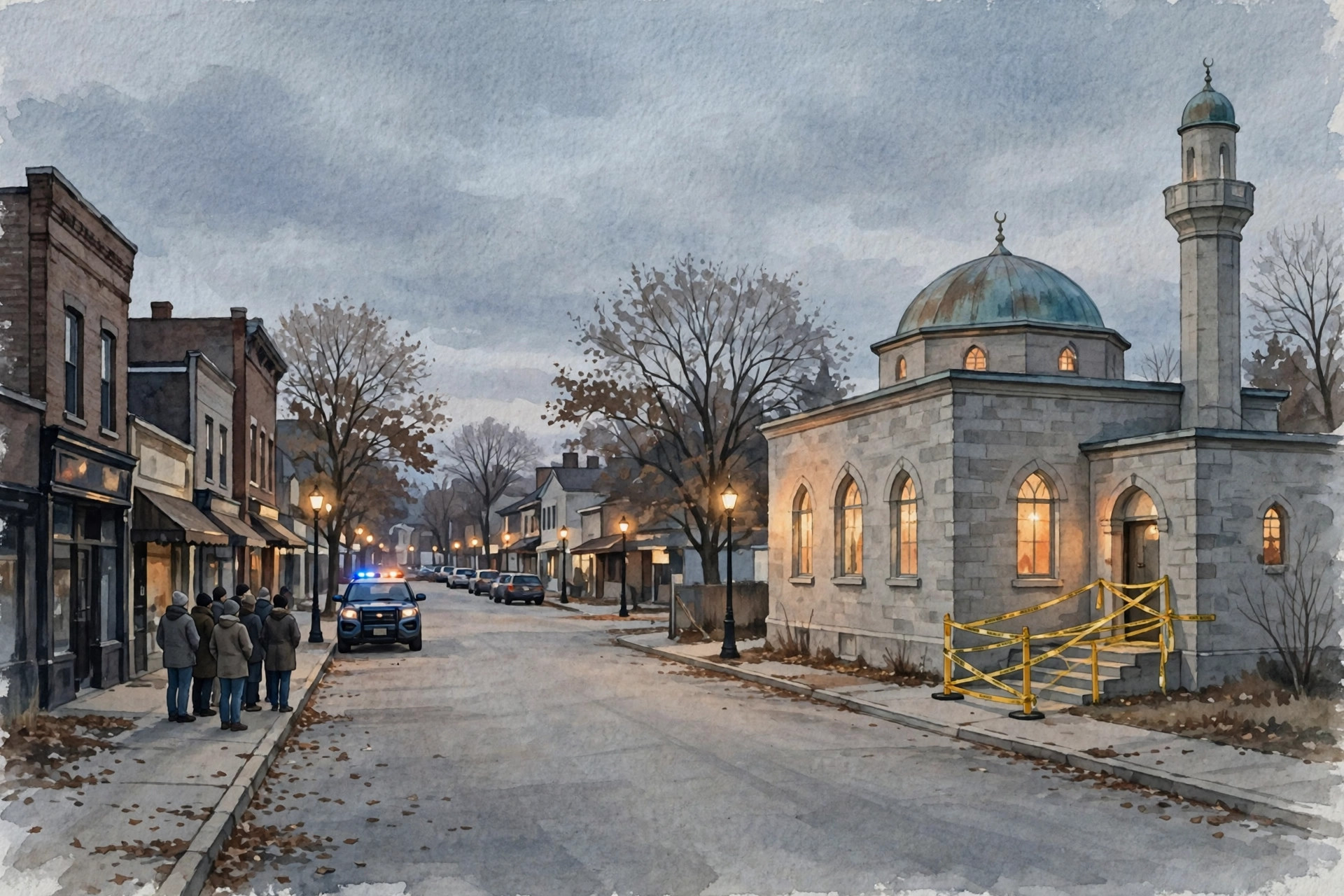
A suspect has been arrested in connection with the fire set at the entrance of the Gadsden Islamic Society in Gadsden, Alabama, the FBI’s Birmingham Field Office and the Gadsden Police Department announced on Saturday night, November 14, 2026. The arrest came three days after an incendiary device was thrown at the front entrance of the mosque on Wednesday evening, November 11, and it followed a public appeal for help, the release of surveillance images and the offer of rewards totalling up to 30,000 dollars. The building was empty when the fire was set, no one was hurt, and community members put the flames out within minutes, before the fire could spread inside. The investigation remains active, and authorities have said no additional information is available for now.
Gadsden Police have now identified the suspect as 35-year-old Daniel Timothy Mason Black. According to the Etowah County Jail record, Black faces charges of second-degree arson and possession or manufacture of a destructive device, and his bond was set at 750,000 dollars. The FBI, in announcing the arrest on Saturday night, did not identify the person arrested or provide information about possible charges. That gap between the federal announcement and the local identification is itself part of the story: the FBI said the arrest resulted from coordinated investigative efforts and information provided by members of the public, and it thanked the community and local law enforcement for their assistance, while declining to release further details. The charges as listed in the jail record are allegations, and Black is presumed innocent unless proved guilty in court. No motive has been made public, and police have not said whether the fire is being investigated as a hate crime.
The fire was set at about 6:20 p.m. on Wednesday, November 11, at the Gadsden Islamic Society building at 108 South Ninth Street. Gadsden firefighters were called for what was first reported as a trash fire, and police said a rug outside the building’s entrance burned. Surveillance video shows a masked person walking up to the front entrance and throwing an object, followed by flames and smoke. Yousef Alabbasi, a co-founder of the Gadsden Islamic Society, told WBRC that the object was a rubber mat that was set on fire and thrown like a Molotov cocktail. The mosque’s imam helped put out the fire within minutes, before it could spread, and nearby community members saw the flames and put them out before the fire reached inside. Firefighters found a burned doormat, and the building was not damaged. The FBI’s Birmingham Field Office posted a public notice calling it an arson and said an incendiary device was used at the entrance of the building.
How the Gadsden Alabama mosque arson investigation unfolded
The investigation moved quickly, and in public. On Friday, November 13, the FBI posted its public notice and released pictures depicting a person wearing gray clothing and a hooded sweatshirt approaching the entrance and throwing an object that ignited a fire. The Alabama office of the Council on American-Islamic Relations announced on Friday that it offered a 10,000 dollar reward for information leading to the arrest and conviction of the person depicted in the images. The FBI then offered a reward of up to 20,000 dollars for information leading to the identification, arrest and conviction of the individual or individuals responsible. Those with information were asked to submit a tip to the FBI or by calling 1-800-CALL-FBI, and photos and video could be sent through the FBI’s Digital Media Tip Line or through the bureau’s dedicated page for the case.
By Saturday night, the FBI and Gadsden police announced that a person had been taken into custody. FBI Birmingham Special Agent in Charge David R. Fitzgibbons thanked the community and local law enforcement for their assistance. “This arrest reflects the tireless work and close collaboration of our law enforcement partners at every level,” Fitzgibbons said. In a statement on Saturday afternoon, Fitzgibbons had said: “Acts of violence targeting places of worship threaten the safety and security of entire communities. The FBI is committed to identifying those responsible for this act of violence and ensuring they are held accountable under the law. To encourage the public’s assistance, the FBI is offering a reward of up to 20,000 dollars for information leading to the identification, arrest, and conviction of the individual or individuals responsible. To those responsible, Justice Will Find You.” Fitzgibbons added that even minor information could help the FBI’s investigation significantly.
Gadsden Police Chief Lamar Jaggears, speaking before the arrest, said the department was doing everything it could to find out who set the fire. “We want our community to know that we’re doing everything we can to find out who did this,” Jaggears said. “We’ve been working closely with the FBI and our other law enforcement partners, sharing all the information we have and following every lead. We’re thankful for their help and the resources they’ve brought to this investigation.” The arrest, announced about 48 hours after the fire, was the result of that joint work and of the public’s help, according to the FBI. The speed of the arrest, from a Wednesday evening fire to a Saturday night custody announcement, was noted by local and federal officials alike, and by the United States Attorney for the district, who said investigators had reached out to local police and the FBI immediately and that a suspect was in custody in a matter of about 48 hours.
What happened at the Gadsden Islamic Society entrance
The details of the fire itself are now well established, and they explain why the damage was limited even though the act was serious. The building was unoccupied at the time, and the fire was confined to the entrance area, where a rug or doormat burned. The object thrown at the doorway was described by the society’s co-founder as a rubber mat set on fire and thrown like a Molotov cocktail, and the FBI confirmed that an incendiary device was used. Community members extinguished the fire before it spread, according to CAIR, which posted a video on YouTube of the fire being set. The society said in a statement that it was working with law enforcement, thanked God for protecting its members and building, and praised community members whose quick action kept the damage from being worse.
The Gadsden Islamic Society is one of the largest mosques in Alabama, according to WBRC, and its building on South Ninth Street serves a community that has lived in the city for many years. That context matters to the way the fire has been received locally. Alabbasi told WBRC it was sad to see this happen in a small town like Gadsden, and he urged whoever did it to look to what faith traditions teach about respecting neighbours and accepting the beliefs of others. The society called the fire an attack on Alabama’s Muslim community and on every person’s right to practise their faith in peace. “This arson attack on the Gadsden Islamic Society is an attack on not only the Alabama Muslim community, but every person’s constitutional right to practice their faith in peace,” the society said in a statement.
The physical facts of the night also matter to the charges. Second-degree arson and possession or manufacture of a destructive device are the charges listed in the Etowah County Jail record for Black, and they reflect the allegation that an incendiary device was used rather than an accidental fire. The jail roster uses shorthand — “attempted second-degree arson” and “possession or transport of a biological weapon” — and notes that charges and bail can change after court appearances; the formal charging papers will control. The bond of 750,000 dollars reflects the seriousness with which the authorities are treating the case, although bond is not a finding of guilt and the charges remain allegations to be tested in court. Black was booked into the Etowah County Jail at 2:33 a.m. on Sunday, 15 November, with Gadsden Police listed as the arresting agency, according to reporting on the jail record, and the investigation remains ongoing, with authorities saying no additional information was available at the time of the announcement.
Community response in Gadsden after the mosque fire
The response from the city and from the mosque’s neighbours was swift and public. Gadsden Mayor Craig Ford condemned the fire in a statement from the city. “We do not condone violence of any kind in our city,” Ford said, according to WEIS. He said everyone in Gadsden deserves to feel safe and respected, and that the city will use every available resource to find answers. The Gadsden Islamic Society called on all Alabama political leaders to “speak out against this crime, condemn anti-Muslim hate, and protect every community’s right to religious freedom.” That call, and the mayor’s condemnation, framed the fire as a matter for the whole city rather than for one congregation alone, and they were echoed by the FBI’s statement that acts of violence targeting places of worship threaten the safety and security of entire communities.
CAIR’s Alabama chapter also called on Alabama leaders, including Governor-elect Tommy Tuberville, to speak out against anti-Muslim rhetoric. CAIR has criticised Tuberville’s past statements about Islam, although it has not presented evidence linking those statements to the Gadsden fire, and investigators have not publicly tied the fire to political speech. The distinction matters: the call for leaders to speak out is a political and moral argument about the climate in which such an attack happens, while the criminal investigation is concerned with who set the fire and why, and on that question the authorities have released no motive. Keeping those two questions separate is important, because the first can be debated in public while the second must be proved in court, and conflating them risks prejudging a case that is still under investigation.
The practical response at the mosque has also been part of the story. The society is seeking comment on the status of the investigation and on any added security, and local reporting has sought comment from the Gadsden Police Department on the same questions. Places of worship that have been attacked often review their security after an incident, and the society’s members, like congregations elsewhere, will be asking what more can be done to protect the building and the people who use it. For now, the building itself was not damaged, the fire was put out within minutes, and the community’s quick action is the reason the incident ended as a burned doormat rather than a burned building.
Is the Gadsden mosque fire being investigated as a hate crime
Police have not said whether the fire is being investigated as a hate crime, and no motive has been made public. Gadsden police told ABC 33/40 that the investigation is active and that they are reviewing surveillance footage and other evidence, and that more information will be released when it is available. The Alabama chapter of the Council on American-Islamic Relations called the fire an arson attack and asked authorities to consider whether the mosque was targeted because of its religion. CAIR’s national deputy director, Edward Ahmed Mitchell, said investigators should look at it as a possible hate crime while saying the motive is not yet known, according to the station. That careful formulation, that the possibility should be examined while the motive is not yet known, is the correct way to frame a question that cannot be answered until the evidence is in.
The question matters because the legal consequences of a fire at a house of worship can depend on why it was set, and because the community’s sense of safety depends on whether the attack was aimed at them specifically or was a random act. Federal law provides enhanced penalties for crimes motivated by bias, and the FBI’s involvement in the case from the start reflects the seriousness with which attacks on places of worship are treated. At the same time, an arrest on arson and destructive device charges does not by itself establish a hate crime, and the authorities have not announced any hate crime charge. Until they do, or until they say they have ruled it out, the honest description is that the motive is unknown and the investigation is continuing.
United States Attorney Phillip W. Williams Jr., speaking on Monday morning, November 16, warned against praising or excusing the suspect charged with starting the fire at the Gadsden Islamic Center Mosque. Williams took to social media to criticise those who applauded, exculpated or took the side of the suspect, and he said investigators had begun reaching out to local police and the FBI immediately after the fire. His intervention, two days after the arrest, shows how quickly the case had become a subject of public argument online, and how seriously federal prosecutors are taking both the attack itself and the public response to it. It also underlines that the case is now in the hands of prosecutors and the courts, where the charges will be tested and where the question of motive may eventually be addressed in open proceedings.
What remains unknown about the Gadsden arson case
Several important facts remain unknown, and they should be stated plainly rather than filled in by speculation. The FBI did not identify the person arrested in its announcement, and the identification of Daniel Timothy Mason Black as the suspect comes from Gadsden Police and the Etowah County Jail record, rather than from a federal statement naming him. The FBI has not provided information about possible charges beyond what the jail record shows, and it has not said what evidence led investigators to the arrest. The investigation remains ongoing, and authorities have said no additional information is available. No motive has been announced, no court appearance or formal indictment had been reported by the evening of Tuesday, 17 November, and no federal or hate-crime charge had been brought. That means the public record, for now, consists of the fire itself, the surveillance images, the rewards, the arrest announcement and the jail record, and any account that goes beyond those facts is speculation.
Other questions will be answered only as the case proceeds. Whether additional charges will be filed, whether the case will be prosecuted in state or federal court, whether a hate crime enhancement will be sought, and what, if anything, the suspect is alleged to have said or done before or after the fire are all matters for the investigation and the courts. The society, the city and the FBI have all said they will release more information when it is available, and the responsible course for readers is to wait for those releases rather than to treat rumour or social media commentary as fact. The arrest is a significant development, but it is not the end of the case, and the most important details, including motive, may not be known for some time.
Why the arrest matters for Gadsden and Etowah County
The arrest matters for Gadsden because it shows that a small city, working with federal investigators and with help from the public, can identify and detain a suspect quickly after an attack on a house of worship. It matters for the Muslim community in Alabama because it shows that the authorities treated the fire as a serious crime from the start, offering rewards, releasing surveillance images and bringing federal resources to bear. And it matters for the wider public because it demonstrates the role that ordinary people played: the community members who put out the fire, the people who provided information that led to the arrest, and the neighbours who spoke out against the attack. Those three acts, extinguishing the flames, providing information and condemning the crime, are the reason the incident ended without injury, without serious damage and with a suspect in custody within about 48 hours.
At the same time, the arrest does not by itself restore the sense of safety that the fire disrupted. A house of worship is a place where people should feel safe, and an incendiary device thrown at its entrance, even one that burns only a doormat, is an attack on that safety. The society’s statement, that the arson is an attack on every person’s constitutional right to practise their faith in peace, captures why the case resonates beyond Gadsden. The coming weeks will show whether the criminal case proceeds to a conviction, whether a motive is established, and whether the community’s sense of security is restored. For now, the facts are these: a fire was set on the evening of November 11, no one was hurt, the building was not damaged, a suspect was arrested on November 14 and charged with arson and destructive device offences, and the investigation continues.
Sources
USN reviewed reporting from multiple outlets for this story. Read more from The Gadsden Times, WIAT and Gadsden Thrive.