

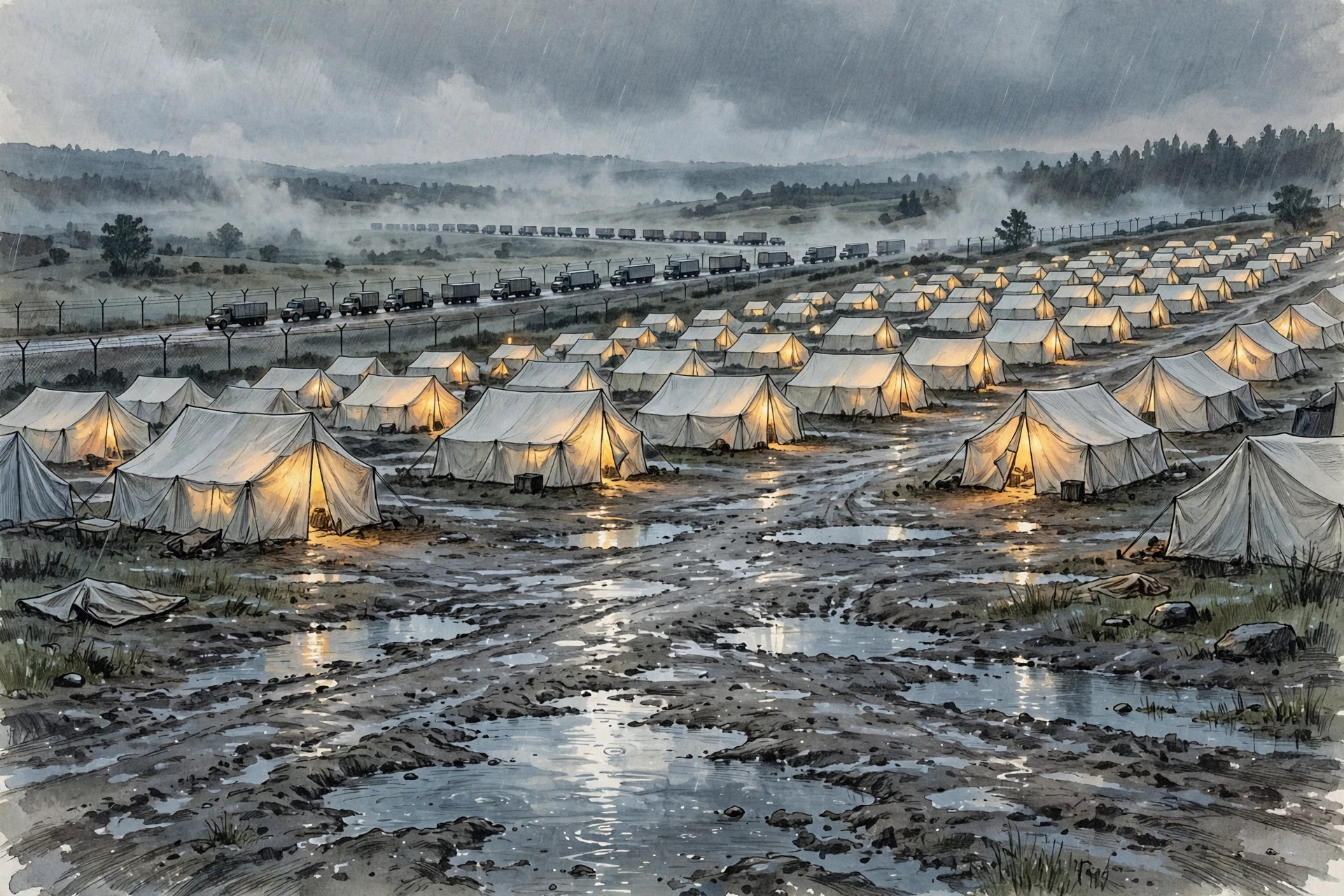
Four nations demanded on Sunday 15 November that Israel let 150,000 tents and other vital supplies into Gaza without further delay, warning that winter floods have turned displacement camps into soaked and dangerous places for more than a million people sheltering in tents. The foreign ministers of Australia, Canada, Italy and the United Kingdom said in a joint statement that “the humanitarian situation on the ground is dire” and called on Israel to “stop the delays now” and allow “immediate, rapid and unimpeded humanitarian access throughout Gaza”. The appeal, reported widely on Monday 16 November, is the sharpest joint diplomatic pressure on Israel over Gaza aid since the ceasefire took effect in October 2025, and it comes after the Board of Peace, the body created by United States President Donald Trump to oversee his Gaza peace plan, described Israel’s response to the flooding as insufficient.
The four governments did not present their statement as a routine expression of concern. They said the flooding had come with only the first storm of the winter, and that conditions could get worse in the weeks ahead. “This situation is entirely reversible, and there is still time to act before the winter fully sets in,” they said. That line captures the argument at the heart of the dispute: the tents, tarpaulins, pumps and medical supplies that Gaza needs are, according to the United Nations and the four governments, already bought and waiting outside the territory, and the question is whether Israel will let them in fast enough to protect families from the cold and rain. Israel says it has already delivered tens of thousands of tents and thousands of truckloads of winter supplies, and it accuses Hamas of blocking recovery and diverting aid. The two accounts do not agree, and the gap between them is now a diplomatic crisis in its own right.
The statement also matters because of who signed it. Australia, Canada, Italy and the United Kingdom are not hostile powers to Israel; they are Western allies, and their decision to speak together, in a single blunt statement, signals that patience with the pace of aid deliveries is wearing thin. The European Union issued a similar statement on Saturday, and the United Nations humanitarian team in the territory said on Friday that the impact of the latest rainstorm had been preventable. The pressure is building from several directions at once, and it is aimed squarely at the crossings into Gaza, where the flow of tents and supplies is decided day by day.
What the four nations actually asked for
The joint statement, issued by the four foreign ministers on Sunday, made three central demands. First, Israel should allow immediate, rapid and unimpeded humanitarian access throughout Gaza, ending the delays that the ministers say are holding back shelter and relief. Second, border crossings must be opened and the entry of tent supplies allowed, including so-called dual-use items needed for humanitarian operations and early recovery. Third, all parties should respect the ceasefire, uphold international humanitarian law and implement the Comprehensive Plan for Gaza so that assistance can reach vulnerable people.
The ministers put the scale of the problem in a single figure: 150,000 tents and other vital supplies are being held at the border and prevented from entering Gaza. The United Nations Office for the Coordination of Humanitarian Affairs, known as OCHA, has said that more than 150,000 tents were outside Gaza ready to go in, along with pumps and other equipment needed to clear floodwater. The four governments warned that recent flooding from the first winter storm had compounded the suffering of civilians desperately in need of shelter and assistance, and that the damage had come early in the season, with more storms expected.
The statement also carried a warning about the direction of travel. The ministers said the humanitarian situation was dire as winter takes hold, and they described the crisis as reversible only if action comes now. That framing matters because it turns the debate from a question of blame into a question of timing. If the tents get in before the next storms, the argument goes, thousands of families can be kept dry. If they do not, the same families will face another round of flooding with shelters that are already damaged, and the human cost will rise with each storm.
The floods that turned a shortage into an emergency
The immediate trigger for the diplomatic pressure was a storm in early November that battered Gaza with heavy rain and wind, flooding displacement camps, damaging tents and leaving families without dry shelter. Hamas said on 8 November that about 70,000 tents were flooded within 12 hours and estimated the initial direct damage at about 3 million dollars. Those figures come from Hamas and have not been independently verified, but the scale of the flooding is not in dispute: OCHA said heavy rain caused widespread flooding, collapsed damaged buildings, damaged shelters and humanitarian facilities, and disrupted essential services, affecting more than 200,000 people and damaging shelters for more than 40,000 families.
The storm also killed people. On the night of 7 November, a sand embankment collapsed onto a tent camp in Deir al-Balah in central Gaza, killing a woman and three children, according to reports citing Gaza’s health ministry; some reports put the toll from that incident at five people. Gaza’s Hamas-run Civil Defense said it had received 2,166 distress calls since the storm began but had managed to respond to only 218 of them. The World Health Organization has warned about the risk of respiratory illness as families spend nights in wet and crowded shelters, and aid agencies say the cold is now as much a threat as the rain.
The numbers behind the shortage are stark. As of 1 November, the Global Shelter Cluster, which coordinates with the Red Cross and the United Nations, estimated that Gaza needed at least 121,000 tents, 561,000 tarpaulins, 57,000 emergency shelter kits and 1.7 million mattresses to help residents cope with the cold and rainy season. The United Nations has said about 1.4 million people, roughly 65 percent of Gaza’s population, are living in makeshift shelters, and that more than 1.9 million Palestinians have been displaced during the conflict, many of them repeatedly. The UN humanitarian coordinator in Gaza said stocks of essential shelter and winter items inside the territory had been exhausted, a point that makes the tents waiting outside Gaza all the more urgent.
The Board of Peace and its rare criticism of Israel
The Board of Peace, established by President Trump to oversee the implementation of his 20-point peace plan for Gaza, sits at the centre of this dispute. The board was created to move Gaza away from Hamas rule, oversee the withdrawal of Israeli forces, and begin reconstruction, and it received backing through United Nations Security Council Resolution 2803. At its meeting in Washington in February, member countries announced financial commitments for Gaza’s reconstruction reported at about 17 billion dollars, and a 28-member National Committee for the Administration of Gaza was set up to take over civilian governance, with preparations under way for an International Stabilisation Force.
Against that background, the board’s criticism of Israel was striking. In a statement reported by the BBC on 9-10 November, the board called on Israel to immediately allow all necessary humanitarian supplies into Gaza after the rain flooded tens of thousands of tents, and said that “the response remains insufficient”. It urged Israel to authorise the entry of essential materials for temporary shelter, water and sanitation, waste management, drainage and sewage removal, and it also called on Hamas to disarm. According to The Jerusalem Post, the board renewed its call on Monday 16 November, saying the situation “no longer represents simply a threat posed by the approaching winter, but an immediate humanitarian emergency”.
The board’s intervention matters for two reasons. First, it is a body chaired by President Trump and set up by the United States, so its criticism of Israel cannot easily be dismissed as hostile to the peace plan; it is, in effect, the plan’s own overseer saying the plan is not being carried out fast enough. Second, the board’s statement puts the question of aid squarely in the language of the plan itself, reminding Israel of its commitments under the Sharm el-Sheikh humanitarian protocol agreed as part of the October 2025 ceasefire. The United Nations backed the board’s assessment, with Deputy UN spokesperson Farhan Haq telling reporters that the organisation agreed with its evaluation.
Israel’s response: supplies delivered, Hamas blamed
Israel’s response has been firm and, in its own terms, detailed. The Foreign Ministry called the European Union’s statement on Gaza “completely unbalanced”, saying it rewarded Hamas’s refusal to disarm as mandated by the peace plan and ignored what it described as Hamas’s abuse of hospitals and diversion of humanitarian aid to military infrastructure. The Israeli military body that coordinates aid into Gaza, known as COGAT, said it was working with the Board of Peace and the United Nations on a winter plan, and that more than 93,000 tents and more than 8,600 trucks carrying winter supplies had entered Gaza since the winter campaign began, up from 91,000 tents and 8,200 trucks earlier in the week.
The Israel Defense Forces made a similar argument in a statement on Friday, saying thousands of additional tents had entered the Strip over the previous week and that trucks carrying medical equipment, including dialysis fluids, defibrillators, incubators, ultrasound machines and physiotherapy equipment, had also been allowed in. “Hamas remains the primary obstacle to the rehabilitation of the Gaza Strip and a different future for its residents,” the military said. “As long as Hamas does not disarm, the rehabilitation of the Gaza Strip will not be possible.” That position links humanitarian aid directly to disarmament: in Israel’s view, reconstruction cannot begin until Hamas gives up its weapons, and the group is alleged to exploit humanitarian infrastructure and divert supplies.
The dispute over numbers is part of the argument. The four nations and the United Nations say about 150,000 tents are stuck at the border, while Israel says more than 93,000 tents have already been delivered, in addition to tents that entered Gaza in the previous year. The two figures are not necessarily contradictory: tents delivered and tents waiting are different things, and the question is whether the pace of delivery matches the scale of need. Critics of the four-nation statement have also pointed out that the United Nations itself has described the 150,000 tents as “waiting to be dispatched” rather than being “prevented” from entering. But the four governments, the European Union and the United Nations humanitarian team have all concluded that the current pace is not enough, and that is the judgement Israel is being asked to answer.
Europe adds its voice, and the pressure widens
The Council of the European Union expressed grave concern on Saturday over the humanitarian crisis in Gaza, which it said had worsened after recent heavy rains and flooding. “The severe flooding and winter conditions that have struck Gaza are further aggravating the living conditions of an already exhausted population,” the council said. It called on Israel to reopen all of Gaza’s border crossings and to allow immediate, unimpeded access for humanitarian aid, as well as large-scale distribution of aid and early recovery support. It also reaffirmed its commitment to a two-state solution and criticised continued Israeli strikes in Gaza despite the ceasefire announced in 2025.
Israel’s Foreign Ministry responded to the European statement on social media, saying it ignored the part Hamas plays in the mistreatment of Gaza’s population. The exchange shows how the argument has widened beyond tents and trucks into a broader debate about the ceasefire itself. The ceasefire took effect on 10 October 2025, and was followed by the return of hostages and the release of Palestinian prisoners, but violence has continued. Gaza’s Health Ministry said Israeli attacks had killed 1,643 Palestinians and wounded 5,964 others since the ceasefire took effect, according to figures released on Saturday, and the ministry puts the total killed since October 2023 at more than 74,000. Those figures come from Gaza’s health authorities and have not been independently verified.
The diplomatic pressure has also spread beyond Gaza itself. On 14 November, the foreign ministers of 18 countries, including Turkiye, Egypt, Indonesia, Jordan, Qatar, Saudi Arabia and the United Arab Emirates, issued a joint statement condemning the Israeli strike on Nasser Hospital in Khan Younis on 12 November, which killed six people including a surgeon and a teenage boy, and describing the attack as a violation of international humanitarian law. That statement, and the four-nation statement that followed it, suggest that the hospital strike and the flooding crisis are being read together by many governments as signs that the ceasefire and the peace plan are under strain. The Board of Peace, for its part, deplored the civilian deaths at Nasser Hospital and called for the peace plan to be implemented immediately, while also condemning what it described as Hamas’s alleged exploitation of hospitals.
Violence continues despite the ceasefire
The diplomacy has not stopped the violence. On Sunday 16 November, an Israeli drone strike killed two Palestinians in southern Gaza, medical sources said, as the four countries were urging Israel to allow aid in. The strike hit an area near Muawiya Mosque in al-Mawasi, northwest of Rafah, killing Ahmed Saeed Fathi Abdeen and Moataz Hajji and wounding several others. A source at Gaza’s crossings authority said the attack targeted an Economy Ministry post that monitors trucks bringing goods into the territory through the Kerem Shalom crossing, and that Abdeen, aged 34, was an employee at the post. The same site was struck on 28 October, killing six government employees, according to Gaza’s Government Media Office. A third Palestinian, Abdullah Mazen Hassouna, aged 28, died on Sunday of wounds sustained in an earlier Israeli strike on a tent sheltering displaced people in Gaza City.
Hamas welcomed the four-nation statement, saying it reflected the severity of living conditions in Gaza and exposed what it described as Israel’s failure to cover up its actions. That welcome is, in itself, a measure of how the statement is being read in the region: not as a neutral humanitarian appeal, but as a political judgement that Israel is failing to meet its obligations. Israel, for its part, has continued to argue that its military operations are aimed at Hamas and that the group bears responsibility for the suffering of Gaza’s civilians. Neither side has shown any sign of changing its position, and the ceasefire, more than a year old, remains fragile.
The practical consequence is that aid workers are trying to operate in a territory where the rules can change from day to day. The Board of Peace and international organisations have pressed Israel in recent days to raise the number of trucks entering Gaza, and Gaza’s truck drivers have warned that their fleet is on the verge of collapse because spare parts, tyres and engine oil are not being allowed in, on the grounds that they could aid a military build-up. Under the October 2025 ceasefire agreement, Israel committed to allowing 600 trucks carrying food and aid packages a day, but the flow of winter supplies, in particular, has become the focus of the current dispute, because tents and tarpaulins are useless if the trucks that carry them cannot move.
What happens next, and what to watch
The immediate test is simple: do the tents get in, and do they get in before the next storm? The four nations said there is still time to act before winter fully sets in, but that window is closing with each week that passes. The next storm will show whether the diplomatic pressure has changed anything at the crossings, and aid agencies will be watching the daily truck counts, the number of tents delivered, and the state of the camps after the rain. If the flow increases sharply, the four governments will be able to claim that their intervention worked. If it does not, the pressure is likely to grow, and the Board of Peace will face harder questions about whether it can enforce the plan it was created to oversee.
A second question is whether the Board of Peace itself can hold together. The board was launched with high expectations, including reconstruction pledges of about 17 billion dollars and troop offers from five countries for a stabilisation force, but its next phase looks uncertain. Hamas and other Palestinian groups are expected to hand civilian governance and security responsibilities to the National Committee for the Administration of Gaza, a step that has not yet happened, and the board has yet to prove that it can guarantee the peace it was set up to deliver. Its public criticism of Israel over the floods was a sign that it is willing to speak out, but speaking out and changing facts on the ground are different things.
Finally, there is the question of the ceasefire itself. The four-nation statement, the European Union statement, the 18-nation statement on Nasser Hospital and the Board of Peace’s own words all point in the same direction: the governments that backed the peace plan are worried that it is drifting, and they are saying so in public. Whether that worry turns into concrete action, in the form of more aid, open crossings and a genuine halt to the violence, will determine whether the winter in Gaza is a season of hardship or a season of disaster. For the families in the tents, the difference is not diplomatic. It is whether they stay dry, warm and alive until spring.
Sources
USN reviewed reporting from multiple outlets for this story. Read more from The Jerusalem Post, Daily Sabah and Pajhwok Afghan News.