

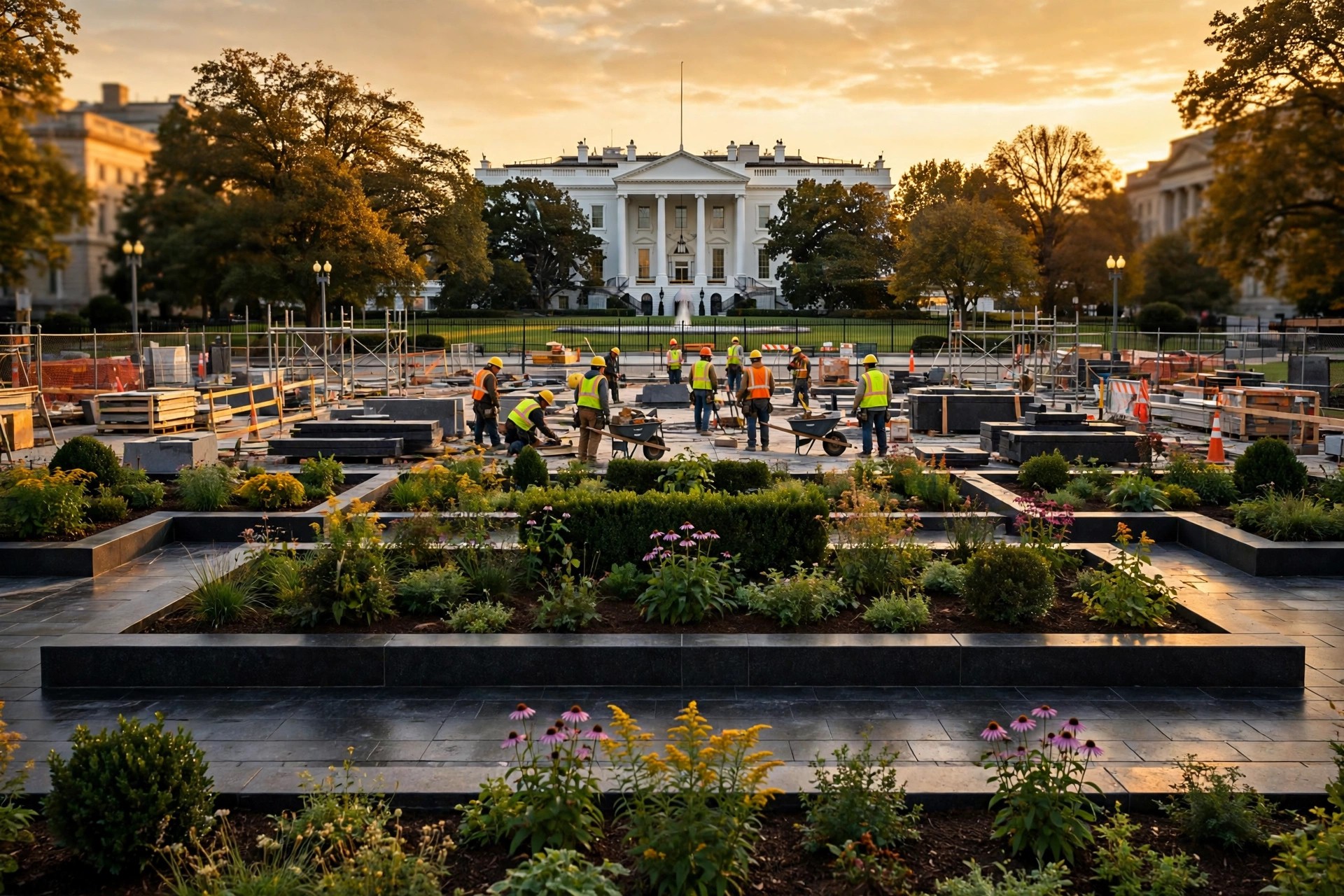
President Donald Trump plans to spend millions more on White House renovations in the final two years of his term, according to a new report published on Tuesday, 17 November 2026, with the National Park Service expected to cover much of the cost. The latest projects extend a building programme that has already reshaped the White House grounds, from the demolition of the East Wing to make way for a large ballroom to the remodelling of the Rose Garden and the installation of a new helipad on the South Lawn.
The report, published by The Washington Post and based on two officials familiar with the plans and documents reviewed by the newspaper, says the next phase will include at least 3 million dollars to reset the bricks in Lafayette Square, the public park across the street from the White House. The National Park Service is set to foot the bill for that project, the officials said, speaking on condition of anonymity because they were not authorised to discuss the matter publicly.
Trump is also personally overseeing the expansion of a black granite walkway he installed outside the West Wing earlier this year. The administration plans to extend the walkway past the remodelled Rose Garden, where workers were seen doing construction work on Monday, 16 November, as Trump left the White House for a week-long trip to the Philippines and China. The president will also continue to oversee the construction of the massive White House ballroom and a new visitors centre, according to the report.
Public opinion, meanwhile, appears to be moving against the building programme. A Reuters/Ipsos poll completed in September and published on Wednesday, 11 November, found that 67 percent of Americans oppose Trump’s White House and Washington construction projects, including half of Republicans who responded. The poll found that only a small minority thought creating and renovating monuments in the capital should be a priority for the president.
The 3 Million Dollar Lafayette Square Brick Project
Lafayette Square, the seven-acre public park directly across Pennsylvania Avenue from the White House, is the most visible of the new projects described in the Post report. The administration is spending about 3 million dollars to reset the bricks in the square, its next phase of a plan to make over the public park, according to documents reviewed by the newspaper. A Washington Post reporter watched teams of workers pursuing the brick-replacement project on Monday, as the president departed for Asia.
The cost of resetting bricks in a public park may seem modest beside the hundreds of millions of dollars associated with the ballroom, but the funding question is what makes the Lafayette Square project significant. According to the officials cited by the Post, the National Park Service is set to foot the bill. The Park Service, which is part of the Interior Department, is responsible for the care of the White House grounds and the surrounding parkland, including Lafayette Square, and its budget is funded by Congress through federal appropriations.
That arrangement means the money for the brick work comes, in effect, from the federal government rather than from the president’s personal funds or from private donors. The Post reported that officials did not respond to questions about the cost and funding source for the Lafayette Square and black granite walkway projects, and the Interior Department’s public statement did not address the issue either. For critics of the building programme, that lack of detail is itself the point: a project presented as the president’s personal beautification effort is, at least in part, being paid for through a federal agency.
The Black Granite Walkway Outside the West Wing
The second project described in the report is closer to the president’s daily routine, and it is one he is overseeing personally. Trump installed a black granite walkway outside the West Wing earlier this year, and he is now overseeing a project to expand it. The new walkway would stretch past the Rose Garden to a roadway south of the White House, according to the officials cited by the Post.
Workers were spotted doing construction on the walkway on Monday, 16 November, as Trump left the White House for his trip to the Philippines and China. The timing underlined how closely the president follows the work: even as he departed on a major diplomatic journey, the building continued outside his office window. Photographs from the departure showed workers at the site, and the Post reported that the expansion was under way.
What the walkway will cost, and who will pay for it, is not yet clear. As with Lafayette Square, officials did not respond to questions about the cost and funding source. The walkway sits on the White House grounds themselves, where the line between the president’s residence, the working offices of the West Wing and the public parkland managed by the Park Service is not always straightforward. That ambiguity makes it harder for the public to know, from the outside, which parts of the work are funded privately and which are funded through the federal budget.
The Ballroom and the New Visitors Centre
Beyond the brickwork and the walkway, the report says Trump will continue to oversee the construction of the massive White House ballroom and a new visitors centre. The ballroom is the largest and most controversial element of the entire building programme, and it is the project that has come to define the president’s approach to the White House.
When the White House released plans for the ballroom on 31 July 2025, Trump told reporters that the 90,000-square-foot addition would be built on the east side of the building. Less than three months later, bulldozers had removed the entire East Wing of the White House. The ballroom, which Trump has described as the greatest of its kind ever built, was initially presented as a project costing about 400 million dollars, to be paid for by the president and wealthy donors.
The project has also faced legal challenges. The National Trust for Historic Preservation sued the administration, saying the project did not seek the necessary approvals before demolition began. After going through the lower courts, the case reached the Supreme Court, which in a five-to-four ruling allowed the Trump administration to continue building the ballroom and an underground military installation. The completion date has been given as the summer of 2028.
Trump held his first public event in the East Wing construction pit on 4 November, the day after Republicans lost both chambers of Congress in the midterm elections. He did not talk about the election at that event. He talked about the ballroom, and he signed the final beam in the construction zone as he stood with workers and other officials. The image captured the president’s priorities in the days after a heavy electoral defeat: the building work would continue regardless of the political result.
Who Is Paying? The National Park Service Question
The central finding of the Post report is not the existence of the projects themselves, which have been visible for months, but the funding behind them. Trump’s White House projects will continue with millions in federal funding from the National Park Service, the newspaper reported, citing two officials and documents. The phrase covers the bulk of the costs in the headline sense: for the projects described, the Park Service, a federal agency, is expected to pay a substantial share.
That finding sits uneasily beside the president’s own account of the work. Trump has said repeatedly that he is paying for the White House makeover, and on Monday he told reporters that the work does not cost money, that it is peanuts, and that he pays for it. He said the White House was in terrible condition when he arrived and is now in beautiful condition, and that it cost him very little money and very little time to achieve that change. He also said that overseeing the projects takes him ten minutes a day.
The Interior Department, which oversees the Park Service, has not provided that breakdown. Its statement to the Post did not address the cost of the projects or the source of the funding. Its statement to PEOPLE on Tuesday praised the president’s work and said he should be thanked for making the nation’s capital better than he found it, but it also did not address the funding question. The White House itself did not immediately respond to PEOPLE’s request for comment on Tuesday, referring the Post’s inquiries to the Interior Department instead.
The funding question matters because the White House is not a private residence. It is a federal building, the seat of the presidency, and its grounds are part of a national park. Congress has a constitutional role in the care of federal property, and the scale of the spending, at least 900 million dollars across the construction programme according to the Post’s earlier reporting, is large enough to raise questions about oversight, procurement and the use of public money.
What the White House and the Interior Department Say
The administration’s public response to the report has been to praise the work rather than to discuss its cost. The Interior Department said in an unsigned statement to PEOPLE on Tuesday that Trump was using his expert builder experience to make the White House beautiful now and to improve and restore the grounds to greatness for future presidents to enjoy. It said the president should be thanked for making the nation’s capital better than he found it, and that he was making the improvements very easily, taking hardly any time.
He then turned on his questioners, saying the work does not cost money, that it is peanuts, and that he pays for it. He described the work as talent, and he said the White House was in terrible condition and is now in beautiful condition, at very little cost to him and with very little of his time. He added: “Losers like you come out and they say, ‘Why are you focused on the White House?'” He went on to say that the White House is a symbol of the country, and that it should look like that, and that the stone should look like that, pointing to the stonework as he spoke.
The White House has not released a full list of the ballroom’s donors, despite the Post’s reporting that it obtained a list of more than 330 million dollars in contributions. The lack of a public donor list has added to the questions about transparency. Who is giving money to build a ballroom on the White House grounds, and what, if anything, do they expect in return, are questions that have been asked repeatedly and have not been fully answered.
What Americans Think About Trump White House Renovations
The polling evidence suggests that the public does not share the administration’s enthusiasm for the building programme. A Reuters/Ipsos poll completed in September and published on Wednesday, 11 November, found that Trump’s White House and Washington construction projects are opposed by 67 percent of Americans, including half of Republicans who responded. The survey, conducted from 11 to 14 September, found that only 19 percent of Americans said creating and renovating monuments in the capital should be a priority for a president dealing with other pressing issues.
Other surveys have pointed in the same direction. An Associated Press/NORC poll later in September found that 68 percent of respondents said Trump had gone too far in remodelling the White House, the Kennedy Center and other landmarks in Washington. A Washington Post/Ipsos poll in July asked respondents how they felt about three projects, the ballroom, the reflecting pool and a proposed triumphal arch, and found that less than a third described themselves as enthusiastic or satisfied, while nearly two-thirds were dissatisfied or upset.
A further Washington Post/Ipsos poll last month found that 59 percent of respondents said Trump was devoting too much attention to building projects in Washington, and that half of Americans said Congress should not allow construction to continue on the White House ballroom, while 31 percent said the project should move forward. A survey by the group More in Common, conducted around the same time, found that 71 percent of respondents thought Trump spends too much time on Washington projects like the Reflecting Pool and the White House.
What Happens Next as Trump Heads to Asia
Trump left the White House on Monday for a week-long trip to the Philippines and China, a journey that will culminate in a meeting with Chinese President Xi Jinping. The building work did not pause for his departure. Workers were on the walkway as he left, and the brick work in Lafayette Square was under way. The message, intended or not, was that the renovations will continue whether the president is in Washington or not.
What happens next will depend in part on the new Congress. Democrats have already signalled that they intend to use their majorities to examine the administration’s spending, and the White House construction programme, with its mix of private donations and federal funding, is an obvious target. The question of whether Congress should allow construction to continue on the ballroom, which half of Americans oppose according to the Post/Ipsos polling, is likely to be raised again once the new Congress is seated.
Trump, for his part, has given no sign that he intends to slow down. He plans to double down on his White House renovations in the final two years of his term, according to the report, and he has described the ballroom, the walkway and the grounds as a legacy that future presidents will enjoy. Whether that legacy is remembered as a restoration or as an overreach will depend on the answers to the funding questions, on the verdict of the new Congress, and on the judgement of the public, which, for now, remains sceptical.
Sources
USN reviewed reporting from multiple outlets for this story. Read more from PEOPLE, The Washington Post and USA Today.