

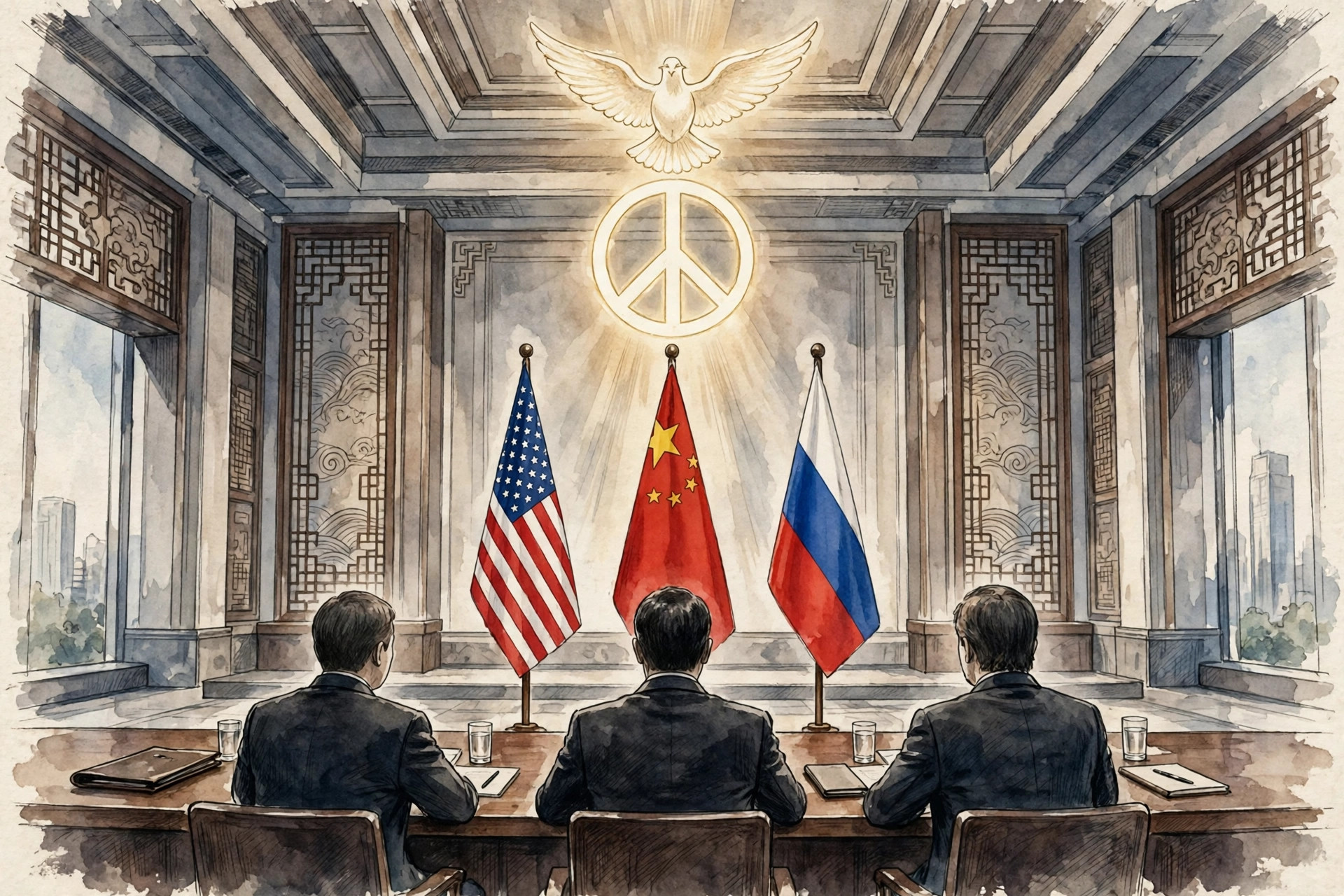
Trump Xi Putin Shenzhen Summit: First-Ever Trilateral Meeting Issues Four-Point Peace Declaration
SHENZHEN, China — President Donald Trump, Chinese President Xi Jinping and Russian President Vladimir Putin sat down together on 19 November 2026, for the first trilateral meeting of the leaders of the United States, China and Russia, and emerged a little over an hour later with a short declaration. The document pledged dialogue on nuclear risks, reform of the United Nations, larger supplies of refined petroleum products and respect for the immunities of state officials. The meeting, held on the sidelines of the Asia-Pacific Economic Cooperation summit in Shenzhen, lasted about 80 minutes, including 10 minutes of opening remarks in front of the cameras. It set no dates, no targets and no negotiating timetable, and it did not mention either of the two wars that dominated the conversations around it — Russia’s war in Ukraine and the conflict involving Iran. Yet the fact of the meeting made it one of the most closely watched diplomatic events of the year.
Trump framed the occasion in sweeping terms. “We are really making history,” he told Xi and Putin as the cameras rolled, adding that the three countries, as the world’s three largest nuclear powers, were “uniquely positioned to discuss how to reduce the number of nuclear weapons on Earth.” Xi, speaking as host, said history showed that “when major powers live in harmony, the world is at peace” and that “when major powers clash, the world falls into turmoil.” Putin said the three countries had “numerous shared interests in the settlement of regional conflicts, including obviously the conflict in Ukraine.” The tone was warm: Trump greeted Putin as “my friend,” and Xi had embraced Trump on the tarmac the day before. The declaration that followed read less like a negotiated agreement than a statement of shared intent.
A first meeting, 80 minutes long, at Kylin Villa
The trilateral meeting was the centrepiece of the final day of Trump’s visit to China, and it came after separate bilateral meetings with each of the other two leaders earlier in the day. Trump met Xi first, for a discussion covering trade and fentanyl, and he met Putin separately before the three men gathered together. Each leader arrived with different priorities. For Trump, the public priority was nuclear weapons. For Putin, it was Ukraine, which he raised directly in his opening remarks. For Xi, it was stability — the idea that positive interaction among the major powers was “not an option but a must,” and that the main topic was maintaining world peace and promoting strategic stability between major powers.
The meeting was brisk. At about 80 minutes in total, it was far shorter than the great-power summits with which it was immediately compared: the 1945 Yalta Conference lasted eight days. Much of the Shenzhen time was taken up by greetings, photographs, opening statements and translation. Supporters argued that the point was the encounter itself — that three leaders who rarely speak in the same room had spoken, and that the declaration gave their governments a framework to continue. Critics argued that 80 minutes was hardly enough to resolve, or even seriously address, the differences between the three countries on wars, economics and technology, and that the meeting was better understood as spectacle than negotiation. What is not in dispute is that it was unprecedented: the United States, China and Russia had never before sat down as a trio in a formal trilateral summit. The leaders met at Kylin Villa, a secluded guesthouse beside a lake outside Shenzhen. The meeting started about two hours late, and Trump left for the airport almost immediately afterwards. Putin later acknowledged that the declaration did not set ambitious goals.
The trilateral was not the only meeting of the day. Before the three-way session, Trump and Xi held their own bilateral meeting, covering subjects the three-way declaration did not. The two leaders discussed trade relations and fentanyl exports, a persistent source of tension between Washington and Beijing. Trump has repeatedly linked fentanyl, which has killed hundreds of thousands of Americans in recent years, to Chinese exports of precursor chemicals, and he raised the issue directly with Xi. No agreement on trade or fentanyl was set out in a joint statement, and the trilateral declaration mentions neither subject — a reminder that the US-China relationship is far broader than the trilateral format, and that many of its most consequential issues are discussed bilaterally.
What the Shenzhen trilateral summit declaration actually says
The declaration runs to only a few paragraphs. It records that the three leaders met in Shenzhen on 19 November 2026, that the Russian and American heads of state thanked China for hosting a historic trilateral summit, and that they had an in-depth exchange of views and committed to maintaining strategic stability and international security. The four commitments that follow are its substance. First, as permanent members of the United Nations Security Council, the three countries committed to reform the UN so it can respond more effectively to global challenges and conform to its fundamental mission of international peace and security. The text does not say which reforms they want, how reform would be pursued, or what role other UN members would play — a significant omission, since UN reform has been discussed for decades without agreement and each of the three holds a Security Council veto.
Second, the three countries plan to increase the production and supply of refined petroleum products for the benefit of all nations, and they reaffirmed the importance of stable energy flows. This was the most economically concrete point, yet it sets no production target, timeline or mechanism, and does not say how the three countries — two major oil producers and exporters, and the world’s largest oil importer — would coordinate such an increase. Third, the leaders recognised that state consent and respect for the immunities of state officials are of paramount importance, and concurred that the International Criminal Court and other similar bodies must not abuse their jurisdiction. The court issued arrest warrants for Putin and other Russian officials more than three years ago over alleged war crimes in Ukraine, allegations Moscow rejects. The declaration names no individual or case, but its language was widely read as a shared pushback against international courts. Fourth, the leaders reaffirmed that a nuclear war cannot be won and must never be fought, and that the three countries will conduct a dialogue on reducing nuclear risks and preventing proliferation. That language echoes a formulation used by the five recognised nuclear-weapon states, but the declaration announced no treaty negotiations, set no date for the dialogue, and said nothing about arsenal sizes or verification. Daryl Kimball of the Arms Control Association called the reaffirmation “positive,” but added: “We need much more than rhetoric. We need action on disarmament diplomacy.”
Trump’s case against the old school of diplomacy
Trump’s opening remarks set the tone. “No problems were ever solved under the old school refusing to talk about them,” he said. “No peace was ever forged by declining opportunities for engagement and speech.” He added: “Together, we are choosing a different course. A historic summit offers us the chance to seek out new opportunities and approaches on a range of very important issues.” The argument is familiar for Trump, who has long presented direct, personal engagement with adversaries as an alternative to the cautious, institutional diplomacy favoured by his predecessors. In Shenzhen he applied it to the two leaders with whom American relations have been most strained, in front of the cameras, with both men beside him.
Trump framed the summit as primarily about nuclear disarmament, but he also floated ending the wars in Iran and Ukraine and collaborating to undermine what he described as “rogue globalist organizations” such as the ICC. The breadth of that agenda was striking given the brevity of the meeting. The declaration narrowed it to four general commitments, none of which addressed the wars directly. Trump said afterwards that he had raised both wars; Putin said Ukraine had been discussed, but the published text mentions neither conflict. Trump’s language about his counterparts was warm throughout the day. He called Putin “my friend” more than once and called Xi a friend and “an amazing leader,” defending the description by saying it was “nice to have people that have 4,000 nuclear weapons as a friend as opposed to an enemy.” His opponents argue that warmth towards Putin, while Russia continues its war in Ukraine, legitimises a leader wanted by the ICC. His supporters argue that refusing to speak to such leaders achieves nothing. Shenzhen did not settle that argument; it restated it on a larger stage.
The nuclear question at the heart of the summit
Nuclear weapons were the reason the meeting was convened, at least in Trump’s telling, and the subject on which the declaration was both most emphatic and most vague. Trump has pushed since his first term for a trilateral arms-control arrangement including China, which has consistently resisted formal negotiations on the grounds that its arsenal is much smaller than those of the United States and Russia. That resistance was visible again in Shenzhen: the declaration promises a dialogue on reducing nuclear risks, but makes no mention of negotiations on a trilateral nuclear arms reduction treaty and sets no timetable for the dialogue it does promise. The distinction matters. A dialogue can cover risks, communication channels and crisis management. A negotiation implies binding limits, with numbers, verification and timetables. The declaration promises the first and says nothing about the second.
Trump returned before the meeting to the size of the world’s arsenals. In a Fox News interview broadcast before the trilateral session, he said the United States had 4,000 nuclear weapons, Russia had 3,800, and China now had 400 or 500 but was building more. He added that the three countries “only need about 10” nuclear bombs and that “you don’t need 4,000.” Those figures were Trump’s own and differ from independent estimates, which count retired warheads as well as deployed ones, but his argument was clear: he wants the numbers to come down, with China at the table. Speaking to Reuters on the flight back to Washington, he acknowledged that a mutual agreement to limit nuclear weapons would be hard to achieve, but said he would keep working on it. “President Xi agrees with me” on limiting nuclear weapons, he said, “but at the same time it’s very hard for somebody to say ‘We have 4,000 nuclear weapons, we’ll give up half.'” China has argued it cannot be expected to join formal limits while its arsenal remains far smaller, and Russia has suspended participation in the last remaining bilateral arms-control treaty with the United States. Shenzhen restated the principle that a nuclear war must never be fought and left the hard work for another day.
What the declaration leaves out: Ukraine and Iran
The most striking feature of the declaration, for many observers, is what it does not contain. It does not mention Ukraine or Iran. It contains no commitment to a ceasefire, no timetable for negotiations, no reference to Ukrainian sovereignty or territorial integrity, and no indication of progress towards a peace settlement. For a document titled a “Declaration toward Peace,” that omission was immediately noticed and became the focus of much of the criticism that followed. The omission is not an accident: the three leaders disagree profoundly about both wars, and a text that mentioned them would have had to take a position on them.
Ukraine is the clearest example. Russia is waging a full-scale war against Ukraine, now in its fifth year, and the United States and China have taken very different positions. China has presented itself as neutral while continuing to trade with Russia and resisting Western pressure to condemn the invasion. The United States, under Trump, has sharply reduced its support for Ukraine and pursued direct talks with Putin, alarming Kyiv and its European allies. Trump said he raised Ukraine with both leaders, telling Xi at the start of their bilateral meeting that he and Xi could work together to end the fighting: “We’re looking to both help with respect to the war with Russia and Ukraine. I’d like to see it ended.” Xi, in his opening remarks at that meeting, did not mention Ukraine. At the trilateral meeting, Putin said the three countries had shared interests in settling regional conflicts, “including obviously the conflict in Ukraine.” None of that made it into the declaration. The same is true of Iran, which Trump said he discussed but which the declaration does not mention at all. Supporters said a short declaration was never going to settle two wars; critics said a declaration that avoids the wars it claims to address is a distraction from the absence of peace.
Europe reacts: Merz calls it a photo op
The reaction in Europe was swift and sharply critical. German Chancellor Friedrich Merz, speaking in Berlin after a meeting of the Coalition of the Willing — the group of countries supporting Ukraine — called the Shenzhen meeting a “photo op” and warned that any deal made without Europe at the table would fail. “A ‘Yalta’ format will not bring peace,” Merz told reporters, adding that European leaders would not allow Europe to be divided up again. “If it comes to peace negotiations, then we will be involved,” he said, adding that such talks “can only be successful with Ukraine and Europe.” The warning was directed at the comparison, made by several commentators and by Trump himself, between Shenzhen and the 1945 Yalta Conference, at which the United States, Britain and the Soviet Union set terms for the post-war order — a conference reviled in much of Eastern Europe as a betrayal, because it is widely seen as having ratified Soviet dominance over countries occupied by Soviet troops.
Merz was not alone. The Berlin meeting itself was, in part, a response to Shenzhen: a demonstration that Europe would not accept a peace settlement negotiated over its head. It brought together the leaders of Germany, France, Britain, Poland, Italy and NATO, along with US special envoys Steve Witkoff and Jared Kushner. Trump called into the Berlin meeting from Air Force One and told participants that Putin wanted to make a deal. Kushner, standing alongside Merz, stressed that Trump wanted a peace deal with Europe at his side and that Russia had agreed to engage in multilateral talks with Europe. Putin, asked about the Yalta comparison in Shenzhen, rejected the suggestion that either event had aimed to carve the world into spheres of influence, saying Yalta had simply acknowledged the realities that emerged after the Second World War. Trump, speaking to Reuters, called Shenzhen “bigger than Yalta.” Ukraine’s foreign minister, Andrii Sybiha, wrote on social media that Shenzhen was “not the Yalta of Putin’s dreams.” Merz’s warning was both principle and fact: a peace settlement for Ukraine without the support of Ukraine and its European allies is unlikely to hold.
What happens next, and what to watch
As of the evening of Thursday, 19 November, the Shenzhen summit had produced a declaration, a set of photographs and competing interpretations, but no timetable for what comes next. No date had been set for the dialogue on reducing nuclear risks that the declaration promises, and no negotiating round had been announced. No working-level process had been described in detail, beyond China’s foreign minister saying the countries would maintain coordination at working level. Trump said he would hold a news conference in Washington at noon on Friday, 20 November, expected to provide the first detailed American account of what was discussed. Several things are worth watching: whether the nuclear dialogue acquires a date, format and participants; whether the multilateral talks with Europe that Kushner said Russia had agreed to are actually scheduled, and whether they include Ukraine; whether the three countries take concrete steps on UN reform, refined petroleum products or the ICC; how Washington reacts, where Senate Democrats led by Chuck Schumer called the summit “a historic embarrassment”; and whether the Group of 20 summit Trump is expected to host in Florida in a few weeks, where he is expected to meet Xi again and potentially Putin, becomes the next test of whether Shenzhen was the start of a process or a one-off event.
The Shenzhen declaration is, in the end, a short document with a long shadow. It restates a principle — that a nuclear war cannot be won and must never be fought — and commits three of the world’s most powerful countries to talk about reducing nuclear risks. It also commits them to reform the UN, to increase supplies of refined petroleum products, and to push back against the International Criminal Court. What it does not do is settle any of the conflicts that divide the three countries, or the countries that were not in the room. It does not mention Ukraine or Iran, and sets no dates and no targets. Whether the summit is remembered as the start of a process or, as Merz suggested, as a photo opportunity will be known in the weeks that follow, in the meetings scheduled or not scheduled, and the wars that continue or come to an end.
Sources
USN reviewed reporting from multiple outlets for this story. Read more from New York Post, Reuters and CNA.