

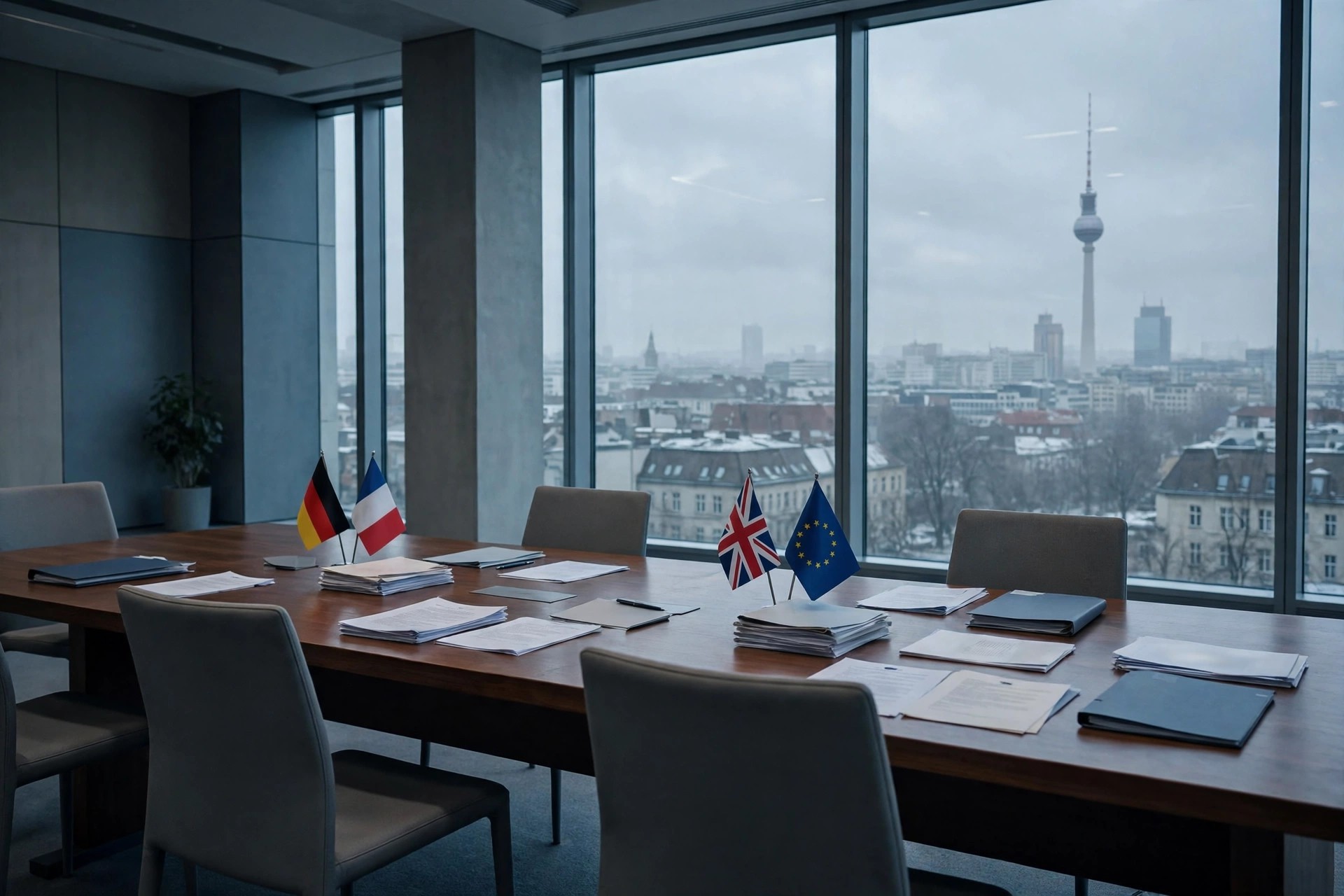
Ukraine held new peace talks with United States and European officials on Monday, 16 November 2026, and agreed to meet in Berlin with the Coalition of the Willing to work out concrete joint steps in the negotiation process, even as fighting escalated sharply on both sides. President Volodymyr Zelenskyy described the online discussions with United States envoys Steve Witkoff and Jared Kushner and European representatives as not easy, but said the participants had reached a result: a further meeting in the German capital, where Ukraine and its supporters would coordinate their approach before any next round involving Russia.
The talks came at a difficult moment in a diplomatic process that has accelerated in recent weeks. Direct talks between Russia and Ukraine, mediated by the United States, resumed in Abu Dhabi on 10 and 11 November after a nine-month pause, and produced an agreement in principle on a large-scale prisoner exchange but no breakthrough on a ceasefire, territory or post-war security arrangements. Since then, American envoys have shuttled between Moscow, Dublin and Kyiv, European governments have tried to secure a fuller place at the table, and Russia has pushed back against any expansion of the format. At the same time, the war on the ground has intensified, with strikes on bridges in Kyiv, a major Ukrainian drone attack on Russia, and a new United Nations report showing civilian casualties in 2026 already far above the tolls of previous years.
The contrast between the diplomacy and the fighting was stark on Monday night. As negotiators discussed security guarantees, European Union membership and post-war reconstruction, Ukrainian intelligence warned of major Russian strikes that night and through Tuesday, and Kyiv’s mayor reported hits on two bridges across the Dnipro River. The Berlin meeting is therefore not a sign that peace is near. It is a sign that Ukraine, the United States and Europe are trying to align their positions before the next, harder stage of talks, while the war continues to exact a heavy price on civilians.
Monday’s Talks: Difficult, but With a Result
Zelenskyy spoke about Monday’s discussions in his nightly address, after a day of online talks involving Ukrainian, American and European negotiating teams. He said the American team was actively engaged, with Witkoff and Kushner joining the discussion online. He described the conversation as difficult, using the words “not easy” to characterise the exchange, but he also said it had produced an outcome. The participants had agreed to meet in Berlin as part of the Coalition of the Willing and to work out concrete joint steps in the negotiation process.
That formulation matters because it captures both the difficulty and the direction of the talks. The discussions were not a formality. They brought together teams that have different mandates, different red lines and different views of what a settlement should look like. Ukraine is seeking a dignified end to the war and guaranteed security against any future attack. The United States, under President Donald Trump, is pushing for a rapid agreement and has been mediating directly with both sides. European governments, which have provided much of the financial and military support for Ukraine, want a seat at the table and a settlement that does not leave them exposed. Bringing those positions together in a single online call was always likely to be hard.
Zelenskyy said that, for the first time, Europe was represented by the full group of countries and institutions that would participate in negotiations with Russia. That group included France, Germany, the United Kingdom, Italy and Poland, along with representatives of the European Commission, the European Council and a representative of NATO. The inclusion of all five countries, plus the European Union institutions and NATO, marked a step forward from earlier, more limited European participation. It also reflected an agreement reached by European Union leaders in Dublin last week to work with the five countries as a single team.
The Berlin Meeting and the Coalition of the Willing
The Berlin meeting took place on Thursday, 19 November 2026, hosted by German Chancellor Friedrich Merz, with President Zelenskyy attending in person alongside leaders and delegations from around 25 to 40 countries, and Witkoff and Kushner representing the United States. President Trump joined by telephone from Air Force One, telling the leaders that Russian President Vladimir Putin wanted to end the war and urging Merz to call Putin directly. The meeting issued a joint statement by Germany, France, the United Kingdom and Ukraine promising robust, legally binding security guarantees for Ukraine once a ceasefire enters into force, with NATO allies pledging 70 billion euros in military equipment, assistance and training for 2026 and at least as much in 2027, and 90 billion euros under the European Union’s Ukraine Support Loan by the end of 2027. The statement also called on Russia to agree to a winter energy ceasefire as a first step, alongside a ceasefire for Black Sea food exports. No date was announced for a next multilateral round involving Russia, and Russia’s objection to European participation in direct talks with Moscow remains unresolved.
Kushner said afterwards that Trump would not impose a deal on Ukraine and was open to an Article 5-like security guarantee, and that the American delegation would convey the Berlin outcome to the Russian delegation. Merz said Europe was ready to talk to Putin only with Ukraine and Europe at the table.
The Coalition of the Willing is a group of countries backing Ukraine that has met regularly since early 2025 to discuss security guarantees, military support and post-war reconstruction. It is not a formal alliance, and its membership has varied, but it has become the main forum in which European governments coordinate their approach to the war and to any settlement. Meeting in Berlin, rather than in Paris or London, also carries symbolic weight. Germany is Ukraine’s largest European supporter in financial terms, and Berlin has become a central location for discussions about European security.
Ukraine Peace Talks: The Three Pillars Outlined by Kushner
Kushner, Trump’s son-in-law and a United States special envoy, said on Monday that Washington was making progress towards an agreement in coordination with Russia, Ukraine and Europe. In a post on X, the social media platform, he outlined three pillars for Ukraine’s future: credible security guarantees, a path towards European Union membership, and a comprehensive post-war economic prosperity plan. He said he and Witkoff had spoken with Kremlin aide Yuri Ushakov on Monday morning to discuss progress made and next steps in the peace process.
The three pillars are significant because they go beyond a ceasefire. A ceasefire alone would stop the fighting, but it would not answer the question that has dominated every discussion of a settlement: how to ensure that Russia does not attack again. Credible security guarantees are intended to address that question, although what counts as credible remains a matter of dispute. Ukraine has sought guarantees that would be binding and enforceable, while Russia has resisted any arrangement that would place Western forces or commitments on its border.
A path towards European Union membership is a second pillar, and it reflects a long-standing Ukrainian aspiration. Ukraine was granted candidate status for European Union membership in 2022, and accession talks have begun, but membership is a long and demanding process that requires reforms in governance, the rule of law and the economy. Framing a path to membership as part of a peace settlement would give Ukraine a clear European future, but it would also require the European Union to agree on the pace and conditions of that path.
Kushner also said that he and Witkoff had held a productive call with Ukraine and their European partners, including the national security advisers of Germany, France, the United Kingdom, Poland and Italy, along with representatives of the European Union and NATO. He said preparations had begun for the agenda of the next multilateral meeting, which the participating sides were working to convene in the near future. That language suggests that the American envoys see the Berlin meeting as part of a sequence, rather than as a one-off event.
Moscow’s Different Account: No Agreement on European Participation
Russia gave a different account of where the process stands. Ushakov, the Kremlin aide, said Russia had not agreed to expand the talks beyond the existing Russian, Ukrainian and United States delegations. No date had been agreed for the next round, he added. His comments, reported by Reuters, directly contradicted the impression that European participation in the next round with Russia had been settled.
The disagreement has its roots in the days after the Abu Dhabi talks. Witkoff and Kushner later met Russian President Vladimir Putin in Moscow on 12 November and said European representatives would join the next round. Moscow disputed that assertion on Monday. Ushakov said several more United States-Russia-Ukraine rounds might be necessary before Russia considered European participation. That position, if maintained, would keep Europe on the sidelines of direct talks with Russia, even as European governments coordinate their own position in Berlin.
Zelenskyy, for his part, said that the European representatives who took part in Monday’s discussion would have the same representation in future meetings with Russian negotiators. That statement reflected Ukraine’s position, not an agreed outcome with Russia. The gap between Kyiv’s expectation and Moscow’s position will be one of the main issues for the Berlin meeting to address, and it is likely to remain unresolved until the American envoys return to Moscow or until a further round of trilateral talks is held.
Fighting Escalates: Kyiv Bridges and the Crimea Bridge
While the talks were under way, the fighting escalated on both sides. Zelenskyy warned on Monday that Ukrainian intelligence indicated Russia was preparing major strikes that night and throughout Tuesday. Hours later, Kyiv Mayor Vitali Klitschko reported strikes on two bridges in the capital. According to preliminary information, there had been hits on the North and South bridges across the Dnipro River, along with other critical infrastructure. There were water and power cuts in parts of the city, he added later.
Russia’s defence ministry later confirmed the strikes, saying on Telegram that it had hit transport, military and energy facilities in Kyiv, Zaporizhzhia, Cherkasy and Dnipropetrovsk, along with port infrastructure and cargo ships. Reuters witnesses reported a series of loud explosions in the capital overnight. Klitschko said Russia had struck the capital’s North and South bridges, a claim later confirmed by Moscow, and partially damaged the metro system. Reuters said it could not immediately independently confirm all of the reports, a caution that applies to much of the battlefield reporting from both sides.
Ukraine, meanwhile, struck the Crimea Bridge overnight, in what Russian defence ministry data indicated was the biggest overnight drone attack on Russia since the start of the full-scale war in 2022. The bridge, a 19-kilometre road and rail link between southern Russia and Crimea, was once a key supply route for Russian forces in Ukraine. It is a flagship project closely associated with Putin after Russia annexed the peninsula from Ukraine in 2014, an annexation that the United Nations General Assembly has said was illegal and that most countries do not recognise.
There was no official confirmation of the extent of damage to the Crimean bridge after the first strike this week, and the Kremlin said the first attack had caused only minor damage. The attacks continued overnight, with the Crimea Bridge being hit again on Tuesday, according to Reuters, as part of what data suggested was the largest Ukrainian drone attack of the war. Russia’s defence ministry said it shot down 1,441 drones over 22 regions, surpassing the previous record of 1,336 set on Monday. State news agencies described the overnight attack as the largest overnight Ukrainian drone attack on Russia since the start of the full-scale war in 2022. Those figures come from Russian sources and have not been independently verified, and they should be treated as Russian claims rather than as established fact.
The scale of the drone attacks, if the Russian figures are accurate, would mark a significant escalation in Ukraine’s long-range campaign. Ukraine has increasingly targeted oil refineries, military facilities and transport infrastructure inside Russia, in an effort to raise the cost of the war for Moscow and to disrupt its logistics. Russia, in turn, has intensified its strikes on Ukrainian cities, energy infrastructure and transport links. The exchange of strikes on bridges, in Kyiv and in Crimea, illustrates how both sides are now targeting the infrastructure that sustains the other’s war effort.
The Human Cost: UN Reports a Sharp Rise in Civilian Casualties
The escalation is taking a heavy toll on civilians. The United Nations Human Rights Monitoring Mission in Ukraine, known as HRMMU, said on Tuesday, 17 November, that civilian casualties in 2026 already far exceed the tolls of previous years. In October 2026, the number of civilians killed, 372, and injured, 1,981, was 95 per cent higher than in October the previous year. The figures were reported by UN News and by the mission itself.
The mission said the first ten months of 2026 had seen more civilian deaths than all of 2025, which in turn was worse than the year before. The head of the mission, Danielle Bell, urged the world not to become numb to the deadly toll the war exacts on Ukraine’s civilians. In all, almost 18,000 civilians have been killed and almost 58,000 injured in Ukraine since February 2022, according to the mission, which put the precise figures at 17,994 killed and 57,854 injured. In the first ten months of 2026 alone, at least 2,957 civilians were killed and 17,218 injured.
October was the highest civilian death toll for that month since the start of the full-scale invasion, according to the mission. In October 2025, by comparison, 183 people were killed and 1,021 injured. Long-range weapons remained the leading cause of deaths and injuries, the mission said. Missile and drone strikes accounted for 55 per cent of all casualties in October, killing 177 people and injuring 1,108. Casualties from aerial glide bombs also increased, with the number of civilians killed doubling compared with September, reaching 92 killed and 331 injured.
The highest numbers of casualties in October were recorded in Kyiv, where 25 people were killed and 174 injured, Kramatorsk, where 29 were killed and 124 injured, Kharkiv, where 19 were killed and 129 injured, Zaporizhzhia, where 31 were killed and 103 injured, and Sloviansk, where 27 were killed and 96 injured. Civilians were killed or injured in 22 regions of Ukraine and in Kyiv. The mission said it was still verifying the identities and status of some victims, but had confirmed that dozens were civilians, including local residents, administrative staff and emergency workers.
Where the Process Stands After Abu Dhabi
The current round of diplomacy began in Abu Dhabi, where Russian and Ukrainian representatives resumed direct peace talks on 10 and 11 November after a nine-month pause. The United States-mediated meetings were the third round of trilateral talks hosted by the United Arab Emirates in 2026, and they were led on the Russian side by Vladimir Medinsky and on the Ukrainian side by Rustem Umerov. The talks produced an agreement in principle on a large-scale prisoner exchange but no breakthrough on a ceasefire, territory or post-war security arrangements.
The prisoner exchange was the clearest outcome of the Abu Dhabi talks, and it remains the most tangible humanitarian result of the current process. Kushner described the discussions as difficult but productive and said both sides had agreed to pursue a major humanitarian release of prisoners, with the final numbers still to be confirmed. Zelenskyy indicated that the exchange could involve between 1,000 and 1,500 prisoners from each side, although the final scale and implementation arrangements had not been confirmed in the initial announcements. Russian state news agency TASS reported that the exchange could take place within two to three weeks. The agreement is yet to be finalised, and even if it is carried out, it will add to the approximately 10,000 soldiers returned in 35 previous swaps.
On 12 November, Witkoff and Kushner met Putin in Moscow to discuss the results of Abu Dhabi, and the next day they met Zelenskyy in Dublin. The envoys initially said Putin had accepted European participation in the next round, but Ushakov said on 16 November that Moscow had made no such agreement and that several more United States-Russia-Ukraine rounds might be necessary first. That sequence explains why Monday’s talks, and the planned Berlin meeting, have focused so heavily on coordination among Ukraine, the United States and Europe, rather than on direct negotiation with Russia.
For now, the process is best understood as a sequence of steps, each of which is necessary but none of which is sufficient on its own. Abu Dhabi restarted direct contact and produced a humanitarian agreement. Monday’s talks brought Europe into the process in full for the first time and agreed a meeting in Berlin. That meeting, held on Thursday, turned the coordination into concrete joint steps, including the security-guarantee and funding pledges in the joint statement. Whether those steps lead to a further round with Russia, and whether that round leads to a ceasefire, will depend on decisions that have not yet been taken in Kyiv, Washington, Moscow or the European capitals. The talks continue, and so, for the moment, does the war.
Sources
USN reviewed reporting from multiple outlets for this story. Read more from Al Jazeera, Tribune India and UN News.