

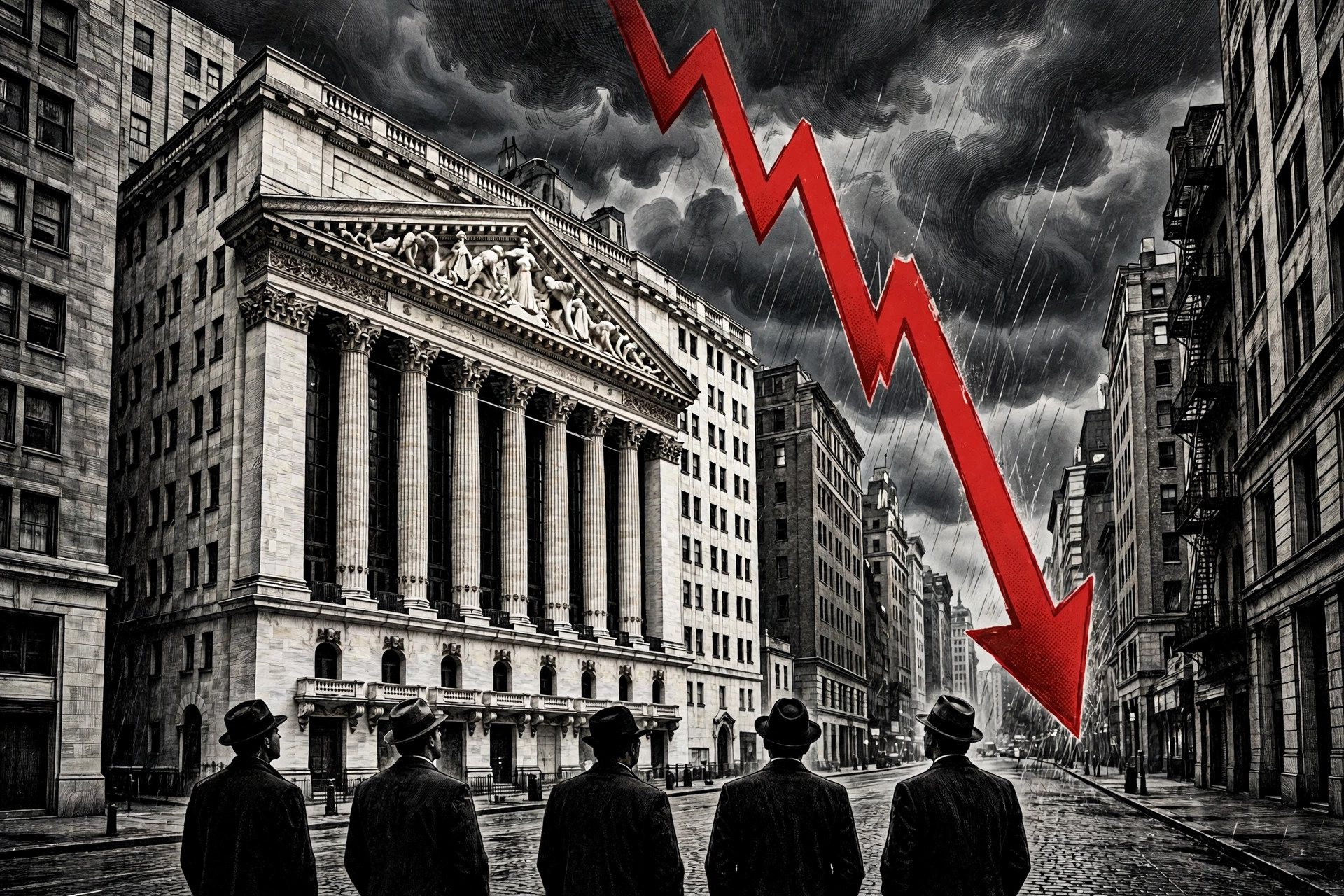
Wall Street’s sell-off deepened for a second day on Friday, November 20, 2026, pushing both the Dow Jones Industrial Average and the S&P 500 into correction territory. The Dow fell 949.73 points, or 1.93 percent, to close at 48,147.33, while the S&P 500 dropped 265.44 points, or 3.70 percent, to 6,910.39, its seventh consecutive losing session. The Nasdaq Composite sank 1,261.47 points, or 5.28 percent, to 22,617.73. The slide followed Thursday’s 1,101-point Dow plunge and came even though Anthropic, the artificial intelligence company behind the Claude chatbot, had found a strong welcome for its first day of trading, with its shares rising sharply above their initial public offering price.
Thursday’s decline was striking in scale. The Dow has now lost about 2,500 points over its last three sessions alone. The S&P 500 fell 147.80 points to 7,175.83 and is now down 8.2 percent from the all-time high it set last month. The Nasdaq Composite dropped 550.69 points to 23,879.20. More than 90 percent of the stocks in the S&P 500 finished lower, and only one of the 30 stocks in the Dow Jones Industrial Average ended the day higher. The selling was not confined to technology: health care, consumer, industrial and financial stocks all fell, and the Russell 2000 index of smaller companies dropped 2.2 percent to 2,655.11.
What made Thursday’s session particularly unsettling was the way it unfolded. Stocks opened higher, and the S&P 500 rose as much as 1.3 percent in early trading on enthusiasm around Anthropic’s debut. Then the rally faded, sellers took control, and the market slid steadily for the rest of the day. By the close, the volatility index known as the VIX, Wall Street’s gauge of expected market turbulence, had jumped about 14 percent. Analysts described a market in which rallies were being sold rather than bought.
The central question hanging over the market is one that has been building for weeks: whether the enormous sums of money pouring into artificial intelligence will ever pay off. Companies have committed hundreds of billions of dollars to data centers, chips and power infrastructure, and investors are increasingly asking whether that spending will produce enough profit and productivity to justify the valuations that AI-related stocks reached during their long rally. On Thursday, that doubt overwhelmed even a successful debut by one of the most prominent AI companies in the world.
Why the Dow Drops Matter for Investors and Retirement Savers
A drop of 1,101 points in the Dow sounds dramatic, and it is, but the meaning of the move depends on where an investor sits. The Dow is a price-weighted index of 30 large American companies, and its level of nearly 50,000 means that a two percent move translates into more than a thousand points. The percentage move, 2.2 percent, is the more useful measure, and it was matched across the market: the S&P 500 fell 2 percent and the Nasdaq fell 2.3 percent. A single day like Thursday does not by itself define a market, but the pattern around it does. The S&P 500 has now fallen for seven straight sessions, its longest losing streak since April 2024, and the Dow has fallen for five consecutive days. The S&P 500 is now more than 10 percent below its record, and the Dow is about 11.4 percent below its record close of 54,349 — both in what market watchers call correction territory, a decline of 10 percent from a recent peak.
For millions of Americans, the S&P 500 is the index that matters most, because it sits at the heart of many 401(k) retirement accounts, pension funds and index funds. A decline of more than 10 percent from a record high trims the value of those accounts, and a seventh straight day of losses tests the patience of savers who have grown used to steady gains. Financial advisers generally counsel long-term investors not to react to a single week of trading, and history shows that markets have recovered from far deeper declines. But the speed of the recent slide, and the fact that it has been driven by doubts about the very technology that powered the rally, has made this pullback feel different from a routine dip. Investors who bought AI stocks at high prices are now asking whether they paid too much, and whether the companies they own can grow into their valuations.
The breadth of Thursday’s selling added to the concern. When more than 90 percent of the stocks in the S&P 500 fall on the same day, the decline is not about one company or one sector. Defensive stocks, which often rise when investors seek safety, had already risen sharply during the recent rally, leaving fewer obvious places to hide. On Thursday, even the stocks that had been the market’s leaders were among the hardest hit.
AI Spending Doubts at the Heart of the Sell-Off
The dominant explanation for the sell-off, offered by analysts and strategists across Wall Street, is a growing skepticism about the economics of artificial intelligence. For two years, the AI trade has rested on a simple story: companies would spend vast sums building data centers, chipmakers would supply the hardware, cloud providers would rent out computing power, and the resulting AI services would generate enough revenue and productivity to justify it all. That story lifted the market to a series of record highs. In recent weeks, investors have begun to question each link in the chain.
The doubts take several forms. Some investors worry that AI stocks broadly went into a bubble after rising so far and so fast, and that their prices now assume a future that may not arrive on schedule. Others question whether the massive investments in data centers will deliver the productivity gains companies expect, or whether much of the spending will turn out to be duplicative, with too many data centers chasing too little demand. Still others point to the financing of the AI buildout: with interest rates elevated, borrowing to fund data centers is expensive, and companies that have taken on large debts to build AI infrastructure may find the burden harder to carry if revenue growth slows.
Anthropic’s debut was supposed to be a test of that enthusiasm. The company priced its initial public offering late on Wednesday at 83 dollars per share, above the range it had originally pitched to investors, in what became the largest initial public offering on record. Its shares began trading on the Nasdaq just before noon on Thursday, opening at about 111.50 dollars, and at one point rose as much as 34 percent above the IPO price. By the close, Anthropic’s shares were still up about 17 percent from their IPO price, valuing the company at just below 1.8 trillion dollars. But the strong debut did little to lift the broader market. As one portfolio manager put it, the IPO was attracting enormous attention, but it did little to address the market’s bigger problems: concerns about AI profitability, massive spending, high interest rates, credit market stress and geopolitical risk.
The pattern repeated itself across the AI-linked stocks. Micron Technology, whose sales of computer memory have soared because of the AI boom, initially rallied 7.8 percent and then swung to a loss of 2.1 percent. CoreWeave, a company that rents out AI computing capacity, surged 10.5 percent in the morning before reversing to close down 6.1 percent. The message from the market was consistent: even good news about individual AI companies was not enough to overcome the broader doubt about the sector’s economics, and early gains were being used by investors as an opportunity to sell.
Nvidia’s Slide and Scrutiny of Its China Sales
No single company embodies the AI trade more than Nvidia, and no single stock’s performance on Thursday illustrated the market’s mood more clearly. Nvidia’s shares rose as much as 4.7 percent early in the session, after the chipmaker had issued an upbeat revenue forecast, and then erased the entire gain to close down about 3 percent. It was Nvidia’s sixth straight session of losses, and the reversal from a strong early gain to a sharp loss captured the day in miniature: optimism that could not survive the selling.
Nvidia’s troubles extend beyond the market’s general doubts about AI. The company has faced a lengthening list of worries in recent weeks. Earlier in November, chief executive Jensen Huang resigned after the revelation that he had a relationship with a woman suspected of being a Chinese spy, according to reporting by CBS News, a development that shook confidence in the company’s leadership at a delicate moment. Some lawmakers have stepped up scrutiny of Nvidia’s sales to China and to companies in Southeast Asia, and this week the Commerce Department signaled that it plans to tighten export controls on AI chips. The combination of a leadership crisis, political scrutiny and the prospect of tighter controls on one of the company’s important markets has weighed heavily on the stock.
The chip sector as a whole fell sharply on Thursday. Advanced Micro Devices, Nvidia’s rival, dropped more than 7 percent after the investment firm Hunterbrook Capital disclosed a short position in the company and raised allegations that the chipmaker had violated export controls related to China. Those allegations have not been proven, and AMD has not been found to have broken the law, but the claim added to the nervousness around chip stocks with exposure to China. The Philadelphia Semiconductor Index, which tracks the chip sector, fell 2.4 percent. The episode illustrated how quickly an allegation, even an unproven one, can move a stock when investors are already anxious, and how the politics of US-China technology competition have become a direct factor in the market’s daily movements.
Anthropic’s Record IPO Fails to Revive the Market
Anthropic’s first day as a public company was, by the usual measures, a triumph. The offering was the largest initial public offering ever, surpassing even the massive share offering by SpaceX earlier in the year, and the company’s shares closed about 17 percent above their IPO price. For the company’s founders and early investors, the day was a validation of years of work on the Claude chatbot and the AI models behind it. For the market as a whole, it was not enough.
Analysts offered several reasons why the IPO failed to lift sentiment. The market had already priced in a successful debut, since Anthropic had increased its offering and priced it above its original range. A single company’s success also does not answer the sector-wide questions about the profitability of AI spending. And the IPO arrived after weeks of declines, when one good day for one company could not reverse a trend driven by doubts about interest rates, regulation and data center construction.
There was also a practical effect. A very large IPO can draw money and attention away from the rest of the market, as investors sell other holdings to buy the new stock. Some analysts suggested that the rush into Anthropic shares contributed to the selling elsewhere, as investors reallocated their portfolios. Whatever the precise mechanism, the result was clear: the most anticipated stock market debut in years coincided with one of the worst days of the year for the broader market, and the contrast between the two became the story of the day.
Interest Rates, the Fed and the December Decision
The AI doubts were not the only force weighing on stocks. Investors are also recalibrating their expectations for interest rates after the release on Wednesday of the minutes from the Federal Reserve’s October policy meeting. The minutes showed that Fed officials wanted to keep inflation in check even before the recent releases of consumer and producer price data, which showed price pressures heating up. Financial markets are now pricing in a high likelihood, about 94 percent according to the CME FedWatch tool, of a 25-basis-point increase in interest rates at the central bank’s December meeting.
Higher interest rates are a headwind for stocks in general and for AI stocks in particular. When rates rise, future earnings are worth less in today’s terms, which hurts companies whose valuations depend on growth far in the future. Higher rates also raise the cost of borrowing for companies building data centers and for consumers buying homes and cars.
The inflation picture remains contested. Consumer and producer price data released recently showed price pressures rising, which supports the case for tighter policy. But the economy’s underlying momentum, described below, suggests that demand remains strong, which could keep inflation elevated. The Federal Reserve’s next moves will depend on the data that arrives in the coming weeks, including the Commerce Department’s personal consumption expenditures report, which contains the Fed’s preferred inflation gauge. Investors will be watching that report closely, and any surprise could move the market sharply in either direction.
The Contrast: A Strong Economy Behind a Falling Market
One of the most striking features of Thursday’s sell-off is the gap between what the market is doing and what the economy is doing. By many measures, the American economy is performing well. The Federal Reserve Bank of Atlanta’s GDPNow forecast, a running estimate of economic growth based on incoming data, put the United States economy on track to grow more than 3 percent in the final three months of 2026, after a 3.4 percent increase in the third quarter. The model’s November 18 update put the figure at 3.2 percent, still a strong pace. Consumer spending, the main engine of the economy, surged at a 3.8 percent annual pace in both the second and third quarters after adjusting for inflation, and a snapshot of retail sales in October offered further evidence of the economy’s endurance.
The October retail sales report, released in mid-November, showed headline sales rising 0.2 percent, slightly above economists’ expectations, while the control group of sales, which feeds into the calculation of gross domestic product, rose 0.6 percent, beating forecasts. Overall retail sales grew 6.8 percent from a year earlier, the strongest year-over-year pace in four years, and sales at online stores surged for a third consecutive month, suggesting a strong holiday shopping season. Restaurant sales have risen 7 percent over the past 12 months, the fastest rate in three years even after adjusting for inflation. Weekly data from the Redbook index of same-store sales at major retailers showed sales up 9.5 percent from a year earlier through November 16, near the strongest pace in several years.
Other indicators tell a similar story: the Dallas Fed’s Weekly Economic Index implied 3.3 percent year-over-year GDP growth through November 7, and household spending has remained resilient despite higher prices and elevated interest rates. None of this looks like an economy on the edge of recession. That is precisely why some economists and strategists are puzzled, and even reassured, by the market’s slide: if the economy is growing at more than 3 percent and consumers are still spending, the market’s decline may reflect a repricing of AI stocks rather than a verdict on the economy as a whole.
But the contrast cuts both ways. A strong economy can keep inflation higher for longer, which can keep interest rates higher for longer, which in turn pressures stock valuations. And a market decline, if it deepens and persists, can itself affect the economy, by reducing household wealth, denting consumer confidence and making it more expensive for companies to raise money. The relationship between the market and the economy runs in both directions, and Thursday’s sell-off was a reminder that the two do not always move together. Investors will be watching whether the economy’s strength eventually steadies the market, or whether the market’s weakness begins to drag on the economy.
What Investors Will Watch Next
Several events in the coming days and weeks will help determine whether the sell-off deepens or stabilizes. The Commerce Department’s personal consumption expenditures report, due next week, will show whether inflation is continuing to heat up or is beginning to cool, and it will shape expectations for the Federal Reserve’s December meeting. Any sign that the Fed is leaning toward a larger rate increase could put further pressure on stocks, while a softer inflation reading could offer relief.
Investors will also watch the AI companies themselves: Nvidia’s statements about its China business and chip demand, any further news on export controls, Anthropic’s share performance after its debut, and the next round of technology earnings, which will test whether data center spending is translating into revenue.
Finally, the holiday shopping season will provide a real-time test of the consumer strength shown in the October retail sales data. If shoppers spend freely, it will reinforce the view that the economy is sound and the market’s decline is mainly a repricing of AI stocks. If spending disappoints, the concern will shift from valuations to the economy itself.
Sources
USN reviewed reporting from multiple outlets for this story. Read more from Investopedia, The Manila Times and The Straits Times.