

WASHINGTON — President Donald Trump said on Sunday, November 22, 2026, that he is inclined to resume military strikes against Iran after the New Year if Washington and Tehran fail to reach an agreement, warning that months of diplomacy have produced only delay while Iran has grown more aggressive. The remarks, made in a telephone interview with Fox News chief foreign correspondent Trey Yingst, set a rough end-of-year marker on a confrontation that has already lasted about nine months, and they came a day after an Iranian attack on Bahrain injured two people and a day before the United States imposed fresh sanctions on Iranian-linked entities.
Trump’s warning was not an order to strike. No new military operation has been announced, and the White House has not set out a formal deadline beyond the president’s own words. But the language was sharper than anything Trump has said about Iran in weeks, and it was paired with a demand for what he called a permanent agreement, one that would bar Iran from ever obtaining a nuclear weapon. At the same time, the president accused Iranian negotiators of using talks to stall, dared Tehran to challenge the American naval blockade of its ports, and used a series of posts on his Truth Social platform to claim that Iran had become more aggressive since the November 3 midterm elections. The result is a picture of a president who says he still wants a deal, but who is publicly preparing the ground for a return to war if one does not arrive.
The stakes of that choice are high, and they are not only American. The conflict has already spread across the Gulf, drawing in Bahrain, the Strait of Hormuz and the shipping lanes that carry a large share of the world’s oil. Two tankers were struck in the strait in recent days, Iran says it shot down an American drone, and American warplanes have struck Iranian positions. Any resumption of large-scale strikes after the New Year would risk a wider regional war, while a failed negotiation would leave the central question of the conflict, Iran’s nuclear programme, unresolved. The weeks between now and January 1 are therefore likely to be among the most consequential of the confrontation.
What Trump Said to Fox News
Trump’s comments came in exclusive remarks to Fox News on Sunday, in a call with Trey Yingst that the network reported the same day. Asked about the state of negotiations, the president dismissed the diplomatic engagement with Tehran as ineffective and accused Iranian negotiators of using the talks to stall while continuing hostile actions against the United States and its allies. He described the Iranian officials as “professional tap dancers,” adding, according to Fox News, “They talk all the time. All they do is talk but it’s all BS.” The network reported that Trump said he was inclined to conduct military strikes on Iran after the new year if no deal was reached.
The president also turned to the United States naval blockade of Iranian ports, which was first imposed in April. Asked whether Iran might attempt to challenge the blockade, Trump responded with a warning. “I hope they do, they will all be at the bottom of the sea like the rest of the navy,” he told Yingst. The remark was aimed at reports that Iran was preparing to test the blockade, with more than a dozen oil tankers reported to have assembled near the country’s main export terminal as Tehran threatens retaliatory strikes against Gulf energy infrastructure if American forces attempt to stop them.
The tone of the interview was consistent with the frustration Trump has expressed in recent days. A day earlier, he had said that Iran was interested in ending the conflict but not on terms acceptable to Washington. On Thursday, by contrast, he had told an Israeli television network that he was “not rushing” a deal and could wait until next year to decide his next move, and earlier this month he told reporters that the conflict was “effectively over.” That oscillation, between declaring the war over and threatening to resume it, has become a feature of Trump’s handling of Iran, and it leaves allies, adversaries and the American public uncertain about which of his statements reflects a settled decision. What is clear from the Fox News interview is that, as of Sunday, the president’s public inclination was toward renewed strikes if the talks fail by the end of the year.
Trump also encouraged anti-government demonstrators in Iran to continue protesting after watching videos of renewed demonstrations in the country, Fox News reported.
The “Permanent” Deal Trump Says He Wants
Even as he threatened possible military action, Trump said he remained open to an agreement with Tehran, provided it permanently addresses American concerns over Iran’s nuclear ambitions. Speaking on Saturday, the president said any future agreement would have to be lasting in nature. “I am going to make a deal that is going to be permanent. I am not going to let somebody allow them to have a nuclear weapon,” Trump said. He added, in remarks reported over the weekend, “Iran will never have a nuclear weapon, ever.”
The insistence on permanence is the heart of the American position as Trump has stated it. The administration’s demand, as the president has framed it, is not for a pause in Iran’s nuclear programme or a temporary freeze, but for an agreement that dismantles the programme in a way that cannot be reversed by a future Iranian government. That is a far-reaching demand, and it is one that Iran has so far shown no sign of accepting. Tehran has maintained that its nuclear programme is peaceful, and Iranian officials have insisted that the country will not surrender its right to enrichment. The gap between those two positions is the reason the negotiations have stalled, and it is the gap that Trump’s New Year warning is meant to close by pressure.
The president’s own record on the question is mixed. He has oscillated between favouring an agreement that would end the fighting and saying the United States does not need to make any deal at all. That ambiguity may be deliberate, a negotiating tactic designed to keep Tehran guessing about whether Washington will settle or strike. But it also carries a cost: if Iran concludes that no American offer will ever be acceptable, it has little reason to make concessions, and if American allies conclude that the president’s threats are not matched by a clear plan, they may hesitate to support a new campaign. The demand for a permanent deal is clear enough. The path from that demand to a signed agreement is not.
Iran “More Aggressive” After the Midterms, Trump Claims
Trump reinforced his warning in a series of posts on his Truth Social platform on Sunday, in which he linked the confrontation with Iran to the November 3 midterm elections. In the posts, Trump said he had predicted two developments ahead of the election: a substantial decline in United States stock markets if Democrats won, and increased aggression from Iran. He accused Democrats and Iran of trying to keep oil prices high before the vote, while linking the subsequent decline in crude prices to the election outcome, and he blamed Democrats separately for the downturn in American stock markets, criticising the party’s economic policies.
Those claims about the election and the markets are Trump’s own assertions, and they have not been independently verified. The claim about Iran, however, was stated in more specific terms. Trump said Iran had become more aggressive since the election, telling Fox News that Iranian officials are “more aggressive now than before the election.” In a separate post, the White House said Trump had reported that Iran launched more drones and missiles over the past week than at any point in more than a year following the midterm elections. That assertion, too, comes from the president and his administration, and it has not been independently confirmed by public reporting.
The midterm framing matters because it reveals how Trump is presenting the conflict to his supporters: not only as a foreign policy problem, but as a consequence of the election result, in which Democrats won control of Congress. The president has accused Iran of viewing the Democratic Party as weak and ineffective, and of acting on that view by stepping up its attacks. Whether Tehran’s recent actions were in fact driven by the American election, by the dynamics of the war itself, or by other factors is not something the available public evidence establishes. What the public record does show is a series of Iranian attacks in the days around the election, including the strike on Bahrain, and a pattern of tit-for-tat exchanges that predates the vote. The president’s explanation of that pattern is his own, and it should be read as his argument rather than as an established fact.
The Bahrain Attack and the Dispute Over What Was Hit
The most serious incident of the weekend took place in Bahrain, home to the United States Navy’s Fifth Fleet. Bahrain said on Saturday, November 21, that an Iranian attack had hit a civilian industrial facility, causing a fire and material damage. In a statement on Sunday, the country’s Interior Ministry said two people were injured in the Iranian attacks during the previous day: a Pakistani resident, who was in a critical condition, and a Bahraini citizen, who was in a stable condition. The ministry said the Bahraini citizen has a disability. Both were receiving hospital treatment.
Bahrain’s account and Iran’s account of the same attack differ sharply, and the difference is itself part of the story. Bahrain’s Defence Force said its air defences had intercepted a number of incoming Iranian aerial attacks, and that falling debris and shrapnel from the interceptions caused material damage. Civil Defence teams worked to contain the fire at the industrial facility, and residents reported seeing smoke rising over Sitra Island, on Bahrain’s east coast, home to several industrial sites including a refinery run by the state oil company Bapco. Bahrain’s Foreign Ministry condemned the attack, saying it threatened civilian lives and violated the kingdom’s sovereignty, and said the facts of the targeting proved that the target was a purely civilian industrial facility.
Iran’s Islamic Revolutionary Guard Corps, by contrast, claimed that its aerospace forces had launched a combined missile-and-drone assault on United States military positions at the Al-Riffa and Awali bases in Bahrain, and said two radar systems belonging to United States Army Patriot air defence batteries were struck. The claim was carried by the Iranian state news agency IRNA, which said the operation was carried out in retaliation for what Tehran called ongoing aggression and repeated violations of Iranian airspace. A United States official, however, told CBS News that the attacks caused no damage to United States military personnel or facilities in the region. Bahrain, for its part, denied the Guard Corps’ claim that American bases had been hit. The competing claims cannot both be true in full, and neither side has published evidence that would settle the question. What is established is that an Iranian attack took place, that a civilian facility caught fire, and that two people were hurt.
The Naval Blockade and the Strait of Hormuz Flashpoint
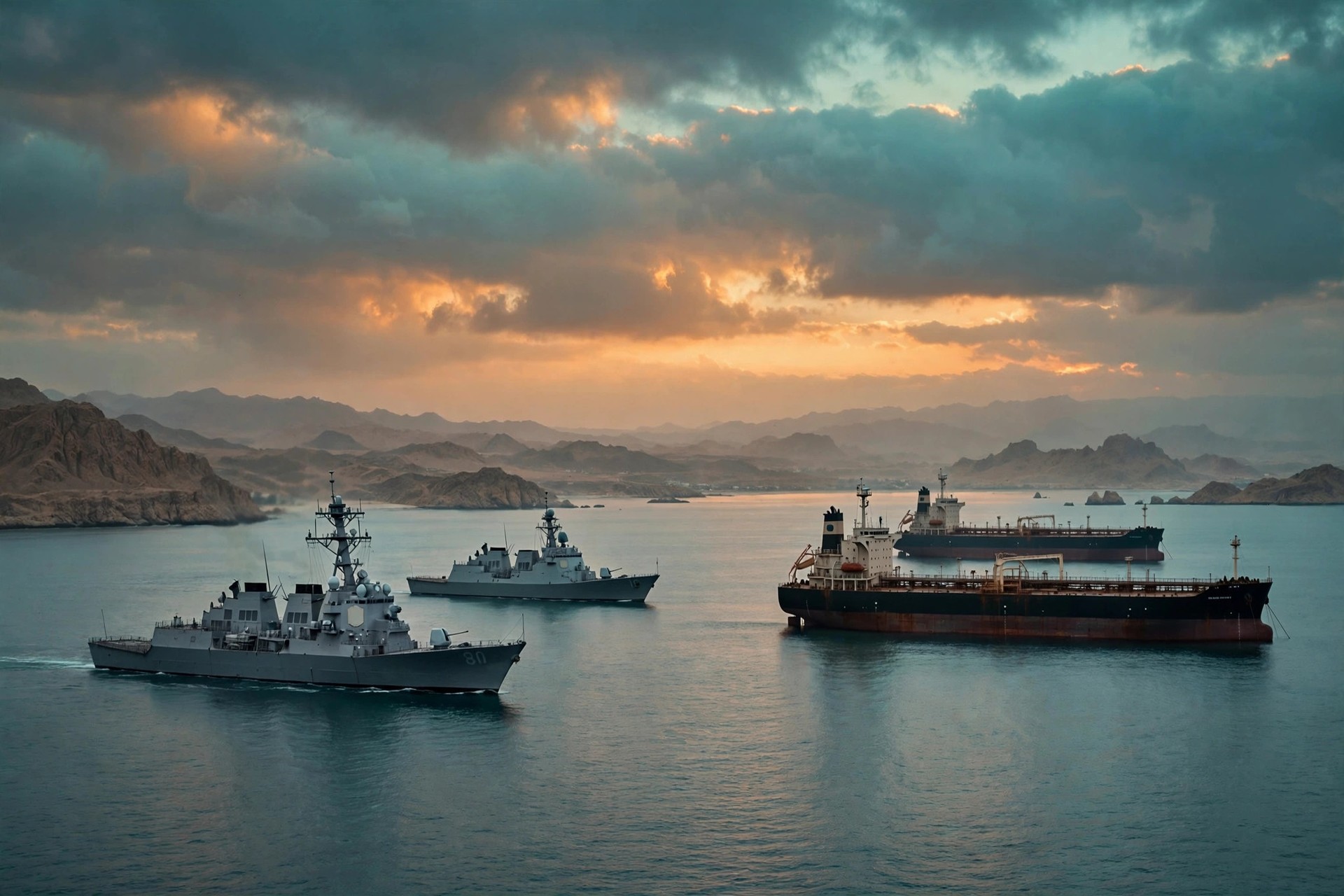
The Bahrain attack came against the background of a confrontation centred on the Strait of Hormuz, the narrow waterway through which a large share of the world’s seaborne oil passes. The United States has enforced a naval blockade of Iranian ports since April, as part of the broader confrontation, and the blockade has become the most likely trigger for a direct clash at sea. Iran has threatened to break the blockade, and reports in recent days have described more than a dozen oil tankers assembled near the country’s main export terminal, in what has been read as a preparation to test American resolve.
Trump’s warning that Iranian vessels attempting to breach the blockade would end up at the bottom of the sea was therefore not an abstract threat. It was a response to a specific and imminent risk, and it raised the possibility that the next phase of the conflict could begin not with a decision in Washington or Tehran, but with a collision at sea that neither side fully controls. The danger of such an incident is compounded by the pattern of recent days: two tankers were struck in the Strait of Hormuz, Iran said on Saturday that it had shot down a United States drone over Qeshm Island in the strait, and American fighter jets struck an Iranian missile site on Qeshm earlier in the week, according to a United States military official. Each of those incidents was, on its own, limited. Together, they describe a conflict in which the line between blockade enforcement and open warfare is growing thin.
The blockade also shapes the diplomacy. As long as it remains in place, Iran’s oil exports, the lifeblood of its economy, are constrained, and Tehran has an incentive to find a way to break it, whether by negotiation or by force. As long as it remains in place, the United States has leverage in the talks, but it also has a continuing military commitment that requires ships, aircraft and personnel to remain on station in the Gulf. Trump’s New Year warning can be read, in this light, as an attempt to use that leverage while it lasts: to tell Tehran that the blockade will not be lifted without a deal, and that the alternative to a deal is not a return to the status quo, but a resumption of strikes.
The strait’s dangers sharpened on Wednesday, November 25, when Iranian naval authorities said three oil tankers and a liquefied natural gas carrier had struck naval mines and caught fire in or near the Strait of Hormuz. Iran’s Revolutionary Guards said the LNG carrier had switched off its positioning systems and taken an unauthorised route, and the Iranian Army said an oil tanker had entered a restricted zone with its identification systems off. Reuters said it could not independently verify the Iranian reports, and the identities of the vessels and any casualties remained unconfirmed. The International Maritime Organization’s secretary-general had said a day earlier that transiting the strait remains unsafe and that ships should avoid the route.
Sanctions and the Pressure Campaign
Military pressure is not the only tool the administration is using. On Monday, November 23, the United States Treasury imposed sanctions on 22 entities and eight people linked to Iran, according to reporting on the day’s developments. The designations are part of a continuing campaign of economic pressure that has run alongside the military confrontation, aimed at cutting off the networks that fund and supply Iran’s military and its regional activities. Treasury sanctions of this kind do not, on their own, change the course of a war, but they signal that the administration intends to keep tightening the economic screws even as it talks about a deal.
The sanctions also illustrate the dual track of American policy: negotiation and coercion at the same time. Trump has said he wants a permanent agreement, and his administration has continued to engage with Tehran, but it has also continued to add names to the sanctions list, to enforce the blockade and to keep its forces in the region. That combination is familiar from earlier phases of the confrontation, and it reflects a belief in Washington that Iran will only make concessions under pressure. Whether that belief is correct is an open question. Iran has so far responded to pressure with defiance, including the Bahrain attack and the threats to the blockade, and there is no public sign that the sanctions have brought Tehran closer to accepting the American demand for a permanent dismantling of its nuclear programme.
The economic dimension also extends to the oil market, which Trump himself has linked to the conflict. The president has accused Iran and the Democrats of trying to keep oil prices high before the midterm elections, and has pointed to the subsequent fall in crude prices as evidence that the election changed the dynamic. Oil prices are in fact sensitive to the conflict, rising on news of attacks in the Gulf and falling when the risk of disruption recedes, and any resumption of large-scale strikes after the New Year would be likely to push prices up sharply. That gives the administration a reason to weigh the economic consequences of a new campaign, even as it threatens one.
The Wider War: Nine Months of Strikes and Counter-Strikes
The confrontation Trump is threatening to escalate is not new. The war began on February 28, 2026, and is now about nine months old, a period marked by successive rounds of American and Israeli strikes on Iranian targets and Iranian missile and drone attacks on American positions and allies across the region. At least 23 American service members have been killed in the war, according to the Daily Beast. The pattern has been one of escalation and pause: major strikes, followed by negotiations, followed by a breakdown in the talks and a return to attacks. Trump’s warning of a resumption after the New Year fits that pattern, but it also raises the question of what a new round would look like.
Reporting in recent days has suggested that the scale of any new campaign is already under discussion in Washington and Jerusalem. The New York Times reported on November 19 that Trump is weighing another round of major strikes, with Israeli Prime Minister Benjamin Netanyahu urging the United States to join an air campaign of roughly four to seven days, according to the Jerusalem Post, citing the Times. Officials are reported to be divided over the intelligence, and Trump has not decided, according to that reporting. A senior Israeli official disputed the account that Netanyahu had pressured Trump, which means the details of the Israeli position remain contested. What is not contested is that the option of a multi-day air campaign is on the table, and that it would be a far larger undertaking than the limited strikes of recent weeks.
The range of options before the president has also widened. NBC News reported on November 24 that administration officials are debating whether the United States military should target senior Iranian leaders in an effort to remove hardliners and end the war, with supporters arguing it could give Trump an off-ramp and opponents warning it could harden Tehran’s position, undermine American credibility in future negotiations and put American officials at greater risk. Trump has made no final decision, and other options under discussion include resuming large-scale combat operations and striking oil facilities on Kharg Island, energy infrastructure on Qeshm Island and nuclear enrichment sites at Pickaxe Mountain.
The human and strategic costs of such a campaign would be considerable. A multi-day campaign would risk Iranian retaliation against American bases across the Gulf, against shipping in the Strait of Hormuz and against Israel, and it would test the air defences of the United States and its allies in a way that the Bahrain attack, for all its seriousness, did not. It would also raise questions in Congress, where Democrats, who will take control in January, have already signalled their intention to scrutinise the administration’s conduct of the war. Trump has not explained why he chose the turn of the year as his marker, and whether the end of the year is a firm deadline or a negotiating threat remains unclear. What is clear is that the threat itself has now been made in public, and that walking it back would carry its own political cost.
What to Watch Before the New Year
The weeks between now and January 1 will be shaped by three things: the negotiations, the blockade and the politics of the transition in Washington. On the negotiations, the question is whether either side moves from its stated position. The United States has demanded a permanent agreement that bars Iran from a nuclear weapon. Iran has insisted on its right to a peaceful nuclear programme and has shown no public willingness to accept the American terms. Unless one side shifts, the talks are likely to remain where they have been for weeks: active in name, unproductive in substance.
Diplomacy has not stopped entirely. A Qatari delegation visited Tehran on November 21 and held talks lasting about two hours, Iranian Deputy Foreign Minister Kazem Gharibabadi said, but formal negotiations with Washington have not begun. Iran has said it will not negotiate until its conditions are met, including an end to hostilities, the lifting of the naval blockade and sanctions, and the release of frozen Iranian assets, and Tehran has proposed reopening commercial shipping through the Strait of Hormuz within 48 hours if the United States meets its key demands. Iran’s parliament speaker and chief negotiator, Mohammad Bagher Qalibaf, said on November 24 that Tehran would not hold talks with Washington until seven conditions are fulfilled, though Iranian authorities have not publicly listed all seven.
On the blockade, the question is whether Iran tests it. A test would force Trump to act on his warning that Iranian vessels would be sunk, and it could trigger the wider exchange of strikes that the president has said he expects. The administration’s own reporting suggests that Trump expects further exchanges of strikes between American and Iranian forces even before any decision on a larger campaign, which means the coming weeks may see more incidents like the Bahrain attack and the Qeshm Island shootdown, even if no major operation is ordered.
On the politics, the question is how the change of control in Congress affects the president’s freedom of action. Democrats take control in January, at almost exactly the moment Trump has set for his warning to take effect, and they are likely to demand a say in any decision to resume large-scale strikes. The president has shown, in his handling of the war so far, that he is willing to act without waiting for congressional approval, but a new campaign launched against the wishes of a Congress controlled by the opposition would carry legal and political risks that the earlier rounds did not. For now, the warning stands: a deal by the New Year, or a return to strikes. The test of whether it is a deadline, a threat or a bluff will come in the weeks ahead, and the first signs will be visible in the Gulf long before January 1 arrives.
Sources
USN reviewed reporting from multiple outlets for this story. Read more from Dawn, NDTV and The Straits Times.