

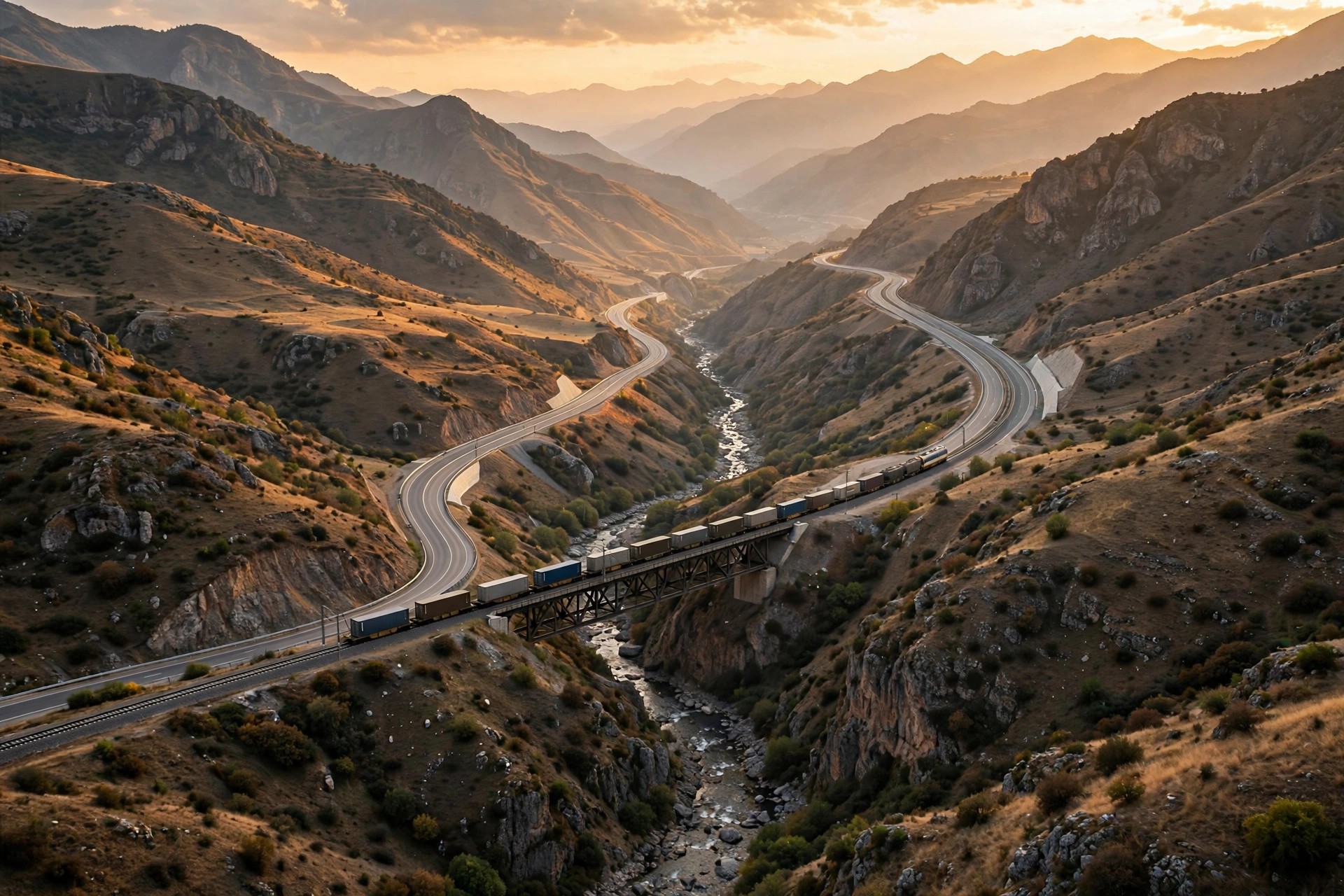
YEREVAN — Armenian Prime Minister Nikol Pashinyan and United States President Donald Trump on Monday, November 23, 2026, announced the launch of the practical phase of the Trump Route for International Peace and Prosperity, known as TRIPP, a United States-backed corridor designed to connect mainland Azerbaijan with its Nakhchivan exclave through Armenian territory. The announcement, delivered in separate video messages by the two leaders, marked the start of preparatory construction work in Armenia’s southern Syunik province and opened a new chapter in a peace process that began with a White House summit in August 2025.
Pashinyan described the project as the largest economic undertaking in Armenia since the country gained independence, saying it would bring new investment, trade and economic development, and would strengthen Armenia’s security by widening the circle of countries with a stake in its stability. Trump, in a recorded message played shortly after Pashinyan’s address, congratulated the Armenian prime minister on what he called his courageous leadership in choosing the path of peace, and announced the creation of a new TRIPP Development Company to build and operate the route. The launch comes at a delicate moment for the region, with a formal peace agreement between Armenia and Azerbaijan still unsigned and Iran openly warning against a United States presence on its northern border.
The corridor itself is about 43 kilometres, or 27 miles, long, running through the mountainous Syunik region between mainland Azerbaijan and Nakhchivan, with an onward link toward Türkiye. According to Armenian officials, it is planned as a multimodal route carrying a railway, a highway, pipelines, electricity transmission lines and fibre-optic cables, creating a new trade connection between Central Asia and Europe. For Armenia, the project promises transit revenue, energy links and a deeper connection to international markets. For Azerbaijan, it promises the long-sought overland link to Nakhchivan that does not depend on passing through Iran. For Washington, it promises a lasting American economic and strategic foothold in the South Caucasus.
What the Trump Route TRIPP Is
TRIPP is the infrastructure centrepiece of the peace framework that Trump brokered between Armenia and Azerbaijan in Washington in August 2025. Its full name, the Trump Route for International Peace and Prosperity, reflects both its purpose and its politics: a transport and energy corridor built under an American name, operated by a joint American-Armenian company, and presented as the physical proof that a decades-long conflict can be replaced by shared commerce. The route is intended to establish what Pashinyan has called unimpeded, multimodal transit connectivity in the South Caucasus, based on full respect for the sovereignty, territorial integrity and jurisdiction of the countries involved.
The emphasis on sovereignty is not accidental. For years, the idea of a corridor through southern Armenia was one of the most sensitive issues in the region, with Yerevan insisting that any transit route must remain under Armenian law and control, and Baku pressing for guaranteed, unhindered access to Nakhchivan. The framework agreed in Washington sought to square that circle by placing the corridor under Armenian sovereignty while giving the United States a central role in developing and operating the infrastructure. Under the implementation framework, the TRIPP Development Company will receive land-use and development rights in the designated areas for 49 years, with the United States holding a 74 percent stake and Armenia holding the remaining 26 percent, according to reporting on the framework agreement. If the two sides agree to extend their cooperation for a further 50 years, Armenia’s stake would rise to 49 percent and the American share would fall to 51 percent.
That structure is itself part of the story. Armenia’s parliament ratified the framework agreement on strategic cooperation concerning TRIPP on October 28, 2026, by 63 votes to 32, and President Vahagn Khachaturyan signed the ratifying law on November 10. The parliamentary debate was contentious, and the vote reflected real divisions in Yerevan over how much control Armenia should hand to a foreign partner, even a friendly one. Supporters of the project argue that American involvement is precisely what makes the corridor viable, because it brings investment, engineering capacity and a powerful guarantor that neither neighbour can easily ignore. Critics, including opposition lawmakers who voted against ratification, have questioned the length of the arrangement and the scale of the American stake, and have asked what happens if the political winds in Washington change.
How the Launch Unfolded on 23 November
The launch was staged as a national moment in Armenia. Pashinyan delivered a televised address announcing the start of the practical phase of TRIPP and of what he called the regional unblocking process, and the broadcast then crossed live to Syunik province, where preparatory construction work was beginning around the city of Meghri, near Armenia’s border with Iran. “We are launching work on the largest economic project in Armenia since independence,” Pashinyan said, telling Armenians that the project would significantly improve the country’s access to foreign markets, help develop its business environment and encourage investment.
Trump’s video message followed immediately. “A very special hello to everyone in Armenia on this unbelievably exciting occasion as you officially launch the Trump Route for International Peace and Prosperity,” the president said. “I’m very proud of that. I want to congratulate my friend, Prime Minister Pashinyan, for his courageous leadership in choosing the path of peace and working with us to end the long-running conflict between Armenia and Azerbaijan. For more than 35 years, this conflict caused enormous suffering, and many tried to find a resolution, but failed. But we got it done, and last year, we signed a historic peace agreement at the White House.”
Trump went on to announce the new operating company and to promise American commitment to the project. “Today, we continue our progress with the launch of the Trump Route for International Peace and Prosperity and the brand-new TRIPP Development Company,” he said. “This partnership between the United States and Armenia will create new trade routes for the flow of goods, energy, and travel throughout the region, and we’re committed to ensuring it is a great, great success.” He thanked both Pashinyan and Azerbaijani President Ilham Aliyev for working with Washington to make the day possible, and thanked them for what he said was their generous nomination of him for the Nobel Peace Prize. He also invited Pashinyan to the White House next year, when the Armenian leader travels to Washington for the National Prayer Breakfast, describing him as “an exceptional man and a great friend.”
The timing of the announcement had been trailed in advance. Pashinyan had said at the DigiTec 2026 technology exhibition in Yerevan on November 21 that the launch would be officially announced on November 23, correcting an earlier remark in which he had given November 22 as the date. The care over the date underlined how closely the event was being watched, in Yerevan and beyond, as a test of whether the August 2025 framework was moving from paper to ground.
The August 2025 Washington Peace Framework Behind TRIPP
TRIPP cannot be understood without the summit that produced it. On August 8, 2025, Trump hosted Pashinyan and Aliyev at the White House, where the two leaders signed a joint declaration intended to advance peace, normalise relations and reopen regional transportation links, and initialled a peace agreement. The declaration was the culmination of a United States diplomatic push to end a conflict that had shaped the South Caucasus for more than three and a half decades, most recently through the war over Nagorno-Karabakh, an internationally recognised part of Azerbaijan that was controlled for years by ethnic Armenian separatists before Azerbaijani forces retook the territory in 2023.
The Washington meeting produced more than a handshake. The joint declaration committed both sides to respecting each other’s territorial integrity within the administrative borders of the former Soviet republics, and it established the basis for the TRIPP initiative, giving Washington a central role in developing the corridor infrastructure. In the months that followed, the two sides continued to meet, including a recent encounter between Pashinyan and Aliyev on the sidelines of the European Political Community summit in Dublin, where the leaders said their discussions built on the outcomes of the August 2025 summit and reviewed progress on TRIPP, including the planning and design of its railway and highway components and prospects for transit connectivity.
Progress has not been limited to declarations. In early November 2025, Armenia resumed rail transit through Azerbaijan for the first time since 1991, a practical step that showed the unblocking of regional transport was already under way before the formal TRIPP launch. Even so, the formal peace agreement itself remains unsigned, and the path to a signature runs through politics in Yerevan. On the same day as the TRIPP launch, Pashinyan presented a draft proposal for a new Armenian constitution and offered to resign if voters reject it in a referendum, while saying he would not run again if they back it. Azerbaijan has made a new Armenian constitution a condition for signing a formal peace agreement, according to reporting on the issue, because Baku wants the removal of constitutional language it regards as a territorial claim. Pashinyan has therefore tied his own political future to the same peace process that TRIPP is meant to embody, raising the stakes of the project well beyond its engineering.
What the Corridor Will Carry: Rail, Road, Energy and Data
The corridor is planned as far more than a single railway line. Armenian officials have said the route will include a 43-kilometre railway, a highway, a gas pipeline, power transmission lines and a fibre-optic cable, making it a bundle of transport, energy and digital infrastructure rather than a road alone. That breadth matters, because each element serves a different constituency: the railway and highway serve freight and passengers, the pipeline and power lines serve energy trade, and the fibre-optic cable serves the digital connectivity that Armenia’s growing technology sector needs.
Energy is a particularly important part of the project. Pashinyan said at the DigiTec 2026 event that energy and electricity transit would be a very important component of TRIPP, and that Armenia would connect its electricity grid to the grids of Türkiye and Azerbaijan. Armenia is already connected to the grids of Georgia and Iran, and officials say investment is being made to make electricity transmission more efficient. The result, if the plans are realised, would be an Armenian grid plugged into every one of its neighbours, turning a landlocked country that has often been described as blockaded into a small but real energy transit hub.
The wider trade logic is equally significant. Pashinyan has said TRIPP will give additional momentum to the Trans-Caspian trade route and to West-East connectivity, the network of rail, road and shipping links that carries goods between China and Central Asia on one side and Europe on the other, passing through the Caspian Sea and the Caucasus rather than through Russia or Iran. For shippers, a functioning corridor through southern Armenia would shorten and diversify that route. For Armenia, it would mean transit fees, jobs and a reason for international traders to care about the country’s stability. For the United States, it would mean a commercial stake in a trade artery that bypasses two of its adversaries.
The TRIPP Development Company and the 49-Year Framework
The TRIPP Development Company is the institutional heart of the project. Announced by Trump in his video message and established under the framework agreement ratified by Armenia’s parliament, the company will oversee the development, construction and operation of the corridor, holding land-use and development rights in the designated areas for 49 years. The ownership split, with the United States holding 74 percent and Armenia 26 percent during the initial period, reflects the expectation that American capital and expertise will drive the build-out, while the provision for Armenia’s stake to rise to 49 percent if the arrangement is extended for a further 50 years reflects Yerevan’s insistence that the project must eventually become more Armenian.
The long time horizon is deliberate. Infrastructure of this kind is not built in a season, and the 49-year term is designed to give investors the certainty they need to commit money to a railway and a highway through difficult mountain terrain. But it also means that the corridor will be an American-Armenian enterprise for a generation, outlasting the governments that signed it. That durability is presented by its supporters as a strength, a guarantee that the peace it serves cannot easily be undone by a change of leadership in any of the three capitals. It is presented by its critics as a risk, a long-term concession of control over a strategic strip of Armenian territory to a foreign partner whose priorities may one day diverge from Yerevan’s.
What is not yet public is the full financing picture. Neither government has published a detailed cost estimate for the corridor, a construction timetable with firm completion dates, or a list of the private investors expected to take part alongside the two governments. The launch on November 23 was the start of preparatory construction work, not the completion of a finished route, and the hard engineering questions, including tunnelling, grading and the sequencing of rail and road works through Syunik’s mountains, remain to be answered in public. Those details will matter in the months ahead, because the difference between a ceremonial groundbreaking and a working corridor is measured in budgets, contracts and kilometres of track laid.
Why the Corridor Matters for the South Caucasus and Beyond
For the South Caucasus, TRIPP is the most concrete product yet of the August 2025 peace framework, and its success or failure will shape how the region’s other disputes are viewed. If the corridor is built and freight begins to move between mainland Azerbaijan and Nakhchivan through Armenia, it will demonstrate that the two countries can cooperate on shared infrastructure after decades of hostility, and it will give both sides a material interest in keeping the peace. If it stalls, it will feed the argument that the Washington declaration was a diplomatic performance rather than a durable settlement.
For Armenia, the stakes are existential as well as economic. Pashinyan has argued that the project will strengthen Armenia’s security precisely because it expands the circle of stakeholders interested in the country’s stability, adding the United States and international traders to the list of parties with something to lose if the region returns to war. That argument is central to his government’s case for the project, and it is why he has described TRIPP as a matter of national security as much as of economics. The corridor also offers Armenia a way out of geographic isolation: a landlocked country with closed borders to two of its four neighbours would gain open, functioning transit links in every direction.
For Azerbaijan, the corridor delivers the overland connection to Nakhchivan that Baku has sought for decades, and it does so without the confrontation that a forced corridor would have required. For Türkiye, which has close ties to Azerbaijan and cut off relations with Armenia in the post-Soviet era, the project opens the prospect of a direct land link to Azerbaijan through Nakhchivan and of new energy and trade flows across a region it has long sought to connect. For the United States, the corridor is a rare example of an American infrastructure project in a region where Russia and Iran have traditionally held sway, and its success would mark a shift in the balance of influence in the South Caucasus.
Iran’s Objections and the Regional Reaction
Not every neighbour welcomes the project. Iran, which shares a border with Armenia’s Syunik province and has long used its own territory as Azerbaijan’s route to Nakhchivan, has warned against any development it believes could threaten its security or regional influence. In the days before the launch, Ali Akbar Velayati, a senior foreign policy adviser to Iranian Supreme Leader Ayatollah Ali Khamenei, accused Armenia of disregarding Tehran’s security concerns over the proposed route, and Iranian rhetoric around the corridor has included threats reported in the press, among them a warning that Tehran would “break legs” over the project. Iran’s concern is straightforward: a United States-operated corridor on its northern border would reduce its leverage over Azerbaijan’s access to Nakhchivan, place American commercial and potentially security personnel close to Iranian territory, and weaken Tehran’s role as a transit power in the region.
Those objections have added a sharp edge to the launch. The corridor has gained added strategic significance amid the ongoing United States confrontation with Iran, as Tehran seeks to secure its northern trade routes and limit any American security presence near its borders, while Washington maintains a naval blockade of Iranian ports. Armenian officials have responded by stressing that TRIPP is a civilian, economic project, built on Armenian territory under Armenian sovereignty, and that it threatens no neighbour. Pashinyan’s own framing has been consistent on this point: the corridor, in his words, is aimed at establishing unimpeded transit connectivity based on full respect for the sovereignty, territorial integrity and jurisdiction of the countries of the region.
Reaction elsewhere has been more measured. Azerbaijan has welcomed the progress on the corridor while keeping its focus on the conditions it has set for a formal peace agreement, including the constitutional changes in Yerevan. Türkiye, which stands to gain from the new links, has followed the project closely. Russia, which has traditionally regarded the South Caucasus as its sphere of influence and which once stationed peacekeepers in the region, has not been a central public player in the TRIPP launch, and the project’s American character is itself a sign of how much the region’s politics have shifted since the 2023 war over Nagorno-Karabakh.
What Happens Next for Armenia, Azerbaijan and the Peace Deal
The immediate question is construction. Preparatory work has begun in Syunik, but the corridor will only become real when earth is moved, track is laid and power lines are strung across the province’s mountains. The TRIPP Development Company will need to publish its plans, secure its financing and show measurable progress, and the Armenian government will need to demonstrate that the work is proceeding on schedule and under Armenian law. Delays or cost overruns would give the project’s critics in Yerevan fresh ammunition and would test the patience of Baku, which has waited decades for the Nakhchivan link.
There are already dates attached to the next steps. The railway component has an agreed completion date of 2028, according to reporting on the launch, and Azerbaijan has joined a trilateral working group with Armenia and the United States and expects its own road and rail infrastructure connecting to the corridor to be ready by early 2027.
The political questions are just as pressing. Pashinyan’s constitutional referendum will be the next major test, because a rejection by voters would, by his own offer, end his premiership, while approval would clear one of Azerbaijan’s stated conditions for signing a formal peace agreement. The referendum therefore links the fate of the corridor to the fate of the government that launched it, and its outcome will be watched in Baku, Ankara, Tehran and Washington alike. A signed peace agreement would in turn unlock further steps, including the full normalisation of relations between Armenia and Azerbaijan and the reopening of borders that have been closed for a generation. Opposition lawmakers in Yerevan criticised the launch, arguing that starting construction without a signed peace agreement amounts to implementing concessions without peace and that the negotiation process is practically stalled. Pashinyan has said his government aims to complete the peace process by 2031.
For now, the launch of TRIPP stands as the most visible evidence that the August 2025 framework is moving from declaration to construction. Trump has put his name on the corridor and his administration’s credibility behind it. Pashinyan has put his political future behind the peace process it serves. Whether the route becomes the trade artery its supporters promise, or another unfinished project in a region full of them, will be decided in the months ahead, in the mountains of Syunik and in the referendum that will determine who governs Armenia.
Sources
USN reviewed reporting from multiple outlets for this story. Read more from Armenpress, Daily Sabah and Fox News.