

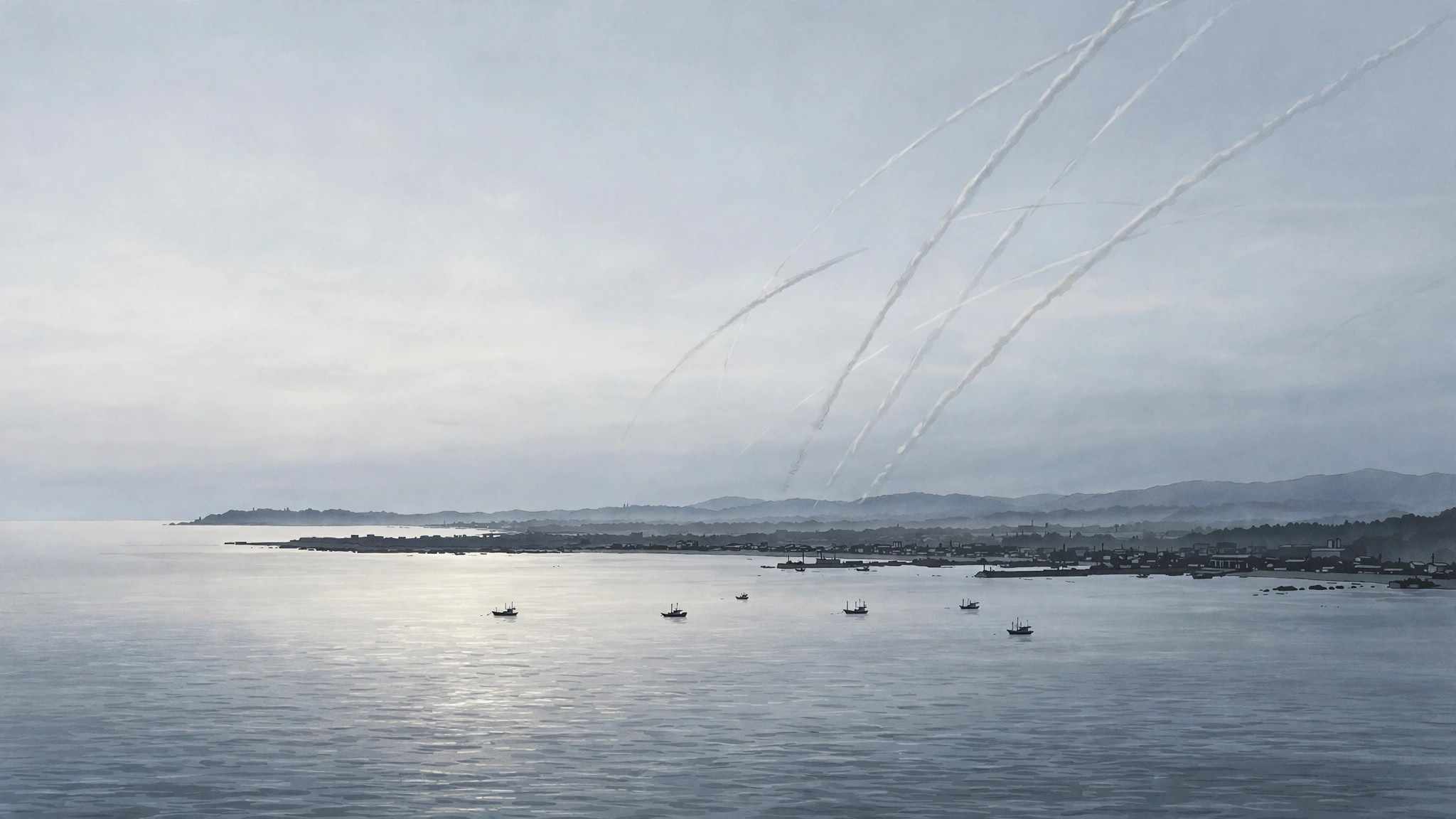
North Korea fired around a dozen short-range ballistic missiles toward the Sea of Japan on Thursday, the largest single salvo reported in weeks, in a launch that South Korean and Japanese officials condemned as a violation of United Nations Security Council resolutions and that arrives in the middle of a poisonous dispute over landmines in the Demilitarized Zone. The missiles, launched at around 12:30 p.m. local time from the vicinity of Wonsan on North Korea’s east coast, flew approximately 250 kilometers before falling into the sea, according to South Korea’s Joint Chiefs of Staff. None landed within Japan’s exclusive economic zone, and no damage to ships or aircraft was reported.
What happened on Thursday
South Korea’s military said it detected “around a dozen short-range ballistic missiles fired from the Wonsan area of North Korea towards the East Sea,” using the Korean name for the body of water also known as the Sea of Japan. “Our military has stepped up surveillance and vigilance against possible additional launches,” the Joint Chiefs said in a statement, adding that Seoul was closely sharing information with the United States and Japan and maintaining a heightened state of readiness. Japan’s Defense Ministry made its announcement at around 12:30 p.m. and estimated that the missile — Tokyo initially tracked at least one launch — had fallen by about 12:45 p.m.; the Japan Coast Guard urged vessels to be vigilant and confirmed that no damage to shipping had been identified.
Japan’s Chief Cabinet Secretary Minoru Kihara told a press conference in Tokyo that the launches “violate U.N. Security Council resolutions and pose a serious problem to the safety of the people,” and said Japan had lodged a protest with North Korea through the embassy route in Beijing. Ballistic missile launches of any range by North Korea are prohibited under a series of Security Council resolutions adopted in response to Pyongyang’s nuclear and missile programs. Thursday’s barrage was the first launch reported by Japan’s Defense Ministry since October 12.
A year of accelerating tests
The Wonsan salvo continues the most intense year of North Korean weapons testing in recent memory. Japan’s Defense Ministry has counted at least eleven ballistic missile launch events since the beginning of 2026, involving at least eighteen missiles — a launch tempo more than double that of all of 2025, with the number of individual missiles roughly triple the previous year’s pace. The program on display has grown more varied as it has grown faster: Pyongyang has recently tested a new precision-guided torpedo system and an intermediate-range hypersonic missile, both said by the North to employ artificial intelligence technology.
The immediate prelude to Thursday’s launch came on October 12, when North Korea fired different types of ballistic missiles from near Pyongyang at around 9:20 a.m. One traveled about 220 kilometers at a maximum altitude of roughly 20 kilometers; a second flew more than 910 kilometers, reaching about 70 kilometers in altitude, and may have flown on an irregular trajectory designed to complicate interception. Japanese Parliamentary Vice Defense Minister Takashi Koyari “strongly condemned” those launches at the time, and South Korea convened an emergency national security meeting. South Korean officials assessed that the October 12 firing was likely a response to Seoul’s first test-firing of a hypersonic missile earlier in the month — which itself followed an October 3 North Korean launch of what Kim Yo Jong, the influential sister of leader Kim Jong Un, described as an intermediate-range strategic missile capable of flying on an irregular trajectory, a test Kim Jong Un inspected alongside his daughter.
The autumn chronology of escalation
The Wonsan launch is the third act of an autumn sequence that has steadily raised the peninsula’s temperature. On September 20, North Korea fired two short-range ballistic missiles. On October 3, it launched a ballistic missile from the Wonsan area at around 6:30 a.m. that flew about 680 kilometers before landing in waters outside Japan’s exclusive economic zone; Pyongyang described the weapon as a strategic intermediate-range missile, and state media showed Kim Jong Un inspecting the launch preparations with his daughter. Days later, South Korea conducted the first test-firing of its own hypersonic missile — the event Seoul’s own officials linked to the North’s October 12 salvo, in which one missile’s flight of more than 910 kilometers, possibly on an irregular, maneuvering trajectory, demonstrated a reach and evasiveness well beyond Thursday’s shorter-range barrage. Japanese Prime Minister Sanae Takaichi responded to the October launches by instructing government offices to make all-out efforts to gather and analyze information, share it quickly and accurately with the public, and ensure the safety of navigation at sea and in the air — the standing playbook of a government that has now executed it at least eleven times this year.
The military track has been shadowed throughout by the landmine affair. The September 21 explosion that wounded three South Korean soldiers inside the DMZ was, in Seoul’s preliminary assessment, caused by mines the North had planted on the southern side of the demarcation line; the joint Seoul–United Nations investigation reached the same conclusion, finding the mines had been laid more than a year earlier. North Korea denied involvement entirely, calling the affair a “farce of their own making” for which Seoul should pay a price. The exchange matters beyond its facts: the Armistice framework that has kept the peninsula’s peace since 1953 depends on a shared, if grudging, factual floor between the two militaries, and that floor is visibly cracking.
The landmine dispute poisoning the atmosphere
Thursday’s missiles were fired against a diplomatic backdrop that has deteriorated sharply. On September 21, a landmine exploded inside the Demilitarized Zone, injuring three South Korean soldiers. A joint investigation by South Korea and the United Nations concluded that North Korea had planted the mines on the southern side of the military demarcation line more than a year ago. Seoul accused Pyongyang of “a clear violation of the Armistice Agreement” and called on the North to return to dialogue; it renewed an offer of military talks with the North to address the two sides’ conflicting views of where the inter-Korean border lies. Pyongyang has rejected the finding angrily, denying involvement, and Kim Yo Jong dismissed South Korean demands for an apology as “despicable” and derided President Lee Jae-myung’s diplomatic overture as “the climax of the farce.”
The sequence captures the peninsula’s current deadlock. Each side’s weapons tests are presented domestically as answers to the other’s provocations: Seoul’s hypersonic test answered the North’s October 3 launch, which Pyongyang in turn frames as deterrence against the alliance arrayed against it, while the landmine affair has removed what little diplomatic channel remained. For Washington, which maintains a mutual defense treaty with South Korea and stations tens of thousands of troops on the peninsula, the launches are a standing reminder that the North Korean arsenal — nuclear-armed, increasingly maneuverable and now tested at triple last year’s cadence — continues to mature regardless of who occupies the White House or what else dominates the world’s agenda. With the United States consumed by its midterm elections and its war with Iran, Thursday’s dozen missiles from Wonsan were, at minimum, Pyongyang’s way of ensuring it is not forgotten. Japan and South Korea both confirmed that their militaries were analyzing Thursday’s launches in close coordination with the United States, the trilateral mechanism that has become the default response to each new test.
Sources
USN reviewed reporting from multiple outlets for this story. Read more from NHK World-Japan, TRT World, Qazinform (Jiji Press) and The Mainichi (Kyodo).
[…] test, which South Korea said was fired toward the Yellow Sea from the northwest. Readers following earlier North Korea missile tests should not merge the two: different coasts, different days, different reported circumstances, and […]