

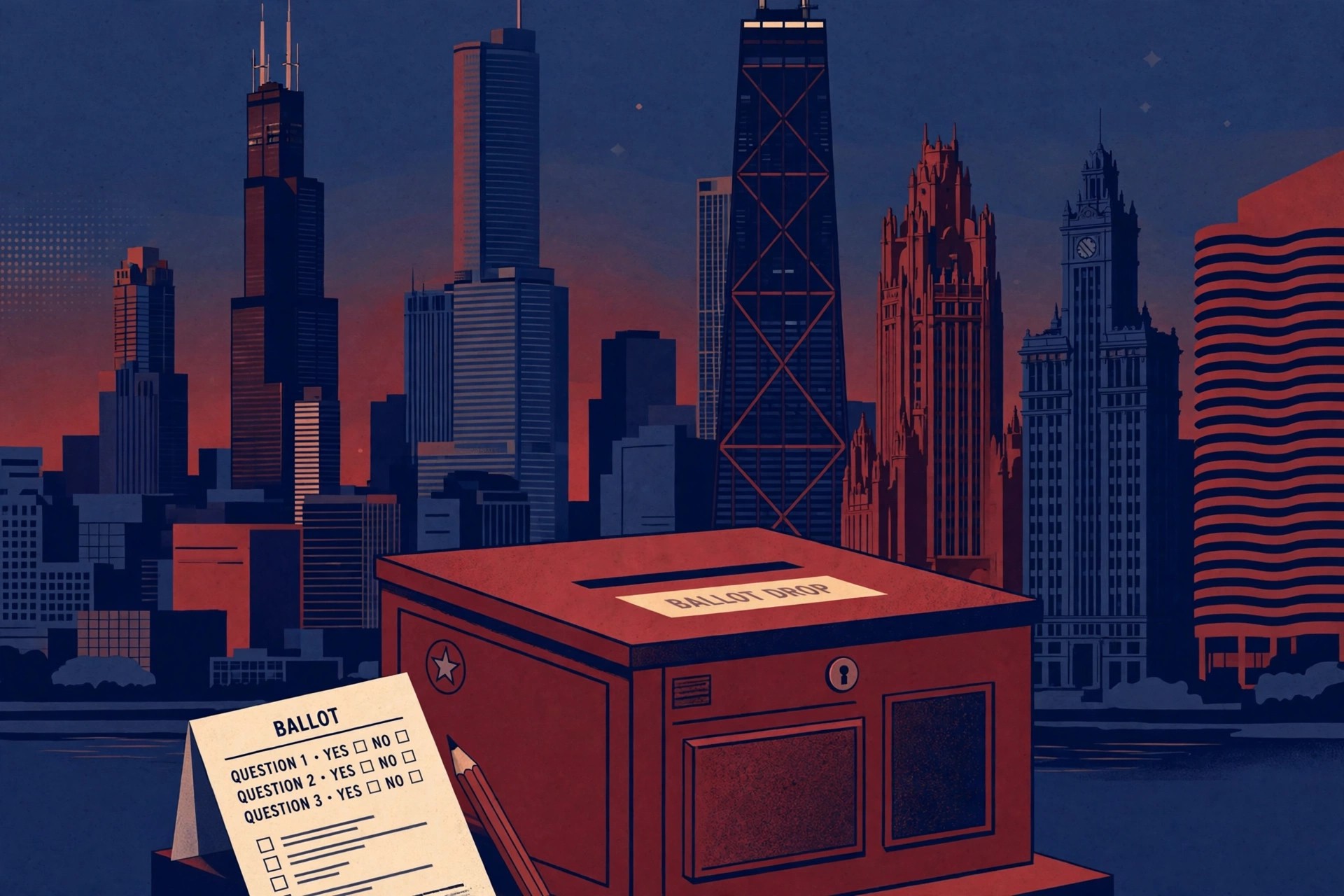
Chicago Voters Head to the Polls With Opinions to Give, Not Laws to Pass
Chicago voters casting ballots on Tuesday, November 3, 2026, will find more than candidates on their papers. Every voter in the city will see six advisory questions, sometimes called non-binding referenda, that ask for an opinion on some of the most argued-about issues in city and state politics: whether gunshot detection technology should return, whether Illinois should tax very high incomes to fund schools and property tax relief, whether Chicago should build a permanent festival space, and whether the city should try to recover money from the federal government over immigration enforcement operations. Some voters will see additional questions that apply only to their ward or precinct, so no two sample ballots are guaranteed to look exactly alike.
The single most important fact about all six citywide questions is also the easiest to miss in a busy election season: none of them changes a law by itself. An advisory vote is a formal temperature check. A yes majority does not impose a tax, restart a technology contract, build a venue or file a lawsuit, and a no majority does not forbid any of those things. What the results do is give mayors, alderpersons, county commissioners, school officials and state lawmakers a public, countable signal about what voters in one of America’s largest cities say they want, at a moment when each of these ideas still needs further legal, budgetary or political steps before it could become real policy.
That distinction matters for every question below. Supporters present the votes as a mandate to act, while critics often describe them as opinion polls dressed up as ballots. Both descriptions capture part of the truth. The questions are real ballot items, placed there through city, county and school-district processes, and their results will be counted and reported. But the hard decisions — the tax rates, the contract terms, the site, the price tag and the legal strategy — would all still have to be made later, by the bodies that actually have the power to make them.
What the Chicago Advisory Ballot Questions Actually Decide — and What They Do Not
Chicago voters will be asked three questions that come from the City of Chicago itself. The first asks: should the city restart the use of gunshot detection technology that informs first responders when gunshots are detected? The second asks: should Chicago develop a permanent festival and outdoor event space for large-scale events? The third asks whether the city should pursue all lawful means to recover financial compensation from the federal government for the costs and economic harm caused by federal immigration operations, including the operation known as Midway Blitz.
Voters in the Chicago Public Schools district will also be asked two questions. One asks whether Illinois should use revenue from a surcharge on millionaires to increase funding to public schools. The other asks whether the city should require owners of long-term vacant or undeveloped commercial or investment properties to pay an additional annual charge that would support Chicago Public Schools. Cook County voters, a group that overlaps heavily with Chicago voters but is not identical to them, will be asked a sixth question: whether Illinois should adopt a Millionaire Amendment for Property Tax Relief and Education, which would enact a 3 percent income tax surcharge only on millionaires, with half of the new revenue going to property tax relief and half to improved state funding for public education.
The overlap between the county question and the schools question is deliberate, and it can confuse voters. Both point in the same direction — a surcharge on incomes over one million dollars — but they come from different governments, ask slightly different things and would need different next steps. The county question describes a constitutional amendment and a 50-50 split between property tax relief and education. The schools question focuses on school funding alone. Neither, on its own, creates the surcharge. Illinois currently has a flat income tax structure, and changing it in the way described would require a constitutional amendment, which in turn would require a supermajority in the legislature and then approval by voters in a binding statewide vote. A strong advisory result in Chicago and Cook County would therefore be best understood as pressure on Springfield, not as Springfield’s decision.
Gunshot Detection Returns to the Ballot Two Years After ShotSpotter Ended
The gunshot detection question revives a debate that has never fully left Chicago politics since Mayor Brandon Johnson ended the city’s ShotSpotter contract in 2024. Supporters of the technology argue that it alerts police and other first responders to gunfire quickly, even when no one calls 911, and that faster response can save lives and preserve evidence. Critics argue that the system has raised accuracy concerns, that it can send officers into neighbourhoods on the basis of alerts that turn out not to involve gunfire, and that the money could be better spent on other public safety measures. Local reporting on the ballot guide notes that the mayor ended the contract because of local concerns about accuracy and said he would look for a replacement, and that no replacement has been approved or implemented since.
That history is why the wording of the question matters. It does not name ShotSpotter, and it does not promise a particular vendor, price or deployment plan. It asks only whether the city should restart the use of gunshot detection technology in general. A yes vote would therefore not automatically bring back the old system on its old terms. City officials would still have to decide whether to seek bids, what accuracy and privacy standards to require, how alerts would be used, and how much the city could afford. A no vote, likewise, would not permanently ban the idea; it would signal that voters, at this moment, do not want the city to go back down that road.
The debate also sits inside a wider argument about what public safety technology should do. Advocates tend to frame it as a response-time tool. Opponents tend to frame it as a surveillance and deployment question, asking who bears the cost when alerts are wrong and whether communities that already experience heavy policing would experience more of it. Voters answering this question are not being asked to settle the technical argument about any single product. They are being asked, in broad terms, whether they want the city to try again.
The Millionaire Tax Idea, and Why an Advisory Yes Would Still Be Only a First Step
The millionaire tax questions are the most financially consequential ideas on the ballot, and also the ones most likely to be misunderstood. The proposal described in the Cook County question would add a 3 percent surcharge on individual incomes over one million dollars a year. Supporters estimate it would raise billions of dollars, divided equally between property tax relief for residential and commercial taxpayers and improved funding for public education. The schools question asks the same voters, from a different angle, whether that kind of surcharge revenue should be used to increase funding for public schools.
For Chicago homeowners, the property tax part of the pitch is central. Property taxes fund a large share of local government and schools in Illinois, and they are a recurring source of frustration for owners who see bills rise even when their incomes do not. A surcharge on very high earners is presented by supporters as a way to ease that burden without cutting school funding. Opponents, in past Illinois debates over similar ideas, have argued that high earners are mobile, that revenue estimates are uncertain, and that a new surcharge could affect business decisions and jobs. Those arguments are not settled by the advisory vote, and USN does not present any revenue estimate as a guaranteed figure, because the tax does not yet exist and its final design — including exactly what counts as income over one million dollars — has not been enacted.
The procedural history also deserves a plain explanation. Earlier in 2026, state lawmakers did not advance a binding constitutional amendment proposal, and the city council’s own attempt to place a millionaire tax question on the city ballot ran into Illinois rules that cap the number of public questions per government per election and set filing deadlines. The question reaches voters anyway through the Cook County Board, which voted to place its countywide advisory question on the November 3 ballot, and through the schools district questions. That route is lawful, but it underlines the point that this is a campaign for future action in Springfield, not a tax that takes effect the morning after the election. Readers who want to think through the household side of election policy can find background on how election policies can change household finances.
A Permanent Festival Space, Muddy Parks and an Unanswered Price Tag
The festival space question may sound lighter than taxes or policing, but it touches a real and recurring Chicago argument: where should very large events go, and who pays when parks are damaged? Grant Park regularly closes for weeks in summer for festivals such as Lollapalooza, and cleanup after heavy rain can leave grounds muddy and damaged. Douglass Park, home to Riot Fest, has raised similar neighbourhood concerns. Supporters of a permanent space point to examples such as the Summerfest grounds in Milwaukee, a dedicated lakefront festival site with stages, facilities and food options, and argue that a permanent venue would protect everyday park use while giving large events a proper home.
The sponsor of the question, Alderperson Nicole Lee of the 11th Ward, has herself acknowledged the limits of the idea at this stage, telling local media she did not yet have a specific location in mind and was not sure about the maths of the investment. That candour is important for voters to hear. The ballot question does not say where a permanent space would be built, how much it would cost, who would pay for it, or which events would move there. A yes vote would therefore be a vote to keep exploring the idea and to take the concept seriously, not a vote to approve a named site or budget. A no vote could be read either as opposition to the concept or as a judgement that the idea is too vague to endorse, and the result alone will not distinguish between those two reasons.
Neighbourhood effects cut both ways in this debate. Residents near current festival parks complain about noise, crowds, closures and damage. Residents and businesses near any future permanent site would face their own questions about traffic, noise and year-round use. Festival organisers, meanwhile, value the character and visibility of established parks. The advisory question does not resolve any of that. It asks voters to weigh a general direction of travel: should Chicago try to build its way out of the annual park-versus-festival tension, or keep managing it event by event?
Federal Cost Recovery and the Midway Blitz Question
The most politically charged of the three city questions asks whether Chicago should pursue all lawful means to recover financial compensation from the federal government for costs and economic harm linked to federal immigration enforcement, including the Midway Blitz operation. The ballot wording itself describes the operations in strong terms, and voters should understand that that wording is the question as placed on the ballot, not a court finding. No court has, in the material reviewed for this story, ruled on the merits of a Chicago compensation claim, and the city has not yet recovered money through such a claim.
Supporters of the question argue that the operation disrupted immigrant business corridors, scared customers and workers away, imposed public safety response costs and forced the city and community organisations to provide services to affected residents and families. One widely cited estimate, reported in local ballot coverage, put lost economic activity for Chicago-area businesses at more than one billion dollars, with another summary citing 1.2 billion dollars in lost revenue. Those figures should be treated as estimates from studies and summaries cited by supporters and local coverage, not as audited losses accepted by all sides, and the precise scope, method and time period behind them are not stated in the ballot question itself. Critics of the idea are likely to argue that federal immigration enforcement is a federal responsibility, that causation and damages would be hard to prove in court, and that a legal campaign could be long, expensive and uncertain even if voters support it.
What a yes vote would authorise, in practical terms, is political backing for the city to explore lawful recovery routes — which could include litigation, negotiation or federal claims processes — and to spend staff time and, potentially, legal resources on that effort. It would not guarantee recovery, set a dollar amount or name a defendant beyond the federal government in general terms. A no vote would signal that voters do not want the city to prioritise that fight. Either way, the next step after November 3 would be a separate decision by city lawyers and elected officials about whether a viable claim exists and what it would cost to pursue.
What Happens After November 3, and How Voters Can Check Their Own Ballot
When the advisory results are counted, expect each side to claim momentum, and expect the real work to move elsewhere. Gunshot detection would return to the council and the mayor’s office for a procurement and policy decision. The millionaire tax idea would return to Springfield, where a constitutional amendment would need legislative supermajority support and a future binding vote. The festival space idea would need a site, a financing plan and a neighbourhood process. The federal compensation idea would need a legal assessment. The vacant-property charge for schools would need its own ordinance, definitions of vacancy and rates. None of those steps is automatic, and none should be reported as done simply because an advisory question passed.
Voters who want certainty about their own ballot should check their precinct-specific sample ballot through the Chicago Board of Election Commissioners, because ward and precinct questions can add items beyond the six citywide questions described here. Polls in Chicago on Election Day are open from 6 a.m. to 7 p.m., and voters may also vote at any vote centre in the city. Early voting, which ran in the weeks before November 3, has already closed by the time many readers see this story, so Election Day voting is the remaining route for those who have not yet cast a ballot.
The value of an advisory ballot, in the end, is that it forces a public conversation into a countable form. Chicago voters are being asked, all at once, about safety technology, high-income taxation, school funding, the future of its parks and its relationship with the federal government. The answers will not settle those debates. They will, however, tell the people who must settle them what the city’s voters said when they were asked directly — and that, in a democracy, is a signal worth recording carefully, without overstating what it can do on its own.
Sources
USN reviewed reporting from multiple outlets for this story. Read more from FOX 32 Chicago, NBC Chicago and Illinois Policy Institute.