

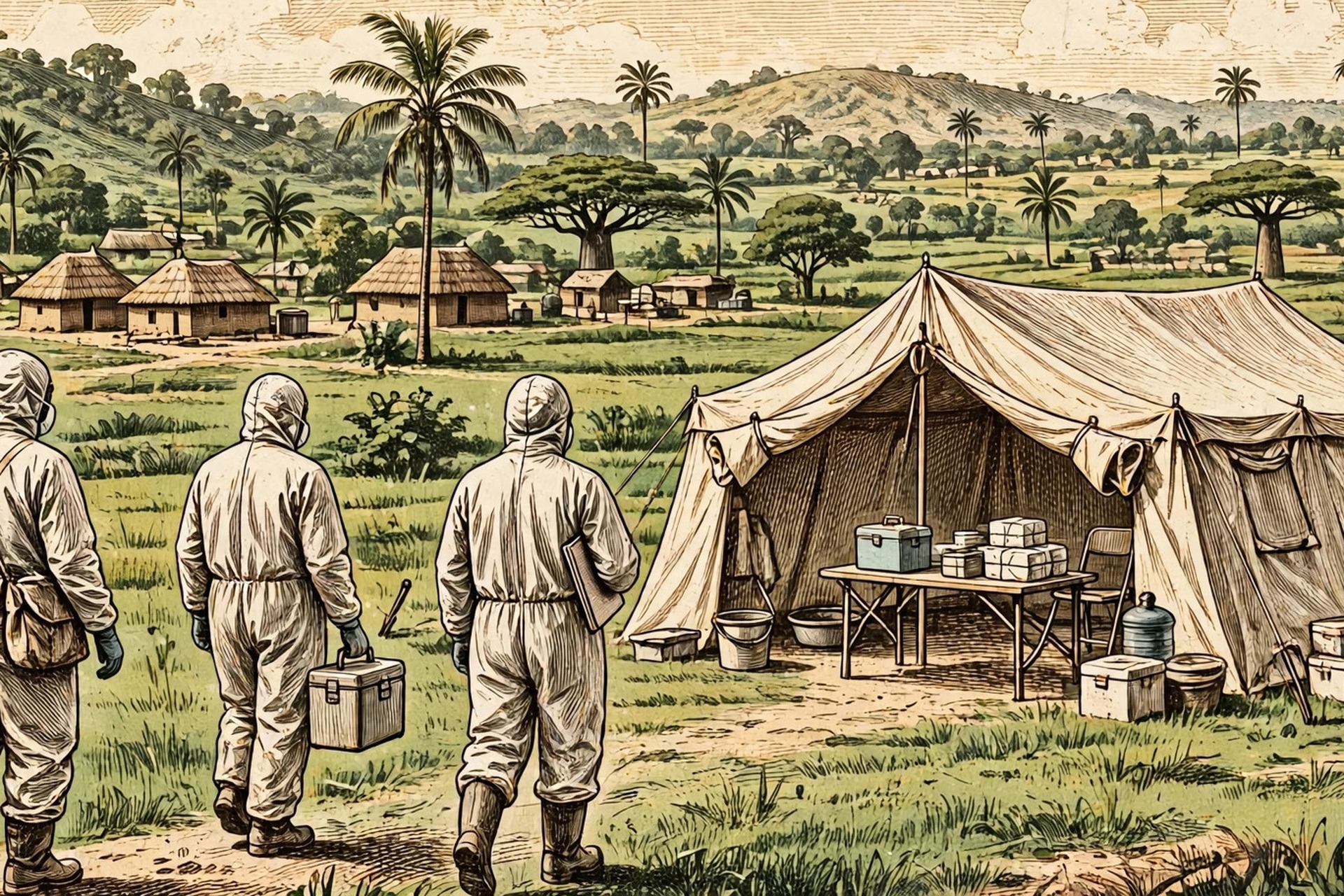
KINSHASA — The Ebola outbreak in the Democratic Republic of Congo has passed 10,000 cases, according to Congolese Ministry of Health data reported by the United Nations on 28 October 2026, making it the largest Ebola outbreak in the country’s history and the second-largest in the world after the West Africa outbreak of 2014–2016. The figures, dated to Monday, 27 October, put the total at 10,141 cases and nearly 5,000 deaths, with more than 2,600 people recovered. Those numbers will have moved by the time readers see this article — outbreak counts change daily — so they must be read as a snapshot as of 27 October, not as a current total. What has not changed is the central challenge: the virus driving this outbreak, Bundibugyo ebolavirus, has no approved vaccine or treatment, and the response is therefore built on case-finding, contact tracing, isolation, community trust and, now, clinical trials.
The outbreak, declared in May 2026, is the DRC’s 17th Ebola outbreak, but its scale and geography set it apart. By late October it had spread to eight provinces — Ituri, the epicentre, plus North Kivu, South Kivu, Tshopo, Haut-Uele, Bas-Uele, Sud-Ubangi and Nord-Ubangi — and beyond the country’s borders, with imported cases reported in Kenya and Nigeria. About half of infected people have died, a proportion consistent with Ebola’s known lethality and with the difficulty of reaching patients early in remote, conflict-affected areas. The World Health Organization’s message, as reported on 28 October, was stark: “Sustained efforts are essential to end the outbreak.” That is not a declaration of success or failure, but a warning that the outbreak will not end on its own.
Congo Ebola Cases Pass 10,000: Counting a Moving Outbreak
Case counts for this outbreak differ by source and date, and reporting them without dates would create a false precision. The UN News report of 28 October, citing Ministry of Health data, gave 10,141 cases and nearly 5,000 deaths as of 27 October. A government situation report also dated 27 October, as reported by Outlook India on the same day, put confirmed cases at 10,060 — a different total for a similar date, reflecting different reporting cutoffs and case classifications. Earlier figures show the trajectory: WHO data via Ankara Report on 24 October gave 9,765 cases and 4,727 deaths, while the European Centre for Disease Prevention and Control counted 9,704 confirmed cases and 4,687 deaths in data to 20 October.
Those differences are normal in outbreak surveillance, but they matter for headlines. A headline that says “passes 10,000 cases” is supported by both 27 October figures, which are above 10,000, even though they differ from each other by 81 cases. A headline that gave a single, exact total without a date would be stale within days and would hide the uncertainty inherent in counting cases in areas where health systems are stretched. Readers should therefore treat 10,141 as the UN-reported total as of 27 October, 10,060 as the government situation-report total for a similar date, and the overall picture as an outbreak that crossed 10,000 cases in late October and continued to grow.
Surveillance counts also understate the true burden, according to a warning from WHO’s regional director cited in reporting: many infected people are dying at home, unreached by health workers, and therefore never enter the official count. That warning does not mean the official figures are invented; it means they are a floor, not a ceiling, and that the gap between counted and actual cases is likely larger in remote areas, in conflict zones, and in communities where trust in health authorities is low. Any article that presents a case count as a complete picture of infections would therefore be misleading, however accurate its arithmetic.
Bundibugyo Virus: Why No Vaccine Changes the Response
Bundibugyo ebolavirus is one of several ebolaviruses, distinct from the Zaire ebolavirus that caused the West Africa outbreak and for which a vaccine, Ervebo, was developed. There is currently no approved vaccine or treatment specifically for Bundibugyo, and that fact shapes every part of the response. Without a vaccine to offer contacts, health workers must rely on the classic Ebola toolkit: finding cases quickly, isolating them, tracing and monitoring contacts, ensuring safe burials, and engaging communities so that people seek care early rather than hiding illness.
Contact tracing on this scale is enormous. About 30,000 contacts are monitored daily, each followed daily for three weeks, according to WHO data reported on 24 October. That is a logistical operation involving thousands of health workers, many of them Congolese, travelling to villages, towns and displacement sites, often in areas where roads are poor, insecurity is real, and mobile-phone coverage is patchy. The work is also social: a contact who trusts the tracer will report symptoms early; a contact who fears isolation, stigma or violence may not. Community trust is therefore not a soft, secondary factor in this outbreak; it is a determinant of whether cases are found in time for isolation and supportive care to make a difference.
That trust has been tested by violence. In the week before 27 October, a nurse was killed in Bafwasende, in an attack reported by officials and described in a Reuters-seen memo in the on-disk reporting reviewed for this article. The perpetrators’ motive should not be stated as fact without a confirmed account, and this article does not do so. What can be said is that attacks on health workers, whatever their motive, disrupt tracing, vaccination trials and treatment, and they force responders to weigh their own safety against the urgency of reaching cases. An outbreak that is already geographically vast becomes harder to contain when the people containing it cannot safely travel.
Trials in Bunia: Testing Whether Ervebo Works Against Bundibugyo
One of the most closely watched parts of the response is the TUMAINI trial in Bunia, which will first test whether Ervebo — the vaccine approved for Zaire ebolavirus — also protects against Bundibugyo. That is a scientific question, not a foregone conclusion: vaccines are often strain-specific, and cross-protection cannot be assumed. If Ervebo does protect against Bundibugyo, it would give responders a powerful tool they currently lack. If it does not, the search for a Bundibugyo-specific vaccine becomes even more urgent, and WHO expert groups on two Bundibugyo-specific vaccine candidates were due to report in the week of 27 October, according to UN reporting.
Trial ethics in an outbreak setting deserve explicit attention, because they are often simplified in coverage. A ring-vaccination trial, in which contacts of a case and contacts of contacts are offered vaccination, must balance speed, consent, and the uncertainty of whether the vaccine works against the strain in question. Participants must understand that they are in a trial, that benefit is not guaranteed, and that standard care — isolation, supportive treatment, contact monitoring — continues regardless. Reporting that describes a trial as a vaccination campaign, or a campaign as a trial, would confuse both. TUMAINI is a trial, and its results, when they come, will be evidence, not an immediate solution.
Beyond vaccines, treatment for Bundibugyo Ebola remains supportive: fluids, electrolytes, management of symptoms and complications, and treatment of co-infections, delivered in isolation units where staff can protect themselves. No specific antiviral has been approved for Bundibugyo, and claims about experimental treatments should be treated with the same caution as claims about vaccines: promising in a laboratory or in a small study is not the same as proven in an outbreak. The response’s honesty about that gap — stating plainly that there is no approved vaccine or treatment — is itself a form of trust-building, because it avoids raising hopes that cannot yet be met.
Beyond Congo’s Borders: Kenya, Nigeria and the Travel Question
The outbreak’s spread beyond the DRC is, so far, limited but consequential. Kenya reported nine cases, with an index case involving a man who worked in the DRC, flew to Nairobi via Uganda on 3 October, and died on 5 October. The number of deaths among Kenya’s nine cases is reported differently in different sources, and this article reports that discrepancy rather than resolving it by fiat: UN News on 28 October reported nine cases including two deaths, while earlier ECDC-based reporting on 24 October reported nine cases including one death. The difference may reflect a later death, a reclassification, or a reporting cutoff, and readers should check the latest Kenya Ministry of Health or WHO update for the current figure rather than treating either earlier figure as final.
Nigeria reported an imported case on 20 October and activated incident management. That response — rapid activation, contact tracing and isolation for an imported case — is the standard playbook for preventing a single importation from becoming a local outbreak, and it is the reason imported cases, while alarming, do not automatically mean sustained transmission in a new country. Whether Kenya’s or Nigeria’s cases lead to further local transmission depends on how quickly contacts were found and monitored, and on whether any cases were missed. At the time of the 28 October UN report, there was no evidence in the sources reviewed of sustained, large-scale transmission outside the DRC, but that assessment, like the case counts, is dated and must be updated.
WHO advises against travel and trade restrictions in response to this outbreak, a position it has taken in previous Ebola outbreaks on the grounds that restrictions can hinder the response, damage economies and discourage transparent reporting, without reliably preventing spread. That advice is WHO’s position, not a guarantee that no country will impose restrictions, and some countries may do so regardless. Readers planning travel should check official guidance from their own governments and from WHO at the time of travel, rather than relying on a general statement in a news article.
The outbreak’s scale — more than 10,000 cases, nearly 5,000 deaths, eight provinces, two countries with imported cases, 30,000 contacts monitored daily, and no approved vaccine or treatment for the strain involved — makes it one of the most significant public-health events of 2026. Its end will not come from a single announcement, but from the accumulation of traced contacts, isolated cases, recovered patients and, eventually, trial results. Until then, the accurate story is one of a vast, moving outbreak, a response stretched across geography and conflict, and a scientific race to give that response the vaccine it currently lacks.
Sources
USN reviewed reporting from multiple outlets for this story. Read more from UN News, Outlook India and Ankara Report.