

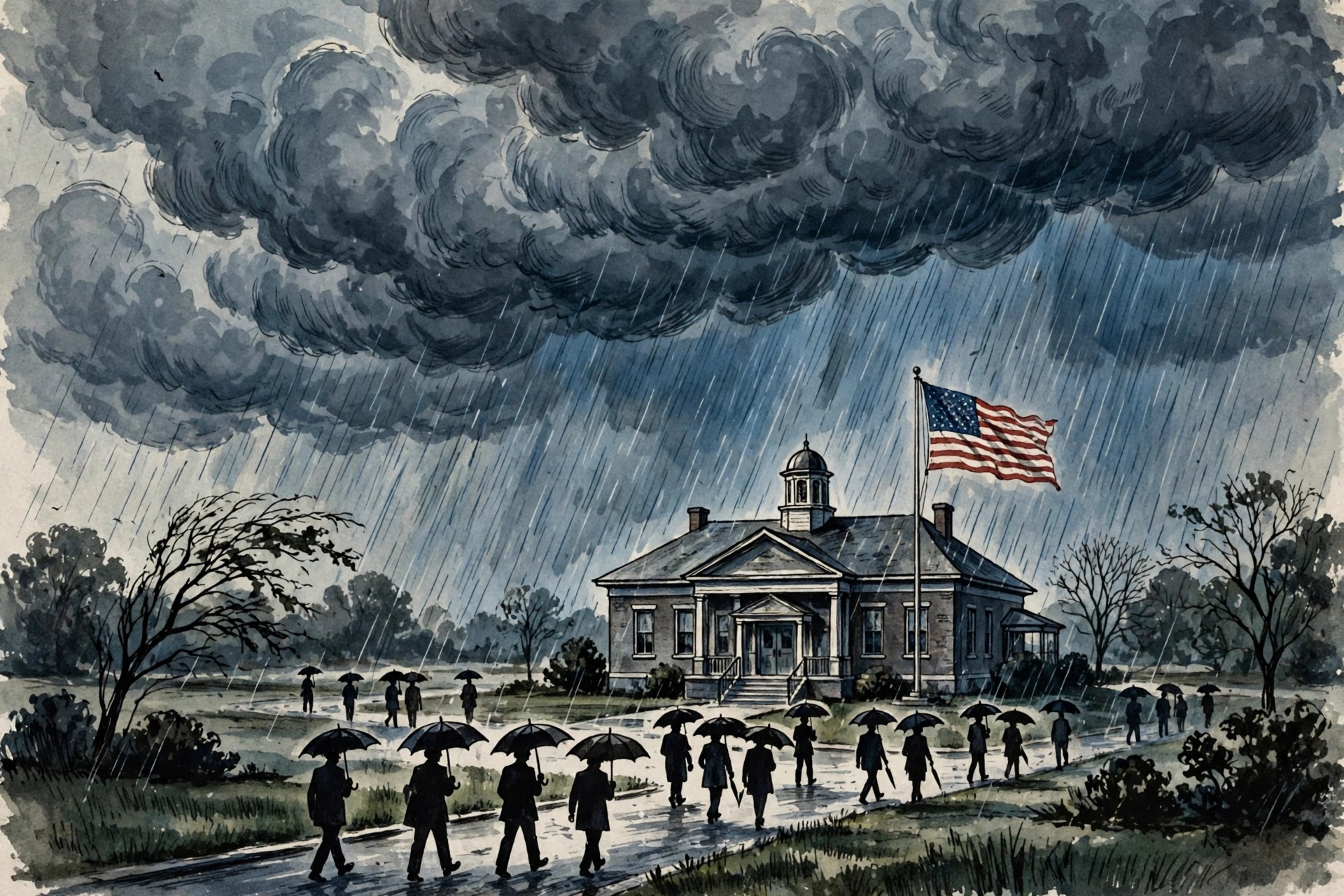
A wet Election Day is forecast across the middle of the country
A storm system moving across the United States is set to bring a soggy Election Day to much of the middle of the country on Tuesday, November 3, 2026, raising questions about whether rain, wind and severe weather could affect turnout in some of the midterm elections’ most competitive races. Forecasters expect rain and thunderstorms from the Great Plains and Upper Midwest through the Lower Mississippi Valley and the western Gulf Coast, with the heaviest and most disruptive weather concentrated in states where Senate and House contests are already close.
The system began its journey over the weekend, crossing the country on Saturday night and bringing heavy rain and a serious flash-flood risk to Arizona, New Mexico, Utah and Colorado on Sunday into Monday, according to CNN’s forecast published on October 31. From there it pushes east, so that by Election Day the wettest weather sits squarely over the central United States. The National Weather Service’s Weather Prediction Center has echoed that broad picture, warning of locally heavy rainfall across parts of the Mississippi Valley, the Southeast, and into Ohio and the Tennessee Valley on November 3, with a marginal risk of excessive rainfall for parts of the mid-to-lower Mississippi Valley, including Missouri and Arkansas, as well as Louisiana, Mississippi and Alabama.
None of this means voting will be impossible, and it certainly does not mean the outcome of any race is decided by the weather. But the timing is awkward. Election Day is the last chance for millions of voters who have not already cast a ballot, and even modest obstacles, a long walk in driving rain, a flooded road, a power cut at a polling place, can be enough to persuade a marginal voter to stay home. That is why election officials, campaigns and forecasters all watch the Election Day forecast with unusual care, and why this storm has drawn attention well beyond the usual weather audience.
How the Election Day storm could affect voter turnout
Research on weather and voting has repeatedly found an association between wet conditions and lower turnout, although the size of the effect is debated and it varies by place, by race and by how bad the weather actually gets. A rainy day does not empty polling stations. It trims the margins, and in a close race, a trimmed margin can matter. That is the key caveat for this story: the storm is a risk factor for turnout, not a prediction that turnout will collapse, and any claim stronger than that would go beyond what the evidence supports.
The other important context is early voting. More than 49 million Americans had already voted early before Election Day, according to CNN’s October 31 report, which means a large share of the electorate will never face Tuesday’s weather at all. The voters most exposed to the storm are those who plan to vote in person on the day itself, including people who work long hours, people without easy transport, and people in rural areas where a flooded road can add a long detour to the trip to the polls. Campaigns in the affected states will therefore be watching not just the forecast, but their own turnout operations, from rides to the polls to contingency plans for polling places that lose power.
There is also a counterweight that forecasters and political scientists both stress: bad weather does not fall evenly on one party’s voters. Rain soaks supporters of both parties, and in a polarised election where both sides are highly motivated, the net effect can be small. What weather can do, more reliably, is reduce overall participation, which tends to hurt whichever campaign is relying most on turning out less habitual voters. That is a subtler effect than the headlines suggest, and it is the reason this article frames the storm as a risk, not a result.
Where the worst Election Day weather is expected
The most severe weather on Election Day is expected from eastern Texas into Arkansas, Louisiana, Mississippi and Tennessee, where forecasters see the potential for severe storms. To the south, thunderstorms are likely from the Texas and Louisiana coasts north into parts of Missouri and Illinois, and AccuWeather has warned that in some cases those storms could lead to power outages in parts of the south-central region. A polling place without power can still operate, but it may do so more slowly, with longer queues, and queues in heavy rain are their own deterrent.
Wind is the other hazard. Gusts of 30 to 40 miles per hour are expected in Kansas, with gusts up to 50 miles per hour possible in Nebraska, according to CNN’s forecast. In Kansas, rain and thunderstorms on Monday, November 2, are expected to be followed by gusty winds on Election Day itself, and the National Weather Service office in Topeka noted in a post on October 31 that the potential for damaging winds and tornadoes would give way to scattered showers and a forecast high of 65 degrees on Tuesday. Strong winds rarely stop voting on their own, but they can bring down trees and power lines, close roads and make travel unpleasant enough to matter at the margins.
The heaviest rain in the Southwest comes earlier, on Sunday into Monday, but it may still matter on Tuesday. Forecasters have warned that lingering road closures and high water could affect travel in parts of the region even after the rain itself has moved on. That is a reminder that the Election Day forecast is not only about what falls from the sky on Tuesday: it is about what the storm leaves behind on the roads voters must use to reach their polling places.
Election Day weather in key races: Iowa, Kansas and Texas
Iowa is one of the states forecasters are watching most closely. Rain is likely across the state, heaviest in the east, from Monday evening through Tuesday midday, and it is expected to linger through Election Day after possible thunderstorms on Monday afternoon and evening. Much of the state is forecast to see moderate rainfall on Tuesday itself. Iowa is home to a closely watched Senate race in which Republican Representative Ashley Hinson holds a narrow lead over Democratic nominee Josh Turek, according to recent polling cited by national outlets. In a race that tight, even a small weather-related dip in turnout in one part of the state could attract attention, although no forecaster is claiming the rain will decide the contest.
Kansas faces a combination of rain and wind. Showers and possible strong winds are forecast to move across the state on Election Day, with temperatures in the 50s and 60s, and the state is home to a Senate contest in which incumbent Republican Senator Roger Marshall faces a tough test from Democratic nominee Adam Hamilton. Kansas City is among the major cities expected to see Election Day rain, alongside Minneapolis and Chicago, and AccuWeather has noted that while some spots may see only scattered showers, others could see several hours of steady rain.
Texas presents a more mixed picture, which is itself a useful warning against sweeping claims about a single storm. Election Day is forecast to bring clearing skies in north and central Texas, while showers and thunderstorms are expected in the Ark-La-Tex region and around Houston, where the high could reach 79 degrees. Texas is the battleground for a high-profile Senate race between Democrat James Talarico and Republican Attorney General Ken Paxton. Voters in Houston may face wet weather; voters in Dallas or Austin may not. The storm’s political significance, if it has any, will therefore be local, not statewide.
Other states in the storm’s path include Nebraska, Wisconsin, Minnesota and Michigan, all of which are likely to see rain that could affect voters travelling to the polls or waiting outside to vote. Michigan, where Democrat Abdul El-Sayed leads Republican Mike Rogers in the Senate race according to recent polling, faces the potential for heavy rainfall in the western part of the state, with rain also forecast more broadly and temperatures in the 60s. Detroit is expected to be partly cloudy with a chance of showers and a high of 71. Maine, by contrast, faces only a 30 percent chance of rain, with a high near 61, in a state where five-term Republican Senator Susan Collins is seeking re-election against former state Senate president Troy Jackson.
Where Election Day should stay dry
Not every voter will face bad weather. Most of the West, the Northeast and the Mid-Atlantic, including Georgia, North Carolina and Virginia, are expected to have a dry Election Day, according to AccuWeather. That matters because some of the cycle’s most closely watched races are in those regions, and their voters will face no weather excuse at all. The contrast also underlines the storm’s uneven footprint: this is a central United States weather event, not a national one, and its turnout effects, if any, will be concentrated in the middle of the map.
It is also worth remembering that Election Day weather forecasts can shift. The storm’s precise track, timing and intensity will be refined as new data arrives, and a system forecast on Saturday to hit one state hard on Tuesday may weaken, speed up or slow down. Voters in affected states should check their local National Weather Service office on Monday night and Tuesday morning for the latest guidance, rather than relying on a national forecast published days earlier. Local offices will have the best information about road closures, flash-flood warnings and polling-place disruptions in their own counties.
What campaigns and election officials can do about the weather
Campaigns in wet-weather states have well-practised responses to a rainy Election Day. They step up their get-out-the-vote operations, offer rides to polling places, and remind supporters that a raincoat and a few extra minutes are all that stand between them and a ballot. Election officials, for their part, prepare for power outages, move outdoor queues under cover where possible, and communicate quickly if a polling place has to relocate. None of these measures eliminates the effect of bad weather, but they can blunt it, and in a close race the difference between a blunted effect and an unblunted one may be the difference between a normal turnout day and a noticeably soft one.
Voters themselves have the simplest remedy: vote early where that option is still available, or plan the trip to the polls with the weather in mind. Checking the forecast, allowing extra travel time, and knowing an alternate route to the polling place are small steps, but they are exactly the steps that turn a weather risk into a non-event. For voters who cannot vote early and cannot easily travel in bad weather, the storm is a genuine obstacle, and it is those voters, more than any campaign strategist, who deserve the most attention in this story.
The broader stakes of Tuesday’s vote are already high. The midterms will decide control of the House and could reshape the Senate, and both parties have spent the final weekend urging supporters to treat the election as a referendum on the direction of the country. USN’s own midterm outlook and results guide set out what is at stake and when results are expected to arrive. Against that backdrop, a storm is a footnote to democracy, not the story itself. But footnotes can matter in close elections, and this one is worth watching until the last polls close.
One final note of caution applies to everything in this article. Forecasts are probabilities, not promises, and turnout research describes tendencies, not certainties. The storm may arrive weaker than expected, or shift its heaviest rain away from the closest races. It may also arrive exactly as forecast and still leave turnout essentially unchanged, because motivated voters vote in the rain. What can be said now is that a large, wet system is heading for the central United States on Election Day, that several key races sit in its path, and that wet weather has, in the past, been linked to lower turnout. Whether that link shows up on Tuesday is something only Tuesday’s turnout figures will reveal.
Sources
USN reviewed reporting from multiple outlets for this story. Read more from CNN, USA Today and iHeart.