

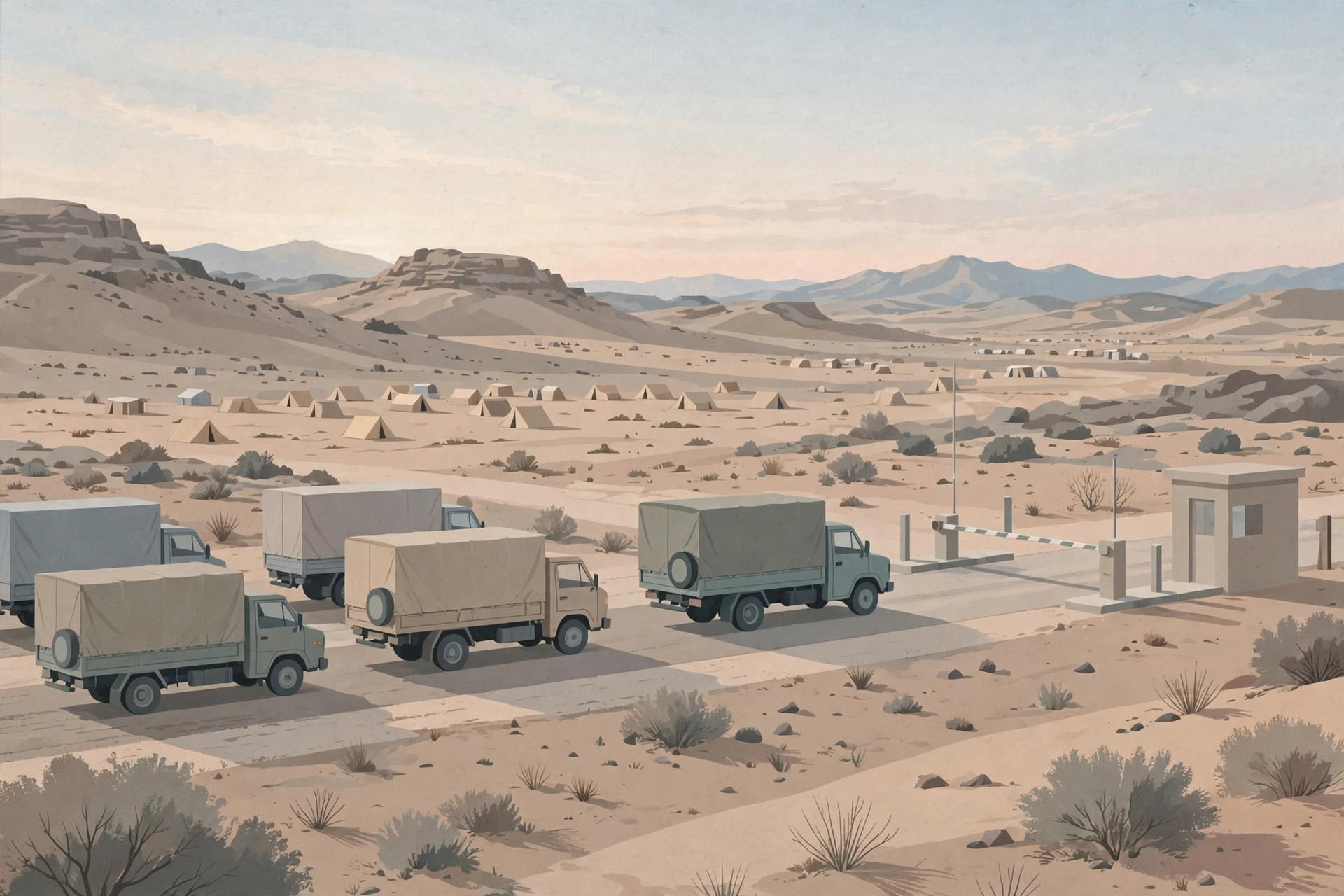
Israel ordered a complete and comprehensive closure of the Rafah crossing on Tuesday, November 3, 2026, blocking the passage of aid, fuel and cooking gas from Egypt into Gaza and turning back travellers who had arrived at the crossing that day. The closure, which was announced without prior notice and without any published change in procedures, according to the Gaza crossings authority, removed one of the main routes by which humanitarian supplies enter Gaza at a time when aid deliveries were already far below the levels promised in the ceasefire agreement that took effect in October 2025. The Israeli military told state broadcaster Kan that the closure was due to smuggling and interference by Hamas security forces, and Egypt was informed of the decision. Aid agencies and Gaza officials, meanwhile, reported that the shortfall in aid was already severe, and that the closure would make it worse. The disagreement over why the crossing was closed, and over how much aid is reaching Gaza, is part of a wider dispute about whether the ceasefire is being honoured in practice.
Rafah is not the only crossing into Gaza, but it is a critical one. Before the suspension, it was carrying about 40 to 60 trucks a day from Egypt, and fuel and cooking gas came entirely through this route, according to reporting on the closure. Kerem Shalom, the other main crossing, remained open, but the loss of Rafah meant the loss of a route that supplied fuel and gas as well as other aid. For a population that depends on humanitarian deliveries for food, water, medical supplies and fuel, the closure of a crossing is not an abstract policy decision. It affects what is available in markets, what can be cooked, what can be transported, and what hospitals can do. The fact that travellers were turned back on Tuesday underlined that the closure was immediate and comprehensive, not a gradual reduction or a temporary administrative delay.
Israel informed the United Nations and the Egyptian committee on Monday evening, according to reporting on the sequence of events, but the announcement itself came without prior public notice. That lack of notice meant that aid organisations, drivers, and people hoping to cross had little time to adjust. The Gaza crossings authority said there had been no published change in procedures, a point that aid groups are likely to raise in discussions about how crossings should be managed. From Israel’s perspective, as stated to Kan, the closure was a response to smuggling and to interference by Hamas security forces. That stated reason has not been independently verified in the reporting available for this article, and it should be presented as Israel’s stated reason, not as an established fact about what occurred at the crossing. From the perspective of aid agencies, the effect of the closure is clear regardless of its stated cause: fewer supplies entering Gaza at a time when supplies are already insufficient.
Gaza Aid Falls Far Short of Ceasefire Levels
The scale of the shortfall is described in figures reported by Gaza’s Government Media Office, which should be attributed to that office and treated with the caution that applies to figures from a party to the conflict. According to that office, only 3,777 aid trucks entered Gaza in October, or 20.3 percent of the 18,600 stipulated in the ceasefire arrangements, and only 247 fuel trucks entered against 1,550 required. Those figures, if accurate, mean that aid in October was about a fifth of the level that had been agreed. Since the ceasefire took effect in October 2025, the same office reported that 77,657 trucks have entered, or 33.4 percent of the 232,800 provided for. That longer-term figure suggests that the shortfall is not a single month’s anomaly, but a pattern that has persisted since the ceasefire began.
The ceasefire agreement itself requires 600 aid trucks per day. In practice, reporting indicates that about 145 to 200 trucks per day have entered on average, and about 150 per day according to Al Jazeera’s correspondent in Gaza. That gap, between the 600 trucks a day required and the roughly 150 a day actually entering, is the central fact of the aid dispute. It is a gap that aid agencies have repeatedly highlighted, and it is a gap that has consequences for food, medicine, and shelter. The figures from Gaza’s Government Media Office are disputed by Israeli figures, including those from COGAT, the Israeli body that coordinates government activities in the territories, which has disputed claims of food shortage. Because the two sides present different figures, this article attributes the truck counts to Gaza’s Government Media Office and to the outlets that reported them, and notes that Israeli figures dispute the characterisation of a food shortage. Readers should understand that the numbers are contested, even though the broad picture reported by aid agencies is one of severe shortfall.
The dispute over numbers does not change the fact that humanitarian organisations working in Gaza report serious shortages. The World Food Programme, known as WFP, announced on October 19 that it is cutting food assistance by about a third due to funding shortages. The number of people receiving food or cash support fell from 1.6 million to 1.1 million. Those who still receive support now get one food parcel a month instead of two, half the previous flour ration, and hot meals have been cut from 250,000 to 150,000 per day. Those cuts were attributed by WFP to funding shortages, not to the closure of a single crossing, but they compound the effect of the shortfall in truck deliveries. When fewer trucks enter and the aid that does enter is spread more thinly because of funding cuts, the result is less food for more people.
Food Insecurity and the Coming Winter
WFP estimates that 1.4 million Palestinians in Gaza, or 67 percent of the population, face acute food insecurity at crisis levels or worse, and that 200,000 are in emergency conditions. Those are estimates, not a census, but they convey the scale of the problem as assessed by a major humanitarian agency. Acute food insecurity at crisis level means that households are struggling to meet basic food needs, and emergency conditions mean that the situation is more severe still. For a population that has already endured more than a year of war and displacement, those levels of food insecurity represent a continuing humanitarian emergency, even under a ceasefire that was intended to allow aid to flow more freely.
The coming winter adds another layer of urgency. The United Nations Office for the Coordination of Humanitarian Affairs, known as OCHA, has said that the near totality of the population is bracing for a fourth winter without adequate protection from the cold, wind, rain and flooding risks, and that more than 60 percent of Palestinians in Gaza are homeless. That description, reported in coverage of the aid situation, points to a population living largely in tents and temporary shelters, without the housing, heating, and infrastructure that would normally protect people from winter weather. Tents, which are the main form of shelter for many displaced families, offer limited protection against rain and cold, and they can be damaged by wind and flooding. The need for winter supplies, including tents, tarpaulins, blankets, and heating fuel, is therefore urgent, and the closure of a crossing that carries fuel and gas makes that need harder to meet.
Medical supplies are also in short supply. Gaza’s Health Ministry said on Tuesday, November 3, that 42 percent of the essential medicines list and 50 percent of medical supplies are completely out of stock. Those figures, attributed to the Health Ministry, indicate that hospitals and clinics are unable to provide many of the medicines and supplies that patients need. The shortage of medicines affects people with chronic conditions, people who need surgery, and people who have been injured. It also affects the ability of the health system to respond to winter illnesses, which are more common in cold and crowded conditions. The combination of food insecurity, inadequate shelter, and medicine shortages creates a set of risks that reinforce each other, and that are particularly serious for children, pregnant women, older people, and people with existing health problems.
Deaths Reported Since the Ceasefire
Four Palestinians were killed in Gaza on November 3, the day Rafah closed, according to reporting on that day’s events. Since the ceasefire took effect on October 10 or 11, 2025, at least 1,593 to 1,599 Palestinians have been killed, according to figures reported by WRP and Drop Site News. Those figures should be attributed to the outlets and to the sources they cite, and the small range in the total reflects differences in reporting and in the date on which the count was made. The deaths reported since the ceasefire took effect are a reminder that a ceasefire does not always mean an end to killing, and that violations, or alleged violations, have been reported by both sides since the agreement began. Earlier in the week, Israel threatened to resume its assault after Hamas refused to commit to full disarmament, according to reporting on that threat. That threat, and the deaths reported on November 3, show that the ceasefire remains fragile.
An analysis by Médecins Sans Frontières, known as MSF, published on Thursday, November 5, says that Israel’s restrictions have manufactured a malnutrition crisis, with rising malnutrition among pregnant women and premature births. That characterisation, attributed to MSF, is the aid organisation’s assessment, and it should be presented as such. It reflects MSF’s view, based on its work in Gaza, that the restrictions on aid and movement have directly contributed to malnutrition. Israel disputes that characterisation, and the dispute over whether there is a food shortage, and over who is responsible for it, is part of the wider disagreement between Israel and aid agencies. Presenting both sides does not resolve that disagreement, but it allows readers to understand that the facts are contested and that different parties draw different conclusions from the same situation.
The neutral language used in this article is deliberate. Terms such as crisis, shortage, and violation can carry different meanings depending on who uses them, and this article attributes such terms to the party that used them where possible. The aim is to report what has been said and what has been reported, without adopting the language of one side as if it were established fact. That approach is particularly important in a conflict where casualty figures, aid figures, and the reasons for military or administrative decisions are all disputed, and where the reader needs to know who is making a claim in order to assess it.
Gaza Rafah Crossing Closed: What Happens Next at Rafah and Beyond
What happens next at Rafah will depend on whether Israel reopens the crossing, and on what conditions, if any, it sets for reopening. No timeline for reopening was reported in the material available for this article, and it would be wrong to speculate about when, or whether, the crossing will reopen. The crossing’s closure has already had an effect, and its continued closure would deepen the shortfall in aid, fuel, and gas. Aid agencies are likely to press for its reopening, and for a sustained increase in the number of trucks entering Gaza through all crossings, to meet the 600-a-day requirement in the ceasefire agreement. Whether that pressure succeeds will depend on negotiations between Israel, Egypt, the United Nations, and other parties involved in the ceasefire arrangements.
The wider question is whether the ceasefire can be sustained, and whether the aid provisions in the agreement can be implemented as written. The agreement was intended to allow a large and sustained flow of aid, to provide for the needs of a displaced population, and to create conditions for a longer-term resolution. The figures reported since October 2025 suggest that the aid flow has fallen far short of what was agreed, and the closure of Rafah on November 3 suggests that the flow can be interrupted without notice. For the people of Gaza, who are facing hunger, homelessness, and a fourth winter in tents, the question is not only whether the ceasefire holds in a formal sense, but whether it delivers the humanitarian relief that was promised. That question remains open, and it will be answered by what happens at the crossings, in the markets, and in the shelters of Gaza in the weeks ahead.
Sources
USN reviewed reporting from multiple outlets for this story. Read more from WRP, Drop Site News and +972 Magazine.