

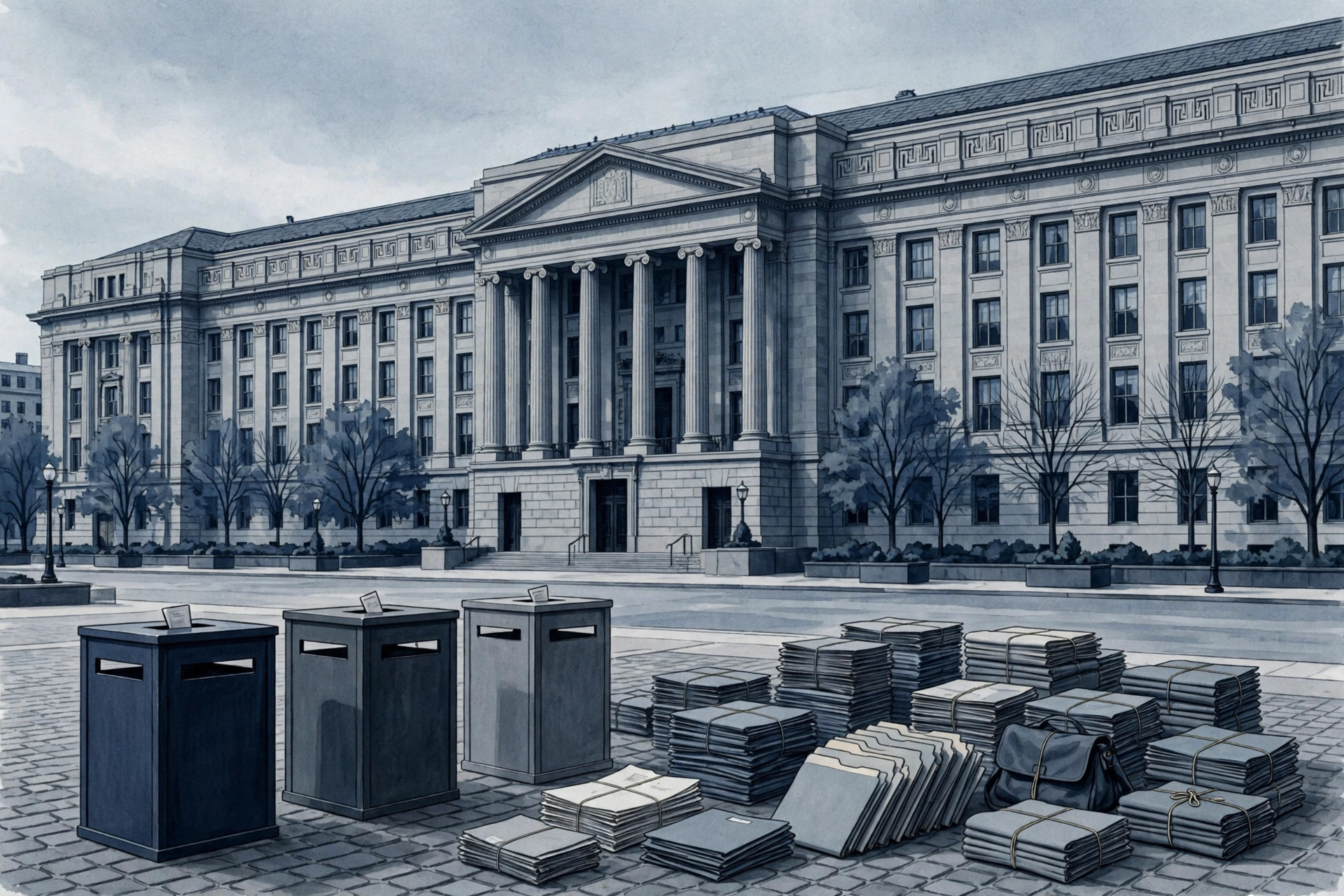
With the midterm elections only days away, the Justice Department has sent a stark written warning to election officials across the country: keep federal election records safe, or face the possibility of criminal prosecution. The letters, dated October 29, 2026, and signed by Acting Deputy Attorney General R. Trent McCotter, tell state officials that willfully failing to preserve ballots and related materials is a crime punishable by up to one year in prison and a $1,000 fine.
The department says, in a Justice Department court filing on Friday, October 30, that the notices had gone to all states. That is the department’s claim about scope, not an independently verified recipient list: as of Friday, only about 12 states had confirmed receipt or posted the letter publicly. Copies obtained from several states, including Colorado, Michigan, Minnesota and Wisconsin, were virtually identical, and officials familiar with the correspondence described the mailing as nationwide, but USN has not independently verified delivery in all 50 states.
That timing is central to the controversy now surrounding the letters. They arrived less than a week before Election Day on November 3, at a moment when early and mail-in voting was already well under way in many states, when courts were already weighing separate federal demands about voter lists and ballots, and when election workers were in the final, busiest stretch of preparations. Supporters of the mailing describe it as a routine reminder of a long-standing legal duty. Critics, including some state officials and former Justice Department lawyers, say the emphasis on prison time, delivered in the final days of a campaign, reads very differently from a routine administrative note.
It is important to be precise about what the letters are, and what they are not. They are a warning and a reminder of an existing preservation duty. They do not announce a prosecution, they do not name a particular official accused of wrongdoing, and, according to reporting on their contents, they do not identify a specific violation or an open investigation. A reader who sees only a headline about jail time could easily conclude that charges are imminent. The documents themselves, as described by news outlets that reviewed them, stop short of that step.
The October 29 letters must also be distinguished from the voter-specific demands in California. The letters identify no particular violation and no open investigation, name no voter whose ballot should be set aside, and make no demand about any individual ballot. The California demands, by contrast, were voter-specific: they named a list of about 20,000 people and asked officials to segregate and withhold their ballots. Treating a general preservation reminder and a targeted ballot demand as the same thing would therefore misdescribe both.
What the Justice Department ballot records warning actually requires
The letters rest on a federal statute, 52 U.S.C. 20701, which dates to the Civil Rights Act of 1960. Under that provision, election officers must preserve, for 22 months after a federal election, records that were required for voting in that election and that came into their possession. For ballots cast on November 3, 2026, that period would run until September 2028.
The October letters spell out, in unusually concrete terms, what counts as a covered record. The list includes completed voter registration forms, poll books, precinct sign-in sheets, copies of identification documents where applicable, mail-ballot requests and envelopes, and the ballot itself, whether it was cast by mail, through a drop box or in person. The letters also make clear that the duty is not limited to a secretary of state in a capital city. It extends, the department says, to every county and local official who administers a federal election.
The criminal language in the letters is equally direct. Quoted in reporting on the documents, McCotter wrote that it is a crime to willfully fail to comply with Section 20701, and that such a failure is punishable by up to a year in prison and a $1,000 fine. The letters add that it is also unlawful to willfully steal, destroy, conceal, mutilate or alter election records. The word willfully matters here, because it points to deliberate conduct rather than an ordinary clerical error, although the letters do not elaborate on how that distinction would be applied in any future case.
The preservation duty exists for a practical reason that is separate from any dispute about this election. Preserved records allow later inspection, audit and, where the law permits, litigation over a result. Under a related provision, the attorney general may later demand access to preserved records for inspection and copying. In other words, the records are kept not only as a historical archive, but as a check that can be examined if a result is challenged or an alleged irregularity is investigated.
The October letters open, according to reporting on the Colorado copy, with examples of close contests, including a California congressional seat decided by 187 votes in 2024 and the 2000 presidential race in Florida, decided by 537 votes. The implicit argument is straightforward: when margins are narrow, the paper trail matters, and losing it can make a dispute impossible to resolve fairly. Critics do not dispute that preservation is important. Their objection is to the manner, timing and criminal framing of this particular reminder.
Why election officials say the warning was not needed
State election officials from both parties told reporters that they already follow the 22-month rule as a matter of routine. Florida Secretary of State Cord Byrd, a Republican, said his state already complies with what the letter states. A spokesperson for Washington Secretary of State Steve Hobbs, a Democrat, said that office would continue to retain records under state and federal law. Connecticut Secretary of State Stephanie Thomas, a Democrat, said her office complies with the law as a matter of course and did not need the reminder.
Thomas added a nuance that captures much of the state-level reaction. She said she hoped the decision to emphasize criminal penalties was intended simply as a reminder of the law, but that it could have been handled differently, and that her office’s work is not something it does only because it receives a letter. That distinction, between informing officials of a duty and pressuring them with the threat of prosecution, is at the heart of the legal and political argument that has followed.
Justin Levitt, a former Justice Department official and voting-rights adviser in the Biden White House, told one news outlet that he knew of no precedent for a nationwide reminder of this kind. He said the letter certainly looked as if it was meant to intimidate rather than to inform, while also saying it was not improper on its face. That careful phrasing reflects the legal reality: reminding officials of a real statute is not, by itself, unlawful, even if the tone and timing raise questions about intent and effect.
There were also practical glitches that undercut the image of a flawless nationwide operation. Several states did not immediately see the letters, and, as in earlier rounds, some were sent to general or incorrect inboxes. Texas received a letter addressed to Secretary Jane Nelson, even though Nelson had left office in July. Such errors do not change the legal duty, but they have fed skepticism among officials who say a genuine effort to help them comply would have been addressed more carefully.
As of Friday, officials in at least 12 states, including Colorado, Florida, Georgia, Michigan, New York and Wisconsin, had confirmed receipt or posted the letter publicly, according to one report. The department did not, in response to questions from that outlet, say how many states had received it. The claim of nationwide scope rests on that court filing on October 30, in which the department said the notices had been sent to all states; it is not, by itself, proof that every state received one.
A third round of warnings, signed at a higher level
The October letters are not the first preservation warnings of this year, and that history shapes how they are being read. In July, the department told states that election officials could face criminal liability for allowing noncitizens to vote, an act that is already illegal and, according to election experts, rare. Later, in September, letters signed by Eric Neff, the acting chief of the Civil Rights Division’s voting section, directed 29 states and Washington, D.C., to preserve records connected to litigation over voter registration data.
The October mailing differs in one important respect: the signature. Earlier rounds were signed by division-level officials, including Harmeet Dhillon, the assistant attorney general overseeing the Civil Rights Division, in July. The October letters bear the signature of McCotter, the department’s second-highest-ranking official, who assumed the acting deputy role in August. For state officials, a letter from the deputy attorney general’s office carries more weight than a routine division notice, and that escalation is part of why the mailing has drawn so much attention.
A Justice Department spokesperson framed the letters as routine, saying the department relies on state records to bring cases involving illegal voting and registration, and that officials were simply being reminded of their obligation under federal law to preserve the documents. That explanation treats the letters as housekeeping. The department has not, in public comments reported so far, addressed the specific criticism that the criminal-penalty language, delivered days before an election, could chill election workers or be read as a threat.
The broader context of federal involvement in election administration has also sharpened the debate. Questions about the proper federal role on Election Day have extended beyond letters and lawsuits to the presence of federal personnel around polling places. USN has previously reported on related assurances, including that FBI and ICE staff will not serve as midterm poll monitors, and on internal unease described in reporting about FBI agents’ worry they could be ordered to seize ballots on Election Day. Those are separate issues from record preservation, but together they help explain why state officials are scrutinizing every new federal communication so closely.
How the California ballot fight collided with the letters
The October 29 letters arrived two days after a federal judge in California delivered a sharp rebuke to the administration in a separate dispute over ballots. On October 28, U.S. District Judge David O. Carter rejected the Justice Department’s emergency request to force California to set aside and stop processing mail ballots associated with about 20,000 people the federal government describes as likely noncitizens.
Carter’s 26-page order was unusually blunt. He wrote that never before in American history had the federal government, on the eve of an election, sought to coerce a state and local government to abandon its own constitutional election procedures and bend to the will of the executive branch. He found that the government had not shown credible evidence to justify disrupting an election already under way, that its demands threatened to disenfranchise eligible voters, and that they improperly intruded on state authority over elections.
The judge also addressed the threats directly. At a hearing the day before his order, he warned that it would be wise for any threats to state and county election employees to cease immediately. In the written order, he reiterated that such threats should cease. Carter noted that the department had warned county officials they risked significant federal scrutiny, and had reiterated in open court that officials who did not comply risked charges for aiding and abetting an offense. He concluded that the government remained free to prosecute individuals where it had evidence they voted illegally, but could not compel California to overhaul its election procedures days before voting ended.
The underlying list was itself a source of dispute. Federal officials had initially identified nearly 191,000 suspected noncitizens on California’s voter rolls, according to the court’s account, before narrowing the figure to about 20,000, without, in Carter’s view, adequately explaining the methodology or providing error rates. California and Los Angeles County officials told the court the list was highly unreliable, that it included duplicates and people who had never registered, and that a sample review found a substantial share of people for whom birthplace was meaningfully reported indicated they were born in the United States, which is strong evidence of citizenship. The department has acknowledged that some names on the list could turn out to be citizens, while maintaining that its broader effort is necessary to enforce the federal ban on noncitizen voting.
Carter also pointed to timing and practicality. Los Angeles County had already processed hundreds of thousands of mail ballots, and its system, officials said, had no function for setting aside the ballots of designated voters once they had been mixed into the count. The judge cited the Supreme Court’s caution against late changes to election rules, noting that the election was not merely upcoming but had already started. He found the requested remedy would likely violate several federal voting laws, including a prohibition on systematic voter removals within 90 days of a federal election.
The October 20 lawsuit alleging pressure on officials
A separate lawsuit, filed on October 20 in federal court in Washington, D.C., frames the preservation letters as part of a broader alleged campaign of pressure. The plaintiffs include Senate Democratic Leader Chuck Schumer, House Democratic Leader Hakeem Jeffries, the Democratic Senatorial Campaign Committee, the Democratic Congressional Campaign Committee, the Democratic Governors Association, the Nevada State Democratic Party and a California voter who is a naturalized citizen. The defendants are President Donald Trump, the Justice Department, Attorney General Todd Blanche, the Department of Homeland Security and DHS Secretary Markwayne Mullin.
The lawsuit alleges that the administration has unlawfully pressured election officials to remove voters, withhold ballots and change election procedures, while threatening officials with potential criminal prosecution. It asks the court to bar the administration from removing legally registered voters from statewide lists, from preventing states from issuing ballots to registered voters or counting ballots they cast, and from threatening officials in that effort. The plaintiffs argue that such intimidation violates Section 11(b) of the Voting Rights Act and the Constitution.
At a hearing on October 29 in that case, Chief Judge James E. Boasberg ordered the Justice Department and the Department of Homeland Security to identify every state where, since July 1, federal officials had sent formal communications asking election officials to remove specific registered voters, refuse to issue them ballots, or segregate or refuse to count ballots they returned. The administration was ordered to provide that information by noon on Friday, October 30.
In its response on Friday, the department identified California and Washington as the states where it had sent communications falling within its interpretation of Boasberg’s order. It maintained that the October 29 preservation letters were separate from the voter-specific demands at issue in the lawsuit. That distinction will matter to the court: a general reminder to keep records for 22 months is not the same, legally, as a demand to set aside a particular voter’s ballot. The plaintiffs, however, argue that the letters cannot be viewed in isolation, because they arrived in the same week, from the same department, with the same criminal-penalty language that judges and officials had already flagged.
The government, for its part, has pushed back against the lawsuit’s breadth. Administration lawyers have described the plaintiffs’ claims as overly broad and vague, and argued that an order of the kind requested would prevent the government from carrying out its constitutional duty to enforce federal laws. At the hearing, Justice Department attorney Christian Dibblee argued that merely sending the letters does not forecast or predict future actions, and that none of the letters threatens prosecution in the sense of announcing a charge. Boasberg appeared skeptical of the plaintiffs’ standing to sue, saying it may be too speculative to assume the administration will threaten more states, but he nonetheless ordered the disclosure and said he intended to rule by Monday, November 2, the eve of Election Day.
Boasberg also noted that the administration could end the dispute at any time by filing a notice that it will not engage in the election-related conduct the plaintiffs challenged. As of the latest reporting, no such notice had been filed. The judge separately ordered the department to hand its 20,000-name California list to an immigrant-rights group so it could help inform voters who feared they might be on the list and were now afraid to cast a ballot.
What happens next, and what voters should watch
In the immediate term, the practical effect of the letters is likely to be limited. States already preserve election records under both federal and state law, and no official has publicly said the letters changed a retention practice. The more consequential questions are legal and institutional, and they will play out after Election Day as much as before it.
First, courts will decide whether the administration’s voter-specific demands, as distinct from general preservation reminders, cross a legal line. Carter’s California ruling and Boasberg’s Washington case are early, interim decisions, not final judgments on the full merits of every claim. Appeals are already under way in California, and the administration could seek emergency relief from higher courts, including the Supreme Court, if it loses again. Those rulings will shape how much latitude the federal government has to intervene in state election administration in the final days of a campaign.
Second, the preserved records themselves will matter if any result is close or contested. The 22-month clock means that ballots and related materials from this election will remain available for inspection well into 2028, long after winners are certified and seated. That is the ordinary, uncontroversial purpose of the statute, and it is why even critics of the letters’ tone do not argue that records should be discarded.
Third, the episode will likely inform how future administrations communicate with election officials. If courts conclude that criminal-penalty language, delivered on the eve of an election without a specific allegation, amounts to unlawful intimidation, agencies will have to be more careful. If courts conclude that such letters are lawful reminders, administrations of either party will have a clearer path to send them. Either way, the precedent set in the next few days will outlast this election cycle.
For voters, the key takeaway is narrower and more reassuring than some headlines suggest. The letters do not cancel ballots, do not remove voters from the rolls, and do not, by themselves, change who is eligible to vote on November 3. They warn officials to keep the paper trail intact. Whether that warning was a helpful reminder or an improper pressure tactic is now, fittingly, a question for the courts, for state officials on the ground, and for the public to judge on the full record, not on a single sentence about prison time.
USN will continue to follow the court cases in California and Washington, any further Justice Department communications to states, and the certification of results after Election Day, and will update this story as those developments become clear.
Sources
USN reviewed reporting from multiple outlets for this story. Read more from Votebeat, Democracy Docket and Newsmax.