

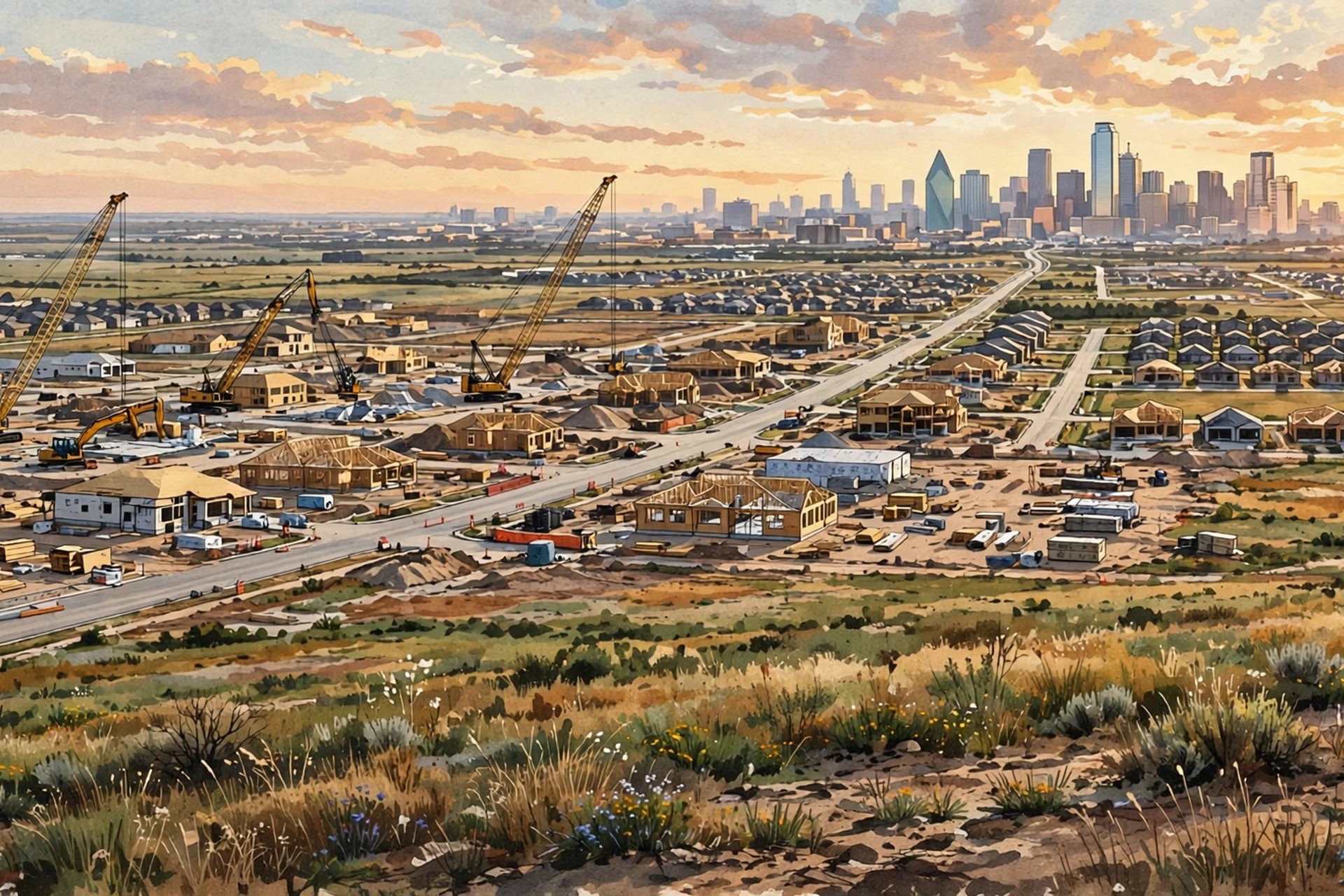
Drive north from Dallas on a road that keeps getting longer, and the change in the landscape tells the story before any statistic does. Open fields give way to graded earth, then to framed houses, then to whole neighbourhoods that did not exist a few years ago, with a grocery store, a school and a new intersection following close behind. This is the edge of the Dallas-Fort Worth metroplex in 2026, and no place on that edge has grown quite like Celina, a small city in Collin and Denton counties about an hour north of downtown Dallas. A feature published by Le Monde on 31 October 2026 uses Celina as its window into a much larger American story: how a once-quiet ranching town becomes a boomtown, and what happens when jobs, houses and people arrive faster than the pipes, classrooms and roads built to serve them.
This article is a feature and an explainer, not a breaking-news report. It draws on that Le Monde reporting, presented here as reported, and checks its central claims against United States Census Bureau figures, Bureau of Labor Statistics data and other reputable reporting. Where the numbers differ slightly because they come from different years, definitions or rounding, this article says so plainly, because in a growth story the exact year matters almost as much as the direction of travel.
Le Monde frames Celina’s decade as a leap from about 8,000 residents to about 80,000. That framing captures the scale of the transformation, but readers should understand what the official count shows today. The Census Bureau’s QuickFacts table puts Celina at 6,028 people in the 2010 Census and at an estimated 64,427 on 1 July 2025, after an estimates base of 17,099 in April 2020. In other words, the town has already grown roughly tenfold since 2010 in the official series, and it added 12,710 people in a single year between July 2024 and July 2025, a rise of 24.6 percent. That one-year increase made Celina the fastest-growing city in the United States among places with at least 20,000 residents, according to Census Bureau estimates released in May 2026, and it had also topped the same ranking in 2023. The 80,000 figure in the Le Monde framing is best read as the trajectory the town is on, not as the Census Bureau’s July 2025 count, which is the most recent official estimate available at the time of writing.
Celina is not an isolated curiosity. It is the sharp end of a regional wave. Eight of the 15 fastest-growing cities in the country between July 2024 and July 2025 were in Texas, and six of them were Dallas-Fort Worth suburbs, including Celina, Princeton, Melissa, Anna, Forney and Greenville. The pattern is familiar to anyone who has watched Frisco, just to the south. Frisco had about 33,714 residents in 2000, reached 116,989 in the 2010 Census and is now estimated at roughly 237,000. Prosper, the next town north, grew from an estimates base of 30,171 in 2020 to 45,605 in July 2025. Celina is simply the latest and fastest chapter in the same northward march along the Dallas North Tollway, as each ring of suburbs fills in and the next one opens up.
Collin County and the wider Dallas boom
Le Monde puts Collin County’s growth at about 70 percent over 15 years, to about 1.3 million people. The Census Bureau series supports the broad picture, with a small difference that comes down to the starting year. QuickFacts records Collin County at 782,341 in the 2010 Census and at 1,297,179 on 1 July 2025, an increase of about 66 percent over that 15-year span, while the estimates base for April 2020 was 1,066,201. Whether the figure is described as about two-thirds or rounded to about 70 percent, the substance is the same: a county that was already large has added the population of a substantial city, and it has done so while the wider Dallas-Fort Worth area reached roughly 8.5 million people in 2025, up about 11 percent since 2020. The Census Bureau has singled out the Dallas area as a clear case of growth on the outer edge, rather than growth concentrated in the historic urban core. Indeed, in the most recent year the city of Dallas itself lost residents, as did several larger suburbs, while the outer ring surged.
Why are so many people heading north? The answers given by residents, developers and local officials are consistent, and they are practical rather than romantic. Texas has no state income tax. New houses in Celina, while no longer cheap, have typically been priced below comparable homes in Frisco or Plano, and buyers get larger lots and newer schools, parks and trails. Many households are not commuting to downtown Dallas at all. They work in Frisco, Plano, McKinney or Allen, or they work remotely, and living in Celina puts them 20 to 30 minutes from those job centres. About 30 percent of Celina residents work remotely, according to the town’s mayor, Ryan Tubbs, as reported in national coverage of the Census figures, while others commute to nearby economic hubs. The school district is the town’s largest employer, with nearly 1,000 employees, a telling detail in a place where new families, rather than a single factory or headquarters, are the main engine of growth.
Developers have responded at a scale that would have seemed fanciful a decade ago. Celina has seen announcements for large master-planned communities, including a planned 4,000-home development and an 11,000-home project on more than 3,000 acres, alongside new retail, a hospital and a downtown commercial project. A new H-E-B, Costco and Lowe’s have been announced for the area, and a 237 million dollar hospital is already open, according to local reporting on the suburb boom. None of this happens by accident. It reflects a deliberate bet by builders that the northward wave still has years to run, and by families that a new suburb can offer a better daily life than an older, more expensive neighbourhood closer to Dallas.
Finance jobs and the Goldman Sachs campus
Houses alone do not explain the boom. Jobs do, and finance has become a central part of the Dallas story. Le Monde describes finance employment in the Dallas area rising from 232,000 in 2010 to 391,000 in 2026. The 2026 endpoint is consistent with the Bureau of Labor Statistics summary for Dallas-Fort Worth, updated in October 2026, which records financial activities employment at 391,000 in August 2026. The longer series, as presented in the Le Monde reporting, therefore points to growth of roughly two-thirds over 16 years, a pace that mirrors the population story in Collin County itself. Dallas is no longer only an energy, telecoms or logistics city. It has become a place where banks and financial firms build careers, not just back offices.
The most visible symbol of that shift is the Goldman Sachs campus rising in the NorthEnd district, just north of downtown Dallas. The project, developed by Hunt Realty with Hillwood Urban, covers about 800,000 square feet on roughly three acres, with room for more than 5,000 employees, and is expected to open for staff in 2028 after interior work is completed. Its cost has climbed from an original estimate of about 500 million dollars to about 709 million dollars, according to state work permits reported by CoStar News, an increase of more than 40 percent that CoStar attributes in part to higher construction costs. Dallas approved about 18 million dollars in economic incentives for the project in 2022. Goldman Sachs has operated in Dallas since 1968, but the new campus would make Dallas its second-largest United States office after New York, and it anchors a financial district that local brokers have nicknamed Y’all Street. Morgan Stanley, Bank of America and Canada’s Scotiabank have also committed to space nearby, according to construction and real-estate reporting on the district.
That concentration matters for Celina, even though the campus itself is about 40 miles to the south. A finance worker who can afford a home in Celina, work remotely for part of the week and commute to Frisco, Plano or downtown Dallas when needed is exactly the kind of household the new subdivisions are built for. The jobs do not have to be in Celina for Celina to benefit from them, and the town’s leaders have said openly that they hope more employers will eventually follow the residents north, so that fewer people have to commute at all. For now, the relationship runs the other way: the region’s job growth pulls people in, and the outer suburbs absorb them.
What Celina, Texas growth means for schools, water and roads
Growth on this scale is not only a success story. It is also a stress test, and the people running Celina say so themselves. Mayor Tubbs has described the challenge in straightforward terms, telling national reporters that growth brings jobs and opportunities, but also significant challenges from an infrastructure standpoint, particularly for water and road resources. Drive around Celina today and the evidence is visible: road construction, new sewer lines and new water lines, all being built to serve residents who are already arriving or are expected soon. The question is not whether the town will grow, but whether the systems underneath the growth can keep pace without losing the small-town character that attracted many residents in the first place.
Schools are the first pressure point, because families with children are a large share of the newcomers. The school district is already the town’s biggest employer, and every new subdivision brings a new cohort of pupils. Building classrooms, hiring teachers and opening campuses takes time and money, and it must be planned years ahead of the children who will fill the seats. A district that guesses too low ends up with crowded classrooms and portable buildings. A district that guesses too high ends up with debt for buildings it cannot fill. In a town growing by a quarter in a single year, that forecasting exercise is unusually difficult, and it is repeated, in different forms, in Prosper, Melissa and Anna as well.
Water is the second pressure point, and in North Texas it is never a purely local question. Celina’s water supply runs through the Upper Trinity Regional Water District, and local reporting on the town’s water position notes a subscribed capacity of 10.5 million gallons per day, with peak usage in 2026 reported at 12.1 million gallons per day on the hottest days. City officials have said the district has been able to meet the higher demand, and that the city is not limiting, capping or pausing utility connections, building permits or plat approvals. The distinction matters: a peak above the contracted subscription is not the same as running out of water, but it does show how thin the margin can become when thousands of new lawns, showers and businesses are added in a single summer. Longer-term relief in the region is tied in part to new supply, including Lake Ralph Hall, whose filling depends on rainfall as much as on any calendar date, and to conservation and landscaping rules that reduce demand per household.
Roads are the third pressure point, and the most visible one for daily life. The Dallas North Tollway is being extended toward Celina, and the town sits between established corridors to the south and a planned Collin County Outer Loop to the north. Until those links are complete, new residents depend on a smaller set of roads that were designed for a farming town, not a suburb of 60,000 people and rising. Commute times, school traffic and construction traffic all compete for the same asphalt. Local officials argue that the road programme is catching up, but residents experience the gap every morning, and it is one reason why the pace of road building is treated in Celina as a quality-of-life issue, not just an engineering one.
Housing affordability at the edge of the boom
The fourth pressure point is affordability, and here the boom contains a paradox. Celina grew in part because it was more affordable than Frisco and Plano, but rapid growth itself pushes prices up. Typical home values in Celina are now above 500,000 dollars, according to Zillow data cited in Texas reporting, compared with roughly 640,000 dollars in Frisco and higher figures in Prosper. That is still below many large coastal metros, but it is a long way from the small-town prices that first drew buyers north. Denton County, which covers part of Celina, approved 40 million dollars in homebuyer assistance in October 2026, authorising its housing finance corporation to assign bond capacity to the Texas Department of Housing and Community Affairs for low-interest mortgages and down-payment help. The programme is projected to assist about 132 households, with nearly 1.4 million dollars in down-payment assistance. That is a real help to those families, but it is small beside the thousands of homes being built each year, and it underlines a wider point: at the current pace, affordability cannot be solved by one county programme alone.
There is also a social question that numbers cannot answer. Many people moved to Celina seeking a quieter, family-oriented community with good schools and a slower pace, as Mayor Tubbs himself did when he moved there from Allen in 2017. As the town grows, it gains shops, restaurants, hospitals and employers, but it also gains traffic, noise and a sense of anonymity that some early arrivals did not expect. Preserving a historic downtown square while building entertainment districts and large subdivisions around it is a deliberate choice, not an automatic outcome. The town’s downtown project, Trackside Junction, a 15 million dollar private investment announced in July 2026, is one attempt to keep a centre that feels like a place, rather than a collection of subdivisions connected only by roads.
None of this means the boom is about to end. The Census Bureau’s 2025 estimates show the Dallas-Fort Worth metroplex still gaining people from migration within the United States at a faster rate than any other metro, and the corporate commitments in downtown Dallas suggest employers expect that to continue. But the Celina story is a reminder that population growth is not the same as prosperity for everyone, and that a town can grow faster than any other in America and still face difficult choices. Every new roof needs water, every new family needs a school place, every new commuter needs a road, and every new worker needs a home they can afford. How Celina answers those four questions over the next decade will determine whether it becomes another Frisco, a mature suburb with its own economy, or a cautionary tale about growing too fast for its own foundations.
For readers elsewhere in America, the lesson is broader. The country’s fastest growth is no longer happening mainly in big cities, but on their outer edges, in places that were farmland a generation ago. Those places are where the housing debate, the water debate and the school-funding debate now meet in their most concrete form. Celina did not choose to become the fastest-growing city in America. It became one because millions of individual decisions, about jobs, schools, prices and space, pointed in the same direction. What it does next will be watched well beyond Texas, because the same decisions are now being made, at a smaller scale, in suburbs across the country.
Sources
USN reviewed reporting from multiple outlets for this story. Read more from U.S. Census Bureau, USA Today and CoStar News.