

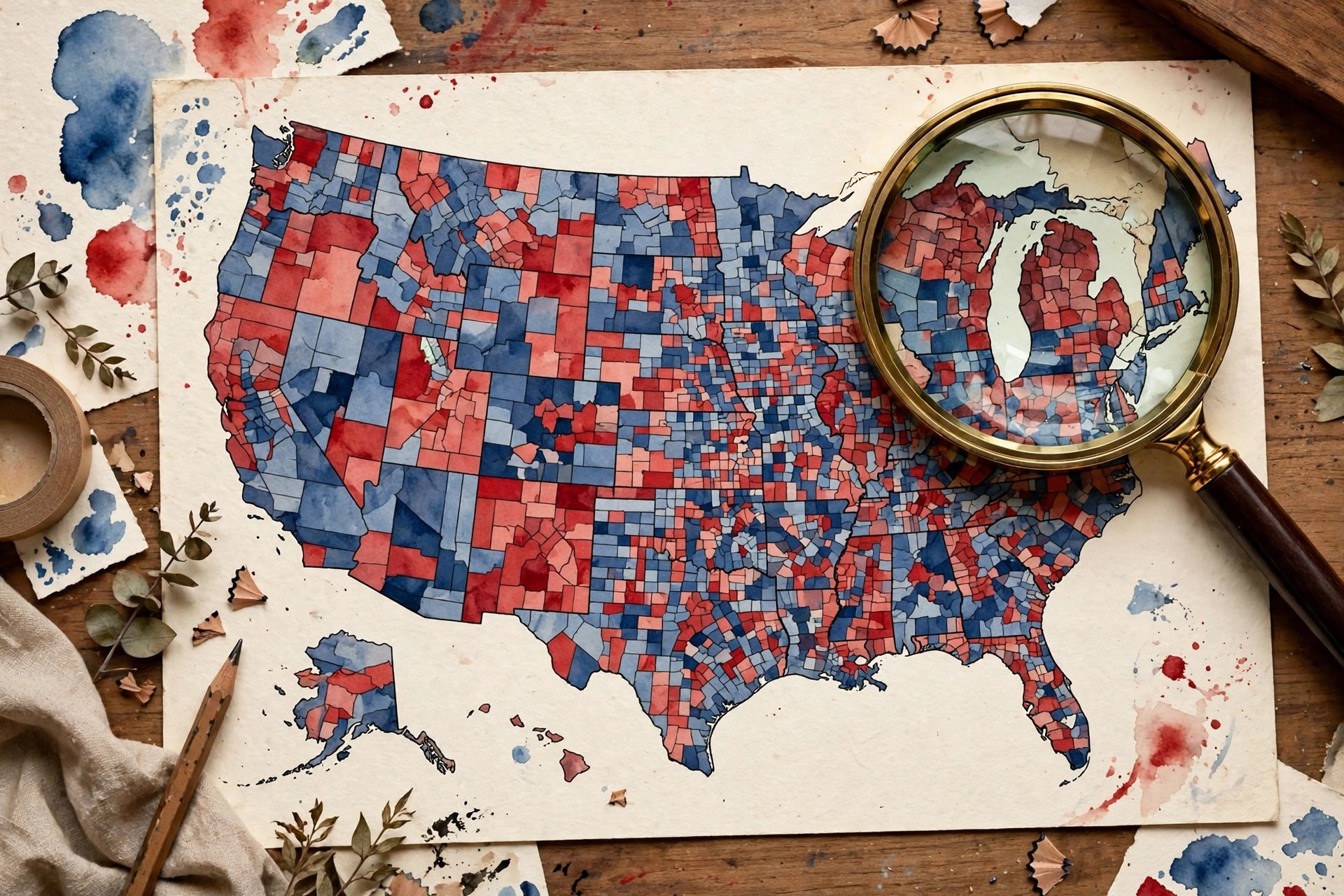
The 2026 midterm elections did more than choose the next Congress. In several states, voters also decided the rules for drawing the maps that will shape the Congress after that, and the results point in opposite directions depending on where you look. Maryland voters approved a constitutional amendment that makes it easier for Democratic state leaders to redraw the state’s congressional districts ahead of the 2028 election. Missouri voters rejected a Republican-backed congressional map that would have redrawn districts to target a Democratic incumbent. And in California, the new map approved by voters in 2025 delivered the gains its supporters promised, flipping Republican-held seats in the first election held under the new lines. Taken together, the three results show that the mid-decade redistricting fight that President Donald Trump set in motion last year is not over. It has moved into a new phase, and the next round will be fought in state capitols and state courts long before voters choose the next House.
Redistricting is normally a once-a-decade exercise, carried out after each census. The 2026 cycle broke that pattern because both parties treated the House map as a live political weapon rather than a settled fact. Texas Republicans redrew their map first, and California Democrats answered with Proposition 50, a ballot measure that temporarily set aside the state’s independent redistricting commission and allowed the legislature to draw new lines. Other states followed with their own proposals, lawsuits, and ballot measures. The midterm ballot carried the next chapter of that fight, and voters in Maryland and Missouri wrote two very different endings for their states.
What happens next will matter for 2028, when all 435 House seats are on the ballot again under whatever maps are in place. A single redrawn district can decide control of the House in a close year, and the parties know it. That is why the Maryland amendment and the Missouri rejection, quiet as they seemed next to the national results, drew close attention from strategists in both parties on election night.
Maryland voters approve a path to a new map for 2028
In Maryland, voters approved a constitutional amendment changing the rules for congressional mapmaking, according to a race call by the Associated Press. The amendment clarifies that state redistricting requirements apply only to state legislative districts, which removes a legal obstacle to redrawing the state’s congressional map. The practical effect is that Democratic state leaders can now draw new congressional districts ahead of the 2028 election, and Maryland has only one Republican-leaning House seat, held by a Republican in a state that votes heavily Democratic in statewide races. The amendment sets up a potential continuation of the partisan redistricting showdown that began when Texas moved first.
The Maryland vote was not close in the underlying ballot question. On Question 3, the measure clarifying that redistricting requirements apply only to state legislative districts, voters supported it by a wide margin, with about 60 percent in favor according to Associated Press results. Supporters argued that the change was needed to let Maryland respond to what other states had done, and that refusing to redraw while Republican-led states redrew their maps would amount to unilateral disarmament. Critics argued that mid-decade redistricting, whichever party does it, erodes public trust in the idea that district lines should be drawn by neutral rules rather than by whichever party holds power at the moment.
What Maryland does next is not yet decided. The amendment clears the way for a new map, but the legislature still has to draw one, the governor still has to sign it, and any new map is likely to face a court challenge. The timing matters too: a map drawn in 2027 would govern the 2028 elections, and the process of drawing it, debating it, and defending it in court will take months. For now, the important fact is that Maryland voters gave their leaders the legal room to act, and the expectation in both parties is that they will use it.
Missouri voters reject the Republican-backed map
Missouri produced the opposite result. Voters rejected Proposition A, a Republican-backed congressional map, by a wide margin, with about 62 percent voting against it and 38 percent in favor, according to race calls reported after the election. The map had been passed by Republican state lawmakers to try to oust Democratic Representative Emanuel Cleaver by redrawing his Kansas City district, splitting the city across multiple districts so that the Democratic vote would be diluted. The defeat means Missouri is set to hold its 2028 congressional elections using the state’s current map, which was drawn after the 2020 census.
The Missouri map had already been through the courts before it reached the ballot. The Missouri Supreme Court ruled that the redrawn lines could not be in effect for the midterm elections, and instead voters would get to decide on the measure. The United States Supreme Court upheld that state court ruling. That sequence meant the map was never used in 2026, and the referendum gave voters the final word. Cleaver easily won re-election on Tuesday under the existing lines, according to a race call by the Associated Press.
The Missouri result also carried a second lesson about the limits of mid-decade redistricting. Some Republican state leaders have raised the possibility of trying again in 2027 or 2028, but any new attempt could itself be challenged through another ballot referendum. Missouri voters also approved Amendment 6, which limits the legislature’s ability to change voter-approved measures by requiring an 80 percent supermajority in both chambers to amend or repeal a citizen initiative. That amendment was aimed at a broader pattern in which lawmakers had altered or repealed measures voters had passed, including a paid sick leave requirement and a minimum wage increase approved by voters in 2024 and repealed by lawmakers in 2025. The combination of the two votes makes another redistricting attempt in Missouri harder, both legally and politically.
California Proposition 50 delivers the seats Democrats wanted
California was the test case for whether a mid-decade redraw actually works as its supporters promise, and on the evidence of the first results, it did. Voters approved Proposition 50 in 2025 to make five Republican-held districts more favorable to Democrats, as a direct response to the Texas redraw. In the 2026 election, early results pointed toward a clean sweep for Democrats in those five targeted districts, with Democrats winning or leading across the battlegrounds created by the new map.
Two of the most closely watched races showed the scale of the shift. In the Central Valley’s 22nd District, Democrat Randy Villegas defeated Republican Representative David Valadao with about 65 percent of the vote, ending the tenure of an incumbent who had survived years of Democratic challenges. In the open 48th District in San Diego and Riverside counties, Democrat Marni von Wilpert, a San Diego city council member, defeated Republican Jim Desmond with about 59 percent of the vote. Both districts had been reshaped under Proposition 50 to increase the Democratic registration advantage. At least one more targeted seat also flipped: Democrat Mike McGuire won the 1st Congressional District. Democrats were also projected to win back control of the House nationally, which reduced the national stakes of the California redraw, but for the California delegation the map did what it was drawn to do.
The California result also illustrated the trade-offs of the strategy. Proposition 50 set aside the state’s independent redistricting commission, which voters had created precisely to take map-drawing out of partisan hands. Supporters said the move was a necessary response to Texas, and that refusing to respond would have left Democrats fighting with one hand tied. Critics said it damaged a reform that had been held up as a national model. Both arguments will be replayed in 2028, when California’s map, and the maps drawn in response to it, are tested again.
Colorado weighs a ban on partisan maps
Colorado offered a different kind of answer to the same question. Voters there considered a constitutional amendment aimed at banning congressional maps designed to purposefully favor any single political party. The measure reflected a growing argument among reformers that the problem is not which party draws the map, but that maps are drawn to favor a party at all. Colorado already uses an independent commission for redistricting, and the amendment would have added a constitutional ban on partisan intent in map-drawing. The outcome of that vote was still being counted as results came in, but the fact that it was on the ballot at all showed how the redistricting debate has widened beyond the two parties’ tactical moves.
The Colorado debate also points to a longer-term question that the 2026 results do not settle. If both parties keep redrawing maps between censuses whenever they hold power, the map becomes a permanent campaign issue rather than a settled framework. Courts have so far allowed much of the mid-decade redrawing to proceed, and the Supreme Court’s decision to let the Missouri question go to voters rather than imposing the map suggests the justices are content to let the political process, including referendums, sort out the disputes. That leaves the next round to state legislatures, governors, and voters.
What the map fight means for 2028
The practical consequence of the 2026 redistricting votes is that the House map for 2028 is still being written. Maryland is likely to draw a new map that could eliminate the state’s only Republican-leaning seat. Missouri will keep its current map unless lawmakers try again and survive another referendum. California will keep the Proposition 50 map, which has already shifted the state’s delegation. Other states that considered mid-decade changes will watch these results and decide whether to follow.
For voters, the lesson is that the ballot measures on redistricting matter as much as the candidate races, even though they draw far less attention. A vote on a map is a vote on the rules of the next several elections, and the rules decide how much each vote counts. In 2026, voters in Maryland, Missouri, and California used that power in three different ways, and the combined effect will shape the House that voters choose in 2028.
Sources
USN reviewed reporting from multiple outlets for this story. Read more from NPR Illinois, The Desert Sun and Election Law Blog.