

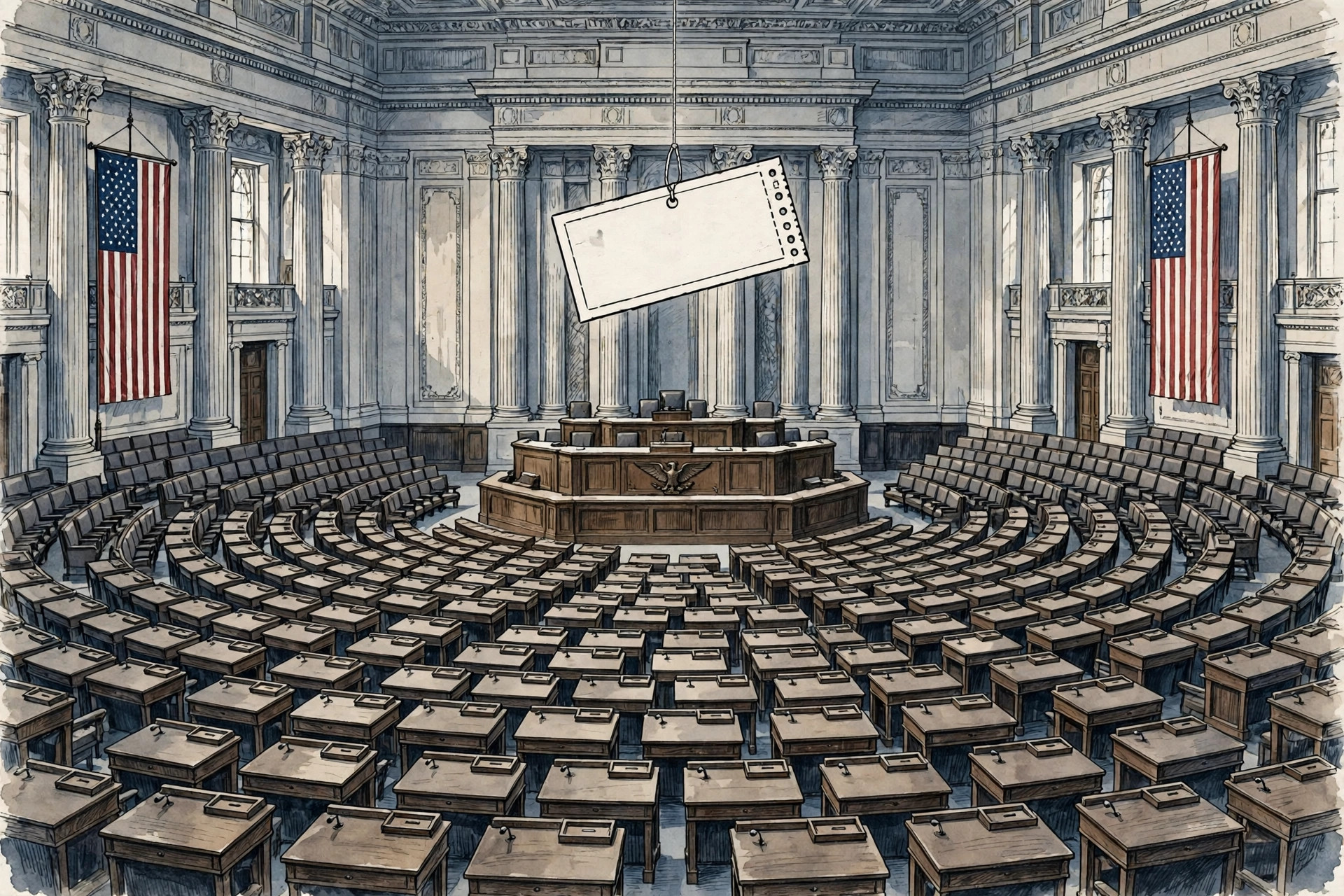
The Senate has voted to put its own pay on hold during future government shutdowns, adopting a resolution that would stop senators’ paychecks whenever a funding lapse shuts down federal agencies. The measure, sponsored by Senator John Kennedy, Republican of Louisiana, cleared the chamber without opposition, a rare unanimous result in a Senate more often defined by close, party-line votes. Its message is deliberately simple: if Congress cannot keep the government open, senators should not keep collecting a full salary while federal workers go without theirs. Its practical effect, however, is narrower and slower than the headline suggests, and it is worth spelling out exactly what the resolution does, what it does not do, and when it would actually bite.
The resolution is S. Res. 526, and its mechanism is withholding rather than cancellation. Under its terms, the Secretary of the Senate would place senators’ salaries on hold — Kennedy himself has described the paychecks as locked in a vault — whenever a shutdown affects one or more federal agencies, and would release the money only once funding is restored and the government reopens. Senators would therefore not lose the pay permanently under the plan as described; they would receive it late, after the impasse ends. That distinction matters for how voters judge the measure. It removes the immediate financial insulation of office during a shutdown, but it does not impose a lasting financial penalty on a senator who votes against reopening the government. Supporters present delayed pay as shared sacrifice. Critics of such measures generally argue that a delay, rather than a forfeiture, is largely symbolic, and that it changes little for wealthier senators while doing nothing to alter the Senate’s 60-vote threshold for most spending bills.
The resolution’s history explains why it arrived in this form. Kennedy first introduced versions of the proposal in November 2025, during a 43-day government shutdown that stretched from October 2025 into January and that he has called the longest in American history. That shutdown was fought largely over Affordable Care Act subsidies, and it left federal employees missing paychecks while members of Congress continued to be paid, a contrast that became a recurring point of public anger. In December 2025, the Senate Rules and Administration Committee advanced Kennedy’s legislation unanimously, clearing the way for a floor vote. The path was not entirely smooth: in March 2026, Kennedy attempted to pass the resolution by unanimous consent and Senate Democrats objected, blocking that fast-track route, according to Kennedy’s own office account of the episode. The later procedural vote told a different story about the chamber’s mood.
On the motion to proceed, the Senate voted 99 to 0 to advance the resolution, with Senator Pete Ricketts, Republican of Nebraska, not voting. A 99-0 procedural result is itself notable, because procedural votes are usually where a Senate majority tests whether it has the 60 votes needed to overcome a filibuster, and they often expose the very divisions that later kill a bill. Here, no senator voted against proceeding. The resolution then passed by voice vote, the form of approval used when no senator demands a recorded vote, and reports on 2 November 2026 described the adoption as complete. Because the measure is a Senate resolution governing the Senate’s own internal arrangements, rather than a bill, it does not require House passage or the president’s signature. That procedural point is central to its fate: it could be adopted by one chamber acting alone, where a broader law covering both chambers could not.
The most important limit on the resolution is its start date. It does not take effect immediately, and it does not apply to any shutdown that may occur before the current Congress ends. Under the Twenty-Seventh Amendment to the Constitution, a law varying the compensation of members of Congress cannot take effect until after an intervening election of the House of Representatives. The resolution is therefore written to take effect the day after the November 2026 midterm elections, which fall on 3 November 2026. Kennedy has said he would have preferred immediate effect, but that the delay keeps the measure on sound constitutional footing. The consequence is that the senators who adopted the rule will face its consequences only in a future Congress, and only if a future funding lapse occurs after that date. Voters heading to the polls on 3 November are thus being asked to judge a promise about future shutdowns, not a rule that changes anyone’s pay this week.
A second limit is its scope. The resolution applies solely to senators. It does not cover members of the House of Representatives, and it does not change the pay of federal employees, contractors, or military personnel during a shutdown. Separate proposals to extend a similar pay freeze to the House have been introduced, and reports describe a broader bill backed by Senator John Cornyn, Republican of Texas, that would have applied the same principle to the House, but the Senate-only resolution leaves the House untouched. That asymmetry is likely to feature in the next debate: House members can fairly be asked why the Senate has bound itself while the House has not, and Senate supporters can fairly reply that each chamber controls only its own rules. Either way, a voter who assumes that “Congress” as a whole has stopped its own pay during shutdowns would be mistaken. Only the Senate has acted, and only from after the midterms.
How Senate Pay During a Government Shutdown Will Be Withheld
The practical question is how the withholding would work in a real funding lapse. The trigger, as described in the resolution and in Kennedy’s account of it, is a shutdown affecting one or more federal agencies. That wording matters, because not every funding lapse shuts down the entire government at once. Some agencies may be funded through full-year appropriations bills while others lapse, and a partial shutdown can leave some federal workers paid and others furloughed. By tying the trigger to any agency being affected, the resolution sets a low bar: senators would not be able to argue that a shutdown was too small to count. Once triggered, the Secretary of the Senate would hold the paychecks, and release would follow reopening. The resolution is described as remaining in effect until repealed, so it would not need to be re-adopted for each new shutdown, although a future Senate could in principle repeal or amend it.
Senator Roger Marshall, Republican of Kansas, described the measure as a way to put pressure on colleagues to avoid future shutdowns, and that framing captures the theory behind it. The idea is that personal financial discomfort, even if temporary, sharpens the incentive to compromise before a deadline, and that the public symbolism of shared sacrifice restores a measure of trust. Senate Majority Leader John Thune, Republican of South Dakota, has likewise been reported as backing the resolution as an additional incentive to avoid shutdowns. The theory is plausible, but it has limits that should be stated plainly. Senators are not, as a group, financially dependent on a single missed paycheck in the way that many federal workers are, and a delayed paycheck does not change the underlying policy disagreements — over health care subsidies, Medicaid, defence spending, or immigration enforcement funding — that actually cause shutdowns. A pay rule can raise the political cost of a shutdown; it cannot, by itself, resolve the substantive dispute.
The timing of the adoption also gives the measure a particular political context. The federal government is currently funded through 11 December 2026 under a stopgap law, H.R. 6500, signed on 2 September 2026 after the House approved it 370 to 48 and the Senate backed it 90 to 6. Congress returns on 9 November for a lame-duck session that must deal with 12 unfinished full-year spending bills for fiscal year 2027, defence spending at a record requested level of about $1.5 trillion that Senate Democrats oppose, and the same health care questions that fuelled earlier shutdown fights. The pay resolution does not change any of those negotiations, and it does not make a December shutdown more or less likely on its own. What it does is change the optics of the next fight: if the lame-duck session fails and funding lapses after the resolution takes effect, senators will be able to say that they, too, went without pay until the government reopened, while federal workers will still have borne the far heavier burden of missed rent, bills, and household costs.
That comparison is the heart of the fairness argument, and it deserves to be stated in full. During the 43-day shutdown that began in October 2025, federal employees missed paychecks, with many working without pay in essential roles or furloughed entirely, while members of Congress were paid on schedule because their salaries are provided for under a permanent appropriation that does not lapse during a funding gap. The resolution does not change that underlying constitutional and statutory arrangement for House members, and it changes it for senators only through an internal Senate rule that delays, rather than cancels, their pay. Supporters argue that even a delay is a meaningful break with the past, because it ends the spectacle of lawmakers being paid while the workers they failed to fund are not. Sceptics argue that the real test of shared sacrifice would be a law covering both chambers and imposing a genuine loss, not a deferred payment, and that the Senate’s unanimous vote was easy precisely because the cost to senators is modest and deferred.
Both readings can be true at once, and voters are entitled to hold them together. The unanimous vote is a genuine signal: a Senate that rarely agrees on anything agreed, without a single opposing vote on proceeding, that its own members should feel a shutdown in their pay. The mechanism is also genuinely limited: Senate-only, delayed rather than forfeited, and effective only after an election. The resolution’s supporters would say that a limited step unanimously adopted is better than an ambitious bill that dies, and that it establishes a principle that the House can now be pressed to match. Its critics would say that principle without a House companion, and without a permanent loss, is closer to a press release than a reform. The next test will not be a speech about the resolution, but the first shutdown after it takes effect, when the public can see whether senators’ paychecks are in fact held, for how long, and whether the House follows suit.
For now, the facts are these. The Senate has adopted a resolution, sponsored by John Kennedy, to withhold senators’ pay during future shutdowns, advanced 99-0 on procedure and passed by voice vote, effective after the 2026 midterm elections under the Twenty-Seventh Amendment, applying to the Senate alone, with pay released after reopening. It does not cover the House, it does not protect federal workers’ pay, and it does not resolve the December funding deadline. What it does is put the Senate on record, unanimously, that the next time the government shuts down, senators will wait for their money too. Whether that record changes behaviour in the lame-duck session, or merely changes the rhetoric around the next shutdown, is a question the December deadline will answer soon enough.
Sources
USN reviewed reporting from multiple outlets for this story. Read more from LegiStorm, KVNU and NBC Palm Springs.