

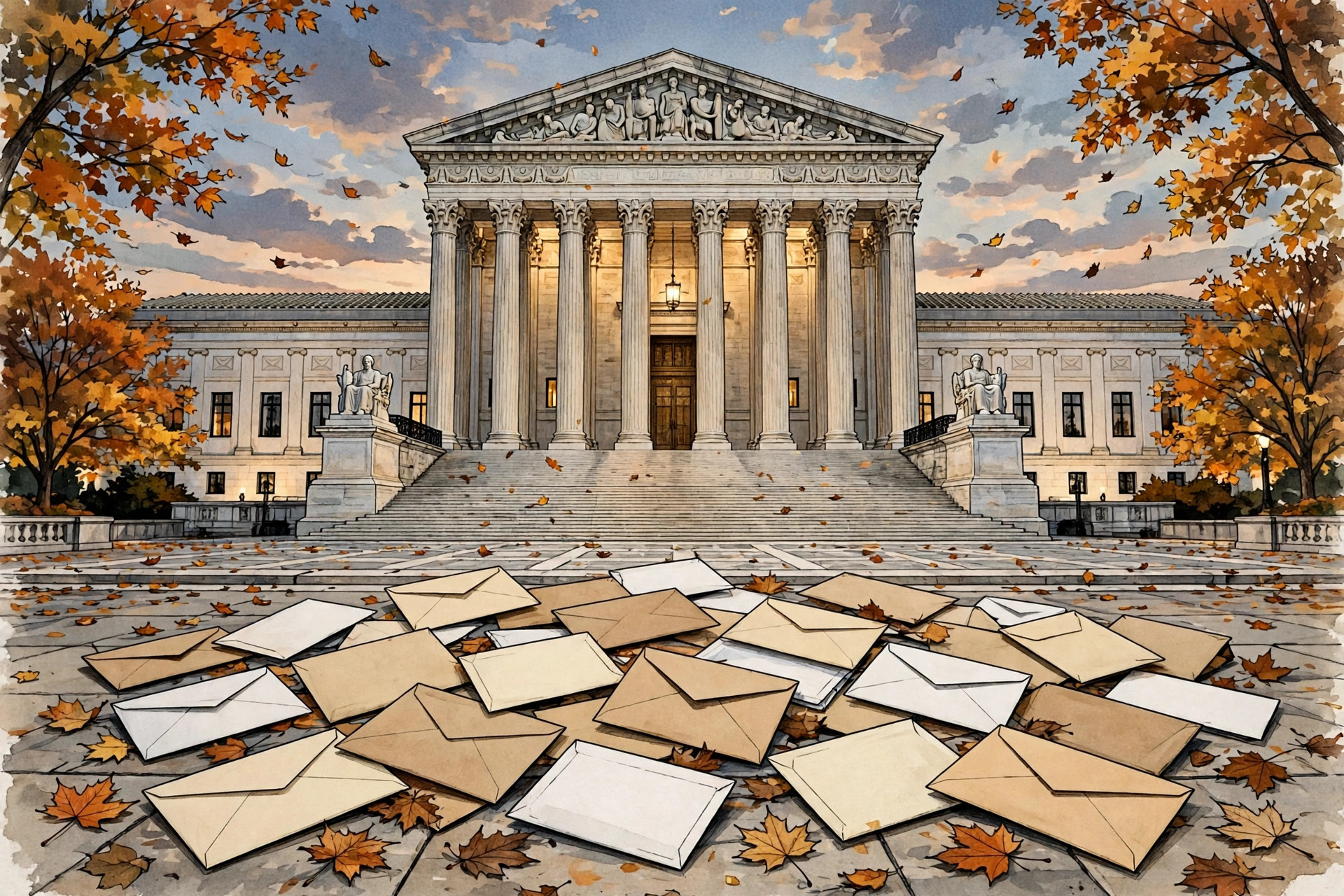
WASHINGTON — One day before Americans voted in the midterm elections, the Trump administration took its fight over California mail ballots to the United States Supreme Court, asking the justices for emergency help after two lower courts refused to intervene. The filing, made on Monday, 2 November 2026, asks the court to direct California to set aside mailed ballots connected to about 20,000 registered voters whom federal officials allege may not be United States citizens, while the underlying dispute over their eligibility is examined.
The request does not ask the Supreme Court to decide, in this emergency step, that any particular voter is ineligible or that any particular ballot is unlawful. What it seeks is a holding pattern: keep the questioned ballots separate from the rest, the administration argues, so that if a court later finds some of them should not have been counted, they can still be identified and removed. Once ballots are taken out of their identifying envelopes and mixed with thousands of others, the government says, there is no practical way to pull them back out again.
That distinction matters to how the case should be understood. California officials and voting-rights advocates dispute the premise of the federal list, the method used to build it, and the legal authority claimed for the intervention. Lower courts that rejected the request focused less on the final question of who may vote — a question the law answers clearly in one direction, since noncitizens are barred from voting in federal elections — and more on whether the federal government had shown, on this record and at this late stage, that it was entitled to force a state to change its counting procedures in the middle of an election already under way.
The dispute began on 15 October 2026, when the Justice Department sued California. The department invoked a federal law, 18 U.S.C. Section 611, which makes it a crime for a noncitizen to vote in a federal election. Federal officials said they had assembled a list of roughly 20,000 registered voters after reviewing California voter-roll information together with immigration records. According to the department, investigators used data checks and enrichment methods to identify people it considered likely noncitizens. California has pushed back hard on that account, describing the process behind the list as highly suspect and arguing that the state already has safeguards to prevent noncitizen voting.
California Attorney General Rob Bonta has said publicly that the federal government has no right to interfere in California elections, a position rooted in the Constitution’s allocation of election administration. Under that framework, states run elections and Congress sets rules for federal contests; the executive branch does not have a general power to direct how a state counts its votes. The Justice Department answers that it is not trying to run California’s election, but to enforce a federal criminal prohibition. That clash — enforcement of a federal voting law versus a state’s authority over its own election machinery — is the legal heart of the case, and it is why the Supreme Court filing has drawn attention far beyond California.
The administration’s path to the Supreme Court ran through two defeats. On 28 October, United States District Judge David Carter declined to grant a temporary restraining order that would have blocked counting of the questioned ballots until voters’ citizenship could be verified. Judge Carter warned in forceful terms that the federal demand, made on the eve of an election, risked disenfranchising citizens and amounted to an unprecedented attempt to pressure a state to abandon its own constitutional election procedures in favour of the executive branch’s wishes. Two days later, on 30 October, a divided panel of the Ninth Circuit Court of Appeals in San Francisco declined the emergency request by a 2-1 vote.
The Ninth Circuit majority concluded that the government had not clearly shown that the law and the facts justified imposing new ballot-separation and citizenship-verification procedures during an ongoing election. The panel also weighed the risk on the other side: forcing California to use a disputed list at the last minute could, in the majority’s view, prevent valid votes from being cast and disrupt the Los Angeles County election in particular. Circuit Judge Patrick Bumatay dissented, taking the view that the government’s request was reasonable as a precautionary measure while eligibility was checked. That split — a majority emphasising the lateness and uncertainty of the request, a dissent emphasising the irreversibility of commingling ballots — frames the choice now facing the Supreme Court.
The emergency application to the Supreme Court, filed by Solicitor General D. John Sauer, asks for two layers of relief. The first is a short administrative order that would hold the position while the justices consider the request. The second is an injunction pending appeal: an order directing California to stop commingling the suspected ballots with lawful ones while the case proceeds. In the government’s phrasing, reported by multiple outlets, the proposed order is a limited injunction, not a final judgment. It would preserve the status of the questioned ballots without, by itself, cancelling any vote.
Context helps explain why the timing is so sensitive. Voting in California had been under way since early October, and by Sunday, 1 November, more than six million mail ballots had already been returned statewide, according to the California secretary of state’s office. That scale is part of California’s response: a last-minute change to counting procedures, applied to a list whose accuracy is contested, would affect an election already substantially cast. It is also part of the government’s argument: the longer counting proceeds without separation, the harder it becomes to isolate any ballot later found to be ineligible.
What is known, and what is not, about the list itself remains a central point of contention. The Justice Department has said the number came from an analysis of voter records, with third-party analysis involved. During an appeals hearing on 25 October, judges pressed the department’s lawyer on the credibility of the claim that 20,000 noncitizens were on California’s rolls, and on the data and methodology behind it. California’s response in the district court case argued that the federal government had not provided sufficient underlying data and methodology to validate the list. The number of names on a list, on its own, does not establish how many ballots were cast by people on that list, nor how many of those people are in fact ineligible. Those are separate questions, and the emergency filing does not resolve them.
Legal experts quoted in coverage have been sceptical about the administration’s chances in this emergency posture. Rick Hasen, an election law expert at the University of California, Los Angeles, described the Supreme Court appeal in a blog post as a long-shot petition, arguing that the administration was seeking an extraordinary remedy that exceeds federal power under election law and comes too close to the election. That assessment is not a prediction of how the justices will rule — the Supreme Court has repeatedly granted emergency relief to the Trump administration in other cases, though it previously rejected an earlier presidential push to restrict mail ballots ahead of the midterms — but it captures the doctrinal hurdle: emergency relief at the Supreme Court ordinarily requires a clear showing of entitlement, and lateness weighs heavily against the applicant.
The California case is not the administration’s only election litigation to reach a courtroom in the final days before the midterms. In a separate matter, the Justice Department has appealed the dismissal of its lawsuit over Alaska’s Senate election, after a federal judge dismissed that case on 1 November. In California, a separate strand of litigation also moved on 2 November, when a federal judge in Washington ordered the administration to stop demanding that California election officials segregate ballots cast by people on the government’s lists of suspected noncitizens, in a case brought by an immigrant-rights group challenging threats of legal action against county officials. And in San Francisco, another federal judge ordered the department to stop threatening state and local election officials with criminal prosecution over voter-qualification disputes. Those rulings, in different cases with different parties, point in the same direction as the district and appeals decisions in the ballot-segregation case itself: courts, so far, have been unwilling to let the executive branch impose new election procedures by threat or emergency order in the days before voting ends.
The Justice Department’s broader posture in this election cycle has itself become part of the story. Reporting on the department’s election interventions notes a break with decades of practice under which the department proceeded cautiously in election investigations, precisely because its involvement can create uncertainty or be exploited for partisan purposes. Attorney General Todd Blanche has said the department’s efforts are lawful and aimed at protecting the integrity of the vote, and a department spokesperson has said the department is enforcing the law rather than helping any campaign. Critics, including former officials who once led the department’s election work, argue that the interventions risk sowing doubt about the midterms, which decide control of Congress and dozens of governors’ races. The Supreme Court filing sits at the intersection of those two accounts: to its supporters, a routine enforcement step to preserve evidence; to its critics, an extraordinary federal intrusion into a state election on the eve of voting.
Supreme Court California Mail Ballot Dispute: What Happens Next on Election Day
As of the filing on 2 November, no Supreme Court ruling had been issued, and California’s counting rules had not changed as a result of the emergency application. The justices’ next steps will be closely watched: whether they ask California for a response, whether they grant a short administrative pause while they consider the request, and how quickly they act given that Election Day, Tuesday, 3 November, arrives immediately. Any order that does come is likely to be brief and procedural, as emergency orders often are, rather than a full opinion on the merits of noncitizen voting law or on the accuracy of the federal list.
For voters, the practical message from the courts so far is narrower than the headlines suggest. No court has found that 20,000 noncitizens voted in California, and no court has ordered any ballot to be discarded. The litigation concerns a precautionary procedure — separation pending verification — and the authority to impose it. California voters who cast lawful ballots are not, on the current record, affected by the emergency request, and the state has said its existing verification procedures remain in place. The dispute is about the margin: a set of names whose eligibility is alleged but not proved, in an election in which millions of ballots have already been returned.
For the longer legal fight, the emergency application is only the opening move at the Supreme Court. Even if the justices decline emergency relief, the underlying lawsuit over California’s voter rolls and the federal government’s authority will continue in the lower courts, where the accuracy of the list and the scope of executive power over elections can be tested with a fuller record. If the justices grant separation, California would face the administrative task of identifying and isolating ballots linked to the list — a task whose feasibility, on the eve of counting, was one of the reasons lower courts hesitated. Either way, the case is likely to become a reference point in future disputes about how far a federal administration may go, and how late, in seeking to police state elections.
The election itself provides the immediate backdrop. All 435 House seats and 35 Senate seats were on the ballot on 3 November, alongside governors’ races across the country. Control of Congress, and with it the power to set the legislative agenda, investigate the executive branch and confirm or block presidential priorities, turns on the outcome. That is why a dispute over 20,000 names on a list in one state has become a national story: it touches the machinery by which the result is produced, and the question of who gets to police that machinery. The Supreme Court’s handling of the emergency request, whatever it decides, will be read as a signal about the limits of federal election intervention — not only for California in 2026, but for the next election in which a similar list, a similar deadline and a similar claim of urgency arrive.
USN will update this story when the Supreme Court acts on the emergency application, and when California’s response, if requested, is filed. Until then, the position stands as the lower courts left it: the ballots are being counted under California’s existing procedures, the federal list remains contested and unproved as a measure of ineligible voting, and the question of whether the justices will intervene before counting is complete remains open.
Sources
USN reviewed reporting from multiple outlets for this story. Read more from USA Today, The Korea Times and Redding Record Searchlight.