

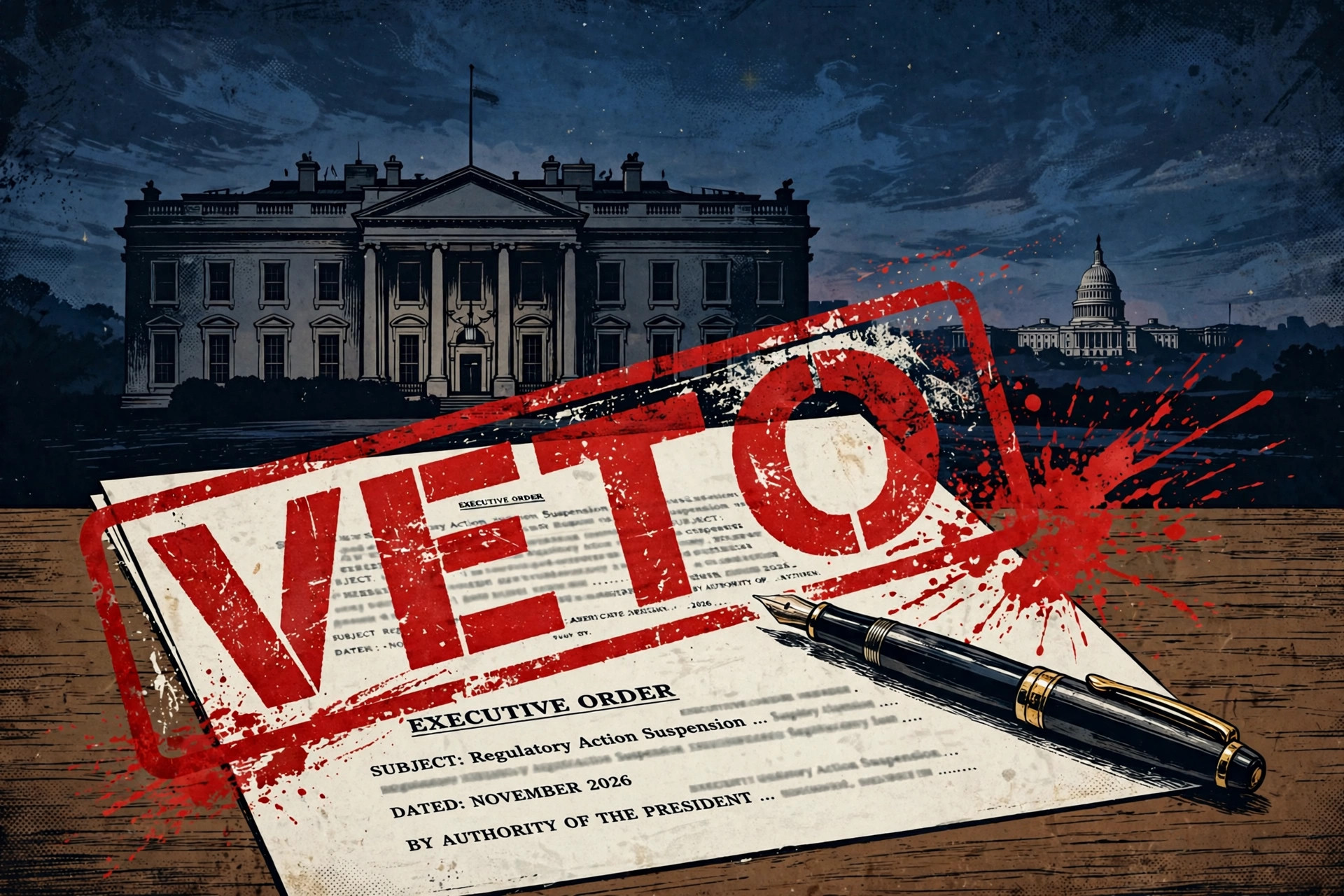
WASHINGTON — The morning after a midterm election is always a moment of recalibration in Washington, but the recalibration now facing President Donald Trump is sharper than most. Projections after the November 3, 2026 vote point to Democratic majorities in both the House and the Senate when the new Congress is seated in January 2027, ending two years in which Republicans controlled both chambers alongside the White House. Final certified results in some races were still being completed as the first assessments were published, and the precise margins remain subject to official certification. What is already clear, however, is the direction of travel: the next two years of this presidency will be fought, in large part, over what a president can do alone, what he can block, and what he cannot do without a Congress that is no longer led by his own party.
Trump himself has previewed the posture he intends to adopt. In appearances before and after the vote, he embraced the label of veto-wielding president, telling interviewers in substance that if Democrats send him legislation he opposes, he will veto it and then expect them to come back and negotiate. One widely reported image summed up the message in a single word: a red cap bearing the word “VETO.” Supporters read that as a promise of firmness. Critics read it as a promise of gridlock. Both readings may prove true at different moments, because a veto is at once a shield and a bargaining chip. It stops a bill, but it does not write a replacement, fund a programme, or settle a dispute on its own.
That distinction matters for understanding the period ahead. Trump is not leaving office in January 2027. His term runs to January 2029, and he remains commander-in-chief, head of the executive branch, holder of the pardon power, and the country’s chief diplomat. The phrase “lame duck,” used loosely in much of the post-election commentary, is therefore best understood here as shorthand for reduced legislative leverage, not for an absence of power. A president who has lost Congress has lost the easiest route to new laws. He has not lost the presidency. The question for the next two years is how much of an agenda can be carried by executive action alone, and how much will stall for want of a signature that Congress will not supply and a veto that Congress cannot override.
The lame-duck session: what happens before January 2027
Before any new majority takes power, there is a bridge period that deserves close attention: the lame-duck session of the outgoing Congress. Under the Constitution, the new Congress is seated on January 3, 2027. Until then, the outgoing House and Senate — still under Republican leadership — remain in session and can still pass legislation, confirm nominees, and complete unfinished business. Presidents and outgoing majorities have often used such sessions to finish appropriations work, confirm judges and executive nominees, and clear bipartisan measures that might be harder to pass under a new alignment.
This lame-duck window cuts both ways. On one hand, it gives the White House a final stretch in which its legislative partners still hold the gavels, and therefore a last chance to move items that have been waiting for floor time. On the other hand, outgoing lawmakers who have just lost their seats, or whose party has just lost its majority, may have less incentive to take difficult votes, and members of the incoming majority will be watching closely for any measure they regard as an attempt to tie their hands before they arrive. Expect the session to be judged less by its volume than by its choices: whether funding is kept flowing, whether any nominations are rushed or deliberately held, and whether either side uses the interval to set traps for January rather than to clear the decks.
Funding is the most immediate test. Federal spending requires appropriations laws, and a lapse in appropriations can shut down parts of the government. If the lame-duck Congress does not complete the funding work, the fight will simply be inherited by the new Congress in January, with the White House negotiating from a weaker position. That is why, in divided-government transitions, the seemingly dull business of continuing resolutions and spending bills often matters more than the set-piece speeches. A president can veto a spending bill he dislikes, but he cannot spend money Congress has not appropriated, and a shutdown imposes political costs on both sides. Watch, therefore, not only for veto threats but for the quieter signals: whether negotiators are meeting, whether stopgap funding is extended, and whether either side is preparing the public for a standoff it believes it can win.
Trump After 2026 Midterms: The Veto Math That Shapes Every Negotiation
The veto is the centrepiece of the White House strategy Trump has described, and its arithmetic explains why. A presidential veto can only be overridden by a two-thirds vote in both the House and the Senate. In practical terms, that means 290 votes in the House and 67 votes in the Senate if every member votes — thresholds that a projected Democratic majority, on its own, does not approach. Even a comfortable majority falls well short of two-thirds. To override a veto, Democratic leaders would need substantial Republican support in both chambers, and on the most partisan issues that support is unlikely to materialise in large numbers.
That math gives the veto real force as a defensive tool. Bills to reverse administration policies on immigration enforcement, regulation, energy, or foreign assistance, if they passed a Democratic Congress, could be stopped at the president’s desk unless they commanded a genuinely bipartisan supermajority. The same math, however, limits the veto as an offensive tool. A veto does not enact the president’s preferences. It preserves the status quo. If the status quo is a policy the White House itself wants to change — a spending level, a tax provision, an expiring authority — then simply saying no does not achieve the change. That is where negotiation re-enters the picture, and where Trump’s own framing is revealing: he has suggested that after a veto, Democrats will want to make a deal. Deals, by definition, require concessions, and the history of divided government suggests that the most durable outcomes are usually trades — a Democratic priority advanced in exchange for a Republican priority preserved — rather than outright victories for either side.
There are also forms of veto that operate more quietly than a televised rejection. A president can threaten a veto early, while a bill is still being drafted, in order to shape its contents before it reaches his desk. White House statements of administration policy, private warnings to congressional leaders, and public veto threats all serve that purpose. Equally, a president can allow a bill to become law without his signature, or use a pocket veto when Congress has adjourned, though the latter is a narrower and more technical device. Observers should therefore track not only the number of vetoes actually issued — which may remain modest — but the number of bills that are rewritten, delayed, or abandoned because a veto was credibly threatened. The shadow of the veto often does more work than the veto itself.
Democrats, for their part, face a strategic choice about how to use their new majorities in the face of that arithmetic. One approach is to pass broadly popular measures that put pressure on the White House and on Republican members, forcing the president either to sign or to veto something the public supports. Another is to pass partisan priorities knowing they will be vetoed, in order to draw a clear contrast for the 2028 election. A third is to focus on oversight, investigations, and the confirmation process, where a Senate majority has tools that do not require the president’s signature at all. In practice, expect a mixture of all three, with the balance shifting according to the issue, the polling, and the proximity of the next election. Republican members, meanwhile, will have to decide on each vote whether loyalty to the White House or the politics of their own districts matters more — and their answers will determine whether any veto override ever becomes plausible.
Executive orders: what the pen can do, and where it stops
If the veto is the president’s shield, the executive order is his sword. Trump has used executive orders far more heavily than his predecessors in this term. Reports citing the American Presidency Project put the total at 292 executive orders since January 2025, already exceeding the 220 he signed across his entire first term, with more than 140 of them issued in his first 100 days back in office. That record suggests that the White House is unlikely to treat a Democratic Congress as a reason to slow down. If anything, the incentive to act unilaterally grows when the legislative route narrows.
Executive orders are powerful precisely because they direct the machinery the president already controls: federal agencies, the military chain of command, immigration enforcement, the management of public lands, the implementation of existing statutes, and the conduct of foreign policy. A president can order agencies to reinterpret rules, pause or accelerate enforcement priorities, reorganise White House processes, and issue new guidance within the bounds of laws Congress has already passed. In areas such as trade, tariffs, sanctions, and national security, the president also enjoys broad delegated and constitutional authority that Congress has historically found difficult to constrain quickly, in part because any constraining bill can itself be vetoed.
But executive action has limits that are often underestimated in the first flush of post-election commentary. First, an executive order cannot appropriate money. A president who wants a new programme funded, or an existing programme expanded beyond its appropriation, still needs Congress. Second, an executive order cannot repeal or rewrite a statute. Where Congress has spoken clearly in law, an order that contradicts that law is vulnerable in court. Third, executive orders are reversible. Just as Trump revoked many of his predecessor’s orders on returning to office in 2025, a future president can revoke his. That reversibility makes executive action a fragile foundation for long-term policy, and businesses, state governments, and foreign partners all know it. Fourth, the courts remain a check. Executive orders in this term have already generated extensive litigation, and a Democratic Congress with control of oversight committees will be well placed to surface legal vulnerabilities, demand documents, and amplify court challenges, even if it cannot itself strike an order down.
The result is likely to be a pattern familiar from earlier periods of divided government, but at a higher tempo: a stream of executive orders and agency actions from the White House, followed by congressional hearings, lawsuits, and occasional bipartisan legislation to codify or block the most consequential moves. Immigration enforcement, regulatory rollbacks, and foreign policy — including arms deliveries, aid decisions, and the handling of ongoing conflicts — are among the areas most likely to be contested in this way, because they sit closest to the president’s independent authority and furthest from Congress’s power of the purse. Healthcare coverage, by contrast, is an area where executive action can adjust implementation at the margins but cannot by itself rewrite the underlying statutes or funding formulas, which is why it is likely to feature heavily in veto fights rather than in unilateral moves alone.
What still needs Congress: money, confirmations, and the calendar
Three categories of business will define whether divided government produces deals or deadlock. The first is money. Appropriations, the debt limit, and any extension of expiring tax or spending provisions all require laws. A president can shape those negotiations with veto threats, but he cannot conclude them alone. The second is personnel. While the president nominates Cabinet secretaries, judges, and senior officials, the Senate must confirm them, and a projected Democratic Senate majority would give Democrats leverage over the pace and outcome of confirmations that they did not have before. Vacancies left unfilled, nominees withdrawn under pressure, and acting officials kept in place for extended periods are all plausible features of the next two years, and each carries its own legal and political complications.
The third is the calendar. The new Congress will set its own agenda, its own committee chairs, and its own investigative priorities. House committees under Democratic leadership are expected to pursue oversight of the administration, including its senior officials and its handling of foreign and domestic policy, and Senate committees will have parallel powers. Oversight does not require the president’s signature, and it does not need a veto-proof majority. It requires only a majority willing to issue subpoenas, hold hearings, and publish findings. That is why, for the White House, the loss of Congress is felt not only in legislation that will not pass, but in scrutiny that will now arrive on a schedule the White House does not control.
Democrats will argue that this scrutiny is accountability, and that voters endorsed it by delivering them the majorities. Republicans will argue that it is partisan harassment, designed to distract the administration and to generate material for the next election. Both arguments will be made loudly, and the public’s judgment will depend less on the rhetoric than on what the investigations actually uncover and whether the White House cooperates or resists. A White House that treats oversight as a negotiation, producing documents and witnesses where it can, will fare differently from one that treats every request as a confrontation. The early tone set in January 2027, in the first exchanges between the new committee chairs and the White House counsel’s office, will therefore be worth watching as closely as any veto.
Reactions from both parties, and what to watch next
The immediate reactions after the projected result captured the two competing stories that will run through the next two years. Trump, in public remarks and social-media posts reported after the vote, combined a willingness to accept the results and to work with Democrats with an unmistakable warning that he would use the veto freely. That combination — conciliation on process, firmness on policy — is a classic divided-government opening: it keeps the door to deals open while signalling that the price of a deal will be high. Democratic leaders, meanwhile, have framed the projected majorities as a mandate to check the administration, to protect programmes they say are under threat, and to use oversight powers that were unavailable to them in the minority. Neither side has an incentive, in the first days, to concede the other’s framing, and the first real test will come not in speeches but in the first bill that reaches the president’s desk.
For readers trying to follow this story without being misled by the noise, a few markers matter more than the daily headlines. First, the certified margins: until results are final, every claim about the size of a majority should be treated as projected, and the difference between a narrow majority and a comfortable one will affect how bold Democratic leaders can afford to be. Second, the lame-duck session’s output: what the outgoing Congress finishes, and what it leaves behind. Third, the first veto, and the first veto threat that changes a bill’s contents. Fourth, the first major executive order challenged in court under the new alignment, and how the administration defends it. Fifth, the funding deadlines: the dates on which government funding expires are the forcing events that turn posturing into negotiation.
None of those markers will, on its own, settle the question of whether Trump after the 2026 midterms is a weakened president or merely a differently armed one. The honest answer, at this stage, is that he is both. He has lost the legislative majority that made his first two years unusually productive in statutory terms, and he has kept the veto, the executive branch, the pardon power, and the foreign-policy platform that no Congress can simply take away. Divided government rarely produces either total paralysis or smooth cooperation. It produces a grinding, issue-by-issue contest in which each side wins some fights, loses others, and blames the other for the fights that end in stalemate. The lame-duck agenda to January 2027 is the prologue to that contest. The two years that follow will be the contest itself.
Sources
USN reviewed reporting from multiple outlets for this story. Read more from Le Monde, Al Jazeera and The Times of India.