

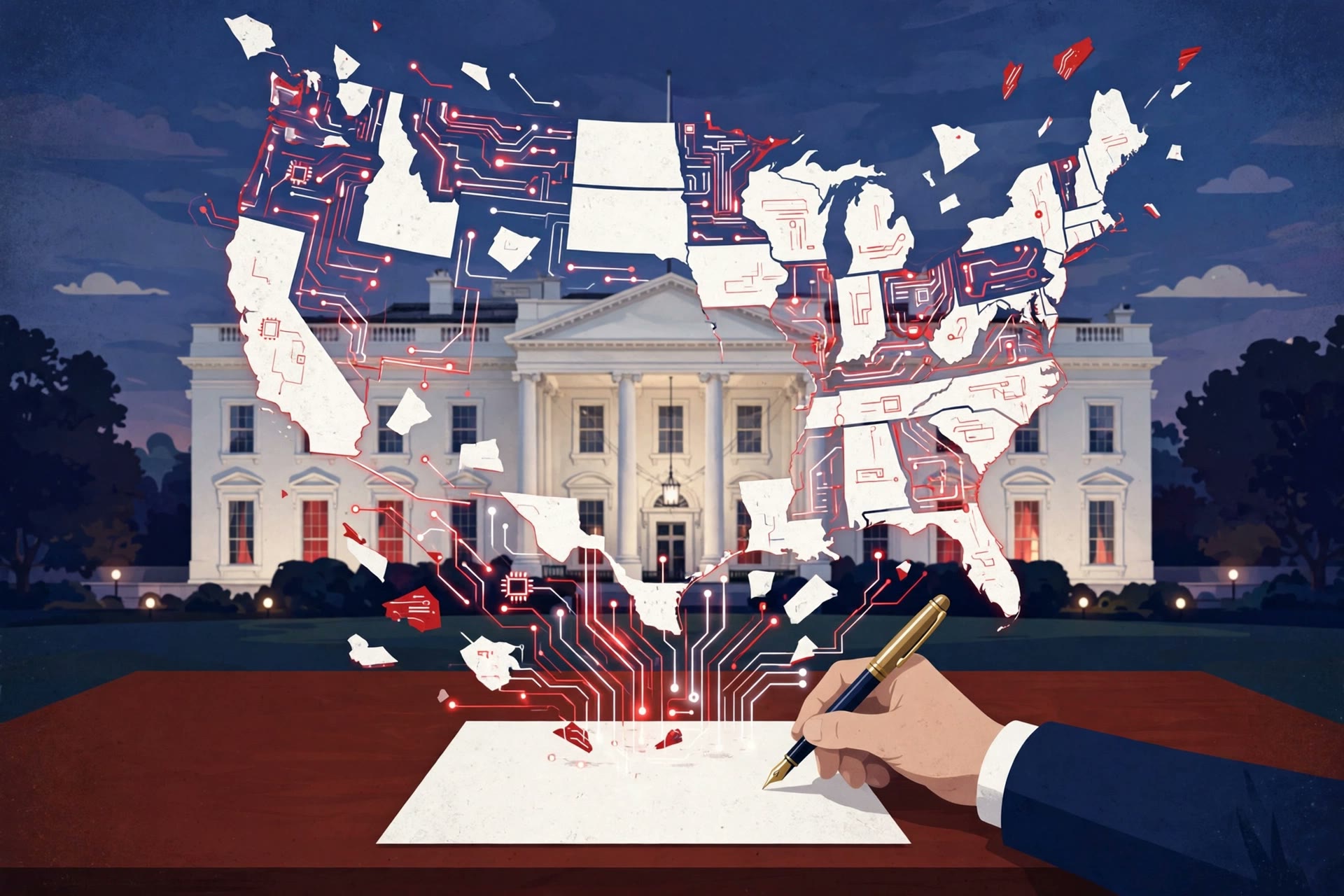
President Donald Trump signed an executive order on Thursday, 29 October 2026, that sets the federal government against state artificial intelligence laws, directing the Justice Department to sue states over their AI rules and threatening to withhold federal money from states whose laws the administration dislikes. At an Oval Office signing event, Trump said technology companies cannot be expected to seek approval from dozens of state governments. “You have to have a central source of approval when they need approval,” he said. “They can’t go to California, New York and various other places.”
The order, titled “Eliminating State Law Obstruction of National Artificial Intelligence Policy,” does not and cannot repeal a single state law by itself. No executive order can do that. What it does instead is build machinery: a dedicated litigation task force to challenge state laws in court, a Commerce Department review to name the laws the administration considers “onerous,” funding conditions designed to pressure states into backing down, and a promise to ask Congress for a federal law that would settle the question. It is the administration’s second major directive on the subject, after a December 2025 order established a national AI policy framework, and it arrives after Congress itself refused to impose the moratorium the White House wanted.
What the order directs the government to do
The sharpest tool in the order is legal. It directs Attorney General Pam Bondi to establish an “AI Litigation Task Force” inside the Justice Department within 30 days, whose sole responsibility will be to challenge state AI laws in court. The grounds the order names are broad: that a state law unconstitutionally regulates interstate commerce, that it is preempted by existing federal regulations, or that it is otherwise unlawful in the Attorney General’s judgment. That third category, lawyers note, gives the task force wide discretion over which of the dozens of state AI statutes now on the books it chooses to attack first.
The second tool is money. The order directs Commerce Secretary Howard Lutnick to publish, within 90 days, an evaluation identifying existing state AI laws the administration considers onerous and conflicting with its policy, and to refer those laws to the litigation task force. It also directs the Commerce Department to issue a policy notice tying states’ eligibility for funding under the Broadband Equity, Access, and Deployment Program — the federal broadband build-out known as BEAD — to the absence of onerous AI laws, so a state that keeps a disfavoured AI statute could lose non-deployment broadband funds. Other agencies are told to review discretionary grants with the White House’s AI adviser to see whether funding can be conditioned the same way. The Federal Communications Commission is directed to open a proceeding on a federal reporting and disclosure standard for AI models that could preempt conflicting state rules, and the order carves out some territory from its own campaign: state laws on child safety, AI computing and data center infrastructure, and states’ own government procurement and use of AI are exempted.
The order also looks beyond the executive branch. It directs David Sacks, the White House special adviser for AI and crypto, together with the assistant to the president for science and technology, to prepare a legislative proposal for Congress that would create a uniform federal AI framework — the durable preemption that an executive order alone cannot supply. Until such a law passes, every state AI law remains in force unless a court blocks it, a point the administration’s own legal summaries concede.
Trump executive order on state AI laws is the second attempt after Congress refused a moratorium
The order exists because the legislative route failed. Administration officials and Republican lawmakers tried earlier this month to include language curbing state AI laws in a must-pass defense bill, and the effort collapsed. Before that, a proposal to pause state AI laws outright was rejected by the Senate by a vote of 99 to 1, one of the most lopsided defeats of the Trump presidency. With no federal AI statute on the books and none in prospect, the White House has turned to the tools a president controls alone: litigation, agency rulemaking and the federal purse.
It is also not the administration’s first move. On 11 December 2025, Trump signed Executive Order 14365, “Ensuring a National Policy Framework for Artificial Intelligence,” which set the goal of a “minimally burdensome national policy framework” and first sketched the challenge-and-review approach toward state laws. The new order escalates that framework with a named task force, deadlines of 30 and 90 days, and explicit funding consequences. The stated rationale has not changed: the order argues that American AI leadership requires, in its words, a “minimally burdensome national standard — not 50 discordant State ones.”
The push has been championed inside the administration by Sacks, after months of lobbying by major AI companies and investors, including OpenAI, Google and the venture firm Andreessen Horowitz, according to reporting on the signing. Those companies have argued that a state-by-state patchwork forces them to design products around the strictest state’s rules, raises compliance costs, and slows deployment against foreign competitors. The order’s framing — sustaining American “global AI dominance” through a light federal framework — mirrors that argument closely.
The states kept legislating anyway
The backdrop to the signing is that the states never stopped. By one legal tracker’s count, states had enacted 109 AI laws as of 1 July 2026, covering everything from hiring algorithms and insurance decisions to deepfakes, chatbots and government use of automated systems. In health care alone, 40 state AI bills had been enacted across 24 states by the third quarter of 2026, according to Manatt Health’s tracker, including rules that bar insurers from denying care based on an AI system’s output without human review. Whatever pressure Washington applied through 2026, state legislatures treated the absence of a federal AI law as an invitation rather than a warning.
Individual states have also begun adapting rather than simply defying. Colorado, whose AI Act was the country’s most closely watched, repealed and replaced the law in May 2026 with a narrower statute that takes effect in January 2027 and drops several of the original duties. Colorado was also the first real test of the federal court strategy: in April 2026, Elon Musk’s xAI sued the Colorado attorney general over the AI Act, the United States intervened in the case on the challengers’ side, and enforcement of the law was paused by agreement while the litigation proceeds. That case, still unresolved, is a preview of the fights the new task force is being built to multiply.
State officials, for their part, have not signalled surrender. Governors and attorneys general who backed their states’ laws argue that they were filling a vacuum Congress left, that their rules target concrete harms — discriminatory hiring tools, undisclosed chatbots, AI-driven insurance denials — and that a state law remains valid law until a court says otherwise. Several states are expected to defend their statutes against the first task force challenges, and some are expected to sue over the funding conditions, arguing that Congress, not the Commerce Department, wrote the broadband law and set its terms.
Both sides of the preemption fight
The administration’s case is about uniformity and competitiveness. A company releasing an AI model nationally, its officials argue, cannot practically maintain fifty different compliance regimes, and the practical result of state patchwork is that the strictest state sets the national standard without ever winning a national election. A single, light federal framework, they say, would give companies certainty, keep development in the United States, and prevent foreign rivals from gaining ground while American firms litigate. Industry groups have largely echoed that case, while pressing the administration to follow through with the promised federal bill, since an executive order can be reversed by the next president and a statute cannot.
The critics’ case is about who gets to decide, and what gets lost. Brad Carson, president of Americans for Responsible Innovation, said the order will “hit a brick wall in the courts,” and that it “directly attacks the state-passed safeguards that we’ve seen vocal public support for over the past year, all without any replacement at the federal level.” That last point is the centre of the legal and political dispute: preemption normally happens when a federal law displaces a state one under the Constitution’s Supremacy Clause, and here there is no federal AI law doing the displacing — only an executive order, agency pressure and lawsuits arguing that state laws burden interstate commerce. State lawmakers add a federalism argument: when Congress considered a moratorium and voted it down 99 to 1, it did not merely fail to act, it decided — and the executive branch should not be able to achieve by directive what the Senate refused by vote.
Between those poles sit the companies the order is meant to help, many of which must comply with state laws today regardless of the litigation ahead, and the state regulators who must decide whether to keep enforcing laws that the federal government is now formally committed to challenging. Both are likely to live with uncertainty for as long as the court cases take.
What happens next
The order sets two clocks running. Within 30 days, the Justice Department’s AI Litigation Task Force should exist, and its first filings will show which state laws the administration considers most vulnerable — likely those that dictate how models are built or what they may output, rather than the consumer-protection rules that poll better. Within 90 days, the Commerce Department’s evaluation will publish the first official list of “onerous” state AI laws, and the BEAD funding notice will test whether broadband money can lawfully be used as leverage, a question at least one broadband policy institute has already argued the administration will lose.
The longer game is in Congress and the courts. If the administration’s promised legislative proposal reaches Capitol Hill, it will land in a Senate that rejected a simpler moratorium almost unanimously, which is why the order’s authors may prefer the slower judicial route: a few favourable rulings against prominent state laws could chill statehouses more effectively than a bill that cannot pass. If the courts instead side with the states — holding that an executive order cannot manufacture preemption — the patchwork survives, and state AI law remains, as it is today, the only AI law most Americans actually live under. The signing on Thursday settled none of that. It announced that the fight is now the federal government’s, and that it intends to have it in court. State capitols, meanwhile, will render their own verdicts in the months ahead — in courtrooms first, and in next year’s legislative sessions after that.
Sources
USN reviewed reporting from multiple outlets for this story. Read more from BitRss, Intercore and JD Supra.