

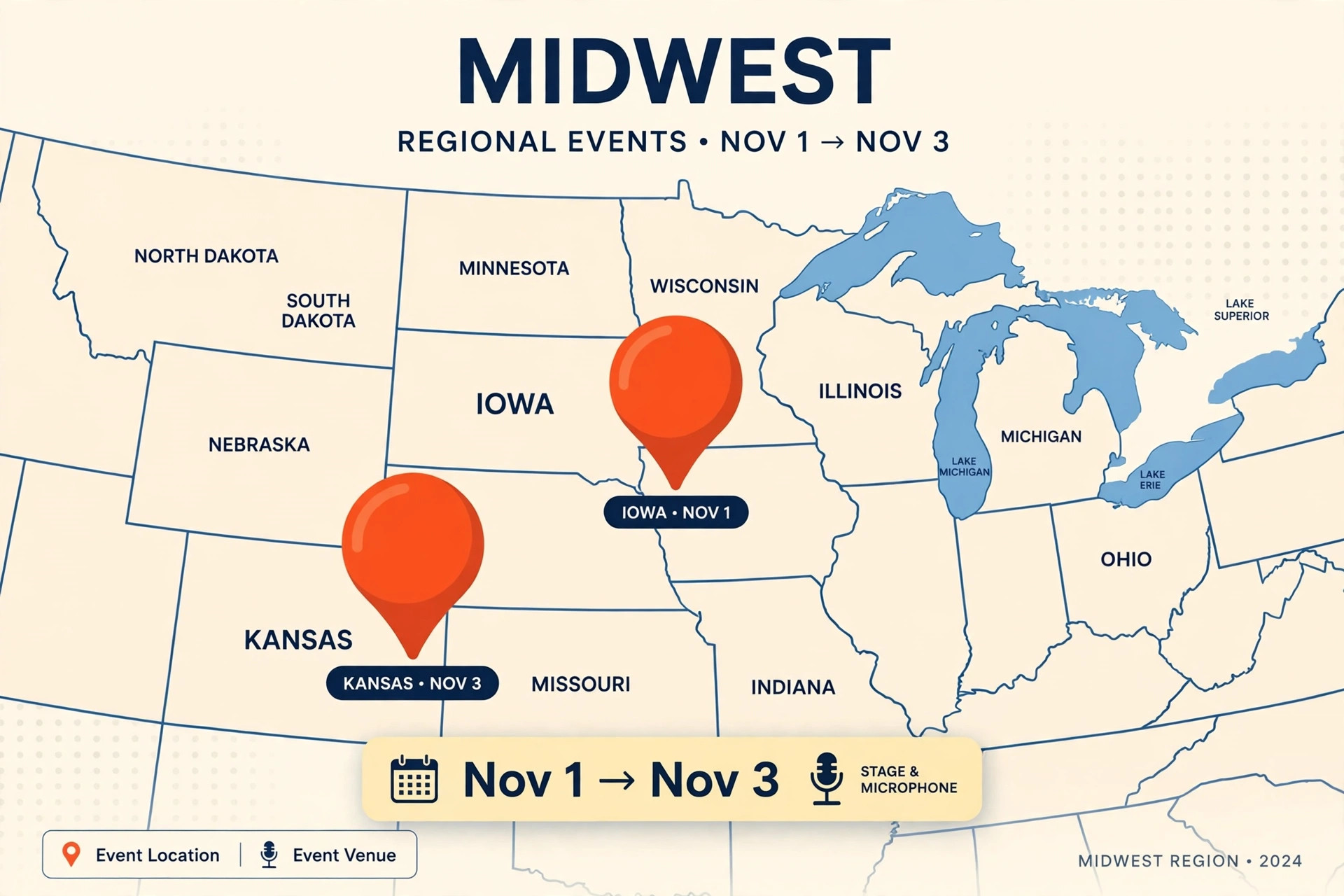
WASHINGTON — President Donald Trump returns to the campaign trail in person on Sunday, November 1, 2026, with rallies in Iowa and Kansas, two days before midterm elections that will decide control of Congress. The restored in-person stops — in Dubuque, Iowa, in the afternoon and in Salina, Kansas, in the evening — are the news of the day, after a week in which the president’s final-weekend schedule became a story in itself.
Trump is scheduled to speak in Dubuque at 3 p.m. Central Time, 4 p.m. Eastern, at the Five Flags Event Center, 405 Main Street, Dubuque, Iowa, where he will campaign for Ashley Hinson and Iowa Republicans. He is then scheduled to speak in Salina at 7 p.m. Central Time, 8 p.m. Eastern, at Salina Regional Airport, Hangar 509, 2734 Arnold Court, Salina, Kansas, where he will campaign for Senator Roger Marshall and Kansas Republicans. The two-state swing, in a single day and in the final 48 hours before voting ends, is a classic closing-weekend move: use the president’s presence to energise base voters, draw local television coverage, and give down-ballot candidates a final boost in races that could decide Senate and House majorities.
The stakes are unusually clear. All 435 House seats and 35 Senate seats are on the ballot on Tuesday, November 3. Republicans currently hold the Senate 53–47 and the House 218–214, according to the figures cited in campaign coverage. A net Democratic gain of four Senate seats would flip the Senate; a smaller gain that produced a 50–50 tie would still leave Republicans in control, because the vice president breaks ties. In the House, where the Republican margin is only a handful of seats, a small swing in a few dozen districts could change the majority. That arithmetic is why the final weekend matters disproportionately: turnout, enthusiasm, and last-minute persuasion in a handful of states can decide national power.
Trump spent Saturday at Mar-a-Lago, in Florida, after weeks of campaigning across the country. He held more than 25 rallies in October alone, a pace that reflects both his central role in the Republican campaign and the party’s reliance on his ability to draw crowds and dominate news coverage. At a Florida rally on October 30, Trump said he expected that event to be his final midterm event, and he noted that his voice was at “49.2%” — a candid acknowledgment of the toll of a month of rallies — but he added that he was going to Iowa and Kansas. The Sunday trip is therefore not an afterthought. It is a deliberate decision to spend the last full campaign day on the road, in two states where Senate races have drawn national attention.
Trump Iowa Kansas rallies November 1: Dubuque and Salina details
In Iowa, the focus is an open Senate race. Ashley Hinson, the Republican candidate, faces Democrat Josh Turek. Iowa has voted Republican in recent presidential elections — Trump won the state by double digits in 2024 — but Senate races can behave differently from presidential races, and an open seat, with no incumbent running, is inherently more competitive than a race in which a sitting senator seeks re-election. Hinson’s campaign, and the national Republican effort behind her, will be hoping that Trump’s Dubuque appearance helps consolidate Republican voters and persuades late-deciding independents that the seat should stay in Republican hands.
Dubuque, on the Mississippi River in eastern Iowa, is a fitting location for a closing argument in the state. It is a mid-sized city with a mix of manufacturing, agriculture-related industry, and service jobs, and it sits in a region where economic concerns — farming costs, manufacturing jobs, and the cost of living — resonate strongly. A rally at the Five Flags Event Center, a downtown venue, is designed to be visible, accessible, and easy to cover on local television, which remains influential in Iowa politics even in an era of national cable news and social media.
In Kansas, the race is different and, in some ways, more surprising. Senator Roger Marshall, the Republican incumbent, faces Democrat Adam Hamilton in a contest that has become unexpectedly competitive. Kansas last elected a Democratic senator in 1932 — nearly a century ago — and the state is normally considered safely Republican in Senate races. That Hamilton is competitive at all, let alone leading in some recent polls, is one of the stories of the midterm campaign, driven, according to analysts, by rising farming costs and opposition to the administration’s immigration crackdown, among other factors. Marshall’s campaign will be hoping that Trump’s Salina appearance — at an airport hangar, a classic rally setting that allows for a large crowd and strong visuals — helps restore the traditional Republican advantage in the final hours.
Salina, in central Kansas, is also a strategic choice. It is not the state’s largest city, but it is a regional hub, and an airport-hangar rally there can draw supporters from across central and western Kansas. The 7 p.m. Central start time places the speech in prime time in the East, allowing clips to circulate on evening news and social media before Election Day. The Dubuque-to-Salina sequence — afternoon in Iowa, evening in Kansas — also gives the campaign two distinct news cycles in one day, with local coverage in each state and national coverage of the swing as a whole.
From cancelled rallies to restored in-person stops
The background to Sunday’s trip, mentioned here only briefly because it has been covered in detail elsewhere, is that the Republican National Committee announced on October 29 that the weekend Iowa and Kansas rallies were cancelled and would be replaced by tele-rallies. After pushback from supporters and candidates who wanted in-person appearances, Trump announced that he would go in person on Sunday after all. That reversal is part of why Sunday’s rallies carry extra significance: they are not merely routine stops, but stops that were restored after being cancelled, and their crowds, energy, and coverage will be read as a test of whether the in-person format still matters in the final days.
Tele-rallies — telephone town halls in which supporters listen in by phone — can reach large numbers of people efficiently, and they spare a candidate the travel and the strain of a live event. They do not, however, produce the same visuals, the same local news coverage, or the same sense of momentum as a packed arena or hangar. For candidates in tight races, the difference can matter. A photograph of a full venue, a clip of a cheering crowd, and a local news story about a presidential visit can energise volunteers for the final get-out-the-vote push in a way that a phone call, however well attended, often cannot. That is the calculation that appears to have driven the decision to restore the in-person stops.
Trump’s own comments at the Florida rally on October 30 underline the physical cost of the schedule. Saying his voice was at “49.2%” was both a joke and a signal: after more than 25 rallies in October, the president was candid that he was running low, but was still choosing to travel. For supporters, that reads as commitment. For critics, it reads as a campaign that relies heavily on one person’s stamina and presence. Either way, it explains why the Sunday trip, after a Saturday at Mar-a-Lago, is being watched as a measure of the campaign’s closing energy.
Early voting, the national picture, and what to watch on Sunday
More than 51 to 52 million Americans had already voted before Sunday, according to figures cited in election coverage — a record for a midterm election. The exact figure varies by timestamp, because early and mail ballots continue to arrive and be counted in different states on different schedules, and readers should treat the total as an approximate, attributed figure rather than a precise final count. What the figure does establish is that a very large share of the electorate had already cast ballots before the final weekend rallies. Early-vote totals are ballots cast, not results: they do not, by themselves, show who is winning, because states report turnout by party registration or by mode of voting in ways that do not directly translate into vote shares, and because Election Day voting can shift the picture.
That context matters for how to interpret Sunday’s rallies. For voters who have already cast ballots, a rally is about validation and enthusiasm, not persuasion. For voters who have not yet voted, particularly in Iowa and Kansas, a rally is a final nudge — a reminder to vote, a reason to volunteer, and a message about what is at stake. Campaigns in the final 48 hours focus overwhelmingly on turnout: making sure supporters who have not yet voted actually do so, and making sure volunteers are in place for Election Day operations.
Nationally, the campaign’s closing argument has included promises about household finances, including the $5,000 “Trump dividend” proposal. Readers should note, as separate coverage has stressed, that the dividend is a campaign promise conditional on a Republican win and future legislation, not enacted money that voters will receive regardless of the outcome. It is not a payment that has been approved, funded, or scheduled for distribution. Treating it as approved would mislead voters about what is actually on offer, and the distinction between a promise and an enacted programme is one that voters in Iowa, Kansas, and elsewhere will need to keep in mind as they hear closing speeches.
On Sunday, the specific things to watch are straightforward. First, crowd size and energy in Dubuque and Salina, and how local media cover each event. Second, what Trump says about Hinson and Marshall by name, and whether he tailors his message to Iowa farming and manufacturing concerns and to Kansas farming costs and immigration. Third, whether the speeches introduce any new closing argument, or whether they repeat the themes that have dominated October — the economy, immigration, and the consequences of a change in congressional control. Fourth, how the Democratic candidates and their supporters respond, and whether they stage competing events or rely on their own final get-out-the-vote operations.
The broader campaign context is also worth noting. closing-week campaign trail has featured sharp exchanges with former President Barack Obama, who has been campaigning for Democrats, and the contrast between the two former presidents’ closing messages has become a frame for national coverage. Sunday’s Iowa and Kansas rallies extend that frame: Trump, in person, in two Republican-leaning states where Democrats are nevertheless competitive, making a final case that Republican control of Congress should continue.
For readers following the schedule change itself, the earlier announcement is covered in a separate live post on the earlier cancelled schedule. That background helps explain why Sunday’s in-person restoration is newsworthy, but the story on November 1 is the rallies themselves: Dubuque at 3 p.m. Central, Salina at 7 p.m. Central, two Senate races, and a national majority that could turn on turnout in the final two days.
When the rallies end on Sunday night, there will be one full day of campaigning left — Monday — and then Election Day on Tuesday. For Hinson in Iowa and Marshall in Kansas, Sunday’s presidential visits are the highest-profile endorsements they will receive in the campaign, and they arrive at the moment when undecided voters are making final decisions and when campaigns are shifting from persuasion to turnout. Whether the restored in-person format delivers the boost the campaigns hope for will not be known until votes are counted, but the decision to travel, after a cancellation and after a gruelling October, is itself a statement about how the Republican campaign believes elections are won in their final hours: in person, in the states that matter, with the president on stage.
Sources
USN reviewed reporting from multiple outlets for this story. Read more from SRN News, USA Today and Al Jazeera.