

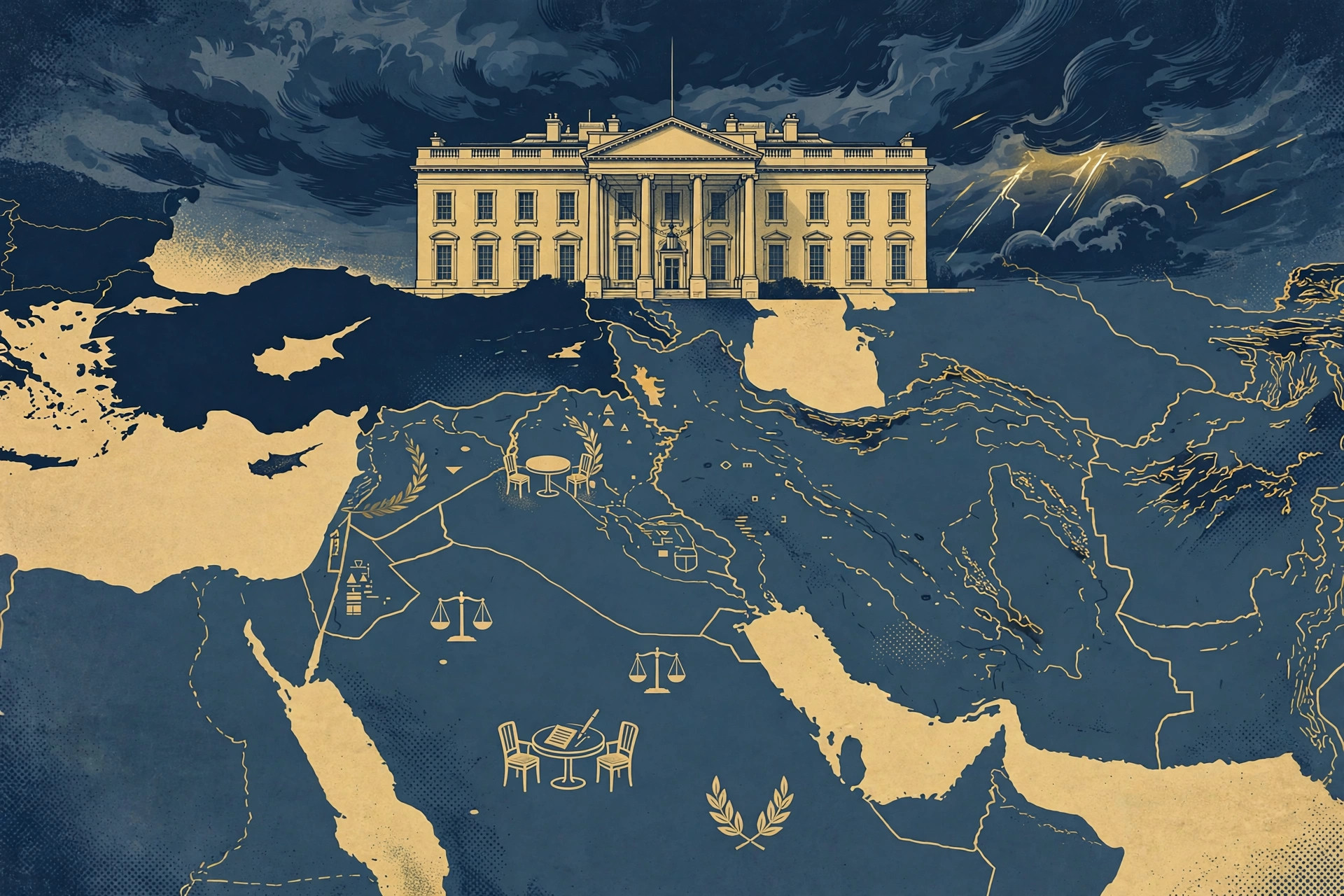
WASHINGTON — The White House entered the final days before the November 3 midterm elections with two messages about Iran that sounded, at first hearing, as if they were pulling in opposite directions. President Donald Trump said on Saturday that the United States still had “one or two sites” in Iran to deal with, and that it could do so in ten minutes. Secretary of State Marco Rubio said the same day that Trump had not made a decision about whether to order new strikes at all. Both statements can be true at once, and the gap between them is the story of November 1 and 2: a president keeping a military option openly on the table, a secretary of state insisting that the option has not been chosen, and an Iranian leadership answering with both a warning and a diplomatic opening.
Nothing in the public record as of November 2 amounts to an order for a new strike, a date for one, or a settled American plan for what would follow one. Reports that Washington has warned Gulf allies to prepare for a possible, brief, intense round of strikes as early as November 4, the day after the midterms, remain reports attributed to officials familiar with the discussions, not an announced decision. Readers should treat that distinction as central, because much of the weekend’s coverage blurred it: a capability described by a president, a contingency discussed with allies, and a decision taken by a president are three different things, and only the first two are clearly documented in the public statements so far.
Trump made his remarks to reporters at his Mar-a-Lago residence in Palm Beach, Florida, on Saturday, October 31. “We’ve knocked out their nuclear. We still have to take care of, I would say, one or two sites, but we can do that in 10 minutes,” he said. “You probably could look at Pickaxe Mountain, and you have to take care of that. We can do that all very quickly.” Pickaxe Mountain has been described by Western intelligence, as reported in the coverage, as a suspected underground site that may have been used to store nuclear material, and as a site the United States has not yet struck in this war. The Iranian government has denied that any nuclear work is carried out there, according to the same reporting. Trump also said negotiations with Iran were “going fine” but that Tehran was “not very reliable,” and he repeated his longstanding position that Iran must never acquire a nuclear weapon.
The remarks followed, by hours, a reported telephone call between Trump and Israeli Prime Minister Benjamin Netanyahu on Saturday morning. The Wall Street Journal reported the call, citing people familiar with the conversation, as the United States weighed plans to resume strikes. That report does not, by itself, establish what was agreed, if anything, in the call, and neither Washington nor Jerusalem has published a readout that settles the question. Its importance for November 1 and 2 is narrower: it places the president’s “one or two sites” language inside an active allied conversation about resuming military action, rather than treating it as an isolated remark at a social event. Israel joined the United States in launching the war against Iran on February 28, and Israeli officials have repeatedly signalled that they see the period after the American midterms as a possible window for further action, a point that complicates any American-only reading of the decision.
Rubio: no decision yet as White House weighs new Iran strikes
Rubio’s statement, delivered at a press conference in Atlanta, Georgia, where he was hosting foreign ministers for a G20 meeting, was the clearest official check on the strike speculation. “We can achieve military objectives if we seek to. He hasn’t made a decision,” Rubio said, referring to Trump. “I have no announcement in that regard with you today, and nor do we take any of it lightly.” He added that Trump prefers a diplomatic solution, and that if a diplomatic solution were available, Washington would be open to it. He declined to characterise the progress of talks or to set a deadline for diplomacy, and he declined to discuss specific military plans.
What Iran said: Khamenei’s warning and a wider battlefield
Iran’s answer came at the highest level, and it was deliberately two-sided. Supreme Leader Mojtaba Khamenei said in a statement issued on Saturday that “any level or type of threat must be met with an immediate, impactful, and geographically unrestricted response,” adding that if the United States and Israel resumed military or terror attacks, it would be the armed forces of Iran and the Iranian nation that determined when and under what conditions those attacks would end. The statement, published on Khamenei’s account on X, also said Iran was updating its military target database to ensure that American and Israeli assets of all kinds were within reach. That is a claim about Iranian intent and preparation, not a verified inventory of targets, and it should be read as a deterrent warning rather than as a confirmed operational plan.
At the same time, Iran’s security chief, Mohsen Rezaei, raised a separate and sensitive point: Tehran was debating whether to lift its longstanding ban on nuclear weapons should hostilities resume, although he said no such decision had been taken. Former Supreme Leader Ali Khamenei banned the development of nuclear weapons in a religious decree in the early 2000s, and Iran has consistently denied seeking such weapons, while enriching uranium to levels that Western governments say have no peaceful application. Rezaei’s comment is therefore best understood as a signal about what Tehran says it might reconsider under attack, not as an announcement that Iran has decided to build a weapon. The distinction matters, because conflating a debate about doctrine with a decision to weaponise would overstate what the public record actually shows.
The Vance letter: a positive step, but no direct meeting planned
The diplomatic thread running through the weekend is a letter from Vice President JD Vance to Rezaei, sent earlier in the week, reportedly at Trump’s direction, to gauge the prospects of restarting negotiations and averting another round of escalation. Foreign Minister Abbas Araghchi said Iran had studied the letter in high-level meetings and described the American attempt to open a door to dialogue as a positive step. “The American side’s attempt to open the door to dialogue and understanding more broadly is a positive step,” Araghchi told Al Jazeera. He immediately qualified that assessment, warning that if Washington’s goal in sending the letter was to stir up discord, it would be yet another mistake added to previous ones.
Rezaei, who confirmed he had read the letter, said its tone had “completely changed” compared with earlier correspondence from Trump, and described that change as a good sign. He said he had not yet responded and would not comment further on its contents. The contents of the letter have not been published, so neither the change in tone nor its practical meaning can be independently verified from the letter itself. What can be verified is the Iranian response to it: a welcome for the opening, coupled with a refusal, for now, of the next step that usually follows such an opening. Araghchi said there were currently no plans for meetings with American officials, called reports of such a meeting merely media speculation, and said Iran saw no need to meet with the Americans at present because its conditions were clear and mediators were continuing consultations about them.
That last point corrects a loose shorthand that appeared in some weekend coverage. The talks now under way in Doha are talks between an Iranian delegation and Qatari mediators, not a confirmed direct meeting between American and Iranian officials. Araghchi said on Saturday that an Iranian delegation, including one of his aides, had travelled to Doha to meet Qatari mediators, following more than twelve hours of discussions on Friday between Iranian and Qatari envoys in Tehran. A source briefed on the negotiations told Reuters that the Doha talks were being coordinated in regular contact with Washington, but coordination through mediators is not the same as direct talks, and Araghchi’s own words rule out a direct meeting for now. Any report of direct talks in Doha should therefore be treated as unconfirmed unless and until either government announces one.
Doha and the Strait of Hormuz: what is actually on the table
The substance of the Doha discussions, as described by Araghchi, centres on a plan to reopen the Strait of Hormuz within two days, provided Washington first meets a set of Iranian conditions. Those conditions, as Araghchi listed them, include lifting recently imposed American sanctions, reinstating oil waivers granted in June, reducing the American military presence in the region, recognising new shipping routes in the strait designated by Iran and Oman, and ending the conflict on all fronts, including Israeli attacks on Lebanon. Araghchi said Iran had reached an arrangement through the mediators that would cut the implementation time for reopening the strait from an original seven-day proposal to two days: on day one, the United States would implement a set of measures, and on day two, the strait would reopen and navigation would be restored.
The wider context for the November 1 and 2 decision point is a war that began on February 28 with American and Israeli strikes on Iran, lasted several months in its most intense phase, and has continued to disrupt global oil supplies and spill across the region, with Iranian retaliation in the form of missile and drone attacks and involvement by Iran-aligned groups in Lebanon and Yemen. The United States has not struck Iran since September 1, according to the reporting, and Trump pledged to refrain from further attacks until after the midterms. That pledge is the immediate reason the calendar matters: the election on November 3 is both a political constraint the president imposed on himself and, in the eyes of regional governments, a possible trigger for action once it passes. The decision point, in other words, is not whether the war exists — it does, in a paused and mediated form — but whether the pause ends after the votes are counted.
That is also why this article does not revisit, in detail, the earlier American military briefings about Iran options. Earlier USN coverage of Washington warning allies about possible new Iran strikes and Vance’s quiet letter to Tehran set out the background to the allied warnings and the letter; the new development on November 1 and 2 is the sharpening of the choice itself — Trump naming a remaining target, Rubio confirming that no decision has been taken, Khamenei ordering preparation for an unrestricted response, and Araghchi welcoming the letter while ruling out a direct meeting. Those four positions, held together, describe a standoff in which diplomacy and military preparation are proceeding at the same time, and in which neither side has yet committed to the path the other fears most.
What to watch after November 3
Three questions will narrow the uncertainty after the midterms. First, whether Trump makes a decision, and whether it is announced, leaked, or revealed only by action. Second, whether the Doha mediation produces a verifiable step on the Strait of Hormuz that both sides can point to as progress, or whether the two-day plan remains an Iranian proposal Washington has not accepted. Third, whether Iran’s warnings about a longer, wider war are meant as deterrence or as preparation for a strike Tehran now considers likely.
Until those questions are answered, the responsible summary of November 1 and 2 is a narrow one. The president says one or two targets remain and could be dealt with quickly. His secretary of state says no decision to strike has been made and that diplomacy remains the preference. Iran’s supreme leader orders preparation for an immediate and geographically unrestricted response if attacks resume. Iran’s foreign minister calls the vice president’s letter a positive step, warns against using it to sow discord, says war cannot be ruled out, and says Tehran is prepared for all scenarios — while also saying there is no plan for a direct meeting with American officials. That is a standoff with an open diplomatic channel, not a decision for war, and not yet a deal for peace.
Sources
USN reviewed reporting from multiple outlets for this story. Read more from The Times of Israel, Haaretz and Al Jazeera.