

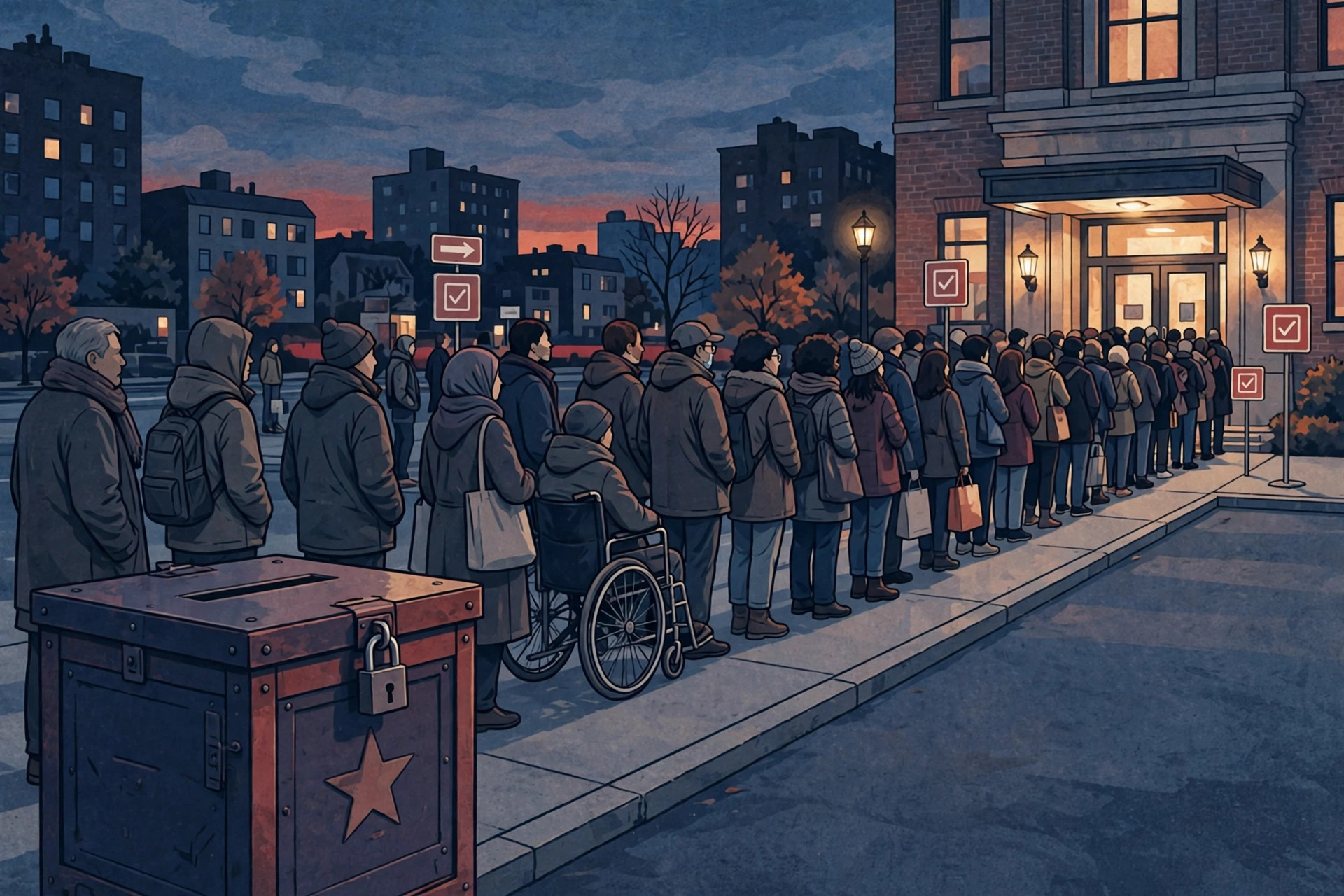
WASHINGTON — Before a single Election Day ballot has been counted, the 2026 midterm elections have already set a record. More than 53 million Americans had voted early as of Sunday morning, November 1, according to the University of Florida’s Election Lab, surpassing the entire early-voting total from the last midterm elections in 2022. The figure is still rising as the final early-voting windows close state by state, and it already tells a story about how Americans now vote, even if it does not yet tell us who will win.
The headline number, 53.14 million as of 6:56 a.m. Eastern time on Sunday, breaks down into roughly 29 million votes cast early in person and about 23 million mail-in ballots returned. That split matters. In-person early voting accounts for much of the increase over 2022, when about 20.5 million people voted early in person across the whole early period, compared with more than 28 million by Saturday of this cycle. Mail voting, by contrast, has remained a large but steadier share, accounting for roughly a third of all votes cast in recent American elections. The surge, in other words, is not mainly a story about mail. It is a story about voters showing up, in person, days and weeks before Election Day, in numbers never before seen in a midterm.
For scale, the 2022 midterm early total was about 46 million, and some trackers put the full 2022 early count at 45.9 million. The 2026 total had already passed that mark with three days still to go before Election Day, and it represents nearly a quarter of America’s roughly 210 million registered voters. Whether final turnout for the whole election also sets a record is a separate question, and one the early numbers alone cannot answer. But as a measure of participation before Election Day, 2026 is already in uncharted territory for a midterm.
Where the record early voting surge is strongest
The national record is built from very different state stories, and the differences are instructive. Texas is the clearest example. More than 7 million Texans had already voted early, about 1.5 million more than voted early in Texas during the whole of the 2022 midterm cycle. In Harris County, which includes Houston, 862,700 people had voted by Wednesday, compared with 564,500 at the same point in 2022. Texas is a large state with a closely fought Senate race between Republican Attorney General Ken Paxton and Democratic candidate James Talarico, as well as a competitive governor’s race, and its early numbers suggest an electorate that is engaged well beyond the usual midterm pattern.
Other competitive states show the same direction, if not the same scale. South Carolina, which President Donald Trump won by nearly 18 percentage points in 2024, has seen early voting surge 83 percent compared with the same point in 2022, with open races for governor and Senate on the ballot. Kansas, where Republican Senator Roger Marshall faces Democratic challenger Adam Hamilton, is up 34 percent, with roughly 83,000 more early ballots than at the same point four years ago. Maine, where Republican Senator Susan Collins faces Democrat Troy Jackson, is up 44 percent. Michigan has recorded roughly 409,000 more early votes than at the same point in 2022, a 32 percent increase. North Carolina had passed 2 million early votes by Friday, just over 23 percent of its statewide turnout in the last comparable cycle, as its early-voting period ended on Saturday.
These state figures also explain why the record should not be read as a single national wave. Early voting windows, eligibility rules and counting procedures vary widely. The number of states offering early in-person voting has expanded from 24 in 2000 to 47 in 2026, plus Washington, D.C., but the length of the window, the availability of weekend voting, and the rules for returning mail ballots still differ from state to state. The record is real, but it is an aggregate of 50 different elections, not one.
What the party numbers do and do not show
One of the most misread parts of any early-voting report is the party registration breakdown. In the states that record the party registration of early voters, registered Democrats have outnumbered registered Republicans so far, by about 11 million to 8 million according to the University of Florida analysis, or about 43 percent Democratic to 32 percent Republican in a separate snapshot of reporting states, with independents and unaffiliated voters making up roughly a quarter. Those figures are frequently quoted as if they were a result. They are not.
First, party registration data is available in only about 27 states, so it does not describe the whole country. Second, registration is not vote choice. A registered Democrat can vote for a Republican, and vice versa, and unaffiliated voters, who are a large share of the early electorate in reporting states, cannot be assigned to either party at all. Third, the early electorate is not the whole electorate. Election Day voters, who have not yet voted, could narrow or widen any early registration gap.
Polling offers a separate, if imperfect, signal. With two days left before Election Day, national polls cited in weekend coverage put support for Democrats at about 51.5 percent and for Republicans at about 43.1 percent in the generic congressional contest, and several forecast models have leaned toward a Democratic edge in the House with a narrower contest for the Senate. Those polls measure intentions, not ballots, and they carry their own margins of error. The early-vote totals measure ballots, not choices. Neither, on its own, decides the election. Together, they suggest a competitive and high-engagement midterm, but the outcome will still be decided by the full count, including the millions who vote on Tuesday itself.
Why so many Americans are voting early
Researchers who study early voting point to several overlapping reasons, and the 2026 cycle appears to combine most of them. Convenience is the simplest: for many voters, casting a ballot on a weekend or on a weekday evening, near work or home, is easier than making a single Tuesday work. Mobilisation is another: both parties, along with civic groups, have invested heavily in getting supporters to vote early, partly to bank votes before the final campaign crush and partly to focus late efforts on voters who have not yet cast a ballot.
Anxiety and a desire to get voting over with also feature prominently in surveys cited by the University of Maryland’s Center for Democracy and Civic Engagement, which notes that many voters report voting early because they want to cross it off their list as soon as possible, or because they are anxious about the election itself. Social and cultural efforts, from community celebrations around voting to so-called parties at the polls, have also tried to make early voting a communal event rather than a solitary errand. And beneath all of that sits the substantive campaign: dissatisfaction with the cost of living, including food, fuel and healthcare prices, has featured heavily in the campaign debate, and voters who feel strongly about those issues may be more motivated to vote at the first opportunity. That cost-of-living pressure is also why how election policies affect household budgets has become a central campaign theme in this cycle.
None of this means that early voting causes higher final turnout in a one-to-one way. A voter who casts a ballot in October is often a voter who would otherwise have cast it on Election Day. A record early total can therefore mean that voting has shifted earlier, rather than that many more people will vote overall. What it does mean, more reliably, is that election administrators have already processed an unprecedented volume of ballots before Election Day, which changes the logistics of the count, reduces the pressure on polling places on Tuesday, and gives campaigns a clearer picture of who has already voted and who still needs to be reached.
Mail ballots, court fights and the rules that survived
The record was set against a backdrop of legal fights over how Americans vote, particularly by mail. President Trump has repeatedly cast doubt on the security of mail-in voting, even though he has himself voted by mail, and his administration sought before this election to impose new federal requirements on mail ballots, including a uniform envelope style and a system under which the Postal Service would have a greater role in determining which voters could receive ballots. In September, the Supreme Court declined to allow those restrictions to take effect before the midterms, leaving a lower court order blocking them in place. The court did not finally resolve every legal question about the Postal Service’s role, but its decision meant that states could continue to send mail ballots under their existing procedures for this election.
A separate dispute over California ballots illustrated the same pattern in the final weekend. A federal appeals court on Friday rejected a Justice Department demand that California election officials set aside ballots from more than 20,000 people the administration claimed could be noncitizens. The administration may still appeal that ruling, as it may appeal other election rulings, but for now the ballots stand under the state’s normal procedures. The broader point for voters is that the rules under which the record early vote was cast are, in the main, the rules that states have used for years: early in-person voting in most states, mail voting in all states, and all-mail elections in eight states plus the District of Columbia, where every registered voter receives a ballot.
That stability matters for the count as well. Mail ballots postmarked by Election Day but received after it may still be counted in some states, while in others ballots must arrive by Election Day. Those differences, combined with the sheer volume of mail ballots, are one reason why some races will not be called on election night. A slow count is not, by itself, evidence of a problem. It is the consequence of rules that deliberately give mailed ballots time to arrive and be verified.
Why some results, including Alaska, will take time
Nowhere is that point more important than in Alaska, whose Senate race could determine control of the chamber. Alaska gives 10 days for mailed ballots sent within the United States to arrive, and 15 days for overseas ballots, and it uses ranked choice voting, under which the final tabulation is not run until after that mail window closes if no candidate wins more than 50 percent in the first round. Election officials and experts have said the winner may therefore not be known for up to two weeks. That is the normal operation of Alaska’s system, shaped by its vast geography and by ballots that must in some cases be flown in from remote communities, not a departure from it.
Alaska is mentioned here only as an illustration of the counting point, not as the main story of this cycle’s early vote. The separate legal dispute over Alaska’s Senate ballots, in which a federal judge on November 1 dismissed a Justice Department lawsuit seeking to delay certification, is covered in detail elsewhere. What matters for the early-voting record is the general lesson Alaska embodies: when a record number of people vote early, and when mail ballots and ranked choice rules extend the count, patience after Election Day is part of the process, not a sign that something has gone wrong. The same logic applies, in less extreme form, to California and other states with large mail-ballot volumes and close races.
What to watch on and after November 3
Three things deserve attention as the early-vote record meets the final count. First, final turnout: whether the early surge translates into a higher overall turnout than 2022, or mainly reflects voters shifting earlier, will only be known once Election Day votes are added and the total is compared with the registered voter base. Second, the Election Day electorate: if Election Day voters differ systematically from early voters in party, age or geography, the final result could look different from any early snapshot, which is why election-night reporting should be read as partial until the count is complete. Third, the close races: in states where the margin is narrow and mail ballots are still arriving, calls may take days, and in Alaska potentially weeks, and that waiting period is when misinformation about the count tends to spread most quickly.
For now, the record stands on its own terms. More than 53 million Americans, roughly 29 million in person and 23 million by mail, have already voted in a midterm election, beating the previous midterm early total before Election Day has even arrived. That is a measure of participation, of organisation, and of an electorate that, for reasons of convenience, anxiety, mobilisation or conviction, chose not to wait. What those voters chose, and who will control Congress for the next two years, is a question the ballots themselves will answer, once they are all counted. The early-vote record tells us that Americans turned out early in unprecedented numbers. It does not tell us, yet, what they decided.
Sources
USN reviewed reporting from multiple outlets for this story. Read more from Al Jazeera, The Times of India and CNN.
[…] and Senate ControlHaley Stevens Endorses Mike Rogers Michigan Senate Race in Stunning Party BreakRecord Early Voting in 2026 Midterms Passes 53 Million Before Election Day2026 Midterm Elections: When Polls Close on Election Day, How Votes Are Counted, and What to Watch […]