

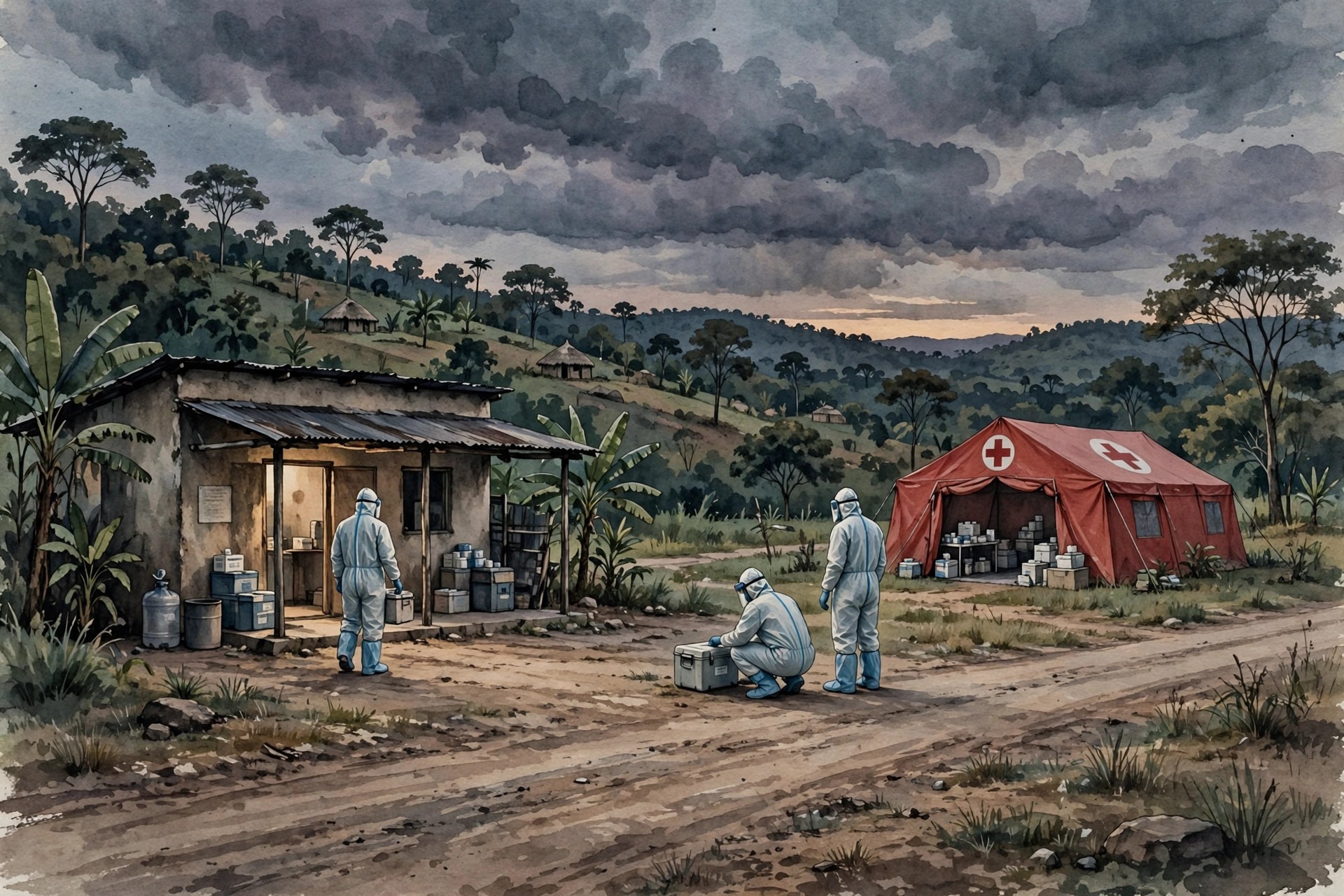
KINSHASA, Democratic Republic of the Congo — The Democratic Republic of the Congo’s Ebola outbreak has passed another grim threshold. The country’s health ministry has confirmed that the death toll has risen to 5,026, making this the deadliest Ebola outbreak ever recorded in Congo, and one of the deadliest in the history of the disease.
The milestone, announced in the health ministry’s latest situation report, comes about six months after the outbreak was declared. It confirms a fear that public health officials have voiced since the first cases appeared in the east of the country: that this epidemic, driven by a strain of the virus for which there is no approved vaccine, would be harder to stop than any Congo has faced before.
The numbers are stark. By October 30, the ministry had recorded 10,186 cases, including 8,980 confirmed and 1,206 suspected cases, and 5,026 deaths. That is a case fatality rate of about 49 percent. Put another way, roughly one in two people known to have been infected has died. The outbreak has now spread across eight provinces, with the east, and particularly Ituri province, hardest hit.
A milestone that changes how the outbreak is understood
To understand why the 5,000-death mark matters, it helps to place it in context. Congo has recorded 17 Ebola outbreaks since the virus was first identified there in 1976. The previous deadliest was the 2018 to 2020 outbreak in the east of the country, which killed 2,287 people over two years. This outbreak has more than doubled that toll in about six months.
The pace is what alarms epidemiologists. The outbreak was declared on May 19, after cases were confirmed in Ituri province. It took about 168 days to reach 5,000 deaths. By comparison, the West African epidemic of 2014 to 2016, which killed more than 11,300 people across Guinea, Liberia and Sierra Leone, took more than a year to reach a comparable toll. Congo’s outbreak is now approaching that scale at a much faster rate, and there is no sign yet that it has peaked.
The geography tells its own story. Ituri province, in the north-east, remains the epicentre, accounting for the largest share of cases and deaths. North Kivu, to the south, is the other main epicentre. Cases have also been reported in South Kivu, Tshopo, Haut-Uele, Maniema, Bas-Uele and Kinshasa province, which includes the capital. The spread to Kinshasa, a city of more than 17 million people, is particularly concerning for health officials, because dense urban transmission is far harder to control than outbreaks in remote villages.
The ministry’s latest figures also show that the outbreak is not slowing. In the week to October 30, 411 new cases were reported, including 363 confirmed and 48 suspected cases, along with 211 deaths. Those figures, if anything, understate the true toll, because many deaths in remote areas are never reported, and many cases are only discovered after the patient has died.
Why this outbreak is so hard to stop
Part of the difficulty lies in the response itself. The outbreak has stretched Congo’s health system to its limit. Health workers are treating patients in facilities that are often understaffed, under-resourced and, in some cases, unsafe. Contact tracing — the painstaking work of finding everyone who has been in contact with a patient and monitoring them for symptoms — is falling behind. In some areas, the proportion of new cases that were already known contacts has fallen below 50 percent, meaning that more than half of new infections are appearing in people who were not previously being monitored. That is a sign that transmission chains are not being broken.
Community trust is another challenge. In parts of Ituri and North Kivu, where armed groups operate and the state’s presence is thin, many people are suspicious of health workers and government officials. Some believe Ebola is a fabrication, or that health workers are spreading the disease. Others are simply afraid: afraid of the isolation units, afraid of being separated from family, afraid of the stigma that follows survivors. That fear keeps people away from treatment centres until it is too late, and it makes contact tracing harder, because families are reluctant to name contacts.
The response is also hampered by insecurity. Health teams cannot safely travel to some areas, and vaccination campaigns — where they exist — cannot be carried out in places controlled by armed groups. In the first 100 days of the outbreak, the Red Cross reported 11 violent incidents against health workers, including an ambulance set on fire. A politician who promoted Ebola containment measures was beaten to death last month, according to local reports.
Staffing problems have made it harder still. On Friday, workers at an Ebola treatment centre in Tchomia, in Ituri province, stopped work over four months of unpaid wages. The stoppage, at a facility on the front line of the response, illustrates a basic vulnerability: the people asked to take the greatest personal risk are also among those least reliably paid. When treatment centres close or slow down, even briefly, patients stay in their communities longer, and the virus gains the time it needs to find its next host.
A virus with no approved vaccine, in a conflict zone
Part of what makes this outbreak so hard to fight is the virus itself. The epidemic is driven by the Bundibugyo species of Ebola, for which there is currently no approved vaccine and no specific treatment. Clinical trials of vaccine candidates are under way, and testing and treatment continue, but for now doctors can only offer supportive care — fluids, treatment of symptoms and complications, and isolation to protect others. That is a very different position from the one responders faced in the 2018 to 2020 outbreak, where a vaccine for the Zaire species of the virus could be deployed in ring vaccination campaigns around confirmed cases.
The geography of the outbreak compounds the problem. The health ministry says the epicentre remains Ituri province in the north-east, a conflict zone where insecurity restricts the movement of health teams and makes it harder to reach communities. North Kivu is the other main epicentre. Both provinces have lived with armed violence for years, and that violence does not pause for an epidemic. Roads close, teams cannot travel safely, and residents who already distrust outsiders have further reason to be wary of strangers arriving in protective suits.
That distrust has turned violent more than once. Earlier in the week, a nurse was killed and another health worker seriously injured while responding to an Ebola alert, after local youths accused them of contaminating water sources and spreading the virus, according to the United Nations-backed Radio Okapi. A politician who promoted Ebola containment measures was beaten to death last month. The Red Cross has reported 11 violent incidents, including an ambulance set on fire, in the outbreak’s first 100 days. Each attack does damage beyond its immediate victims: it persuades other health workers to stay away, and it persuades frightened communities that the response itself is something to fear.
The World Health Organization’s Africa office has said that ending the outbreak requires a continued scale-up of key control measures, greater access to affected areas, and stronger community outreach. That prescription sounds straightforward, but each element depends on the others. Access requires security and trust. Outreach requires health workers who are present, paid and safe. Control measures require knowing where the virus is, which requires patients to come forward early — the very step that fear and violence discourage. Breaking that circle, rather than any single medical advance, is the central challenge of the months ahead.
What the toll means for the United States
The American angle to this story is immediate and practical. The Centers for Disease Control and Prevention has said that, after 11:59 p.m. Eastern time on November 3, passengers boarding international flights to the United States will have to attest that they have not been in the Democratic Republic of the Congo during the previous 21 days. The 21-day window matches the outer limit of Ebola’s incubation period, and the attestation requirement is designed to push screening back to the point of departure, before travellers board a flight. Airlines and passengers with recent travel through the region will need to understand the rule before they reach the airport, because it takes effect within days of the 5,000-death milestone being reported.
The regional picture gives the rule its context. Kenya’s health ministry had confirmed nine cases and two deaths by October 23, according to the Centers for Disease Control and Prevention, and Uganda recorded two deaths and 20 cases shortly after the outbreak began, although no new cases have surfaced there since August. Cases have also been confirmed in Nigeria. None of those figures suggests a large outbreak outside Congo, but each cross-border case is a reminder that an epidemic in one country is rarely contained by borders alone, particularly in a region where people, trade and family ties move constantly between neighbouring states.
For American readers, the comparison that puts the current outbreak in perspective is the 2014 to 2016 West African epidemic, which reached Italy, Britain and the United States and killed more than 11,300 people. That epidemic eventually ended through a combination of treatment centres, safe burial practices, community engagement and, eventually, vaccination. The Congo outbreak has no vaccine to deploy yet, which makes the older tools — finding cases early, isolating patients safely, tracing contacts and burying the dead without further transmission — more important, not less. The United Nations has warned that the current outbreak is taking lives at a much faster rate than Congo’s earlier epidemics, reaching 5,000 deaths in about 168 days since it was declared.
What comes next
The next few weeks will test whether the response can catch up with the virus. The immediate priorities named by health agencies are finding infections outside known contact chains, getting patients into care earlier, restoring services disrupted by conflict, and paying the health workers expected to contain the outbreak. Vaccine research may offer longer-term options, but officials are clear that it will not change the trajectory in the short term. What could change it is the unglamorous work of surveillance, contact tracing, clinical capacity and community engagement in hard-to-reach areas — the work the World Health Organization says must be scaled up now.
There is also a humanitarian backdrop that should not be lost in the case counts. The international food security monitor has reported separately that more than 28 million people in Congo are not getting enough to eat, a figure expected to rise. Hunger, displacement and conflict do not cause Ebola, but they shape how people respond to it: a family worried about its next meal is less able to travel to a distant treatment centre, and a community that feels abandoned by the state is less likely to trust state-backed health teams. Ending this outbreak will therefore depend not only on epidemiology, but on whether the response reaches people as help rather than as an imposition.
For now, the milestone stands as both a record and a warning. Congo has now endured its 17th recorded Ebola outbreak, and this one has killed more people than any before it in the country’s history. Whether it stops at 5,000 deaths or climbs toward the West African record will depend on decisions made in the coming weeks — in clinics in Ituri, in ministry offices in Kinshasa, in neighbouring capitals watching their own case counts, and in airports applying the new American travel rule. The virus will not wait for those decisions. The question is whether the response can finally move faster than it does.
Sources
USN reviewed reporting from multiple outlets for this story. Read more from Ghana News Agency, The Curtain and ChannelOne News.