

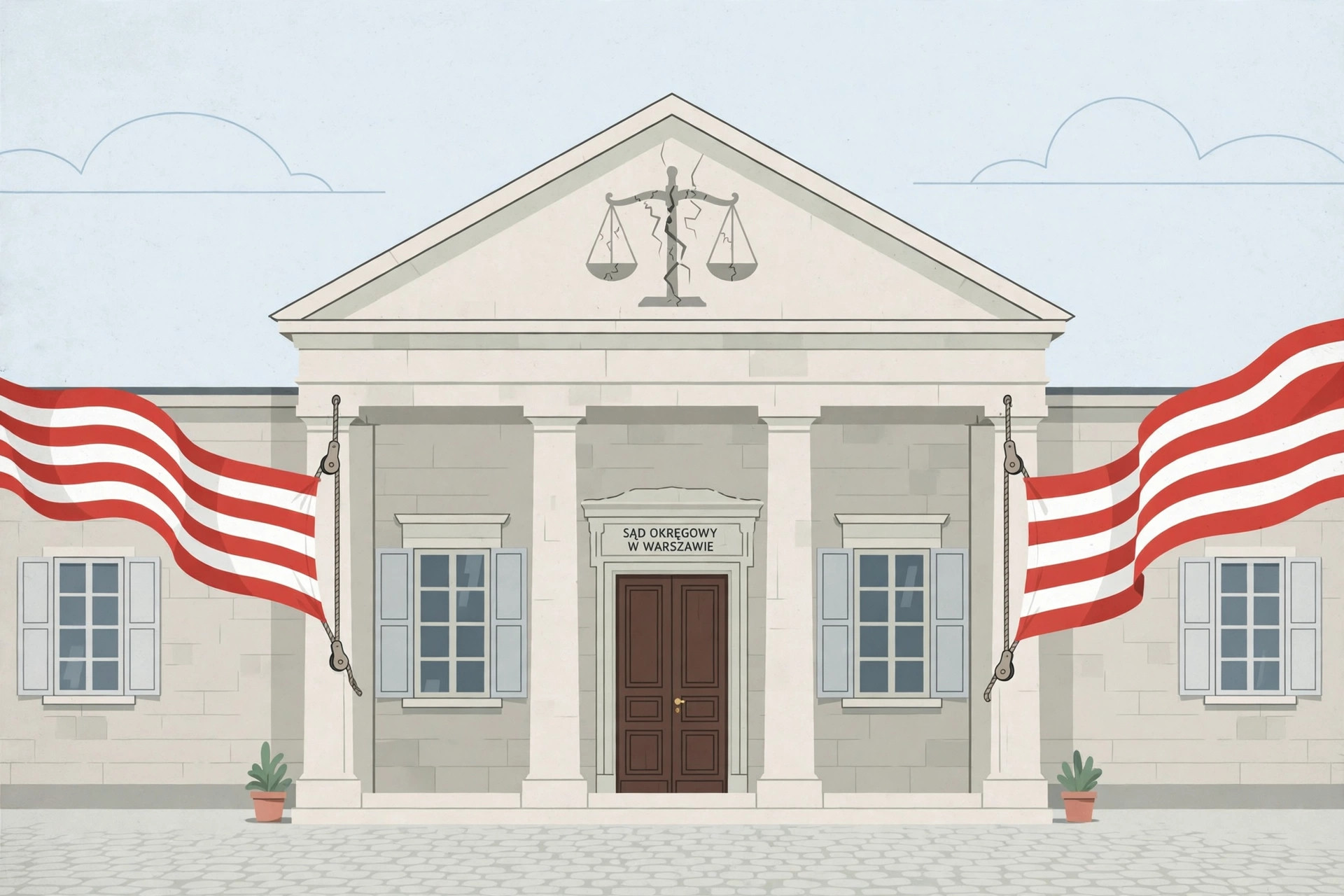
WARSAW, Poland — Poland’s dispute over its Constitutional Tribunal deepened on Saturday, November 1, as President Karol Nawrocki held crisis talks with political leaders at the presidential palace in Warsaw, while Prime Minister Donald Tusk defended his government’s overhaul of the court in a televised address. The talks, described by the president as urgent, followed the suspension on Friday of the Tribunal’s chief judge, Bogdan Swieczkowski, an action that prompted protests, a police deployment and sharply conflicting characterisations from the two sides. Representatives of nationalist, far-right and some governing-coalition parties attended the presidential palace meeting; Tusk’s Civic Coalition stayed away, a split that underlined how far apart the main political forces remain on the future of the court.
Nawrocki convened the consultations, in his words, due to the threat to Poland’s internal security presented by Friday’s suspension. The Tribunal itself said that its longest-serving judge, Anna Korwin-Piotrowska, had taken charge following the suspension. Late on Friday, Nawrocki turned back his plane, which had been heading to Senegal, and headed instead for court headquarters in central Warsaw. By Saturday afternoon, there had been no breakthrough in the talks, and the standoff continued into the evening with both leaders speaking publicly in terms that left little room for compromise.
The language used by each side illustrates why the dispute is so difficult to resolve. Nawrocki said: “Tonight, there was a breach of public order in the Republic of Poland and a forcible takeover of a constitutional body.” The court’s official account on X on Friday described the government’s move as a “coup d’état.” Those are characterisations of the president and of the court’s account, and they are disputed by the government. Tusk, in his Saturday evening speech, accused conservative nationalist opposition leaders of wanting to “destroy democracy and rule of law,” and said: “I am certain that the Constitutional Tribunal will function as it should — independently of me and in line with the constitution.” Neither side’s label — forcible takeover or coup on one side, restoration of the rule of law on the other — is a court finding. They are political characterisations in a contested dispute, and this article reports them as such.
Poland Constitutional Tribunal crisis: what happened on Friday night
Friday night brought the confrontation onto the streets as well as into the court building. Riot police were deployed as several hundred protesters gathered demanding Swieczkowski’s reinstatement. Protesters clashed with police on Friday night, according to reports, and police detained three protesters who entered the court premises. Several people were reportedly injured, according to local media reports. Those injury reports remain media reports, not a confirmed official casualty count, and the circumstances of each incident have not been established in a single authoritative account. What is clear is that a dispute about judicial appointments and court leadership spilled into a physical confrontation outside and inside a constitutional institution, a development that both sides have since cited in support of their competing narratives.
Tusk also criticised Nawrocki directly for his actions on Friday night, accusing the president of joining the protests and forcing his way into the court building. Nawrocki’s supporters, by contrast, present his return to Warsaw and his presence at the court as a defence of a constitutional body under threat. The factual core — that the president cut short a foreign trip, went to the court headquarters, and that protests and police clashed there — is not in dispute in the same way as the interpretation. Whether his presence constituted a lawful exercise of presidential authority, an improper intervention, or something else is part of the wider legal and political argument that remains unresolved.
At the heart of the immediate dispute is the suspension of Swieczkowski and the question of who lawfully leads the Tribunal. The government and its supporters argue that the court as presently constituted is not a genuine court, a view Tusk expressed in strong terms, saying there was “never any doubt that the court in the form imposed by PiS was not a genuine court.” PiS is the Law and Justice Party, which governed Poland before Tusk’s coalition took office. The president and the court’s defenders argue that the suspension and the attempt to install new leadership amount to an unlawful seizure of the institution. The legal validity of the suspension is contested and unresolved, and this article does not present Swieczkowski as having been lawfully or unlawfully removed as a decided fact.
Judges, oaths and a dispute that dates to 2015
The current crisis cannot be understood without the longer history of judicial appointments. Parliament, where Tusk’s coalition holds a majority, elected eight judges to the Tribunal this year, but Nawrocki accepted the oaths of only three of them. The oath is a formal step in taking up a judicial post, and the president’s refusal to accept five oaths has left those judges in limbo, unable to take their seats in the way the parliamentary majority intended. That gap between parliamentary election and presidential oath-taking is now a central procedural battleground, alongside the suspension of the chief judge.
The dispute dates to 2015, when the Law and Justice Party sought to appoint judges to positions already filled by the previous government. That episode triggered a prolonged confrontation over the Tribunal, drew criticism from the European Union, and led to accusations that the PiS government was undermining judicial independence. Successive governments and courts have since argued over which appointments were valid, which judges were lawfully seated, and how to restore a court whose legitimacy is accepted across the political spectrum. The 2015 origins matter because they explain why neither side now trusts the other’s proposed solution: each accuses the other of repeating, in a new form, the manipulation it condemned in the past.
European institutions have also weighed in, though their interventions have not settled the argument. The European Commission on Saturday urged Nawrocki to accept the nomination of new judges, according to AFP reporting. The European Court of Justice ruled in December 2025 that the Tribunal had violated principles of EU law, a judgment that the government and its supporters cite as support for reform, and that the court’s defenders read differently in the context of national constitutional authority. The Helsinki Foundation for Human Rights said on Saturday that the legal basis for the temporary suspension was “questionable,” and warned that it “would not contribute” to restoring the court. That assessment is attributed to the Foundation, not adopted here as a finding, and it illustrates the concern among rights organisations that emergency measures, even when presented as reforms, can deepen rather than resolve a legitimacy crisis.
What happens next in Warsaw — and why Europe is watching
The immediate future is uncertain. The crisis talks on Saturday produced no breakthrough by the afternoon, and the evening speeches from both leaders suggested that positions had hardened rather than softened. If the Tribunal remains split over who leads it, if five parliament-elected judges remain without accepted oaths, and if protests continue around the court building, Poland faces a period in which its constitutional court cannot function with undisputed authority. That would affect not only high-profile political disputes but also ordinary cases that depend on constitutional review, from legislation challenged by citizens to questions referred by lower courts.
For the European Union, the stakes extend beyond Poland’s borders. Judicial independence and the rule of law have been central to the EU’s disputes with Warsaw for a decade, and the current crisis will be watched in Brussels as a test of whether a government that came to power promising to restore the rule of law can do so in a way that is accepted as lawful by the courts, the presidency and the opposition. The Commission’s urging that Nawrocki accept new judges is one signal of that concern. At the same time, EU institutions have limited direct power over the internal organisation of a member state’s constitutional court, and any resolution will ultimately have to be found in Polish law and Polish politics, whether through negotiation, legislation, court rulings or a combination of all three.
Domestically, the political consequences may be as important as the legal ones. Tusk’s coalition holds a parliamentary majority, but it does not control the presidency, and Nawrocki’s ability to refuse oaths, to convene crisis talks and to rally protesters gives him leverage that a purely parliamentary majority cannot override. Nawrocki, in turn, faces a government that controls legislation and administration and that can argue, with the backing of a parliamentary majority and a European Court judgment, that reform is necessary. The standoff is therefore not a simple contest between two institutions, but a confrontation between two sources of democratic legitimacy — an elected government and an elected president — each claiming to defend the constitution against the other. How that confrontation is resolved will shape Poland’s politics well beyond the question of who sits on the Tribunal.
USN will update this story as the crisis talks continue and as the Tribunal, the government and the presidency clarify their positions.
Sources
USN reviewed reporting from multiple outlets for this story. Read more from Al Jazeera, The Jerusalem Post and Times Now.