

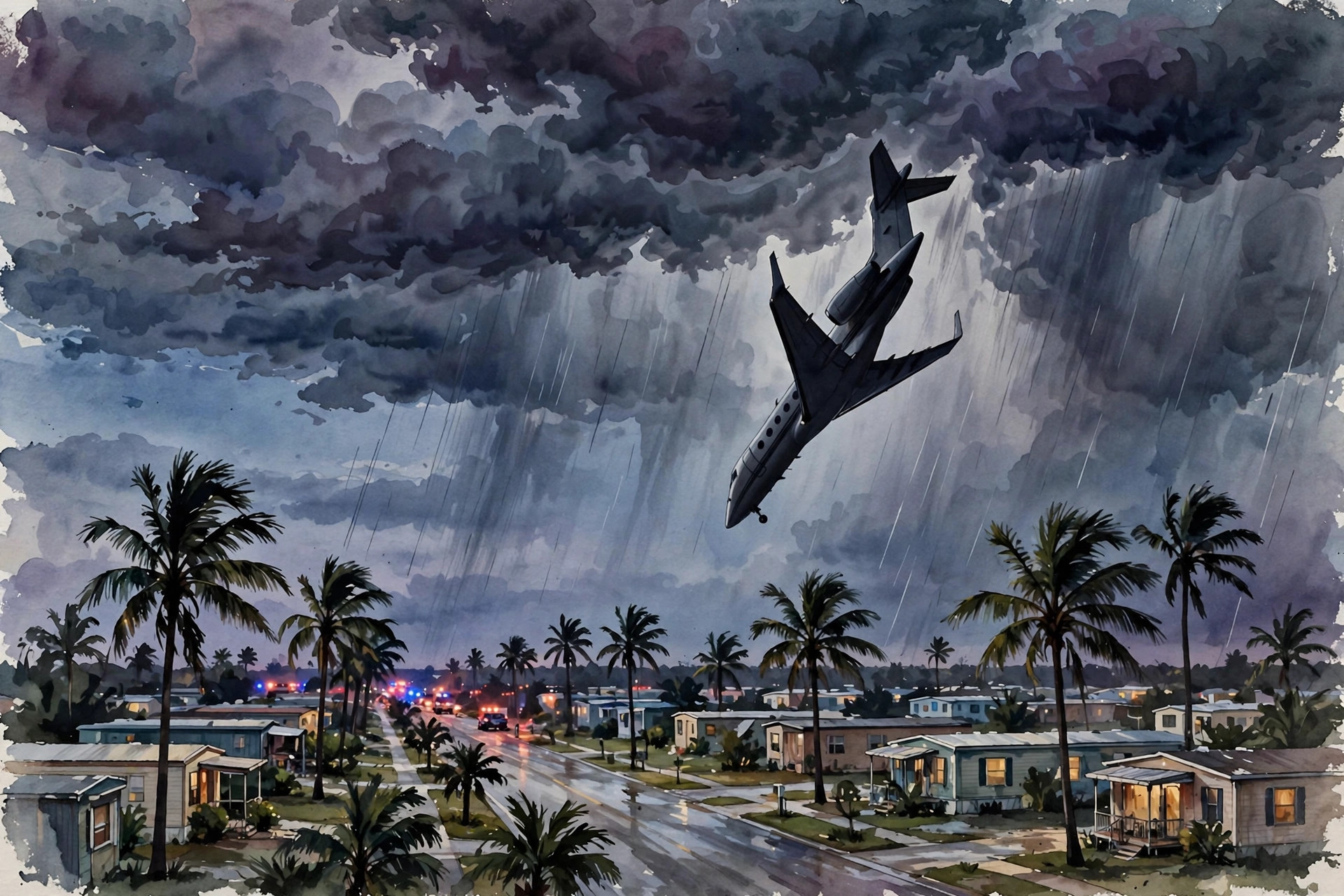
GREENACRES, Florida — All nine people aboard a business jet were killed on Sunday afternoon when the aircraft came down beside a busy road in Palm Beach County, close enough to homes that hundreds of nearby residents were moved out of the area while fire crews and federal investigators took over the scene. The jet, a Learjet 60 travelling from Austin, Texas, toward the Bahamas, crashed at about 12:50 p.m. Eastern time on November 1 near Military Trail and 10th Avenue North, in an unincorporated area near Greenacres and Palm Springs. United States Transportation Secretary Sean Duffy confirmed that everyone on board had died, describing the crash as a horrific tragedy. As of Sunday evening, officials said they had no reports of anyone on the ground being killed or injured, a fact that local leaders called remarkable given how close the wreckage fell to a residential community and a six-lane road lined with shops and restaurants.
The crash immediately became a local emergency as well as a federal investigation. Palm Beach County Fire Rescue and the Sheriff’s Office closed all lanes of Military Trail between Cresthaven Boulevard and 10th Avenue North, urged drivers to stay away and seek other routes, and began moving about 600 people out of a nearby mobile home community while debris, fire and damaged utilities were dealt with. Palm Beach County Commissioner Joel Flores, whose district includes the area, said the immediate priority was making sure displaced residents had shelter and food by nightfall, and he warned that nearby businesses would be shut for the near future while the scene was secured. The Village of Palm Springs, just next to the site, said its officials were monitoring water and sewer services for any disruption. For a community of roughly 45,000 people about seven miles southwest of West Palm Beach, the disaster arrived without warning on an otherwise ordinary Sunday, and its effects — a closed arterial road, an evacuation, and a cordoned-off crash site — were still being felt as investigators arrived.
What is known about the flight itself is now fairly clear, even though the cause remains unknown. The Federal Aviation Administration said the Learjet 60 had departed Austin-Bergstrom International Airport and was bound for North Eleuthera Airport in the Bahamas. Federal records cited in reporting identify the aircraft by the registration N722BD. The plane went down near the entrance to a mobile home community, leaving a crater in the ground, scattered debris over a wide area and a fire that sent thick smoke into the air. Video shared online appeared to show the jet plunging almost vertically before impact, and the Palm Beach Post noted that it was not publishing one circulating dashcam-style clip because it had not been confirmed as showing this aircraft. That caution matters: in the first hours after a crash, dramatic footage spreads faster than verification, and not every clip attached to a disaster online is what it claims to be.
How the Greenacres Florida Learjet crash unfolded beside Military Trail
The location shaped almost everything about the response. Military Trail is a major north-south route through Palm Beach County, and the stretch where the jet fell sits between Cresthaven Boulevard and 10th Avenue North, an area of homes, mobile homes and commercial buildings rather than open land. When a jet strikes ground in such a place, the dangers multiply: burning fuel, debris thrown across a wide area, damaged power lines and the risk of secondary fires in nearby structures. Fire crews therefore had to work on several problems at once — putting out fires, checking nearby homes, keeping onlookers and traffic clear, and preserving the wreckage for investigators. The decision to evacuate about 600 residents from the adjacent community was a precaution against those hazards, not a sign that homes themselves had been struck, and officials stressed that the evacuation was about safety while federal teams examined the site.
Governor Ron DeSantis visited the scene on Sunday evening and described the crash in stark terms, saying the jet had looked like a missile going down and had left a large crater beside the road. He said there was no evidence, as of that briefing, that anyone on the ground had been killed or injured by the impact or by debris. That assessment was repeated by other officials through the evening, but it carried an important qualification: it reflected the reports available at that time, and investigators and fire crews were still working through a debris field spread over a significant distance. In disasters of this kind, early casualty counts for people on the ground can change as more of the site is searched, which is why officials phrased their statements in terms of reports received so far rather than as a final conclusion.
The nine people aboard the jet had not been publicly identified in the reporting reviewed for this article as of Monday morning. That delay is normal after a fatal crash: families must be notified first, and identification can take time when a crash involves fire and extensive damage. Federal officials have also not released a passenger list, and local reporting has not named the victims. Readers should therefore treat any names circulating on social media as unverified unless they are confirmed by the authorities handling the case or by the families themselves. The absence of names does not lessen the scale of the loss — nine families are grieving — but it does mean that the human story behind the flight, who was travelling and why, is not yet part of the public record.
Storms, ice reports and the final moments before the Palm Beach County crash
Weather was a prominent feature of Sunday in South Florida, and it is certain to be part of the investigation, though no official has yet said it caused the crash. Thunderstorms were widespread across the region on Sunday afternoon, driven by a stalled frontal boundary that pushed towering storm clouds tens of thousands of feet into the air. The National Weather Service had a flood watch in effect for excessive rainfall through Monday afternoon, and heavy rain was falling as officials briefed reporters on Sunday evening. A veteran South Florida business-jet pilot quoted in local reporting explained that pilots normally avoid thunderstorms by going around them or climbing above them, but that the same conditions can bring icing and severe turbulence — two hazards that investigators will want to examine closely.
Air-traffic recordings described in reporting add a further layer, and they must be handled with the same care. According to accounts of the recordings, the crew reported moderate turbulence, ice accumulation and precipitation while cruising at about 35,000 feet, then declared an emergency as the aircraft began descending rapidly. The reported rate of descent rose sharply during the final calls, and the pilot was heard warning that the aircraft was about to strike the ground. Those transmissions, if accurately described, show a crew in distress in difficult weather, but they do not by themselves explain why the aircraft lost control. A recording can show what a crew reported; it cannot show whether ice, turbulence, a mechanical failure, or some combination of factors was responsible. Only the flight recorders, the wreckage and the weather data together can begin to answer that question, and the National Transportation Safety Board has not yet announced any finding.
Social media speculation also needs to be addressed plainly, because it spread quickly on Sunday. Some online posts raised the possibility that the jet could have been shot down, noting that flight restrictions were in place while President Donald Trump was in the Palm Beach area over the weekend and that military air-defence systems have recently been positioned around his Mar-a-Lago home. The Palm Beach Post reported that, as of Sunday night, there was no indication the Learjet had been shot down, and it noted that aircraft straying into restricted airspace around the president are normally diverted by military jets, not brought down. The crash site is roughly nine miles from Mar-a-Lago, and Trump had departed the area for Iowa around noon on Sunday. None of that proves anything about the cause, but it does mean the shoot-down theory currently rests on online conjecture rather than on any statement from investigators, and it should be reported as conjecture, not as a competing explanation with equal weight.
What the NTSB investigation into the Florida Learjet crash will examine
The National Transportation Safety Board is leading the investigation, with support from the Federal Aviation Administration, and it said it was sending a go-team to arrive on Sunday night and Monday morning. That team will secure the wreckage, document the debris field, recover the flight data and cockpit voice recorders if they survived the fire, and gather radar, weather and air-traffic records. Investigators will also look at the aircraft’s maintenance history, the crew’s qualifications and recent flying, and the condition of the jet’s de-icing and other systems. Because the crash involved a steep, high-speed descent, the recorders — if readable — could be especially important, since they would show the aircraft’s speed, altitude, control inputs and engine performance second by second in its final minutes.
Such investigations rarely produce quick answers, and the public should expect a preliminary report that states facts without assigning a cause, followed months later by a fuller analysis. The preliminary report typically confirms the flight’s route, the weather, the wreckage pattern and any recorder data recovered, while the final report weighs competing explanations and issues safety recommendations if warranted. In this case, the weather angle alone will require detailed work: investigators will need to reconstruct the exact storm cells near the flight path, the temperatures at altitude, and whether icing conditions matched what the crew reported. They will also need to determine whether the aircraft’s systems were functioning normally until the descent began, or whether something failed first and the weather only compounded the problem.
For Palm Beach County, the investigation will run alongside a longer local recovery. A closed section of Military Trail disrupts commutes, deliveries and access to businesses, and the sheriff’s office has not given a firm reopening date in the reporting reviewed, saying only that drivers should avoid the area until further notice. Residents who were evacuated will want to know when they can return permanently, whether their homes suffered any damage from debris or fire, and what help is available if they cannot stay in place. County officials have pointed to shelter and food as the first needs, but questions about longer-term assistance, insurance claims and road repairs will follow once the investigative cordon lifts. The crash is therefore not only a national aviation story; for the people who live beside Military Trail, it is a neighbourhood disruption that will last well beyond the news cycle.
What comes next for Greenacres residents after the crash
In the days ahead, the most reliable updates will come from the NTSB, the FAA and Palm Beach County authorities, in that order. The NTSB controls the investigation and will provide official updates, while the sheriff’s office controls road closures and access to the area. Families of the victims will be notified through official channels before names are released, and any memorial or funeral information will come from them. Local residents should be wary of unofficial lists, unverified video and claims about the cause that appear before the investigators have spoken, because early speculation after fatal crashes is frequently wrong in its details even when it feels convincing in the moment.
The broader context is also worth keeping in view. Business-jet travel between the United States and the Bahamas is routine, and the Learjet 60 is a long-established aircraft type, but every fatal crash reopens questions about how small jets handle severe weather, icing and high-altitude turbulence. If the investigation finds a mechanical or procedural lesson, it could lead to recommendations affecting operators far beyond Palm Beach County. If it finds that weather was the dominant factor, it will add to the long record of storms contributing to aviation accidents in Florida, a state where warm, humid air and towering thunderstorms are a daily feature of summer and autumn flying. Either way, the answers will come from evidence, not from the first hours of footage and comment, and the nine deaths on Sunday deserve an account built on that evidence rather than on haste.
For now, the confirmed picture is this: a Bahamas-bound jet left Austin on Sunday morning, came down beside Military Trail near Greenacres in the early afternoon, killed all nine people aboard, forced about 600 neighbours from their homes as a precaution, and left a crater, a debris field and a closed road for investigators to work through. No one on the ground was reported killed or injured as of Sunday evening, the cause is unknown, and federal investigators have only just begun their work. Those facts, stated plainly and updated as officials confirm more, are the foundation on which the rest of this story will be built.
Sources
USN reviewed reporting from multiple outlets for this story. Read more from Palm Beach Post, New York Post and NDTV.