

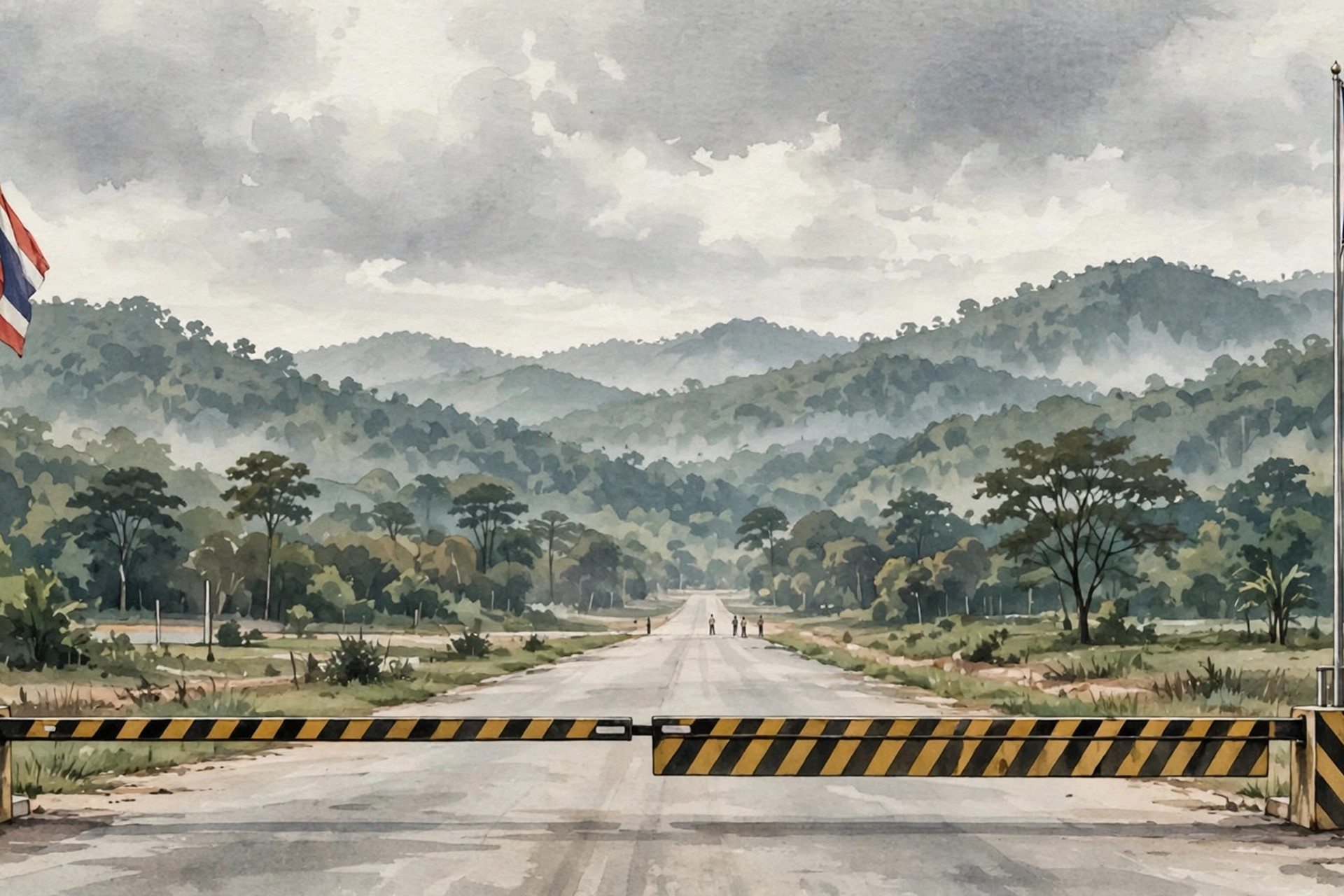
BANGKOK — Thailand will keep its land border crossings with Cambodia closed, with no date set for reopening them, Prime Minister Anutin Charnvirakul said on Saturday, November 1, 2026, dashing any near-term hope that trade and travel across the frontier would soon return to normal. Speaking on his weekly programme, Talk with PM Anutin, Anutin said he could not say when the checkpoints would reopen and gave no sign that relations between the two neighbours were about to return to their previous level. The message, delivered in plain terms, was that Bangkok intends to hold its position until a set of long-standing concerns is dealt with, even as Cambodia insists that disputes should be settled peacefully and through established channels.
The announcement matters far beyond the checkpoint gates themselves. Thailand and Cambodia share a frontier of more than 800 kilometres, and border communities on both sides have long depended on cross-border trade, farm work, markets and family visits. When crossings close, the costs fall first on those ordinary people: traders who cannot move goods, workers who cannot reach jobs, and families separated by a line on a map. Governments, by contrast, tend to frame closures in the language of national interest and security. Anutin’s remarks on Saturday showed that gap clearly. He presented the closure as a protective measure that enjoys public support at home, while Phnom Penh presented the same closure as a problem to be solved through dialogue, law and existing bilateral mechanisms.
Anutin, who also serves as interior minister, listed several reasons for keeping the crossings shut. They included unresolved land and sea boundary questions, the safety of Thai citizens, illegal imports, worries about farm trade, and criminal networks operating across the border. He placed particular emphasis on scam operations run across national borders, an issue that has grown in prominence across Southeast Asia in recent years as fraud compounds have drawn workers from many countries and caused losses far beyond the region. He also argued that economic indicators in Thailand had improved since the closure and that public opinion remained supportive of keeping the restrictions in place. In his telling, reopening the crossings under political or economic pressure, before Thailand’s concerns were met, would put the country’s interests second.
Why Thailand says the Thailand Cambodia border checkpoints will stay shut
The prime minister’s central claim was that the decision rests with Thailand and that no timetable can be given until its conditions are met. That framing is important because it pushes back against any expectation that a single meeting, a goodwill gesture or outside pressure will produce a quick reopening. Anutin said dialogue with Cambodia remained possible, but he drew a sharp line between talking and restoring relations to their earlier state. Several further steps, he said, would have to be completed first, above all rebuilding confidence and trust between the two sides. He also said the government would not let political considerations outweigh what it sees as Thailand’s interests, a remark aimed as much at a domestic audience as at Phnom Penh.
For traders and border residents, however, the absence of a timetable is itself the news. A closure without an end date leaves businesses unable to plan, and it leaves workers in limbo. Thai officials have pointed to improved economic indicators since the crossings were shut, but those national figures say little about the experience of a market trader in a border province whose customers have vanished, or a Cambodian worker whose livelihood depended on daily crossings. The reporting reviewed for this article does not provide a detailed breakdown of how border provinces on either side have fared, and that gap is worth noting. National economic claims and local hardship can both be true at the same time, and a full picture would require province-level trade, employment and household data that has not been published alongside the prime minister’s remarks.
The scam issue deserves separate attention because it has become a regional concern that crosses many borders, not only this one. Governments across Southeast Asia have faced pressure to act against fraud centres that lure jobseekers with false promises and then force them to run online scams. Thailand has repeatedly linked border security to that fight, arguing that open crossings can be exploited by criminal networks. Cambodia, for its part, has also faced international scrutiny over scam operations on its territory, and it has announced crackdowns of its own. The difficulty is that both governments can point to the other’s obligations while the networks themselves adapt, moving people and money through whichever routes remain open. A border closure may disrupt some movement, but it does not by itself dismantle the networks, and experts often warn that closures push activity elsewhere rather than ending it.
Boundary questions form the other, older layer of the dispute. Thailand and Cambodia have disagreed for decades over stretches of their land frontier, including areas around ancient temple sites, and over maritime areas that may hold valuable resources. These are not disagreements that a single statement can settle. They involve maps, historical claims, court rulings and domestic politics on both sides, and any concession can be presented at home as a loss of territory. That is why Cambodian officials have been so careful to say they will not trade territory for peace, and why Thai officials have been equally careful to say they will not reopen crossings simply to restore a previous level of relations. Both positions are, in part, aimed at their own publics.
What Cambodia is saying about the closed Thailand Cambodia border
Cambodia’s response over the weekend was measured but firm. Officials in Phnom Penh repeated that disputes should be handled through bilateral mechanisms and international law, and rejected any compromise over sovereignty. Information Minister Neth Pheaktra said Cambodia would not exchange territory for peace and would keep protesting what it sees as violations of its territorial integrity. He also said Cambodia remained committed to resolving border questions through diplomacy, international law and established mechanisms, and he pointed to four approaches the government says it uses to defend national interests: military, diplomatic, legal and information measures. The inclusion of military measures alongside diplomacy is a reminder that Phnom Penh is not presenting itself as passive, even while it stresses peaceful settlement.
Government spokesman Pen Bona marked the first anniversary of the Cambodia-Thailand Joint Declaration signed in Kuala Lumpur on October 26, 2025, and said Prime Minister Hun Manet had restated respect for the spirit of that declaration and a commitment to settling border demarcation peacefully, without threats or the use of force. He also recognised the roles of the Regional Border Committee, the General Border Committee and the Joint Boundary Commission in dealing with border matters. Those bodies matter because they are the practical machinery of the relationship: committees where officers and officials from both sides meet, exchange information and try to prevent local incidents from escalating into national crises. Their continued existence, even while crossings stay shut, suggests that communication has not broken down entirely.
That point was reinforced by a meeting on October 28, when Cambodian and Thai military officials held an informal session in Oddar Meanchey to discuss putting the December 27, 2025 joint statement into practice, along with operational coordination and rebuilding mutual trust. Informal meetings of this kind rarely produce headlines, but they can be significant. They allow both sides to test language, clarify intentions and manage day-to-day friction without committing to a formal agreement. The fact that such a meeting took place days before Anutin’s public statement also shows that the public message and the working-level contact are moving on different tracks: one firm and political, the other quiet and practical. Whether the second track can eventually produce the trust that Anutin says is missing remains an open question.
A long dispute behind the closed crossings
To understand why a reopening is so difficult, it helps to step back from the latest statement. The Thai-Cambodian frontier has been a source of tension for generations, shaped by colonial-era maps, competing historical narratives and periodic outbreaks of fighting, most recently in the clashes that preceded the ceasefire arrangements of late 2025. Temples and the land around them carry symbolic weight far beyond their size, and maritime boundaries add an economic dimension, since control of sea areas can affect fishing, energy exploration and shipping. When fighting flared, civilians were displaced, soldiers were killed and detained, and regional neighbours, including Malaysia as a mediator and the Association of Southeast Asian Nations more broadly, pressed both sides to step back.
The agreements reached since then, including the October 2025 declaration and the December 2025 joint statement, were designed to stop the fighting and create a framework for further talks, not to settle every boundary question at once. That distinction is often lost in public debate. A ceasefire or a joint statement can halt shooting and set up committees, but it cannot by itself draw a final border line that both publics will accept. Demarcation work is slow, technical and politically sensitive, and it proceeds, when it proceeds at all, through joint surveys and legal processes that take years. In that light, Anutin’s insistence that several steps must come before a return to previous relations is less a new obstacle than a restatement of how Bangkok has approached the issue since the crossings were shut in June 2025.
There is also a regional dimension. Southeast Asian governments have a strong interest in preventing a bilateral dispute from destabilising the wider region, particularly at a time when great-power competition, trade disruption and transnational crime already strain cooperation. ASEAN’s tradition of quiet diplomacy and non-interference means outside pressure is usually applied privately rather than through public ultimatums, and Malaysia’s role in hosting talks reflects that approach. For ordinary readers, the practical consequence is that progress, when it comes, may first appear not as a dramatic announcement but as a small, technical step: a committee meeting, a joint survey, a limited reopening for certain goods, or a statement that a particular incident has been resolved locally.
What to watch next on the Thailand Cambodia border
Several markers will show whether the current stalemate is softening or hardening. The first is the language used by both governments in the coming weeks: whether Bangkok repeats its no-timetable position or begins to name conditions in a form that Phnom Penh could plausibly meet, and whether Phnom Penh continues to stress peaceful settlement without hardening its own public stance. The second is the work of the border committees and any further informal military meetings, which may signal whether working-level trust is being rebuilt even while the political message stays firm. The third is the maritime track: Cambodia and Thailand are engaged in conciliation over their sea boundary, with a further meeting of the conciliation commission scheduled in Kuala Lumpur from November 24 to 27, according to Cambodia’s foreign ministry. Progress or failure there could affect the mood on the land border as well, even though the two tracks are formally separate.
For people living along the frontier, the most meaningful change would be a limited, practical one: the reopening of even a small number of crossings for traders, workers or humanitarian movement, under agreed rules. Nothing in Anutin’s Saturday remarks points to such a step in the near term, and his emphasis on national interests and public support suggests he sees little domestic cost in holding the line. Cambodia, meanwhile, has said reopening is Thailand’s responsibility, since it says Thailand closed the crossings by its own decision. That exchange of responsibility, each side pointing to the other, is familiar in long border disputes, and it is precisely why mediators and joint committees exist: to break a standoff in which neither side wants to be seen as moving first.
Until that changes, the border will remain a line that is closed on paper and in practice, even as officials on both sides say they remain open to dialogue. The distinction between dialogue and reopening is the heart of this story. Talks can continue, committees can meet, and statements can reaffirm peaceful intentions, all while the gates stay shut. For the families and traders waiting on either side, the test of any future announcement will not be its tone but its effect: whether a gate actually opens, for whom, and under what conditions. On the evidence of November 1, that test has not yet been met, and no date has been offered for when it will be.
Sources
USN reviewed reporting from multiple outlets for this story. Read more from Bangkok Post, Khmer Times and Thaiger.