

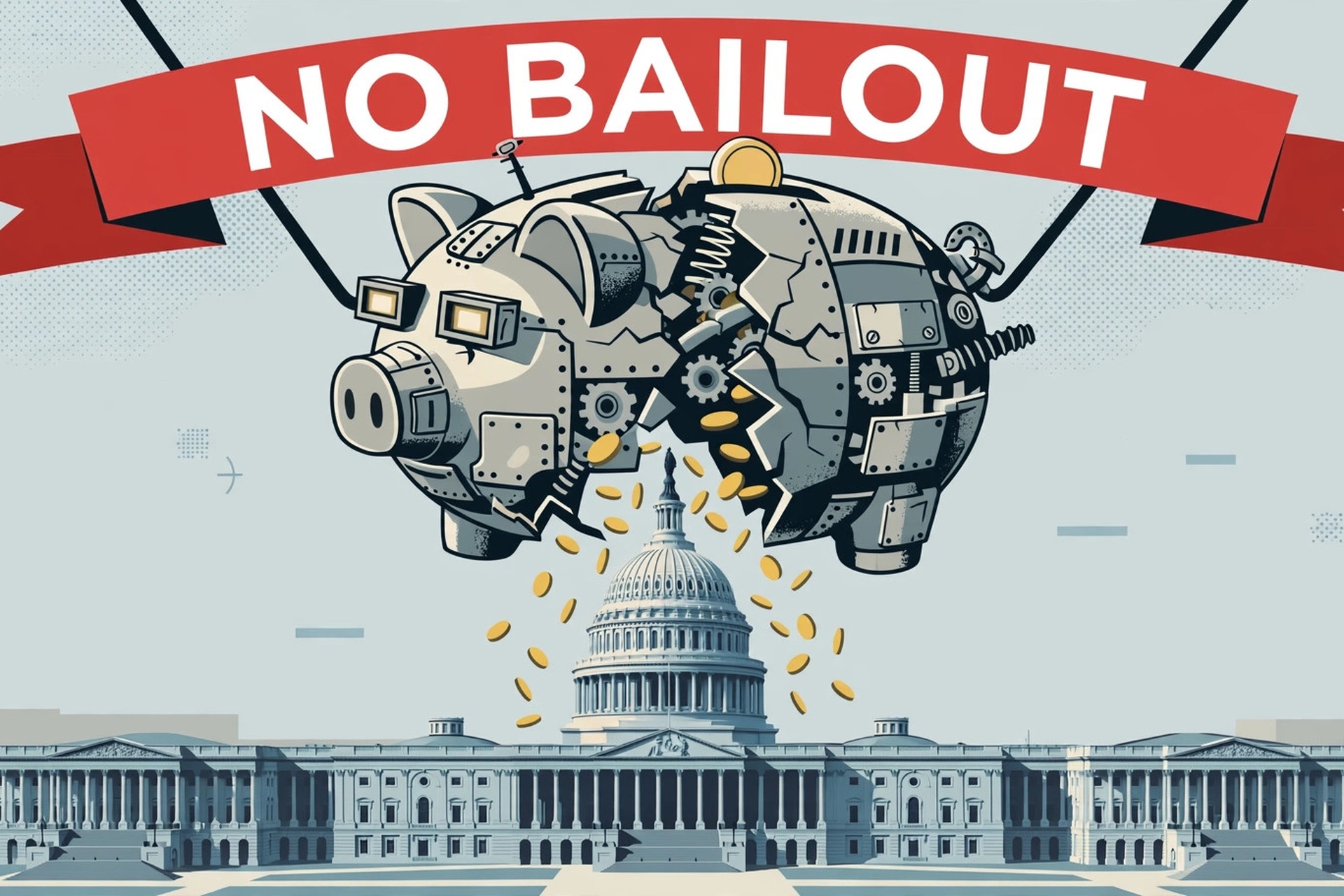
House Democrats have introduced a resolution that would put the House on record against any taxpayer rescue of failed artificial intelligence companies, arguing that firms which bet badly on the AI boom should face ordinary bankruptcy rather than a government bailout, and that any federal help in a future downturn should go to workers and retirees rather than to companies or their executives. The measure, led by Representative Greg Casar of Texas, who chairs the Congressional Progressive Caucus, and Representative Maxine Waters of California, the top Democrat on the House Financial Services Committee, was introduced in late October 2026, with sources differing by a day between 28 and 29 October, and publicised on 29 October. It is a deliberately early move: no AI company had actually asked for a bailout when it was introduced, and its supporters present it as a line drawn in advance, before any crisis creates the political pressure that has historically produced rescues. Whether that line holds if a real failure arrives is a separate question, and one the resolution itself cannot answer, because of the limits built into its form.
The resolution is described as a simple House resolution, and more specifically as a sense-of-the-House measure. That description matters more than its rhetoric. A sense-of-the-House resolution expresses the opinion of one chamber. It does not create law, it does not require approval from the Senate, it does not go to the president for signature, and it cannot by itself block a future bailout, prohibit a payment, or bind a future Congress. If a future administration proposed a rescue package, or a future Congress considered one, this resolution would not stand in its legal way. Its power, if it has any, is political: it creates a public record, it forces members to take a position, and it gives opponents of a future bailout a text to point to. Supporters understand that limit and argue that a record created before a crisis is worth more than a debate held during one, when jobs, pensions and market panic are already in play. Critics, by contrast, could fairly note that a non-binding statement is the weakest form of congressional action, and that its sponsors have chosen a vehicle that signals intent without imposing obligation.
The leadership and sponsorship of the measure tell a story about where it sits in House politics. Casar, as chair of the Progressive Caucus, gives the resolution an institutional home on the party’s left, while Waters, as the senior Democrat on Financial Services, gives it a direct link to the committee that would handle much of any future financial rescue legislation. Reports describe eleven other House Democrats as cosponsors, bringing the total to thirteen including the two leads, although counts in different reports vary slightly in how they present the total. Names cited among the cosponsors include Representatives Pramila Jayapal, Rashida Tlaib, Jan Schakowsky and Delia Ramirez. No Republican cosponsor appears in the sources reporting the introduction. That partisan shape is itself informative. The resolution is, at this stage, a Democratic statement, not a bipartisan consensus, and its prospects for a floor vote depend heavily on who controls the House in the next Congress, a point Casar himself is reported to have acknowledged by saying he wants a vote early in the next Congress if Democrats take the House.
What the no AI bailout resolution would actually say
At its core, the resolution says Congress should oppose any measure that rescues insolvent AI-related companies or shields executives from liability for reckless conduct. That is a broad formulation, and its breadth is part of its purpose. It is not limited to one company, one kind of rescue or one financial instrument. It covers the familiar forms a bailout can take: direct payments, guarantees, subsidised loans, equity injections and other forms of public support that keep an insolvent firm alive when the market would otherwise wind it down. It also covers a subtler form of rescue: legal protection for executives whose decisions contributed to the failure. The argument here is that a bailout is not only a transfer of money, but also a transfer of accountability, and that a rescue which leaves decision-makers untouched while the public bears the cost has failed on both counts.
In place of a rescue, the resolution points to ordinary bankruptcy. Failed firms, in its framing, should wind down or reorganise through the bankruptcy process, the same route available to failed companies in other industries. Bankruptcy is not presented as painless. It involves losses for shareholders, disruption for customers and suppliers, and often job losses. The resolution’s claim is comparative: bankruptcy allocates those losses according to established rules, with creditors, workers and other claimants treated under a legal framework, whereas a bailout allocates losses politically, with the public asked to absorb costs that private investors chose to risk. That comparison will be contested by anyone who argues that some firms are too interconnected to fail in an orderly way, or that bankruptcy in a fast-moving technology sector would cause wider damage. The resolution does not resolve that contest. It takes a side in it, in advance.
The resolution also addresses who should come first if a failure does happen. It gives priority, in its language, to pension and retirement savers, and it says that federal help, if any is provided, should go to workers and retirees and to automatic stabilisers, rather than to firms or to so-called golden parachutes for departing executives. Automatic stabilisers, in this context, mean the programmes that expand automatically when the economy weakens: unemployment benefits, nutrition assistance, housing support and similar measures that reach households directly without a separate vote for each firm in trouble. The contrast is deliberate. A bailout, in this framing, helps a company in the hope that help trickles down to its workers. Direct support for workers, retirees and stabilisers helps households whether or not the company survives. Supporters argue that this is both fairer and more effective. Opponents of the approach, if they engage with it, might argue that it understates the value of preserving a functioning company, its jobs and its technology, and that letting a major firm collapse could harm the very workers the resolution seeks to protect. That debate is real, and the resolution does not settle it, but it does clarify the terms on which its sponsors want it held.
The context: an AI boom, a bubble debate, and a backtracked backstop
The resolution arrives in the middle of a wider argument about whether the AI boom resembles a bubble, and what a burst would cost. Investment in AI infrastructure, including data centres, chips and energy, has reached extraordinary levels, and analysts disagree sharply about whether that spending will generate matching returns. The figures cited in reporting on the resolution illustrate the scale of the argument, and they should be attributed, not adopted as USN findings. One estimate attributed to S&P puts total AI investment between 2025 and 2030 at seven trillion dollars. A projection attributed to Goldman Sachs puts technology sector debt in 2027 at four hundred and twenty billion dollars. Those are very large numbers, and they explain why even a small probability of a major failure worries policymakers. They do not, on their own, prove that a bubble exists, that a crash is imminent, or that any particular company is insolvent. They show why the question of who pays if the boom turns is being asked now, rather than after the fact.
The closest episode to an actual bailout request, and the one most often cited in reporting on the resolution, involved OpenAI. In November 2025, OpenAI’s chief financial officer, Sarah Friar, floated the idea of a federal backstop or guarantee for AI infrastructure financing, a proposal that was widely read as opening the door to public support for private AI investment. She subsequently walked the idea back. OpenAI’s chief executive, Sam Altman, has said that taxpayers should not bail out companies for bad decisions. David Sacks, the White House AI czar, has said there would be no federal AI bailout. Taken together, those statements suggest that, at the level of public rhetoric, there is currently no major figure actively demanding a rescue. The resolution’s supporters would argue that this is precisely the moment to lock in the principle, while no one is asking for an exception. A sceptic might argue the opposite: that a resolution against a bailout no one is requesting is a solution in search of a problem, and that its real purpose is political signalling to voters worried about corporate power.
Both readings can be true at once. A measure can be both a genuine statement of principle and a piece of political positioning. The resolution allows its sponsors to associate themselves, in public, with workers and retirees rather than with technology executives, at a moment when public attitudes toward large technology companies are sceptical. It also allows them to draw a contrast with the financial crisis rescues of 2008, when banks received public support while many households lost homes and jobs, a comparison that remains potent in American politics even though the AI sector is different in structure, regulation and systemic importance. Whether voters reward that positioning, and whether it influences a future Congress facing a real failure, will depend on events that have not yet happened. For now, the resolution’s most concrete effect is to make the question explicit: if an AI company fails, who pays?
Endorsers, limits, and what happens next
Reporting on the introduction cites endorsements from organisations outside Congress, including the American Federation of Teachers, Indivisible and the Future of Life Institute, although lists of endorsers vary between reports and should be read as endorsers cited in those reports rather than as an exhaustive or official roster. The presence of a teachers’ union on such a list is notable, because it connects the AI bailout question to pensions and retirement savings, a theme the resolution itself emphasises. Teachers’ pension funds, like other large retirement funds, hold investments across the economy, and a major corporate failure can affect them indirectly as well as directly. Indivisible, a grassroots organising network, connects the resolution to a broader campaign against corporate influence. The Future of Life Institute connects it to longer-term concerns about AI governance. The coalition, as reported, is therefore not only a technology policy coalition, but a coalition of labour, grassroots and AI-safety voices, each with a different reason to oppose a corporate rescue.
What the resolution does not do is equally important to state, because misreporting on this point would mislead readers in the opposite direction from the fabrication debunked elsewhere in this batch. The resolution does not ban bailouts. It does not amend any law. It does not impose conditions on any company. It does not require any agency to act, and it does not create a fund for workers or retirees. It does not attribute any position to Republican leadership, and it does not attribute any request or response to AI companies beyond the specific public statements already noted. Readers who encounter summaries claiming that Congress has banned AI bailouts, or that a law now prevents rescues, should treat those summaries as incorrect. Congress has, at this stage, seen a proposal for a statement of opinion, introduced by members of one party, awaiting committee consideration and a possible future vote under a future House majority.
The next steps, if the resolution follows a normal path, are unglamorous. It would be referred to committee, where it could be considered, amended, ignored or discharged. It could receive a floor vote in the current Congress, although its sponsors’ own reported comments suggest they are looking to the next Congress, and to a possible Democratic majority, for that vote. If it passes the House as a simple resolution, its legal effect would still be nil, but its political effect would be a formal House position, citable in future debates. If a real AI failure occurs before then, the debate will not wait for the resolution. It will be held under pressure, with arguments about jobs, pensions, national competitiveness and financial stability all competing at once. The resolution’s sponsors are betting that having a pre-existing position will make that debate harder to resolve in favour of a rescue. That bet may or may not pay off, but the act of placing it, in public, before any crisis, is itself a political fact worth reporting accurately, without exaggerating what a non-binding resolution can do.
USN has previously reported on congressional efforts to change how large corporate settlements and mergers are handled, including the Antitrust Accountability and Transparency Act, and on the White House’s approach to AI oversight, including why the pre-release AI testing rules stay hidden. Both provide context for how Congress and the executive branch are approaching technology power in parallel tracks.
Sources
USN reviewed reporting from multiple outlets for this story. Read more from Congressional Progressive Caucus, FactoNews and US News Pulse.