

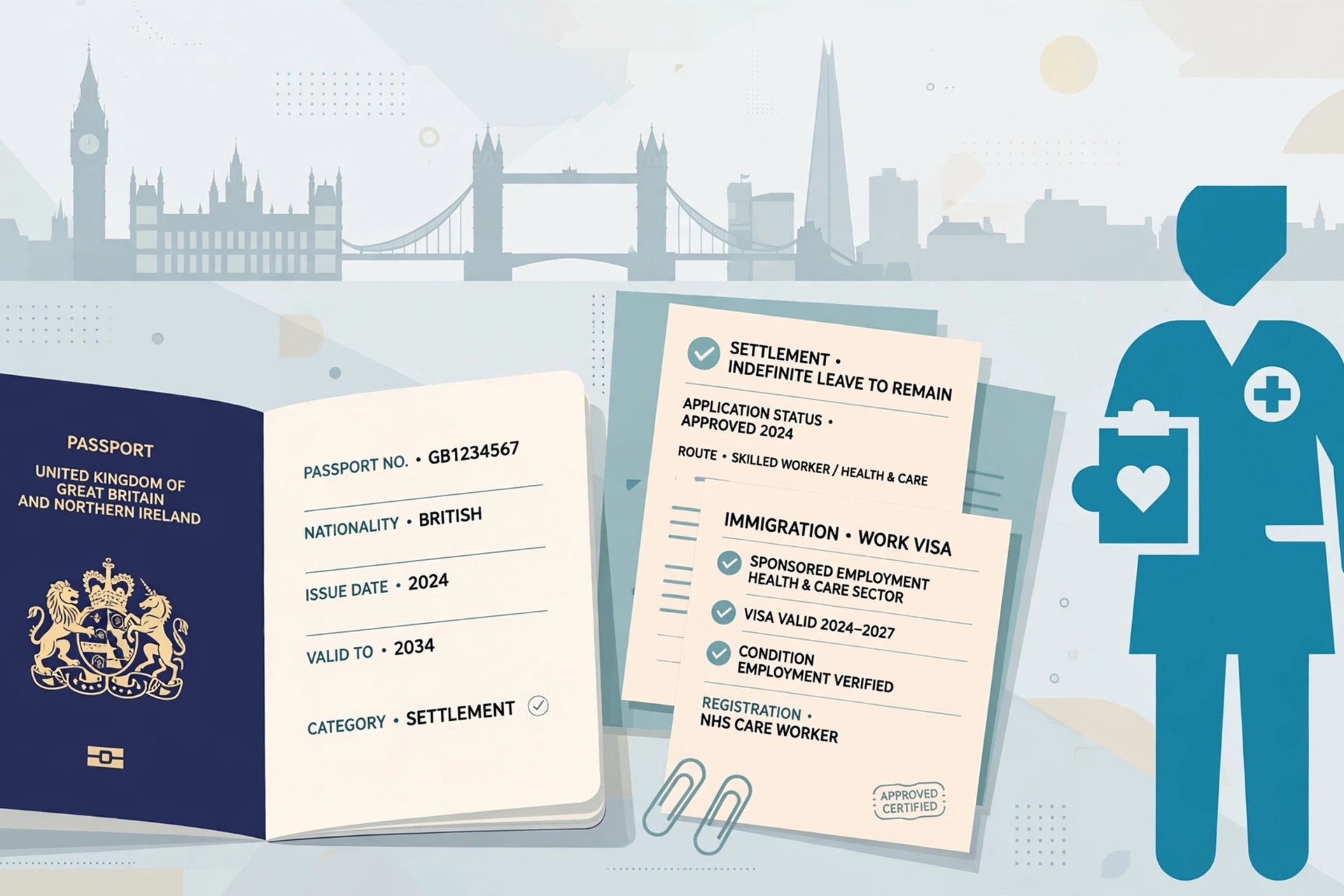
LONDON — Home Secretary Shabana Mahmood delivered the government’s final settlement reforms to the House of Commons on Monday afternoon, 2 November 2026, ending almost a year of argument over how long migrants must wait for permanent residence in Britain. The statement, accompanied by the government’s formal response to its consultation, replaced the November 2025 proposals with a revised “earned settlement” system in which the time a person waits depends on what they have contributed, rather than on residence alone. Its headline outcome was a split decision: most migrants now face a standard wait of 10 years instead of five, while qualifying care workers already in Britain keep the five-year route that the original plan would have taken away.
Indefinite leave to remain, known as ILR, is the status that allows a person to live, work and study in the United Kingdom without a time limit, and to access certain benefits when eligible. It has long been available to most work-visa holders after five years. Mahmood told MPs that automatic settlement after five years was over, and that permanent residence must now be earned through sustained work, lawful conduct and integration. The delivered package keeps that central principle intact while softening its harshest edges, above all for social care workers whose treatment had become the most politically damaging part of the plan.
The scale of the change is large. Home Office estimates reported alongside the statement indicate that around 500,000 migrants will now settle later than they would have under the old five-year system. That figure covers people across the work and family routes whose qualifying periods lengthen under the new ladder, and it is the clearest measure of how far the delivered rules still go, even after the concessions. Ministers presented the longer waits as the price of a fairer system; critics on both sides of the argument disputed either the fairness or the scale of the retreat, as the political reaction made clear.
Care workers keep five years, if they meet the conditions
The most closely watched part of the statement concerned social care workers already in Britain. Under the delivered rules, care workers who entered or switched into the route before the Immigration White Paper was published in May 2025, who have complied with their visa conditions, and who earn at least £25,000 a year in sponsored care work, keep the existing five-year path to settlement. They must also meet the new baseline requirements on English, criminality and public debt that apply to all applicants, but their qualifying period does not double, and the proposed 15-year wait for lower-paid workers does not apply to them.
Home Office estimates reported with the statement put the size of the protected group at around 146,000 care workers and 136,000 dependants. The concession also extends, on the same pre-May 2025 basis, to workers in comparable roles such as nursing auxiliaries and teaching assistants, groups that had raised similar concerns during the consultation. Mahmood framed the protection as recognition of people who had kept the promises they made when they came to Britain, working in a sector that had recruited heavily from overseas after the pandemic and then struggled to retain staff.
The protection is deliberately narrow, and its limits matter. It applies only to workers who were already on the route before May 2025; anyone who arrived after that date falls under the new system, where the standard wait is 10 years. It also requires a salary of at least £25,000 in sponsored care work, which means lower-paid or part-time care workers may not qualify even if they have worked in the sector for years. For a care worker who began a qualifying route in July 2022 and meets every condition, settlement remains available in 2027; for a colleague on lower pay, the same start date could now lead to a much longer journey, and that boundary is where much of the future argument will concentrate.
A second chance for care workers who do not qualify
For the substantial minority of existing care workers who do not meet the conditions for the five-year route, Mahmood delivered a second chance rather than a dead end. Reporting of the statement put that group at around a quarter of the cohort, roughly 100,000 people including dependants. Those workers can apply for a further five-year care visa, restricted to genuine work in the sector and without recourse to public funds, and apply for settlement once that period is complete.
The second-chance visa is also designed to break the link with a failed sponsor. Many care workers lost their route to settlement not through any fault of their own but because their employer’s sponsor licence was revoked, after widespread abuse of the care visa route that Mahmood highlighted in her statement, with around 1,800 sponsor licences revoked. The new visa is not tied to the old employer, and the government said it would help affected workers find legitimate care jobs. From 1 February next year, care workers who lose their job because their employer’s licence is revoked will have up to 120 days to find work and a further 60 days to resolve their visa and employment status.
The second chance does not soften the message for workers who broke the rules themselves. People who committed visa offences or claimed certain benefits face the longest waits in the new system, and settlement can still be refused. The distinction the government drew was between workers failed by their sponsors, who get another opportunity, and applicants who failed to play by the rules, who wait longer. Whether that distinction works fairly in practice will depend on Home Office guidance and on how quickly workers can find a new licensed sponsor in a sector where vacancies and exploitation have both been persistent problems.
How the new UK migrant settlement rules work
For everyone outside the protected care-worker group, the delivered system replaces a single five-year wait with a ladder. The standard qualifying period doubles from five years to 10 years. Higher-rate taxpayers earning more than £50,271 a year, and skilled public service workers including doctors, nurses and teachers, can qualify after five years. The highest earners, those earning at least £125,141, together with people on the highest-talent visa schemes, can settle after three years. Earnings thresholds are measured over several years rather than on a single payslip, so a brief spell on a high salary does not by itself shorten the wait.
All applicants must first clear a set of baseline requirements that cannot be offset by earnings or public service. They include speaking English to a high standard, equivalent to A-level as a foreign language, having no criminal record under a tightened threshold, having no outstanding debt to the taxpayer, and having made at least three years of National Insurance contributions. The new standard route also requires earnings of at least £12,571 in five of the previous seven years. The plan to make dependants qualify for settlement separately, which had drawn strong opposition in the consultation, was dropped from the delivered package.
The ladder extends sharply at its lower end. People who commit a visa offence or claim certain benefits face a 20-year wait. Refugees arriving through new safe and legal routes can settle after five years, while refugees who did not arrive through a safe and legal route face 20 years, falling by 10 years if they enter employment or education. Small-boat arrivals face the longest waits of all: those who enter work or study wait 20 years, while those who do neither face up to 30 years, as the government reported the position in its statement. Mahmood presented that hierarchy as the logical consequence of earned settlement, in which contribution shortens the wait and rule-breaking lengthens it.
Why care workers became the centre of the argument
Social care workers became the focus of the debate for a simple reason: they were the group for whom the original change would have been most dramatic, and the group on whom the country most visibly depends. Many overseas care workers arrived through the Health and Care Worker visa route from 2022 onwards, a period of very high recruitment into a sector that has struggled for years to fill vacancies. A large cohort is now approaching the point at which, under the old rules, they would become eligible for settlement. Moving their qualifying period from five years to 15 would have tripled the wait for people doing some of the lowest-paid and most physically demanding work in the public services.
The government framed the reform as a response to the scale of recent migration and its fiscal consequences. In a speech in March, Mahmood said that between 2021 and 2024 the country experienced levels of migration it had previously seen across four decades. She warned that, without action, some 350,000 low-skilled workers and their dependants who arrived via the health and social care visa would qualify for settlement, and gain access to certain benefits, over the next five years. That figure has been central to the government’s case that the previous settlement system was too generous for the scale of arrivals it now has to absorb.
The cost figures attached to the debate need careful handling, because different numbers measure different things. The Home Office warned that settlement for 117,000 low-paid care workers and 79,000 dependants could cost 9.5 billion pounds over five years. Mahmood, in her March speech, pointed to figures from the Migration Advisory Committee suggesting a lifetime cost to the taxpayer of around 10 billion pounds for care workers and their adult dependants qualifying for settlement between 2026 and 2030. Those two figures are not contradictory, but they are not the same measure either: one is a five-year cost for a defined group, the other a lifetime estimate. Critics of the reform argue that such figures ignore the tax contributions, the care provided and the cost of recruiting replacements if workers leave. Supporters argue that the fiscal cost of settlement, including access to benefits, is a legitimate factor in setting the rules. The delivered concession for qualifying care workers leaves that fiscal argument unresolved, since the protected group still settles after five years.
A consultation that drew more than 200,000 responses
The consultation behind the reforms became a measure of how deeply the proposals cut. More than 200,000 responses were submitted over a nearly year-long process, an unusually large response for an immigration consultation and a sign of how many people felt they had a direct personal stake. Migration Minister Jo White told MPs on October 26 that the consultation had drawn that level of response, and the government said it considered those views before reaching its final position. The delivered package shows that consultation on this scale can change a government’s mind on part of a flagship proposal, even while its central principle survives.
Three consultation outcomes stand out in the delivered rules. The 15-year tier for lower-paid workers is gone entirely, cut to the 10-year standard rather than retained for new arrivals. The plan for dependants to qualify separately was dropped. And transitional protection was given to the care and public-sector groups that respondents raised most often. At the same time, the 10-year default for most workers, which respondents also opposed, remains in place, and the principle that settlement rules are determined when a settlement decision is made, not when a person arrives, was restated by Mahmood in her statement. That principle is what allowed the government to change the terms for people already in Britain at all, and it remains the most contested legal feature of the package.
The Home Affairs Committee added a further dimension before the statement. It warned that the proposal could reach occupations well beyond care, including chefs, welders and administrative workers, and cited figures showing at least 325,000 visa grants since 2021 for workers in medium-skilled jobs, excluding dependants. The committee cautioned that staying with a licensed sponsor for longer could restrict workers’ ability to change jobs and leave them more exposed to exploitation, and that social-care staffing pressures could worsen if care workers received less favourable settlement terms than NHS workers. It called for a workforce impact assessment, a request the government will face again now that large groups still face 10 years. Parliamentarians and organisations representing migrant workers, racial equality campaigners and health professionals had also written to Mahmood warning of the risk of repeating the injustices of the Windrush scandal, in which people with the right to live in Britain were wrongly detained, deported and denied access to work and essential services. The comparison is contested, and the government rejects any suggestion that its proposals resemble Windrush, but the warning shows how sensitive the retrospective element remains.
Political reaction: Labour relief, attacks from the right
The political argument over the reforms ran on two tracks at once, and the delivered statement satisfied neither camp completely. Inside the Labour Party, senior figures objected above all to retrospectivity. Housing Secretary Angela Rayner previously described applying the rules retrospectively to migrants already in the United Kingdom as “un-British”, and she was among the most prominent critics of changing the terms for workers who arrived in good faith. Energy Secretary Miatta Fahnbulleh repeatedly declined to say publicly that she backed prolonging the qualifying period. The care-worker concession is widely read as a response to that internal pressure, and as evidence that the consultation and the parliamentary backlash shifted the government’s position on existing residents, even though the 10-year standard survives for most others.
From the opposition benches, the criticism ran in the opposite direction. Shadow home secretary Chris Philp claimed on social media before the statement that the government was preparing a U-turn on ILR, accusing Mahmood of surrendering to Rayner and what he called the open-borders Labour left, and of allowing hundreds of thousands of low-wage migrants to stay permanently and claim benefits. He argued that the Conservative plan was a 10-year route to ILR only for high-wage workers, that no more low-wage workers should be allowed in, and that those already here should be required to leave when their temporary work visas expire. Those are political claims, made as part of the contest over the policy, rather than descriptions of the delivered rules, which keep a five-year route for qualifying care workers and a 10-year standard for most others.
Reform UK figures went further, with one spokesman saying the party would abolish ILR altogether, while another accused the government of betraying Britain by watering down the reforms. That attack treats any concession as surrender, and it points to the electoral pressure Mahmood faces from the right even after delivering a substantially tougher system for most migrants. The government, for its part, has consistently presented the reforms as a matter of fairness and contribution. Mahmood has said that settled status is a right to be earned, and that the earned settlement system ties permanent residence more closely to a person’s contribution to the country. At the Labour Party conference in September 2025, where she first set out the plan, she said the government had heard concerns that parts of the reforms were unfair and would seek a fairer balance between fairness for those who came legally and fairness to British citizens. The delivered statement is now judged against that promise: it protects qualifying care workers who arrived under the old rules while still delivering a substantially longer wait for most applicants.
What happens next
The statement itself does not end the process. The detailed statement of changes to the Immigration Rules, and the Home Office guidance that follows it, will determine how the ladder works in practice: how earnings are evidenced, how community contribution is assessed where it shortens a wait, how the second-chance visa is administered, and when each element takes effect. Skilled Workers who arrived before the April 2024 salary rise and have been extending on the old thresholds can keep doing so until 2035, rather than 2030, under a further transitional measure reported with the statement. Care workers and employers should therefore check individual circumstances against the published guidance rather than relying on headlines, including the precise £25,000 earnings test and the pre-May 2025 entry condition.
For care workers themselves, the practical position has changed from uncertainty to a set of rules that can be tested. Qualifying workers keep the five-year route, non-qualifying workers get a further five-year visa as a second chance, and workers who lose a sponsor get a defined window to find new employment. Employers in social care still face a harder planning problem: the protected cohort settles after five years, later arrivals wait 10, and the second-chance group sits in between. Workforce planning that assumed a single five-year route for all care staff will need to be redrawn around those three tracks.
The wider argument will continue long after the guidance appears. For the hundreds of thousands of migrants facing a 10-year wait, the debate about earned settlement, fiscal cost and fairness is unresolved, and the legal question of changing terms for people already in Britain has not gone away. For small-boat arrivals facing waits of up to 30 years, the delivered rules are the toughest part of the package and the most likely to face legal challenge. Monday’s statement is therefore best understood not as the end of the story, but as the moment when a year of consultation, speculation and political argument finally became a set of rules that real people will have to live under, with the detail still to be tested case by case.
Sources
USN reviewed reporting from multiple outlets for this story. Read more from The Times, ThePrint and Messenger Newspapers. The Times: https://www.thetimes.com/uk/politics/article/shabana-mahmood-new-immigration-rules-reform-ilr-latest-news-t5252qn3g ThePrint: https://theprint.in/world/uk-to-make-some-migrants-wait-10-years-to-settle-eases-rules-for-carers/3088601/ Messenger Newspapers: https://www.messengernewspapers.co.uk/news/national/26692121.mahmood-waters-plans-make-foreign-carers-wait-15-years-settlement/