

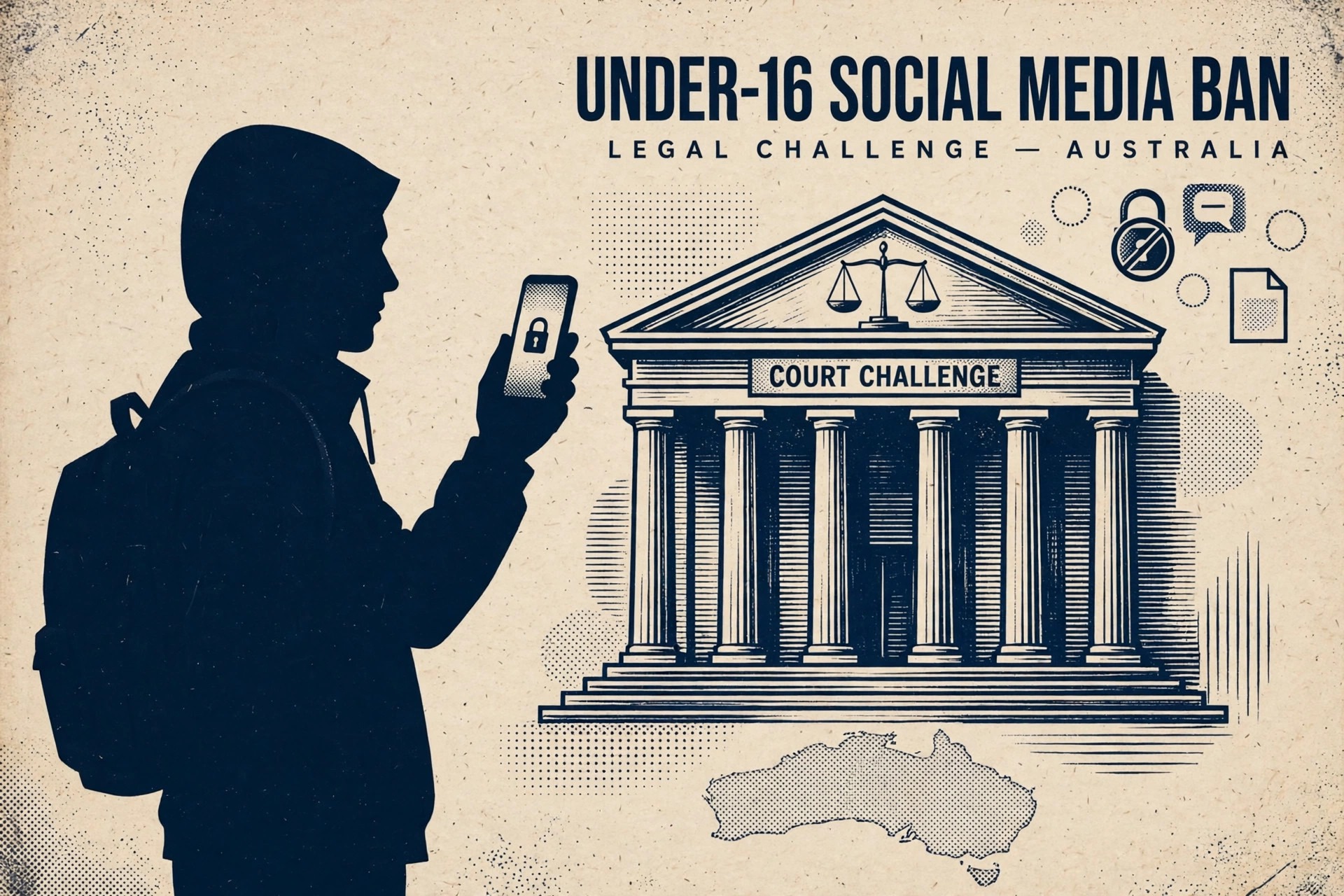
Australia’s High Court began hearing a constitutional challenge on Tuesday, November 3, 2026, to the federal government’s under-16 social media ban, the first law of its kind in the world, in a case that could determine whether Australian children under 16 can be barred from platforms such as Instagram, Facebook, YouTube, Snapchat and TikTok. Seven judges of the High Court, Australia’s highest court, are hearing two joined cases over two days in Canberra. No decision date was given, and no outcome should be assumed from the fact that a hearing has begun. The ban came into force in December 2025, requiring platforms to take reasonable steps to prevent under-16s from creating or holding accounts, with fines of up to 49.5 million Australian dollars for systemic non-compliance. It did not, as some reports have simplified, impose penalties on children or parents for using social media.
The challenge was brought by the Digital Freedom Project and a group of teenagers who argue that the ban is invalid because it burdens the implied freedom of political communication in Australia’s constitution. That freedom is not a free-standing right to free speech in the American sense, but an implied limitation on legislative power, derived by the High Court from the structure of the constitution, which requires that communication about government and political matters remain free. The challengers argue that the ban goes too far, restricting young people’s access to political discussion, news, and civic life, and that less restrictive measures, such as parental controls, education, or age-verification with opt-outs, could achieve the government’s aims without a blanket ban. The government, represented by the Solicitor-General, argues that the law is a valid exercise of parliament’s power to protect children from harms associated with social media, including addictive design, exposure to inappropriate content, and risks to mental health, and that any burden on political communication is justified and proportionate.
The case has drawn international attention because Australia is the first country to impose a ban of this kind, and other governments are watching closely. If the High Court upholds the law, other countries may consider similar measures, citing Australia as a precedent. If it strikes the law down, in whole or in part, that will be a signal that even well-intentioned child-protection measures must be carefully designed to respect constitutional limits, and that blanket age bans may be vulnerable to legal challenge elsewhere. Either way, the hearing in Canberra is a landmark moment in the global debate about children, technology, and the role of government in regulating online life.
The two joined cases, Digital Freedom Project Inc v Commonwealth of Australia (No. 2) and Digital Freedom Project Inc v Commonwealth of Australia (No. 3), involve slightly different arguments and parties, but they raise the same core question: is the ban constitutionally valid? The presence of seven judges, the full court, signals the importance of the question. High Court cases of constitutional significance are often heard by the full bench, and a decision by seven judges will carry particular authority. The hearing over two days will include detailed legal submissions, questions from the bench, and responses from both sides, but the public should not expect a decision at the end of the hearing. High Court judgments are typically reserved, meaning the court will deliberate and deliver its reasons weeks or months later, in a written judgment that may run to hundreds of pages.
Australia social media ban challenge and the High Court hearing
One of the central issues in the case is how the court should assess a law that restricts access to a medium of communication, rather than restricting a particular message. The challengers argue that social media is not merely a recreational platform, but a central forum for political discussion, especially for young people who may not have access to other forums. They point to the use of social media by teenagers to learn about politics, to organise, to express views, and to participate in civic life, and argue that a blanket ban cuts them off from that forum entirely. The government counters that the ban does not prevent young people from accessing political information through other means, such as news websites, television, radio, or in-person discussion, and that it does not target political content as such, but age-based access to platforms as a whole. The court will need to weigh those competing characterisations, and to decide whether the burden on political communication is direct or incidental, substantial or minor, and whether it is justified.
Another issue is proportionality. Even if a law burdens political communication, it may be valid if it is reasonably appropriate and adapted to serve a legitimate end in a manner compatible with representative government. The government will argue that protecting children from online harms is a legitimate end of the highest importance, and that the ban is a proportionate response, given evidence about the risks of social media for adolescents, the difficulty of relying solely on parental controls, and the need for a clear, enforceable rule. The challengers will argue that the ban is disproportionate because it is overbroad, catching all under-16s regardless of their maturity, their parents’ views, or their need to access social media for educational, social, or political purposes, and because less restrictive alternatives were available. The court’s assessment of proportionality will likely turn on the evidence presented, the weight given to competing expert views, and the degree of deference the court gives to parliament’s judgment about child welfare.
The evidence about social media and adolescent mental health is itself contested, and the hearing may reflect that contest. Some studies and expert reports link heavy social media use to anxiety, depression, sleep disruption, and exposure to bullying or harmful content, particularly among adolescents. Others argue that the evidence is correlational rather than causal, that social media also provides benefits, including social connection, support, and access to information, and that harms are concentrated among a minority of users or in particular patterns of use, rather than arising from use as such. The court is not a scientific tribunal, and it will not resolve the scientific debate definitively, but it will need to decide how much weight to give to the government’s evidence about harms, and whether parliament was entitled to act on that evidence even where it is contested.
The platforms themselves are not the direct challengers in these cases, although they have a strong interest in the outcome. Platforms such as Meta, Google, Snap, and TikTok have had to implement age-assurance measures, remove under-16 accounts, and face the prospect of fines for systemic failure. Their compliance efforts, and the effectiveness of age-assurance technologies, will be relevant to the practical operation of the ban, but the constitutional question is about the law’s validity, not about any single platform’s compliance. Reddit, which was also covered by the ban, has been mentioned in some reports as a platform whose users and moderators have raised concerns about the ban’s scope, although the joined cases are brought by the Digital Freedom Project and teenagers, not by Reddit itself. Readers should not confuse the platforms’ commercial interests with the constitutional arguments made by the challengers.
For Australian teenagers, the hearing is about more than abstract constitutional law. It is about whether they will be able to use platforms that, for many, are a primary means of staying in touch with friends, following news, learning about the world, and expressing themselves. Supporters of the ban argue that teenagers will benefit from a break from social media, from more time for sleep, study, sport, and face-to-face interaction, and from protection against addictive design and harmful content. Critics argue that teenagers will lose a valuable tool, that they will find ways around the ban, that the ban will push them to less regulated spaces, and that it will not address the underlying causes of adolescent mental health challenges, such as academic pressure, economic insecurity, or lack of support services. Both views reflect genuine concerns about young people’s wellbeing, and the court will not resolve that policy debate, but only the narrower legal question of validity.
For parents, the ban has also been divisive. Some parents welcomed a clear rule that relieves them of the burden of policing their children’s social media use alone, and that gives them a legal backing for decisions they had already made at home. Others resented the intrusion into family decision-making, arguing that parents, not government, should decide when and how their children use social media, and that the ban undermines parental authority. That division reflects a broader tension in child-protection policy, between state intervention to protect children and respect for family autonomy, and it is a tension that the court may touch on, but will not resolve as a matter of policy. The court’s role is to determine whether parliament acted within its constitutional powers, not whether the ban is wise or popular.
What the under-16 ban means for teenagers and platforms
The ban’s design also matters for the legal analysis. It applies to age-restricted social media platforms, as defined by the law, and requires them to take reasonable steps to prevent under-16s from holding accounts. It does not require platforms to verify age by government ID in every case, but it does require them to use age-assurance measures that are reasonable in the circumstances. The definition of which platforms are covered, the meaning of reasonable steps, and the enforcement approach of the eSafety Commissioner, Australia’s online safety regulator, have all been subjects of discussion since the law came into force. Those practical details may be relevant to whether the law is proportionate, because a law that is flexible and targeted may be easier to justify than a rigid, blanket prohibition, while a law that is vague or overbroad may be harder to defend.
International comparisons are also likely to feature in commentary, if not in the legal submissions themselves. The European Union, the United Kingdom, and several US states have considered or adopted measures to protect children online, including age-verification requirements, duties of care for platforms, and restrictions on addictive design, but none has adopted a blanket ban on under-16s holding social media accounts in the form Australia has. The United States, with its First Amendment protection for free speech, would face different constitutional constraints, and a similar ban would likely face a different legal analysis there. Australia’s implied freedom of political communication is narrower than the First Amendment, but it is still a significant limitation on legislative power, and the High Court’s decision will be closely studied by lawyers and policymakers in other common-law countries.
As the hearing proceeds over two days, the public record will grow through submissions, transcripts, and media reporting, but the most important document will be the judgment, when it is delivered. That judgment will set out the court’s reasoning, the majority and any dissenting views, and the precise scope of any invalidity, if the law is struck down in whole or in part. A decision that the law is invalid in part, for example, might require parliament to amend the law, rather than abandoning the policy entirely. A decision that the law is valid would leave the ban in place, subject to any future political change, but would not end debate about its effectiveness or its social impact. In either case, the hearing is the beginning of a legal process, not its conclusion.
For now, the ban remains in force, and under-16s in Australia remain barred from age-restricted platforms, pending the court’s decision. Platforms continue to enforce age restrictions, parents and schools continue to navigate the new rules, and teenagers continue to adapt, whether by using other services, by waiting until they turn 16, or by finding ways around the restrictions. The High Court’s hearing does not suspend the law, and no interim order suspending the ban was reported in the coverage reviewed. Readers should therefore not assume that the hearing itself changes the legal position for under-16s or platforms.
Sources
Sources: This article is based on reporting by the cited outlets. USN reviewed reporting from multiple outlets for this story. Read more from Malay Mail, Outlook India and EconoTimes.