

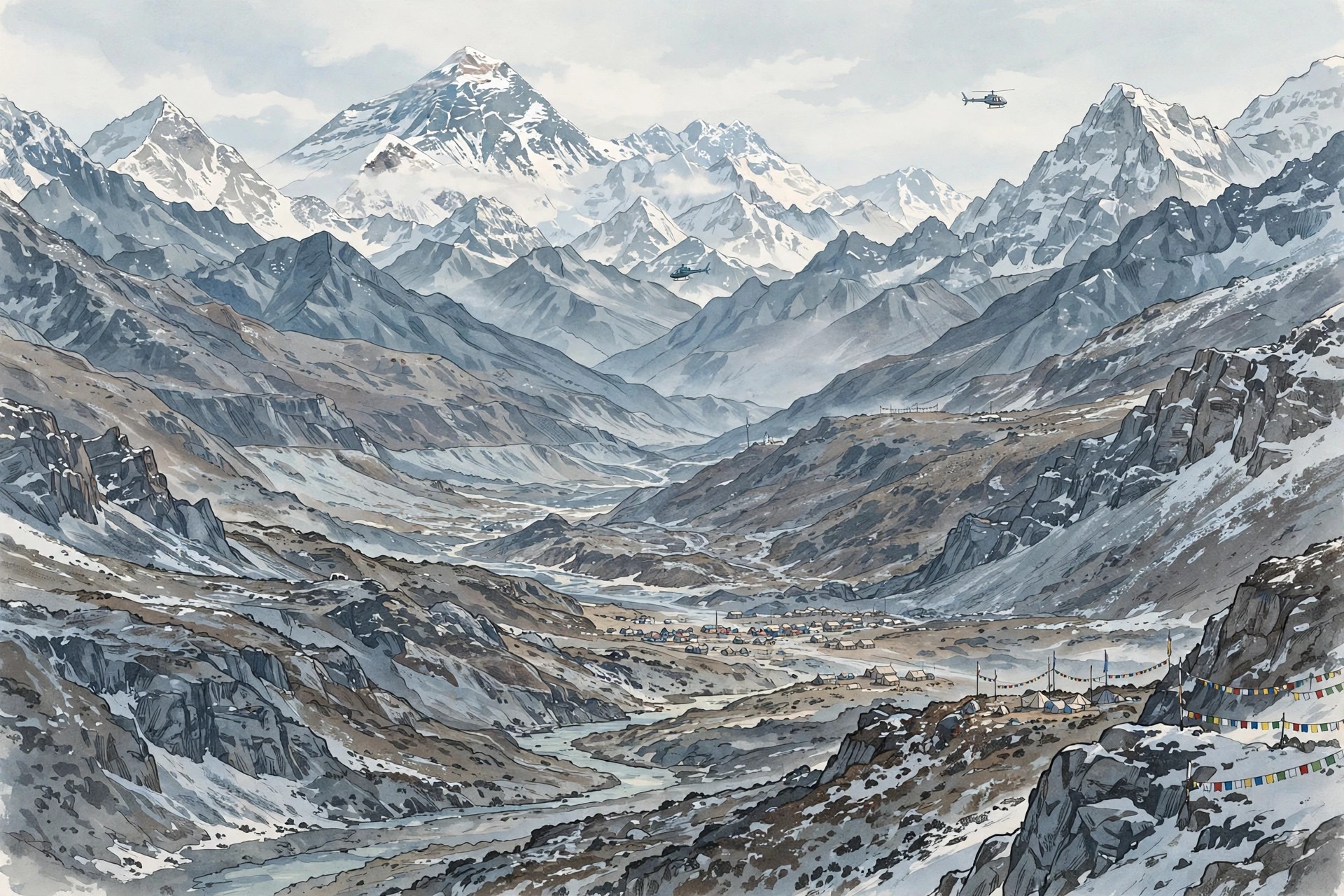
Two helicopters collided while attempting to land at Pheriche, in the Everest region of Nepal, at about 8:11 a.m. local time on Tuesday, November 3, 2026, killing one person and injuring three others. The accident occurred in Ward 4 of Khumbu Pasang Lhamu Rural Municipality in Solukhumbu district, on the route to Mount Everest Base Camp, about 150 kilometres northeast of Kathmandu. Both aircraft had taken off from Lukla Airport, the gateway to the Everest region, and were operating in an area where helicopters routinely ferry trekkers, climbers, and supplies between remote Himalayan settlements, especially during peak trekking season.
Nepal Police identified the person killed as 47-year-old Indian national Vasanth Kumar Balaramaramadu, who was travelling aboard the Fishtail Air helicopter. The spelling of his name varies across outlets, with some reports rendering it differently, and this article follows the Nepal Police statement version where sources differ, rather than merging variant spellings into a single invented form. That caution matters for the family, for official records, and for readers who may encounter different spellings in other reports. The core facts, a 47-year-old Indian national killed aboard a Fishtail Air aircraft, are consistent across the reporting reviewed.
Three other people were injured. Shailesh Krishna Patel, described in most reports as a 49-year-old Indian-origin resident of New Zealand travelling aboard the same Fishtail Air helicopter, was injured, although one outlet gave a different age, and this article notes that variance rather than presenting a single age as certain where sources disagree. Both Nepalese pilots were also injured: Rabindra Prajapati of Fishtail Air and Prajwal KC of Air Dynasty, with pilot name spellings also varying slightly by outlet. The injured were taken to Kathmandu for treatment, a journey that itself illustrates the remoteness of the accident site and the reliance on air transport for medical evacuation in the Everest region.
The Civil Aviation Authority of Nepal identified the aircraft as Air Dynasty helicopter 9N-AOD and Fishtail Air helicopter 9N-AJR. Both are small helicopters of the type commonly used in Nepal’s mountains, where fixed-wing aircraft cannot land at many settlements and where helicopters provide the only rapid link for tourists, workers, and emergency cases. The collision occurred as the helicopters were attempting to land at Pheriche, a settlement at high altitude that serves as a stop for trekkers acclimatising on the way to Everest Base Camp. Landing at high altitude, in thin air, with variable winds and limited space, is among the most demanding tasks in aviation, and Pheriche’s airstrip and landing areas are used by multiple operators throughout the day in peak season.
Nepal helicopters collide at Pheriche near Everest Base Camp
The cause of the collision has not been established, and an investigation has begun. That statement should be read literally: investigators have not yet determined whether the collision resulted from a communication failure, a misunderstanding about landing sequence, weather or visibility, mechanical factors, pilot judgment, air traffic coordination, or a combination of factors. Early reports that speculate about a single cause should be treated with caution until the Civil Aviation Authority and other investigators have examined wreckage, flight records, communications, and witness accounts. Aviation investigations routinely take months, and preliminary findings, when they are released, may be revised as more evidence becomes available.
The accident comes during peak trekking season, when the Everest region is at its busiest. Thousands of trekkers and climbers pass through Lukla, Namche Bazaar, and Pheriche each season, and helicopters are in constant demand for sightseeing flights, supply runs, rescue missions, and transfers between settlements when weather or trail conditions make walking difficult. That volume increases the importance of coordination between operators, clear landing procedures, and reliable communication, because multiple helicopters may be operating in the same valleys, approaching the same landing areas, at similar times. It does not, by itself, prove that congestion caused this collision, but it provides context for why investigators will examine traffic management and coordination closely.
Nepal’s aviation safety record has been a subject of international attention for years. The country’s mountainous terrain, unpredictable weather, short and sloping airstrips, and reliance on small aircraft create risks that are greater than those in flatter, more developed aviation environments. Nepal has also faced scrutiny from international regulators, and its airlines have at times been subject to operating restrictions in other jurisdictions. At the same time, aviation is indispensable to Nepal’s economy and to its remote communities, for whom air transport is often the only link to hospitals, markets, and the outside world. Any safety discussion must hold both truths together: the risks are real, and the need for air service is also real.
For India, the death of an Indian national in Nepal is a consular as well as a human matter. The Indian embassy in Kathmandu and Nepalese authorities will normally coordinate on identification, notification of family, repatriation of remains, and assistance to injured nationals. For the family of Vasanth Kumar Balaramaramadu, the immediate concerns will be practical and painful: confirmation of identity, travel to Nepal or coordination from India, funeral arrangements, and support in a foreign country at a moment of grief. For Patel, the injured New Zealand resident of Indian origin, consular and medical coordination may involve both New Zealand and Indian authorities, depending on his citizenship and residence status, details that have not been fully clarified in reporting.
For the pilots and their companies, the accident raises questions about training, procedures, and support. Pilots who fly in the Everest region are among the most experienced in Nepal, accustomed to high-altitude operations and to the specific challenges of Himalayan flying. That experience makes a collision between two such aircraft particularly troubling to investigators, because it suggests that even experienced crews operating familiar routes can encounter a breakdown in coordination or awareness. Fishtail Air and Air Dynasty are both established Nepalese operators, and their safety records, maintenance practices, and operational procedures will likely be part of the investigation, although no finding has been made against either company at this stage.
The wider trekking community will also be affected. News of a fatal helicopter accident near Everest Base Camp travels quickly among trekkers, guides, and tour operators, and it can affect decisions about whether to fly, when to fly, and which operators to use. Tour operators may review their own safety briefings, and trekkers may ask more questions about helicopter safety before boarding. That heightened awareness is understandable, but it should be balanced against the fact that most helicopter flights in Nepal operate without incident, and that a single accident, however tragic, does not by itself establish a pattern or a systemic failure. The investigation’s findings, when available, will provide a firmer basis for judgment.
What investigators will examine after the Everest helicopter collision
Investigators will likely focus on several areas. First, communications: what did each pilot say, and hear, before landing, and was there a common frequency or coordination procedure in use at Pheriche? Second, landing sequence: who was cleared or expected to land first, and was that sequence understood by both crews? Third, visibility and weather: what were conditions at 8:11 a.m., and did sun, cloud, terrain, or rotor wash affect either pilot’s ability to see the other aircraft? Fourth, aircraft condition: were both helicopters airworthy, and did any mechanical issue contribute? Fifth, operator procedures: did both companies follow the same landing and coordination protocols, and were those protocols adequate for peak-season traffic? Each area requires evidence, and no conclusion should be drawn until that evidence has been gathered.
The location itself, Pheriche, deserves attention in any safety discussion. At an altitude of more than 4,200 metres, the air is thin, engine and rotor performance are reduced, and margins for error are smaller than at sea level. Landing areas are constrained by terrain, buildings, and the need to avoid disturbing trekkers and livestock. Multiple helicopters landing in quick succession must be sequenced carefully, and pilots must maintain situational awareness not only of the ground, but of other aircraft approaching from different directions. Those challenges are well known to Nepalese operators, which is why a collision at Pheriche will prompt questions about whether existing procedures are sufficient for current traffic levels.
For Nepal’s tourism sector, the accident is a reminder of the tension between growth and safety. Everest trekking is a major source of income for Solukhumbu district and for Nepal as a whole, supporting guides, porters, lodge owners, and transport operators. Growth in visitor numbers increases demand for helicopter services, which in turn increases pressure on operators, pilots, and landing infrastructure. Managing that growth safely requires investment in coordination, training, and oversight, as well as a willingness to limit flights when conditions or traffic make operations unsafe. Those are policy choices that Nepal’s aviation authorities, tourism ministry, and operators will need to consider as the investigation proceeds.
For the families and the injured, the investigation’s technical findings will matter less, in the immediate term, than medical care, consular support, and the return of remains and belongings. The human cost of the accident is already clear: one person dead, three injured, families grieving or anxiously awaiting news, and two pilots whose careers and health have been affected. The technical investigation will take time, and its findings, when they come, should be reported with the same care for accuracy and for the people involved that this article has sought to apply to the facts available so far.
Sources
Sources: This article is based on reporting by The Hindu BusinessLine, The New Indian Express and News18. Details about the time, location, victims, aircraft and investigation are drawn from those reports and from Nepal Police and Civil Aviation Authority statements as cited in them. This article was written from those sources.